Power Tool Voltage Comparison Chart: 12V vs 18V vs 20V vs 40V
For most cordless woodworking tools, 18V/20V is the best all-around choice. Pick 12V for compact drivers and light work, and reserve 40V for heavy outdoor tools or other high-draw equipment. Choose wrong, and you pay with extra weight, short runtime, or too little power. This guide compares 12V, 18V, 20V, and 40V for common woodworking use.
| 12V | 18V | 20V | 40V | Winner |
|---|---|---|---|---|
| Light drilling, assembly, small screws, trim tasks | Most woodworking drills, impact drivers, and general shop work | Same practical class as 18V in many brands | Usually oversized for ordinary drill-and-driver work | 18V / 20V |
| Best for compact size and lower weight | Middle ground on size and portability | Middle ground on size and portability | Heavier packs and larger tools | 12V |
| Runtime depends strongly on Ah; smaller packs are common | Good balance of runtime and power potential | Good balance of runtime and power potential | Higher draw tools can justify larger packs | 18V / 20V |
| Low upfront cost, but may outgrow the platform fast | Best ecosystem value for most woodworkers | Platform value depends on brand compatibility | Higher battery and charger cost | 18V / 20V |
What voltage means in cordless tools
Voltage is one input into power, not the whole story. Battery capacity in amp-hours, motor design, and the tool’s electronics all affect how long it runs and how hard it can work before slowing down. For woodworking, those details matter more than the number on the label.
Voltage, current, and power in plain terms
Higher voltage can support more power potential, especially when the tool is under load. That helps with larger holes, longer fasteners, and work that makes a motor heat up. But a higher-voltage tool can also be bigger, heavier, and more expensive.
A battery’s amp-hours matter too. A 2.0Ah pack stores less energy than a larger pack, so runtime usually drops faster even if the voltage class stays the same. In practice, higher voltage can support more output, while Ah is one factor that affects how long a tool can keep working in that class.
Where motor design changes the outcome
Brushless motors are more efficient than brushed motors because they reduce friction and heat. That can improve runtime and durability, especially as the load rises. Brushed motors cost less, but they waste more energy as heat and wear faster over time.
| Voltage | Typical woodworking tasks | Portability | Runtime tradeoff | Upgrade trigger |
|---|---|---|---|---|
| 12V | Drilling small pilot holes, light screw driving, cabinet hardware, occasional trim work | Best for tight spaces and overhead use | Good for light duty; runtime falls faster under sustained load | Move up when you drill larger holes, drive long screws often, or want one drill for everything |
| 18V | General shop drilling, impact driving, hole saws, pocket-hole joinery, most cordless woodworking | Balanced size and weight | Best blend of runtime and power for many users | Stay here unless your tools are consistently underpowered or you need lighter trim-only gear |
| 20V | Same task range as 18V in many brands; common for drills and drivers | Usually similar to 18V tools in hand feel | Depends more on Ah, motor type, and tool design than the label | Choose based on battery compatibility, not the bigger number on the box |
| 40V | Outdoor tools, high-draw equipment, and a few heavier specialty tasks | Least portable of the group | Higher draw tools can benefit, but packs are larger and heavier | Step up only when the tool class needs it or you already own that platform |
Portability, runtime, and cost tradeoffs
For woodworking, portability matters on ladders, in overhead cabinet work, and inside finished spaces. A lighter 12V tool is easier to place precisely, while an 18V or 20V tool usually gives you a better balance of control and muscle. A 40V tool often trades that balance for output you may not need.
Cost also rises with the platform. Bigger batteries, heavier chargers, and duplicate packs add up quickly when you buy a second voltage family. That is why battery ecosystem compatibility matters before you commit.
Battery and charger cost model
Here is a simple way to think about ownership cost. A 12V starter setup usually costs less because the pack is smaller and the charger is simpler. Moving to 18V or 20V often raises the price a bit, but it also gives you the platform most woodworking tools are built around. Moving to 40V usually increases the cost again because the packs are larger and the charger is built for a bigger system.
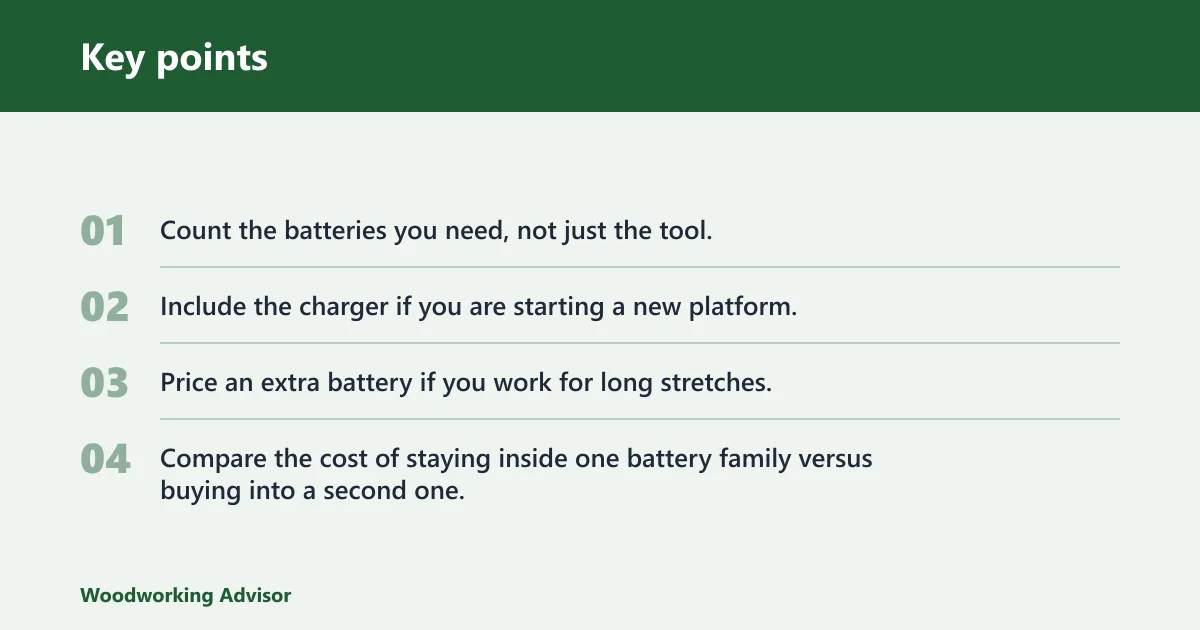
- Count the batteries you need, not just the tool.
- Include the charger if you are starting a new platform.
- Price an extra battery if you work for long stretches.
- Compare the cost of staying inside one battery family versus buying into a second one.
A common first-timer mistake is buying a 12V drill for cabinet work, then replacing it soon after because it bogs down on larger screws. A better buy is often one 18V or 20V kit with a compact battery for light work and a larger Ah pack for longer sessions.
Is 20V really better than 18V?
Usually, no. In some brands, 20V MAX is a marketing label for a platform that is often described as nominally 18V lithium-ion. The number on the battery may look higher, but the practical class is the same. What changes most is the brand’s platform, battery shape, and compatibility rules.
18V and 20V MAX naming explained
Some makers label the same class as 18V, while others call it 20V MAX. For a buyer, the key question is not which label sounds larger. It is whether the battery fits the rest of your tools and whether the platform has the drill, driver, saw, and light you want.
That is why a 20V tool should not be treated as automatically stronger than an 18V tool. In practice, motor quality, battery capacity, and electronics often matter more than the label. Two tools on the same nominal voltage can still feel very different.
Compatibility and marketing labels
Battery platform compatibility is the real gatekeeper. Battery packs are usually brand-specific, so 18V and 20V tools are not generally interchangeable across brands even when the labels look similar. If you already own one family of batteries, staying inside it can save money and avoid duplicate chargers. If you are starting from zero, choose the platform with the best mix of tool coverage and battery support for woodworking.
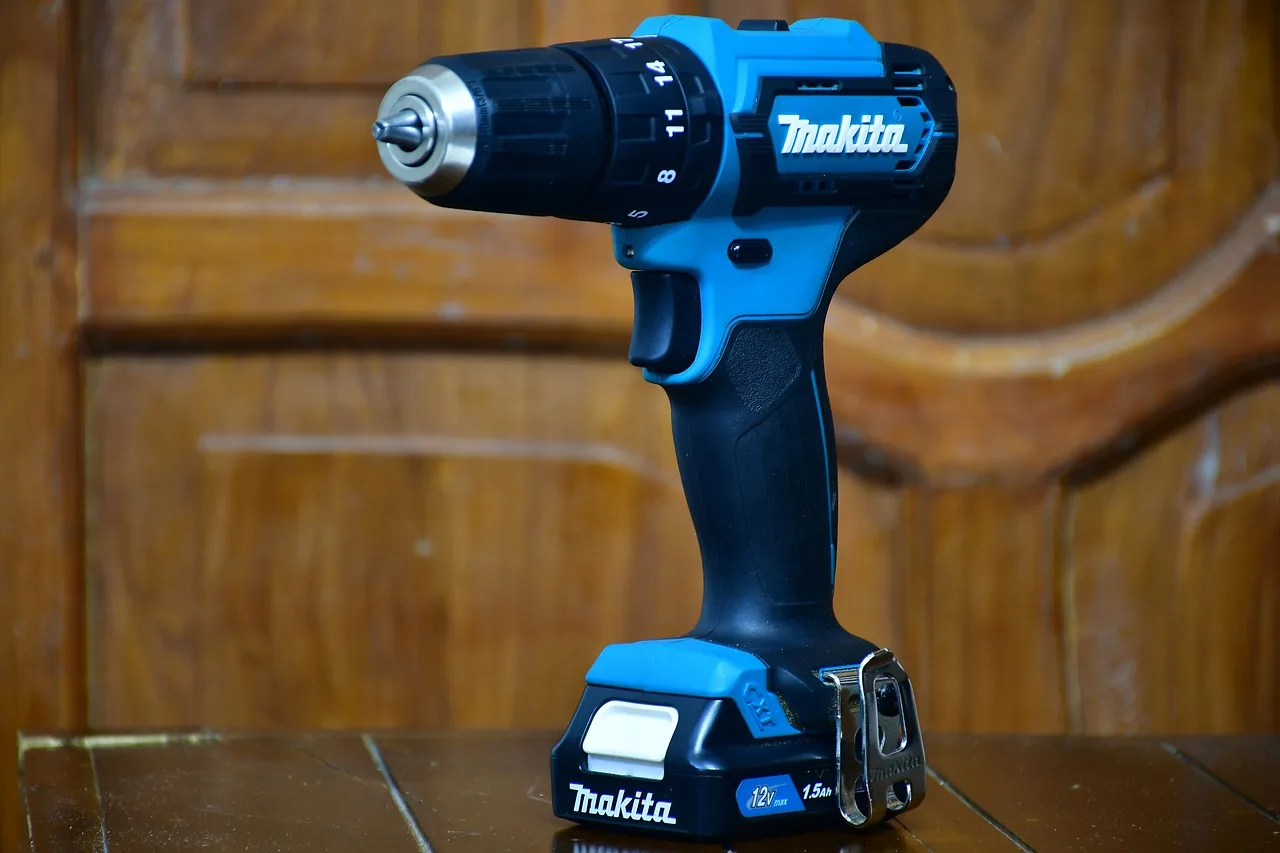
One example of how specs get listed: a drill may be described with a mix of voltage, weight, speed, torque settings, warranty terms, charge time, and output numbers. Those numbers show that motor output, runtime, and control matter alongside voltage.
Which voltage is best for drills and drivers?
For drills and impact drivers, 18V or 20V MAX is the best all-around choice for most woodworkers. It gives you enough power for pilot holes, pocket holes, screws, and many hole-saw jobs without the extra bulk of 40V. Twelve-volt tools are fine for lighter fastening and small holes.
12V for light-duty drilling and fastening
Choose 12V when compact size matters more than brute force. It is a good fit for drilling small holes, driving short screws, and working in tight cabinetry or overhead spots. The lower weight also helps if you want less wrist fatigue during short, precise tasks.
18V or 20V MAX for the main woodworking drill
For a main drill, this is the sweet spot. You get broader bit compatibility, better runtime options, and more headroom when a bit binds in hardwood. If you want one cordless drill to cover most shop work, this is the class to start with.
Power output metrics help here. UWO is one way some brands describe output under load, so it is most useful within that manufacturer’s own lineup. Torque helps with twisting force; RPM tells you how fast the chuck spins. Compare them within a brand or tool class, not as a simple universal ranking.
When 40V is overkill
For ordinary woodworking drills and impact drivers, 40V is usually more tool than you need. The added size and weight make sense only if the tool category itself is high demand. Otherwise, you are carrying extra battery mass without much gain in day-to-day cabinet, trim, or assembly work.
Suppose you are installing shelf pins, pilot holes, and cabinet pulls. A 12V drill is enough for that job. Suppose the same project grows into repeated 3/8-inch drilling in hardwood and long screws into framing lumber. That is when 18V or 20V becomes the better fit.
When should you choose 40V?
Choose 40V when the tool class, not the task list, justifies it. This platform is usually aimed at outdoor tools and higher-demand equipment, where the larger packs and greater power potential make sense. For typical drills and drivers, it is usually more tool than you need.
Outdoor tools and heavier-duty categories
String trimmers, blowers, and other high-draw outdoor tools are common 40V territory. In those categories, the extra voltage helps support harder work and longer sustained load. That is useful when the tool is expected to keep pulling power for long stretches.
Higher demand also means more heat and voltage sag if the system is undersized. A battery that is too small for the load can fade faster under pressure, which shows up as slower cutting, weaker driving, or a tool that feels tired before the pack is truly empty.
When 40V makes sense in a woodworking setup
40V makes sense if your cordless ecosystem is already built around it or if you need one of the specialty tools that only comes in that class. It can also make sense in shared property settings where one battery family is used across outdoor equipment and a few workshop tools.
For most woodworkers, though, 18V or 20V still covers the everyday list better. You usually get a wider selection of drills, drivers, saws, and lights without stepping into heavier batteries than you need.
Brushless vs brushed motors
Brushless motors matter more as loads increase. They waste less energy as heat, which can help runtime and reduce wear. Brushed motors remain common in budget tools because they cost less, but they are less efficient and usually age faster under repeated use.
Efficiency, heat, and runtime
On a lighter tool, the motor difference may be modest. Once the load climbs, the gap widens. A brushless tool may maintain its output better in some conditions as the battery drops, but the result still depends on the tool’s electronics and battery management, not motor type alone.
Wear, durability, and price
If you are buying a cheap drill for rare assembly work, brushed can be acceptable. If the tool will see regular drilling and driving, brushless is usually the better long-term buy. The higher upfront cost often buys better runtime and less wear.
Choose 12V if… / Choose 18V or 20V MAX if… / Choose 40V if…
Choose 12V if you want the lightest, most compact drill for small holes, light screws, and tight spaces. It is a good fit for trim work, cabinet hardware, and occasional use where portability matters more than raw output.
Choose 18V or 20V MAX if you want one cordless platform for most woodworking tasks. This is the best fit for drills, impact drivers, and general shop work when you want a balance of power, runtime, and tool choice.
Choose 40V if your work includes high-draw tools, outdoor equipment, or a platform you already own in that class. It is a better fit for larger batteries and heavier tools than for everyday woodworking drills and drivers.


Frequently asked questions
What is the difference between 12V and 18V cordless tools?
12V tools are usually smaller and lighter, so they work well for compact spaces and light fastening. 18V tools give you more power potential, broader tool options, and better all-around performance for woodworking. If you want one main cordless drill, 18V is usually the safer pick.
Is 20V really better than 18V in power tools?
Not automatically. In many brands, 20V MAX is a marketing label for a nominally 18V lithium-ion platform. The label does not guarantee more power. Battery capacity, motor type, and the tool’s electronics usually matter more than the number printed on the pack.
When should I choose a 40V power tool over 18V?
Choose 40V when the tool itself is a high-draw model or when your work already centers on that battery family. For ordinary woodworking drills and drivers, 18V usually covers the need with less size and weight. Forty-volt makes more sense for heavier outdoor equipment.
Are 12V tools strong enough for woodworking?
Yes, for light woodworking. They handle pilot holes, small screws, and assembly well, especially in tight spaces. They are not the best choice for repeated large-diameter drilling or long fasteners in dense stock. For those jobs, 18V or 20V is the better match.
Do higher-voltage batteries last longer on one charge?
Not by voltage alone. Runtime depends heavily on amp-hours, load, and motor efficiency. A larger Ah battery usually lasts longer than a smaller one in the same voltage class. Under heavy load, a better motor and a larger pack matter as much as voltage.
What does UWO mean on a power tool?
UWO is one way a brand may list output under load. It can help compare tools within the same brand or category, but it is not a universal standard across every maker. For drills and drivers, also check torque, RPM, battery capacity, and motor type.
Are 20V MAX and 18V the same thing?
In many cases, yes at the platform level. The 20V MAX label usually refers to the battery’s maximum charged condition, while the nominal system is commonly treated as 18V. The practical buying question is whether the batteries and tools match the same ecosystem.
Sponsored / affiliate links. As an Amazon Associate I earn from qualifying purchases. I may earn additional commission from eligible campaigns.