MDF vs Chipboard: The Real Difference Explained
MDF (medium-density fiberboard) is denser, smoother, and holds paint and edge banding better than chipboard, which is cheaper and lighter but weaker at screw points and edges. Picking wrong means either overpaying for strength you don’t need or an edge that crumbles under a hinge screw. This guide breaks down density, cost, moisture resistance, and which jobs actually call for each.
Also comparing plywood? See our three-way breakdown of chipboard vs MDF vs plywood for the full picture.
Have you ever found yourself standing in the aisles of a hardware store, staring at the rows of wooden boards, and wondering which one is right for your project? You’re not alone.
When it comes to choosing between MDF (Medium Density Fiberboard) and chipboard, the decision can be quite puzzling. Each has its own strengths and weaknesses, and making the wrong choice could affect the durability and appearance of your project. This guide will unravel the mysteries of MDF and chipboard, helping you make an informed decision that ensures your finished piece stands the test of time.
By the end, you’ll know exactly which material suits your needs, saving you time, money, and effort. Ready to unlock the secrets of wood materials? Let’s dive in!
Material Composition
Best Primer for Sealing MDF Edges
 |
Zinsser 00904 B-I-N Pigmented Shellac Oil Primer-Sealer &Zinsser | Our pick | View |
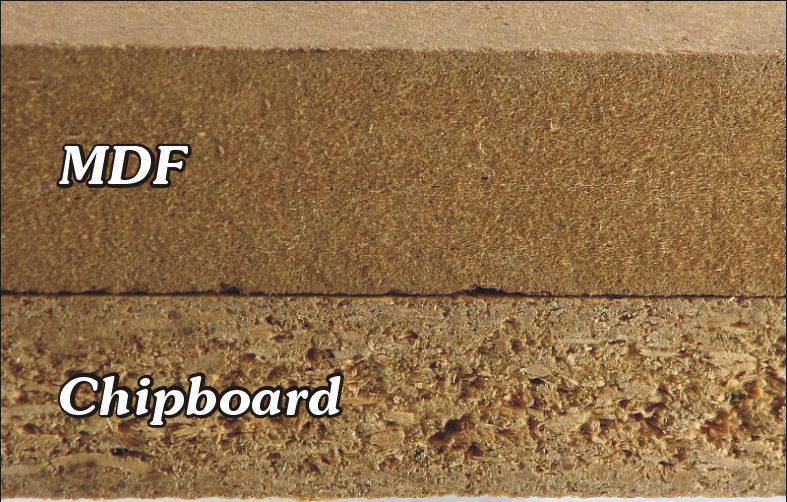
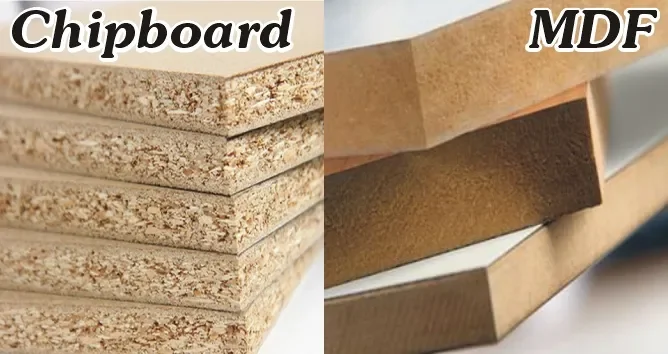
The difference starts at the fiber level. MDF is made by breaking hardwood and softwood scraps all the way down into individual wood fibers, then binding them with urea-formaldehyde resin under heat and pressure — there’s no visible chip or particle in the cross-section, just a uniform, almost cake-like texture that’s identical whether you cut into the middle of the sheet or near an edge. That’s what gives MDF a density of roughly 700-850 kg/m³ and lets it be routed, carved, or cut into detailed profiles without chipping out, the way plywood or solid wood can along the grain.
Chipboard (particleboard) skips the fiber-breakdown step and instead presses larger wood chips, shavings, and sawdust together with a resin binder. Because the particles are bigger and less uniform than MDF’s fibers, you can usually see the individual wood-chip texture if you look closely at a cut edge, especially the larger, coarser particles typically layered toward the panel’s core with finer particles at the faces. That lower fiber density — typically 590-750 kg/m³ — is exactly why chipboard costs less to produce and weighs less, but also why it holds screws and takes an edge far worse than MDF.
Manufacturing Process
Manufacturing MDF is a defibration process — wood chips are steamed and mechanically refined into individual fibers, similar to what happens in paper pulping, before wax and resin are blended in and the mat is hot-pressed at temperatures around 340-390°F. That refining step is the slow, energy-intensive part of the process, which is part of why a sheet of MDF typically costs more than an equivalent-thickness sheet of chipboard.
Particleboard skips defibration entirely. Wood shavings and sawdust — often genuine mill byproducts rather than purpose-cut material — go straight into the resin blender and get pressed in layers, usually finer particles at the outer faces and coarser ones filling the core. That layered-but-chunky structure is why a cut edge of particleboard looks visibly rougher than MDF’s smooth, fiber-uniform edge, and it’s also the reason particleboard needs edge banding or laminate far more urgently than MDF does — an unfinished chipboard edge chips and crumbles under normal handling in a way an unfinished MDF edge generally doesn’t.
Physical Properties
MDF and chipboard differ in density and strength. MDF is denser, smoother, and easier to paint. Chipboard is lighter and often used for affordable furniture.
Density And Weight
A standard 3/4″ sheet of MDF in a 4×8 size runs roughly 95-100 lbs, while an equivalent chipboard sheet typically comes in 15-20 lbs lighter, purely from the fiber-versus-particle density difference. That extra weight in MDF isn’t wasted mass — it’s what lets a router bit cut a clean profile through the material without hitting a void or a loose particle, which is why cabinet doors and molding profiles are almost always MDF, never chipboard.
Strength And Durability
Neither material handles unsupported spans the way plywood does — both sag under load if left unsupported over a wide gap — but there’s a real gap between them on screw-holding strength specifically. MDF’s tight, uniform fiber structure holds a standard wood screw reasonably well as long as a pilot hole is drilled first (skipping the pilot hole is the most common reason an MDF screw joint splits). Chipboard’s chunkier particle structure grips a screw far less securely; back a screw out of chipboard more than once or twice and the hole enlarges and stops holding at all, which is why most flat-pack chipboard furniture uses cam-lock fasteners and dowels instead of screws directly into the panel face. On moisture, both swell when wet, but chipboard’s larger particles and coarser structure mean it swells faster and stays swollen longer than MDF does under the same exposure — a detail that matters if either one ends up near a sink, a dishwasher, or an exterior wall. See our note on chipboard’s durability for more on where that shows up in practice.
Credit: kristinlia.ca
Applications And Uses
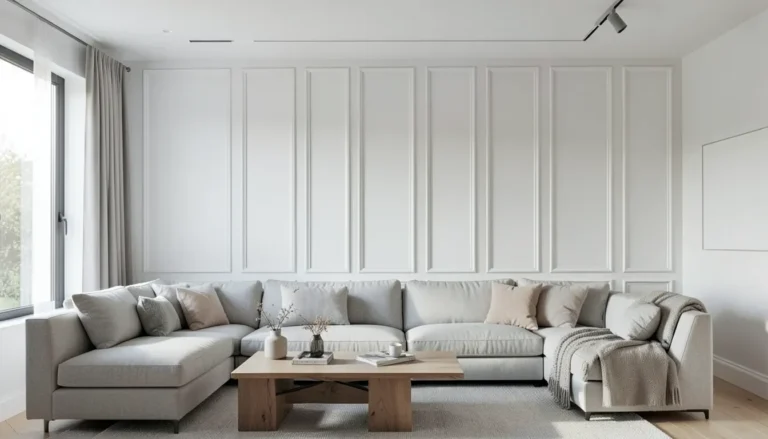
MDF shows up wherever a project needs a crisp, paintable edge profile — raised-panel cabinet doors, decorative molding, wainscoting, and router-carved furniture details all lean on MDF specifically because it routs cleanly without tearing out like plywood veneer can. Kitchen cabinet doors are one of the most common uses: MDF takes a sprayed or brushed paint finish evenly across its face and edges, with none of the visible seams a plywood cabinet door would show once painted. It’s an indoor-only material in almost every application, since none of its common finishes are meant to handle direct weather exposure.
Chipboard’s main habitat is flat-pack and RTA (ready-to-assemble) furniture — the kind that ships flat and gets built with cam locks and dowels rather than screws driven straight into the panel. It’s also the standard subfloor and underlayment material in a lot of budget flooring installations, where it sits under carpet or laminate and never faces direct wear. Because it’s the cheaper option per square foot, it’s the default choice anywhere a project needs to hit a budget more than it needs to survive decades of use — shelving in a garage, temporary display fixtures, and low-cost cabinet carcasses (the box itself, not the visible door) are typical spots for it.
Cost Comparison
A standard 3/4″ 4×8 sheet of MDF typically runs somewhere in the $40-55 range at most home centers, with prefinished or moisture-resistant (often green-tinted) versions running higher. That premium buys the fine, uniform surface that takes paint and router profiles without prep work beyond a light sanding.
The same 3/4″ 4×8 sheet in chipboard usually lands closer to $25-35, roughly a third less, which adds up fast on a project using multiple sheets. The tradeoff for that savings is exactly what shows up in the strength comparison above — weaker screw-holding, faster water damage, and a rougher surface that needs a veneer or laminate rather than paint to look finished. For a one-off shelf or a piece that won’t see repeated hardware installs, that tradeoff is often worth it; for cabinet doors or anything getting screwed and unscrewed repeatedly, the price gap closes fast once you account for redone joints.
Environmental Impact
Both materials are, at their core, a way to use wood that would otherwise be waste — small-diameter trees, mill trimmings, and sawdust that aren’t suitable for solid lumber. The environmental catch with both is the resin: older MDF commonly used urea-formaldehyde adhesive, which off-gasses formaldehyde (a recognized indoor air irritant) for a period after manufacture, especially from cut or unsealed edges. Since CARB Phase 2 and the federal TSCA Title VI formaldehyde emission standards took effect, most MDF sold in the US carries a compliance stamp on the panel edge showing it meets those lower-emission limits — worth checking for on any sheet you’re buying, particularly for indoor furniture in a bedroom or nursery.
Chipboard uses the same category of resin binders and is subject to the same CARB2/TSCA Title VI standards, so the formaldehyde consideration is essentially identical between the two — check for the compliance stamp either way rather than assuming one material is inherently safer. Where chipboard has a real edge is raw material efficiency: because it uses coarser, less-processed wood particles, it typically requires less energy per sheet to manufacture than MDF’s fiber-refining process, which is part of why it’s both cheaper and has a somewhat smaller manufacturing footprint per square foot.
Advantages And Disadvantages
MDF’s biggest practical advantage is that smooth, uniform face and edge — it’s the closest thing to a blank canvas among sheet goods, taking paint, laminate, or a routed profile without the grain-matching or void-filling that plywood or solid wood sometimes need. Its real weak points are moisture (an unsealed edge left near a sink or in a humid basement will swell within days) and weight, since a full sheet is heavy enough that cutting it down at the store rather than hauling a whole 4×8 sheet home is worth asking about. Cutting or routing MDF also produces a very fine dust that’s more irritating to breathe than typical sawdust, which is the one safety step worth taking seriously — a real dust mask or respirator, not just a bandana, and ideally a shop vac connected to the saw.
Chipboard’s advantage is squarely cost and weight — it’s the lightest, cheapest sheet good commonly available, which is exactly why it dominates flat-pack furniture where shipping weight is part of the cost equation. Its disadvantages track directly from its coarser structure: screws back out of it more easily than MDF or plywood, a dropped corner can visibly crumble rather than just dent, and water exposure causes swelling faster than either MDF or solid wood. None of that makes it a bad material — it just means matching it to short-term, low-stress uses rather than asking it to do a cabinet door’s job.
Credit: www.kombiniranimasi.com
Expert Recommendations
MDF is denser and smoother, making it ideal for painting and detailed work. Chipboard, also known as particle board, is cheaper and made from wood chips, offering a rougher finish suitable for basic furniture. Both are popular in furniture making, but differ in strength and appearance.
Choosing Between MDF And Chipboard
The decision usually comes down to two questions: does the piece need to be painted or routed with a profile, and will it be assembled and disassembled more than once? If either answer is yes, MDF is the better fit — its fiber structure holds a screw through repeated use and takes paint evenly without a laminate or veneer. If the piece is going together once with cam locks and dowels (typical flat-pack construction) and staying that way, chipboard’s lower cost and weight make more sense, since you’re not relying on its screw-holding strength at all.
Budget and finish expectations settle most of the remaining cases. A visible cabinet door, a decorative shelf edge, or anything getting a painted finish calls for MDF. A hidden cabinet carcass, a garage shelf that won’t see much handling, or a piece where cost per square foot is the deciding factor is a reasonable spot for chipboard. When in doubt, weigh how many times that specific joint or edge will be stressed over the piece’s life — that single factor predicts which material holds up better more reliably than price or weight alone.
Frequently Asked Questions
What Is Better, MDF Or Chipboard?
MDF offers a smoother finish and greater strength compared to chipboard. It is ideal for detailed furniture work. Chipboard is more affordable and lightweight, suitable for basic construction. Choose MDF for durability and chipboard for budget-friendly projects.
When Should You Not Use MDF?
Avoid using MDF in high moisture areas like bathrooms or kitchens. It swells and deteriorates when wet. MDF is unsuitable for structural applications due to its low strength. It can’t hold screws well, making it unreliable for heavy loads. Opt for solid wood or plywood for durability.
What Is Chipboard Called Now?
Chipboard is now commonly called particle board. It’s made from compressed wood chips, sawdust, and resin. Used in furniture and construction, it offers affordability and versatility. It’s ideal for projects requiring a smooth finish. Particle board remains a popular choice for budget-friendly and durable applications.
What Are The Disadvantages Of Chipboard?
Chipboard lacks durability and is prone to moisture damage. It often swells and warps when wet. Its low strength makes it unsuitable for heavy loads. The material can emit formaldehyde, impacting indoor air quality. Its appearance is less attractive compared to natural wood.
Conclusion
MDF and chipboard solve different problems even though they look similar on a store shelf — one is built for a smooth, paintable, screw-holding surface, the other for the lowest possible cost on a piece that won’t be stressed much. Matching the material to how the piece actually gets used and handled matters more than picking whichever one sounds sturdier on paper.
If the project involves repeated hardware installs, a painted finish, or a routed edge profile, spend the extra $15-20 a sheet on MDF — it pays for itself the first time a chipboard screw hole strips out. If it’s a one-time build on a tight budget where the panel won’t take much stress, chipboard does the job for less. Checking the CARB2/TSCA compliance stamp on either material before buying is worth the extra minute regardless of which one you pick.
Sponsored / affiliate links. As an Amazon Associate I earn from qualifying purchases. I may earn additional commission from eligible campaigns.