Wood Glue Types Chart: PVA vs Epoxy vs Polyurethane
PVA is the default for tight indoor wood joints, because it bonds predictably, cleans up with water, and cures in a day. Epoxy fits loose, gap-filled, oily, or mixed-material repairs. Polyurethane is the backup for damp outdoor joints, where moisture resistance matters and the fit is not perfect. Pick wrong and a joint can creep, starve, foam apart, or fail under moisture. This guide gives a failure-mode chart and selection rules for furniture, repairs, and outdoor work.
| Criterion | PVA | Epoxy | Polyurethane | Winner |
|---|---|---|---|---|
| Joint fit | Best on tight, well-made wood-to-wood joints | Best on loose joints and gaps | Works on imperfect fit, but expansion is not true gap filling | Epoxy for loose joints; PVA for tight joints |
| Moisture exposure | Best for indoor use; Titebond III is the waterproof PVA option | Handles moisture well once cured | Waterproof once cured | Polyurethane or epoxy for wet exposure |
| Material mix | Best for wood-to-wood only | Bonds wood to metal and other materials well | Good for oily woods and mixed materials | Epoxy for mixed materials; polyurethane for oily woods |
| Cleanup | Water or damp cloth | Solvent cleanup while wet; scraping after cure | Messy; gloves recommended | PVA |
| Best use case | Indoor furniture, standard carpentry, clean repairs | Structural repairs, gap filling, wood-to-metal work | Outdoor joints, oily wood, damp repairs | Depends on the failure mode |
Wood glue types
What each glue is built to do
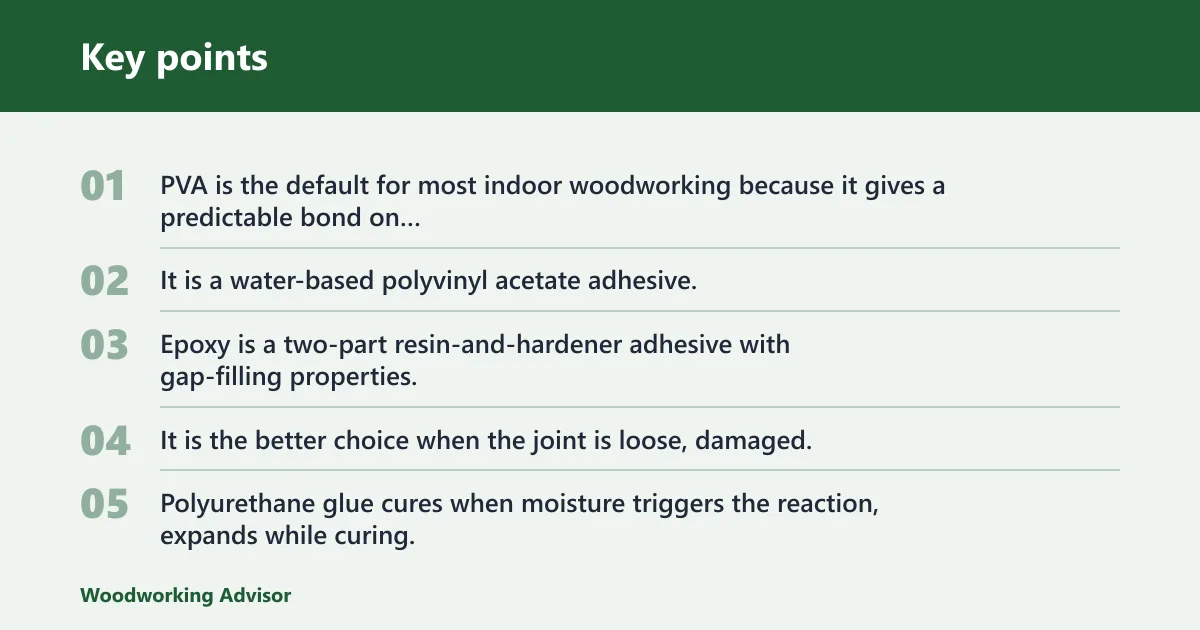
PVA is the default for most indoor woodworking because it gives a predictable bond on joints that already fit well. It is a water-based polyvinyl acetate adhesive, and most manufacturers list open time at 5 to 10 minutes, clamp time at 30 to 60 minutes, and full cure at 24 hours.
Epoxy is a two-part resin-and-hardener adhesive with gap-filling properties. It is the better choice when the joint is loose, damaged, or combining materials such as wood and metal. Polyurethane glue cures when moisture triggers the reaction, expands while curing, and is often useful when wood is oily or the repair is exposed to damp conditions.
Failure mode summary for the wrong choice
The wrong glue usually fails in a specific way. PVA in a loose joint can leave voids and a weak bond line. Polyurethane in a tight indoor joint can foam into the squeeze-out and make cleanup harder than necessary. Epoxy on a clean, tight furniture joint often works, but it is usually more than you need.
Say your chair rail has a clean mortise-and-tenon fit, but you reach for polyurethane because the bottle says it is waterproof. The foaming does not improve the fit. Instead, you may get messy squeeze-out and a joint that needed no gap filler in the first place.
Which glue fits your joint?
Perfect-fit joints and tight furniture assemblies
For snug joints with full wood-to-wood contact, PVA is usually the best match. The bond depends on surface contact and clamp pressure, not on filling a defect. That is why Titebond Original is treated as the standard for indoor furniture work, and Titebond II or III only become relevant when water resistance matters.
Loose joints and imperfect repairs
When the joint has worn edges, chips, or small voids, epoxy is the safer choice. It can bridge gaps instead of relying on perfect wood contact. Polyurethane may look like a gap filler because it foams, but the foam is not the same as a solid structural fill.
End-grain joints and sizing coat needs
End grain can drink adhesive and starve the joint. That is a classic failure mode with PVA, especially on chairs, table aprons, and small repairs. A sizing coat or other prep can help seal the surface before final glue-up. Without it, clamp pressure can squeeze out too much glue and leave the bond thin.
A common first-timer mistake is gluing a broken end-grain leg tenon without any prep, then clamping harder to “make it stronger.” Harder clamping does not fix starvation. It can make the problem worse by pushing the adhesive out of the joint.
Compare open time, clamp time, and cure
PVA timing: open time, clamp time, full cure
PVA gives a short working window, which helps on normal furniture assembly. Most manufacturers list 5 to 10 minutes of open time, 30 to 60 minutes of clamp time, and 24 hours for full cure. That makes it practical for flat, accurate wood-to-wood joints where parts fit quickly and cleanly.
Polyurethane timing: open time, clamp time, full cure
Polyurethane gives more working time than standard PVA in many cases, and the sourced clamp time is 1 to 2 hours. It still needs proper pressure and alignment. Because it expands while curing, squeeze-out can appear larger than the actual structural bond.
Epoxy timing: fast set versus full cure
Epoxy has a wide cure-time range, from about 5 minutes to 24 hours, depending on the formula. J-B Weld WoodWeld, for example, sets in about 6 minutes. Fast-set epoxy helps on small repairs, while slower epoxy is better for positioning, shaping, and structural work.
Water resistance and cleanup
Indoor furniture and standard PVA choices
PVA is the cleanest choice for most indoor furniture. It cleans up with water or a damp cloth, which is a major advantage during assembly. Titebond Original is the standard example for indoor furniture, and Titebond II adds Type II water resistance for work that may see moisture but does not need full waterproof performance.
Titebond II versus Titebond III water resistance
Titebond III is often described as a waterproof PVA glue, and it is a better PVA option for cutting boards and outdoor furniture where water resistance matters. It is still PVA, so it remains most effective on well-fitted wood joints. Waterproof does not mean ideal for loose or badly damaged joints.
Cleanup differences: water, damp cloth, and solvents
PVA is easiest to clean. Polyurethane is messier, and gloves are recommended because cured foam and sticky squeeze-out are difficult to remove cleanly. Epoxy sits in the middle: you can clean uncured epoxy more easily than cured epoxy, but after cure you are usually scraping or sanding.
What glue should you use for oily woods or metal?
Teak, rosewood, and other oily woods
Oily woods can interfere with bond quality, especially if the surface has dust, oil, or wax. Polyurethane is often the better choice here, and epoxy is also strong on oily or difficult substrates when the surface is properly prepared. For teak and similar species, cleaning the surface is not optional.
Wood-to-metal repairs and mixed-material fixes
For wood-to-metal repairs, epoxy is often the first choice. It is recommended for structural repairs and mixed materials, and it bonds well to wood and metal. Polyurethane can also bond wood to metal, glass, and ceramic, but it is still not the same as a purpose-built structural epoxy when the joint carries load.
When epoxy beats wood glue
Use epoxy when the repair is broken, missing material, or combining substrates that do not behave like a normal wood joint. Think chair legs with missing fibers, edge repairs with voids, or a wood bracket tied to a metal insert. In those cases, standard PVA is the wrong tool.
Wood glue decision matrix
| Joint fit | Moisture exposure | Material mix | Open time | Clamp time | Full cure | Cleanup | Best use case | Wrong glue, likely failure |
|---|---|---|---|---|---|---|---|---|
| Tight, accurate | Indoor | Wood to wood | 5 to 10 minutes | 30 to 60 minutes | 24 hours | Water or damp cloth | PVA | Loose-joint creep, weak fill, wasted cleanup with epoxy |
| Loose, worn, or gapped | Indoor or damp | Wood plus metal or other materials | Varies by formula; 5 minutes to 24 hours | Depends on formula; fast set to overnight | Varies by formula; up to 24 hours | Scrape or solvent while wet; sanding after cure | Epoxy | PVA can starve the joint and fail in the voids |
| Fair fit, oily surface, or damp outdoor repair | Outdoor or moisture-exposed | Wood to wood, or some mixed materials | About 20 to 30 minutes | 1 to 2 hours | About 24 hours | Messy; gloves recommended | Polyurethane | PVA may lose reliability on oily or moisture-exposed joints |
| Small damaged edge with missing material | Indoor or controlled | Wood to wood or wood to metal | Fast-set formulas may set in about 6 minutes | Short clamp or hold window | Depends on formula | Scrape and sand after cure | Quick-setting epoxy such as J-B Weld WoodWeld | PVA may not bridge the defect; polyurethane foam is not a structural substitute |
This chart separates fit from moisture and material mix. That matters because a waterproof glue is not automatically the best glue, and a gap-filling adhesive is not always the easiest or cleanest choice.
Choose PVA if… choose epoxy or polyurethane if…
Choose PVA for indoor furniture and clean wood-to-wood joints
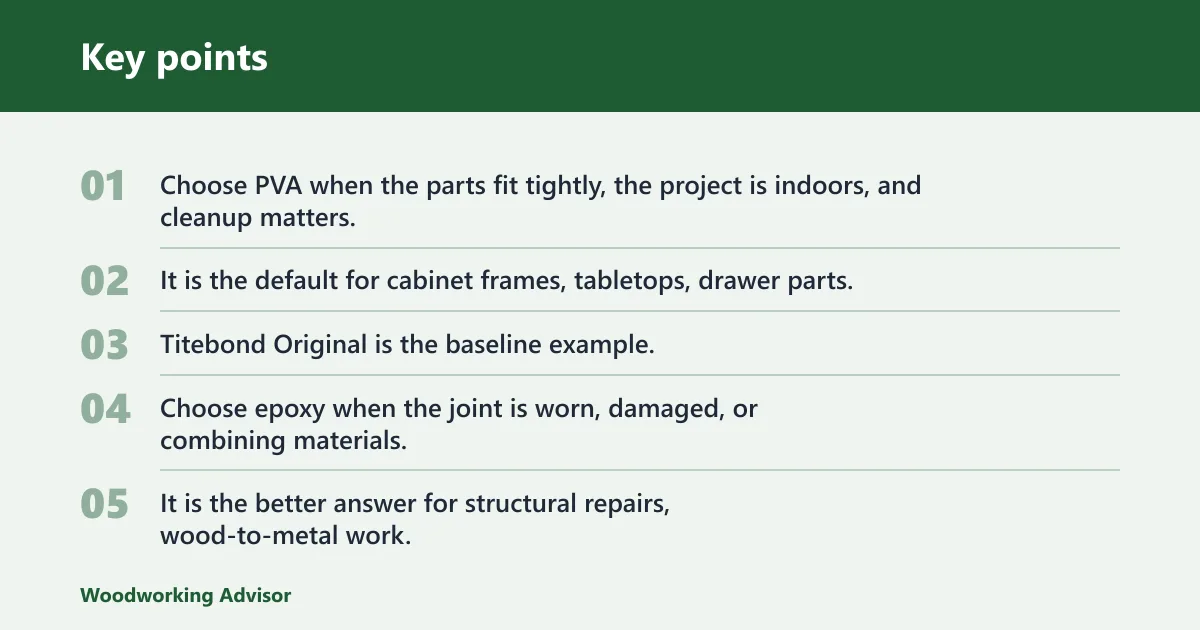
Choose PVA when the parts fit tightly, the project is indoors, and cleanup matters. It is the default for cabinet frames, tabletops, drawer parts, and most standard furniture joints. Titebond Original is the baseline example, while Titebond II or III make sense when the same kind of joint needs more moisture resistance.
Choose epoxy for gaps, structure, and mixed materials
Choose epoxy when the joint is worn, damaged, or combining materials. It is the better answer for structural repairs, wood-to-metal work, and repairs where the gap cannot be closed neatly with clamp pressure alone. If the repair needs body as much as bond, epoxy usually wins.
Choose polyurethane for oily wood or when water resistance matters
Choose polyurethane when the wood is oily, the environment is damp, or the job needs a waterproof cured adhesive and the fit is not perfect. Gorilla Glue is the familiar example here. It expands during curing, so plan for cleanup and do not treat the foam as a substitute for a solid joint design.


Verdict: which should you choose?
Choose PVA if you’re gluing indoor furniture, cabinet frames, tabletops, drawer parts, or other clean, tight wood-to-wood joints.
Choose Epoxy if you’re repairing loose or damaged joints, filling gaps, or bonding wood to metal or other mixed materials.
Choose Polyurethane if you’re fixing damp outdoor joints or oily wood where moisture resistance matters and the fit is not perfect.
Frequently asked questions
What is the best wood glue for indoor furniture?
PVA is the best general choice for indoor furniture because it is designed for clean wood-to-wood joints, it cleans up easily, and it clamps well on accurate parts. Titebond Original is the standard example for indoor furniture work. Use epoxy only when the joint is loose or damaged, and polyurethane only when the joint conditions demand it.
What is the difference between PVA, epoxy, and polyurethane wood glue?
PVA is the standard water-based choice for tight indoor joints. Epoxy is a two-part adhesive with gap-filling properties for repairs and mixed materials. Polyurethane is moisture-curing, expands while curing, and is better for oily woods, damp conditions, and some mixed-material fixes. Their failure modes are different, so the joint condition should drive the choice.
Is polyurethane wood glue stronger than PVA?
Not by default. Strength depends on joint fit, clamp pressure, surface prep, and the substrate. In a tight indoor joint, PVA can be the better choice because it is made for that situation. Polyurethane is more useful when moisture, oil, or imperfect fit would hurt a standard PVA bond.
When should I use epoxy instead of wood glue?
Use epoxy when the joint has gaps, the repair is structural, or you are bonding wood to metal or other mixed materials. It is also the better pick for missing material, chipped edges, and other repairs where ordinary wood glue would not have enough contact area to work well.
Is Titebond III waterproof for outdoor furniture?
Yes. Titebond III is described as a waterproof PVA glue, and it is a sensible choice for outdoor furniture and other projects that need water resistance. It still works best on well-fitted joints. Waterproof does not cancel the need for proper surface prep, clamp pressure, or good joint design.
Does polyurethane glue really fill gaps?
It can occupy space because it expands while curing, but that is not the same as true structural gap filling. The foam helps it bridge some irregularities, yet epoxy is the better option when the gap itself is part of the repair. For critical joints, do not rely on foam alone to carry the load.
How long does wood glue take to cure?
PVA usually cures in 24 hours, with clamp time around 30 to 60 minutes. Polyurethane is typically around 24 hours to full cure, with clamp time of 1 to 2 hours. Epoxy varies widely by formula, from a fast set in about 6 minutes for J-B Weld WoodWeld to much longer curing formulas.
What glue should I use for oily woods like teak?
Polyurethane is often the better choice for oily woods like teak, and epoxy is also strong when the surface is properly cleaned. PVA is less forgiving on oily stock. Whatever you choose, remove dust, oil, and wax first, because surface contamination can undo an otherwise correct glue choice.
Can I glue wood to metal with wood glue?
Standard PVA is not the right choice for wood-to-metal repairs. Epoxy is the better structural option, and polyurethane can also bond wood to metal, glass, and ceramic. If the joint carries load, use an adhesive intended for mixed materials rather than a normal furniture glue.
Which wood glue is easiest to clean up?
PVA is the easiest to clean up because fresh squeeze-out wipes away with water or a damp cloth. Polyurethane is the messiest of the three, and epoxy is easier before it cures than after. If cleanup matters most and the joint is a good fit, PVA is usually the simplest choice.
What should you avoid with end-grain joints?
Avoid assuming clamp pressure alone will fix end grain. The fibers can absorb glue and leave the joint starved. Seal or size the surface first when needed, then apply the adhesive and clamp with enough pressure to close the joint without squeezing every bit of glue out.
Sponsored / affiliate links. As an Amazon Associate I earn from qualifying purchases. I may earn additional commission from eligible campaigns.