Best Furniture Polish for Antique Wood: Research Shows
For antique wood, the safest polish is usually a silicone-free, non-wax cleaner-polish for shellac or lacquer, and a microcrystalline or paste wax only for stable oil-and-wax finishes; avoid oily sprays on fragile, original surfaces. Wrong products can cloud shellac, soften old varnish, build residue, and cut collector value. This guide matches polish choices to finish type and risk level so you protect patina without altering the piece’s original look.
Quick comparison
| Product | Badge | Best for | Price | ||
|---|---|---|---|---|---|
 |
Pledge Enhancing Polish Spray, Wood Furniture & StainlessPledge | Our pick | General wood & stainless polish · Fast shine · Lemon scent | $9.98
Price as of 22 Oct 2026
|
View |
 |
Guardsman Anytime Clean & Polish Wood Cleaner & FurnitureGuardsman | Also great | Wood-specific cleaner & polish · UV protection · Preserves patina | $14.99
Price as of 22 Oct 2026
|
View |
Use the table to identify the finish first, then pick the product. If you are unsure, check the existing finish label or paperwork if you have it, then test a hidden spot with the least aggressive cleaner-polish and watch for softening, clouding, or tackiness. For preservation work, compatibility matters more than shine.
How we chose
The ranking puts finish safety ahead of gloss. Silicone-free formulas come first, wax type matters, and products that can leave residue rank lower for fragile antiques.
We also looked at whether a product fits a maintenance role or a repair role. A polish that handles light conditioning is not the same thing as a product for water rings and heat rings.
- Match the finish type before you buy anything.
- Prefer silicone-free formulas on antiques, especially if future refinishing may ever be needed.
- Choose paste wax for controlled application on carved or delicate work; choose liquid conditioner only on stable, flat surfaces.
- Use ring-removal products only when the finish is sound and the mark is in the finish, not through it.
- Stop and call a conservator when the finish is flaking, sticky, alligatored, or historically important enough that value risk matters more than cosmetic improvement.
What finish is on your antique?
Identify the finish before you polish. Shellac, lacquer, varnish, and oil-and-wax finishes react differently, and a product that is safe on one can haze, soften, or darken another.
Shellac
Shellac is the most finicky of the common antique finishes. It can cloud or soften if you use aggressive cleaners, oily sprays, or a product that sits too wet on the surface, so start with the least aggressive cleaner-polish and test on an out-of-sight spot.
Lacquer
Lacquer is also sensitive to strong solvents and overapplication. A light cleaner-polish can help with dust and fingerprints, but heavy oils or wax buildup can leave the surface greasy and make future touch-up harder.
Varnish
Varnish is generally more durable than shellac or lacquer, but it still does not welcome harsh household cleaners. A silicone-free polish or a light wax can be appropriate if the finish is stable and the goal is maintenance, not restoration.
Oil-and-wax finishes
Oil-and-wax finishes are the most accepting of wax-based care, provided the piece is stable and not already loaded with residue. Paste wax is often the safer choice for carved details because you can control where it goes and avoid soaking corners.
Antique polish decision matrix
This matrix is built to keep you on the least risky path first. If the finish is unknown, treat it as fragile and stop at cleaning dust until you can identify it.
| Finish type | Safest polish category | Risk level | Do not use |
|---|---|---|---|
| Shellac | Silicone-free cleaner-polish used sparingly | High | Oily sprays, heavy wax buildup, strong household cleaners |
| Lacquer | Silicone-free cleaner-polish or very light conditioner only if stable | High | Wet application, harsh cleaners, thick wax layers |
| Varnish | Silicone-free polish; paste wax if the finish is sound | Moderate | Ammonia cleaners, over-oiling, silicone sprays |
| Oil-and-wax | Paste wax or wax blend with beeswax and carnauba wax | Lower | Abrasive cleaners, wet scrubbing, silicone-heavy products |
Yes/no pre-polish checklist
Answer each item before you apply anything. If you hit a “no” on finish stability or a “yes” on value risk, stop and reassess.
| Check | Yes or no | Why it matters |
|---|---|---|
| The finish is stable, not flaking or sticky. | Yes / No | Unstable finish can smear or lift under polish. |
| There is visible old buildup, clouding, or tackiness. | Yes / No | Old residue can trap more residue and dull the surface. |
| Water rings or heat rings sit in the finish, not through bare wood. | Yes / No | Surface marks may respond to a restoration polish; deeper damage may not. |
| The piece has collector value, original label, or untouched patina that matters. | Yes / No | Value-risk situations call for restraint and often a conservator. |
| You can identify the finish type with reasonable confidence. | Yes / No | Unknown finishes are where many polishing mistakes begin. |
When to stop and call a conservator
Stop when the finish is actively failing, the surface is historically important, or the piece may lose value if the wrong product changes the sheen. A conservator should also handle thick old buildup, flaking shellac, or marks that may be through the finish rather than in it.
Howard Feed-N-Wax: best for routine conditioning
Howard Feed-N-Wax is a wax-forward option for many stable finished antiques because its published formula uses a protective coating of carnauba wax and beeswax. That makes it practical for routine maintenance when you want light surface refreshment rather than a heavy cosmetic change.
This fits finished surfaces that can handle a gentle wax treatment. Beeswax mainly contributes a soft, protective surface layer, while carnauba wax is the harder protective wax that adds more durable shine in feed-and-wax blends.
The drawback is that any wax blend can build up if you overuse it. On shellac or lacquer, that means you should apply sparingly and test first; on carved surfaces, too much product can settle in details and leave a dull film. Oil-and-wax blends can also be problematic on some original finishes and residue-heavy antiques.
Milsek Antiques & Restoration Polish & Cleaner: best for rings
Milsek Antiques & Restoration Polish & Cleaner is the better fit when the main problem is water rings or heat rings and the finish still looks sound. The product is sold in a 12 oz bottle, claims a high oil content, and states that it contains no water, no wax, and no silicone.
That profile points to a repair-minded cleaner rather than a general wax. For antique care, that matters because surface marks often call for removal of the ring without forcing a refinish that could erase original finish and patina.
The drawback is the same one that makes it useful: a high-oil product is not the first choice for every finish. If the piece is already oily, soft, or sticky, or if you are dealing with shellac that may react poorly, this is not the place to start.
Paste wax vs liquid conditioner
Paste wax is usually the safer choice for carved or delicate surfaces because it goes on in a more controlled layer. Liquid conditioner can be easier on flat areas, but it may include cleaning agents that need closer ingredient scrutiny, especially on shellac and lacquer.
Paste wax for carved or delicate surfaces
Paste wax gives you control. It is easier to keep out of joints, carving, and veneers, and that is why a guide focused on antiques often recommends paste wax for delicate work.
Beeswax is the common base here, and it suits antique care because it forms a gentle surface coating rather than a deep conditioning treatment. Carnauba wax often joins beeswax to harden the final film and improve durability, but more wax is not better if the surface already has buildup.
Liquid conditioner for flat surfaces
Liquid conditioner makes more sense on broad, flat panels where you can wipe evenly and avoid puddling. The tradeoff is that the formula may carry more cleaning agents and can be riskier on shellac or lacquer, where a wet or solvent-heavy pass can leave dull spots.
A common first-timer mistake is using a spray on a carved sideboard and then chasing the shine with more product. That can leave sticky residue in the grooves and make the surface look darker in the wrong places.
Ingredient checks before buying
Look for silicone-free formula on the label or product details. Silicone is a problem on antiques because it can cause future refinishing headaches and may create buildup that is hard to remove cleanly.
Also watch for ammonia in general household cleaners. That is a sensible line to keep when the finish is old and the goal is preservation, not stripping.
Which one should you buy?
Choose the product by finish and risk, not by shine alone. The safest broad option for many antiques is Guardsman Anytime Clean & Polish when you want a silicone-free cleaner-polish for a stable finished surface; Howard Feed-N-Wax is the better wax-forward choice for routine conditioning; Milsek is the stronger ring-focused option when the finish is intact and the mark is a water or heat ring.
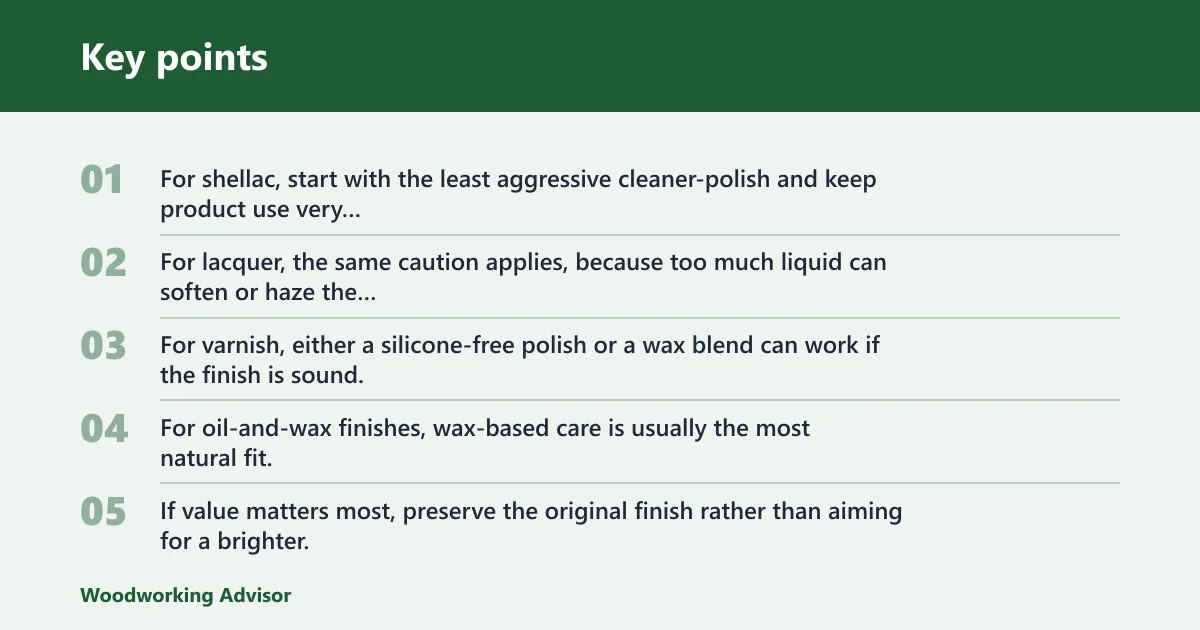
For shellac, start with the least aggressive cleaner-polish and keep product use very light. For lacquer, the same caution applies, because too much liquid can soften or haze the finish.
For varnish, either a silicone-free polish or a wax blend can work if the finish is sound. For oil-and-wax finishes, wax-based care is usually the most natural fit, and paste wax is often the most controlled option.
If value matters most, preserve the original finish rather than aiming for a brighter, newer look. Original finish and patina usually matter more to collectors than a fresh shine, and a wrong polish can lower appeal even when the piece looks cleaner.
Suppose a side table has a stable lacquer finish, a few fingerprints, and no visible ring marks. A light cleaner-polish is the safer move, because the goal is cleaning and restrained shine, not restoration.
Say a chest has a warm-toned oil-and-wax surface with dull corners and light buildup in the carving. Paste wax is the better fit, because it can refresh the surface without flooding the details.
Frequently asked questions
What is the best wax for antique wood furniture?
The best wax for antique wood furniture is usually a paste wax based on beeswax, sometimes blended with carnauba wax for a harder finish. Beeswax is gentle and forms a protective surface layer, while carnauba adds more durable shine. Choose silicone-free products and use them only on stable finishes, not sticky or failing ones.
What can I use to clean antique wood furniture?
Use a soft dry cloth first, then a silicone-free cleaner-polish if the finish is stable and identified. Avoid ammonia-based household cleaners and wet scrubbing. If the piece has flaking shellac, unknown finish, or collector value, cleaning alone may be safer than any polish application.
What to use on antique wood furniture?
Use a product that matches the finish and the risk level. For shellac or lacquer, a very light cleaner-polish is safer than wax buildup. For varnish, silicone-free maintenance products are usually appropriate. For stable oil-and-wax finishes, paste wax is often the most controlled choice.
What is the best furniture polish for antique wood?
The best furniture polish for antique wood is the one that keeps the original finish intact rather than changing it. For many antiques, a silicone-free cleaner-polish is the safest broad choice, while Howard Feed-N-Wax suits routine conditioning on stable finishes and Milsek suits ring-related cleanup on sound surfaces.
Is furniture polish good for wood?
Furniture polish can be good for wood when the formula matches the finish and is used lightly. It can reduce dusting marks and refresh a tired surface. It is not a cure-all, and silicone-heavy or overly oily products can create residue, dulling, or future refinishing problems.
Sponsored / affiliate links. As an Amazon Associate I earn from qualifying purchases. I may earn additional commission from eligible campaigns.
 Milsek Furniture Polish and Wood Cleaner with Lemon Oil - Multipurpose Solution for Home Improvement from Hardwood Floors to Kitchen Cabinets - 12 Fl Oz (Pack of 12)
 Pledge Enhancing Polish Spray, Wood Furniture & Stainless Steel Polish, Remove Dust and Fingerprints, Fast Shine and Protect, Prevent Scratches & Knicks - Lemon Scent, 9.7oz (Pack of 12)