Wood Glue vs Construction Adhesive: Which Is Better?
PVA wood glue is usually a better choice for tight, clamped wood-to-wood joints, while construction adhesive is often better for small gaps, quicker grab, and trim or panels that need to stay put. Pick by fit and movement, not by “stronger” label. Pick wrong and you get weak joints, creep, or repairs that fail early. This guide compares both for furniture, repairs, trim, panels, and outdoor assemblies.
This guide is part of our Wood glue essentials: types, uses, and cure times series.
Wood glue vs construction adhesive: the real trade-off


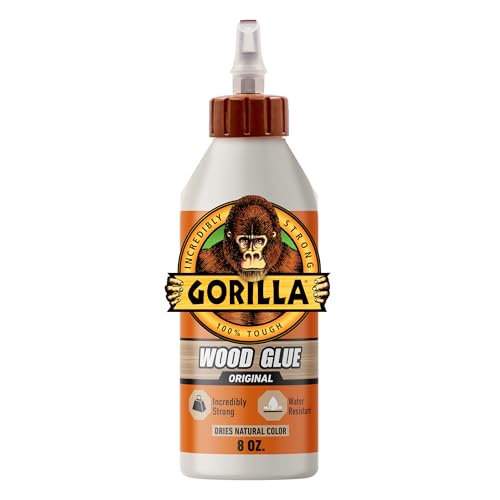
The real choice is not raw strength. It is whether the joint fits well, whether clamping is possible, and whether the parts will stay put while the adhesive cures. PVA wood glue wants close wood contact. Construction adhesive is built for installation work where parts may be oversized, awkward, or already fixed in place.
How each adhesive behaves at the joint line
PVA wood glue is water-based, spreads thin, and tends to work best when the mating faces already fit well. Construction adhesive is thicker, grabs quickly, and can bridge small voids better, but it is not meant for precision joinery. That difference matters more than brand names or broad claims about strength.
Why fit, support, and movement decide the winner
Joint fit drives bond quality. Tight faces give wood glue a continuous glue line and predictable wood failure. Bigger gaps, rough stock, or pieces that must hang overhead favor construction adhesive, because it can support the part while it sets and tolerates less-than-perfect contact.
| Decision factor | Wood Glue | Construction Adhesive: Which Is Better for Woodwork | Winner |
|---|---|---|---|
| Best joint fit | Tight wood-to-wood joints with full contact | Small gaps, rough framing, imperfect surfaces | Wood Glue for tight joints; Construction Adhesive for gaps |
| Clamp need | Requires clamping or strong pressure | Usually little or no clamping needed | Construction Adhesive |
| Open time and assembly speed | Enough for careful shop assembly, but not ideal for long fit-ups | Often more useful for fast site placement and immediate grab | Construction Adhesive |
| Cleanup | Water cleanup before cure | Messier; cleanup depends on product and stage | Wood Glue |
| Best-use case | Furniture joints, edge joints, laminated panels | Trim, subflooring, decking, fixed panels, site-installed parts | Depends on the job |
Best joint fit
Wood glue wins when the joint is tight and flat. It needs contact, not filler. Construction adhesive wins when the parts are irregular, the surfaces are rough, or the joint has intentional gaps that need bridging rather than a thin glue line.
Clamp need
Wood glue usually needs clamping pressure to bring the faces together and hold them in place until the bond starts to set. Construction adhesive is often chosen because it can help hold parts in place on its own. That makes it easier for trim, panels, and overhead work where clamping is awkward or impossible.
Open time and cleanup
Wood glue suits shop work because parts can be aligned, clamped, and wiped clean before cure. Construction adhesive is often better for site work where the installer has to place a part, press it home, and move on. Cleanup is usually simpler with wood glue, especially on bare wood.
What is PVA wood glue?
PVA wood glue is a water-based adhesive made for wood-to-wood bonding. It is the default choice for well-fitted joints because it bonds porous wood fibers well, clamps cleanly, and sets to a hard line that is usually stronger than the wood around it when the fit is correct.
Where it bonds well
It works best on bare, porous wood, milled lumber, and engineered wood with exposed wood fibers. Clean, dry, well-fitted surfaces give the best bond. It is far less dependable on painted, sealed, oily, or dirty surfaces because the glue needs to wet the wood, not the finish.
What happens when the fit is poor
If the gap is too large, wood glue is usually a poor gap filler. The glue line gets thick, squeeze-out gets messy, and the bond may fail at the glue line instead of in the wood fibers. That is why a bad fit often beats a good brand in the wrong joint.
What is construction adhesive?
Construction adhesive is a thicker adhesive used for framing, subfloors, trim, panels, and other installation work. It offers high initial grab and better gap tolerance than wood glue, which helps when parts are large, awkward, or fixed in place before full support is available.
Where its high grab helps
Its value is immediate holding power. That matters for trim on a wall, subfloor sheets, and decking members where the part needs to stay put while fasteners or gravity do the rest. It can bond wood, but that is not the same as being made for precise joinery.
Why gap filling is not the same as precision bonding
Gap filling means the adhesive can occupy space and still hold the part. Precision bonding means the adhesive line is thin, even, and loaded in a way the joint expects. Construction adhesive can bridge imperfections, but it does not turn a loose furniture joint into a proper fitted joint.
Is wood glue stronger than construction adhesive for wood?
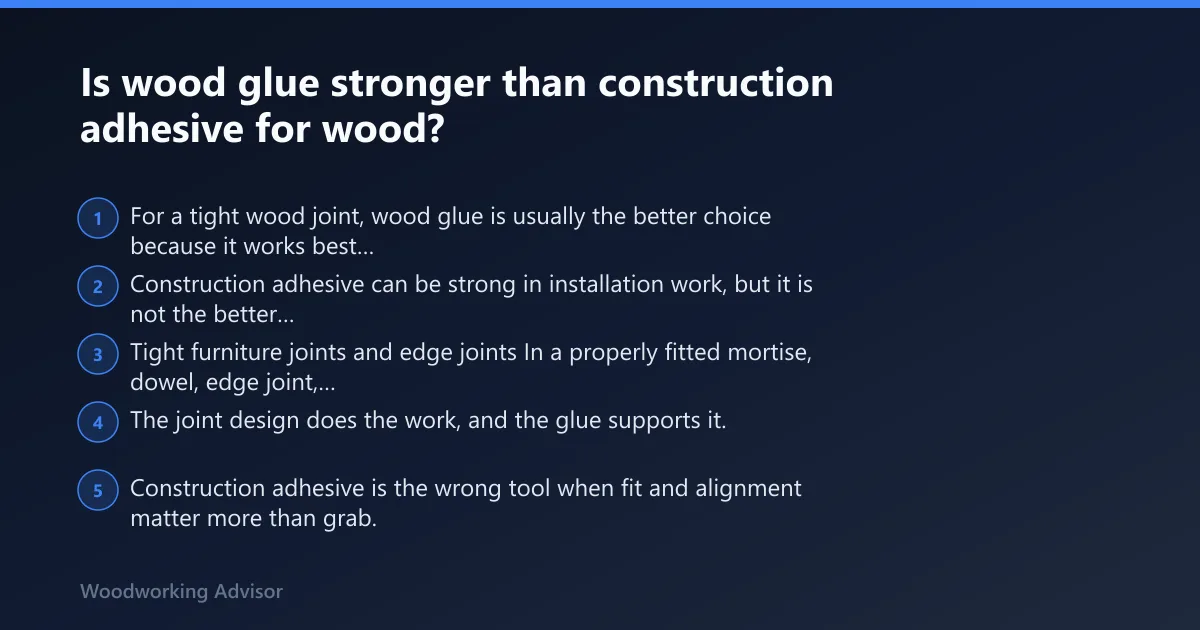
For a tight wood joint, wood glue is usually the better choice because it works best with a thin glue line and a well-fitted joint. Construction adhesive can be strong in installation work, but it is not the better answer when the pieces already fit closely and can be clamped.
Tight furniture joints and edge joints
In a properly fitted mortise, dowel, edge joint, or panel glue-up, wood glue usually produces a cleaner and more reliable result. The joint design does the work, and the glue supports it. Construction adhesive is the wrong tool when fit and alignment matter more than grab.
Gapped repairs and imperfect contact
When the parts do not meet well, construction adhesive often wins on practicality. A small gap, uneven substrate, or site-installed part can make wood glue underperform. The key is that the adhesive must be chosen for the gap, not for a general strength claim.
What failure looks like in practice
With good wood glue joints, failure often shows up in the wood fibers, not at the glue line. With the wrong adhesive for the job, the failure is often at the interface: peeling, creeping, or a joint that opens because the bond never had the right contact or support.
How joint fit changes the answer
Joint fit changes nearly everything. A tight-fit joint gives wood glue the contact it needs, while a gapped or uneven joint can make that same glue weak in practice. Surface flatness, porosity, and how well the parts register against each other matter more than a broad “wood adhesive” label.
Tight-fit versus gapped joints
Tight-fit joints maximize contact area and reduce stress on the bond line. Gapped joints put more load on the adhesive itself, which is why construction adhesive is often the safer choice there. A joint that can be clamped flat is a very different problem from one that must hold shape by itself.
Surface flatness and contact area
Flat, milled stock bonds better than rough sawn or warped lumber. More contact area means less stress on each inch of glue line. When the faces are uneven, the bond becomes dependent on filler-like behavior, and that favors construction adhesive over PVA.
Why milled stock and rough stock behave differently
Milled stock fits predictably and accepts wood glue well. Rough stock, old lumber, and site-cut material often have less contact and more movement. In those cases, the adhesive choice should account for the real surface, not the ideal one.
Decision matrix: choose the safer adhesive for the job
This matrix is about failure risk, not marketing language. The safer adhesive is the one that matches fit, support, and exposure. Clamp access, open time, and movement matter as much as the substrate itself.
| Scenario | Safer adhesive choice | Clamp requirement | Likely failure mode |
|---|---|---|---|
| Tight furniture joint | PVA wood glue | Yes, firm clamping | Wood fibers fail before the glue line |
| Gapped repair | Construction adhesive | Usually minimal; support may still help | Peel or creep if movement continues |
| Panel lamination | PVA wood glue for well-fitted sheets; construction adhesive only for site-fixed, non-precision panels | PVA: yes; construction adhesive: often no | PVA fails if fit is poor; construction adhesive can leave uneven thickness |
| Trim install | Construction adhesive | Usually no, though brads or tape may help | Bond failure on painted or dusty surfaces |
| Subflooring and decking | Construction adhesive | No for the adhesive alone; fasteners still matter | Squeaks, movement, or loss of grab if the substrate is dirty |
| Outdoor assembly | Depends on exposure and movement; neither is ideal for every exterior wood joint | Often yes for wood glue; support for construction adhesive | Moisture cycling, creep, or bond breakdown |
When should I use construction adhesive instead of wood glue?
Use construction adhesive when the part is being installed rather than milled into a tight joinery fit. It is the safer choice for trim, subfloor sheets, decking, rough framing, and site-installed panels where high grab and gap tolerance matter more than a thin, clamped glue line.
Site-installed work
If the piece is large, overhead, already in place, or hard to clamp, construction adhesive has the edge. It helps hold the part during fastening and can reduce the need for clamps. That makes it practical for field conditions where exact joinery is unrealistic.
When neither adhesive is the best answer
For structural outdoor joints, heavily loaded assemblies, or surfaces that are painted, oily, or poorly prepared, neither product may be the right fix by itself. Mechanical fastening, better joinery, or surface prep may matter more than the adhesive choice.
Does wood glue work on painted or finished wood?
Usually no, not well enough to trust for a primary bond. PVA wood glue wants bare, porous wood so it can key into the fibers. Paint, finish, sealer, and wax can block that contact, so the glue may bond to the coating instead of the wood itself.
Painted and sealed surfaces
On painted or sealed wood, the weak layer is often the coating, not the glue. That means the bond may peel off cleanly even if the adhesive cured properly. Sanding to bare wood is the better fix when a durable joint is needed.
Where construction adhesive has an edge
Construction adhesive is more tolerant of imperfect site surfaces, though it still needs a clean enough substrate to hold. It is often the better option when the wood is already painted or the job cannot be taken back to bare fibers.
Is construction adhesive good for outdoor woodworking projects?
It can be useful outdoors, but it is not a blanket answer. Exposure to moisture, temperature swings, and wood movement changes the bond demands. For outdoor woodwork, the better adhesive depends on whether the joint is fitted, exposed, and expected to move over time.
Moisture resistance and weather exposure
Outdoor use raises the bar for both adhesives. PVA wood glue is usually best reserved for exterior-rated products and well-fitted joints with limited exposure. Construction adhesive may handle weather exposure better in some assemblies, but it still needs proper substrate prep and support.
Interior versus exterior suitability
Interior furniture joints and shop assemblies favor PVA because conditions are controlled. Exterior trim, decking, and field repairs often favor construction adhesive because the work is installed in place and may face more movement. Direct water contact and repeated wetting are poor conditions for both unless the product is rated for that service.
How long do wood glue and construction adhesive take to cure?
Wood glue usually reaches handling strength faster, while full cure still takes time. Construction adhesive often has a longer cure window and can depend more on temperature, humidity, bead size, and how much air the joint gets. “Dry to the touch” is not the same as fully cured.
Handling versus full cure
With PVA, parts can often be unclamped earlier than the full cure time suggests, but the joint should not be stressed too soon. Construction adhesive may hold a piece quickly, yet the core of the bead can stay soft longer, especially in thick lines or cool, damp conditions.
Temperature and humidity sensitivity
Both products slow down in cool or damp conditions. Thick adhesive beads, low airflow, and nonporous surfaces can stretch cure time. That matters most on large panels and site work where the installer may want immediate load-bearing performance.
Can I clamp construction adhesive like wood glue?
Yes, but clamping is usually less central than with wood glue. Construction adhesive is often chosen because it can hold with minimal clamp pressure or with temporary support. If the joint needs careful alignment, light clamping or bracing can still help keep the parts where they belong.
When clamping helps anyway
Clamps can reduce slip, improve alignment, and keep the bead thickness more even. That is useful for panels and trim, especially if the pieces are heavy or want to drift before the adhesive sets. The goal is support, not squeezing the joint dry.
Alignment matters more than pressure
Too much pressure can squeeze out too much construction adhesive or push the part out of position. Wood glue, by contrast, depends on enough pressure to close the joint. The same clamping habit does not suit both products.
What fails first: the glue line or the wood itself?
In a good PVA wood-glue joint with proper fit, the wood often fails before the bond does. In a poor-fit joint, on painted surfaces, or where movement is high, the adhesive line is more likely to fail first. Construction adhesive more often fails by peel, creep, or edge separation when used outside its best conditions.
Real-world failure patterns
For furniture and edge joints, a clean glue line and good fit usually shift failure into the wood fibers. For trim, panels, and subfloors, the problem is often movement, insufficient contact, or poor surface prep. Those failures do not look the same, and the adhesive choice should reflect that.
Choose PVA wood glue if… / choose construction adhesive if…
Choose PVA wood glue if the joint is tight, the parts can be clamped, the wood is bare and porous, and the goal is a clean wood-to-wood bond. Choose construction adhesive if the job is site-installed, gap-prone, hard to clamp, or part of trim, subflooring, decking, or a fixed panel.
Choose PVA wood glue if…
- The joint fit is tight and flat.
- You can clamp the pieces securely.
- The wood is bare, milled, and clean.
- You want the joint to act like traditional joinery.
Choose construction adhesive if…
- The joint has small gaps or rough surfaces.
- The part must be installed in place with little clamping access.
- You need immediate grab for trim, panels, subfloors, or decking.
- The work is more about installation than fine joinery.
Frequently asked questions
Can construction adhesive be used for furniture joints?
Only in limited cases, and usually not for primary furniture joinery. It can help with certain repairs or loose, non-precision attachments, but it is not the right adhesive for tight mortise-and-tenon, dowel, or edge joints. Furniture needs fit first, then adhesive.
Sponsored / affiliate links. As an Amazon Associate I earn from qualifying purchases. I may earn additional commission from eligible campaigns.