Average Cost To Drill A Well (Full Price Breakdown)
The average cost to drill a water well in the U.S. typically ranges from $1,500 to $7,000, but can sometimes reach $10,000 or more. This wide range depends heavily on factors like the depth of the well, your geographic location, the type of soil and rock encountered, and the specific equipment and pump system you choose.
Understanding the Price of Drilling a Well
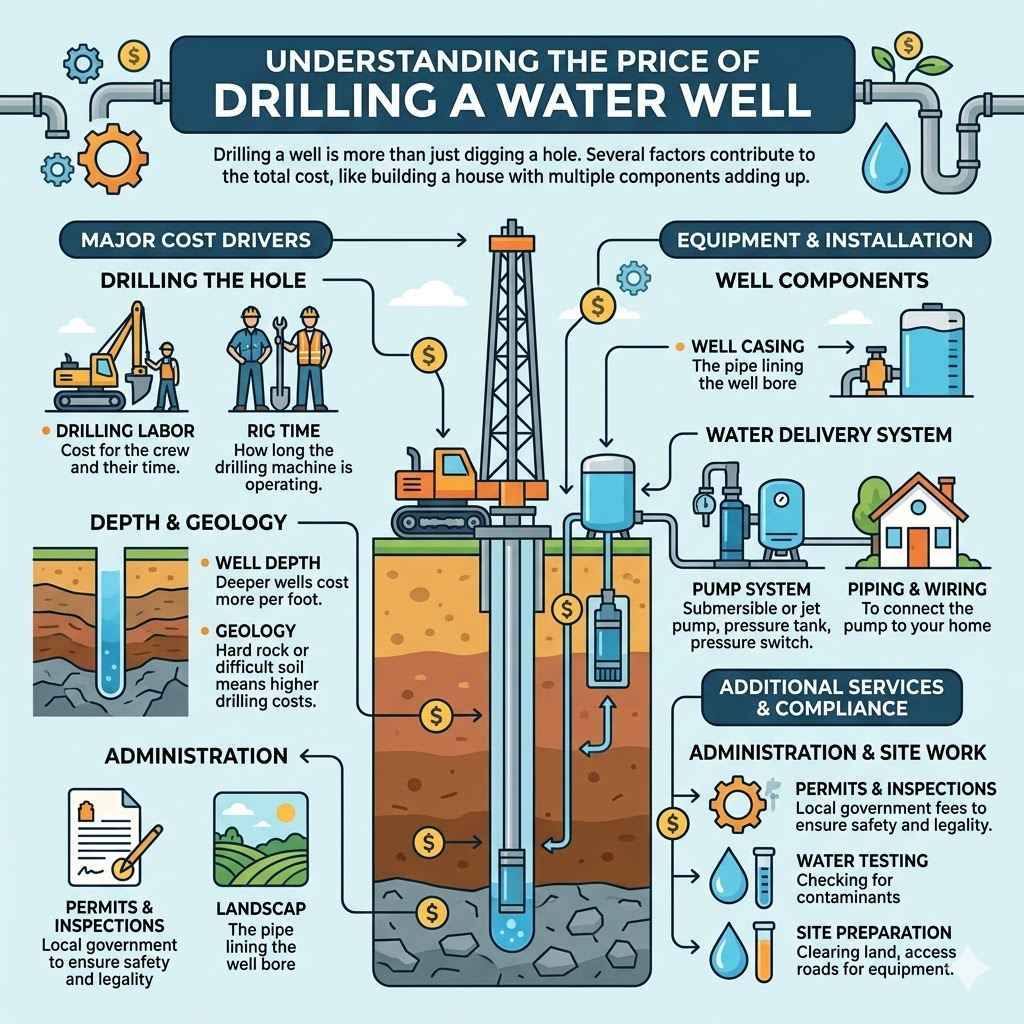
Drilling a well seems simple: you dig a hole, get water. But it’s much more involved. Several big pieces make up the total cost. Knowing these helps you understand where your money goes. It’s like building a house; you have foundation costs, framing, and then finishing touches. Each part adds up.
The biggest chunk of the cost is usually the actual drilling. This involves powerful machines and skilled workers. Think about how deep they have to go! The deeper the well, the more time and effort it takes. This naturally means higher costs. Your local area also plays a role. Some places have harder ground or more rocks. This makes drilling tougher and more expensive.
Then there’s the equipment you need. A good pump is crucial. It brings the water up to your home. The type of pump and its size depend on how much water you need and how high it has to be pushed. Pipes, wiring, and storage tanks also add to the bill. Finally, there are permits and inspections. These are important steps to make sure your well is safe and legal.
Key Cost Components of a Water Well
- Drilling Labor: The cost for the crew and their time.
- Rig Time: How long the drilling machine is running.
- Well Depth: Deeper wells cost more per foot.
- Geology: Hard rock or difficult soil means higher costs.
- Well Casing: The pipe lining the well bore.
- Pump System: Submersible or jet pump, tank, pressure switch.
- Piping & Wiring: To connect the pump to your home.
- Permits & Inspections: Local government fees.
- Water Testing: Checking for contaminants.
- Site Preparation: Clearing land, access roads.
The Impact of Well Depth on Your Budget
Depth is perhaps the most significant factor. Most residential wells are between 100 and 500 feet deep. Some might be shallower, but many need to go much deeper to reach a reliable water source. Every foot of depth adds to the cost.
Drilling companies often charge a price per foot. This price can vary wildly. A shallow well might cost $10-$20 per foot for drilling. A deeper well, say over 300 feet, could cost $25-$50 per foot or even more. So, a 400-foot well could cost anywhere from $4,000 to $20,000 just for the drilling part!
I remember a friend, Sarah, who was building a home in a more rural area. She thought a 200-foot well would be plenty. But after drilling, they hit a lot of solid rock. It slowed everything down. They ended up drilling over 350 feet. The final bill was much higher than she planned. This taught her that depth isn’t the only story; what’s in the ground matters too.
The type of water source also dictates depth. Are you tapping into shallow groundwater or a deep aquifer? Aquifers are underground layers of rock or soil that hold water. Deeper aquifers usually mean more stable water supplies, but at a higher drilling cost. Your local drilling professional will have the best idea of what’s common in your area.
Depth vs. Cost Per Foot
Shallow Wells (Under 100 feet): Usually cost less per foot, but may be more prone to seasonal drying or contamination.
Medium Wells (100 – 300 feet): A common range for many homes. Cost per foot increases slightly.
Deep Wells (Over 300 feet): Most expensive per foot. Often tap into more reliable and cleaner water sources.
Geographic Location and Its Price Influence
Your home’s location matters more than you might think. Different regions have unique geological conditions. This affects how easy or hard it is to drill. For instance, areas with lots of hard granite or basalt rock will be more expensive to drill through than sandy soil.
Think about the American West. Many areas there have rocky terrain. Drilling can be slow and require specialized, more expensive equipment. In contrast, parts of the Midwest might have softer soil and sand layers, making drilling faster and cheaper.
Accessibility also plays a part. If your property is hard to reach, the drilling company might charge more for transportation. They may need to use smaller equipment or build temporary roads. This adds labor and time, thus increasing the final cost.
The cost of living and local labor rates also differ. Drilling in a major metropolitan area might be more expensive than in a very rural town. This is because wages for skilled workers are typically higher in more populated areas. So, always get quotes from local drillers.
Regional Cost Examples (General Estimates)
Northeast (e.g., New England): Often involves rocky terrain, leading to higher drilling costs. Expect prices towards the mid-to-high end of the average range.
Midwest (e.g., Plains States): Can have softer soil and sand, potentially leading to lower drilling costs, especially for shallower wells.
Southwest (e.g., Arizona, New Mexico): Often dry, requiring deeper wells to reach aquifers. This increases cost. Rocky soil can also be a factor.
Pacific Northwest (e.g., Washington, Oregon): Terrain varies greatly. Mountainous areas might be more expensive due to accessibility and rock. Coastal areas might have different geological challenges.
Types of Wells and Their Price Tags
Not all wells are created equal. The type of well you need depends on the water source and the geology. The most common types for homes are:
1. Bored Wells (or Dug Wells): These are older and wider wells. They are usually dug by hand or with a backhoe. They are only suitable for shallow water sources. They are generally less expensive to install but can be more prone to surface contamination. These are less common for new home construction today.
2. Driven Wells (or Sand Point Wells): These are made by driving a perforated pipe into the ground. They are best for areas with shallow, sandy aquifers. They are typically the cheapest to install but can only access water close to the surface. They are often used for irrigation or very basic water needs.
3. Drilled Wells: This is the most common type for modern homes. A large drilling rig is used to bore a hole deep into the ground. The hole is then lined with casing. These wells can reach deep aquifers, providing a more reliable water source. They are the most expensive type to install due to the equipment and depth required.
Drilled wells themselves can be divided further into:
- Rock Wells: Drilled into bedrock.
- Gravel Packed Wells: Used in areas with loose gravel, often requiring a screen and gravel pack to prevent sediment from entering.
The complexity of drilling a rock well versus a gravel-packed well can impact costs. Rock drilling is often slower and requires more robust equipment.
Well Type Comparison
| Well Type | Typical Depth | Cost Factor | Best For |
|---|---|---|---|
| Bored/Dug | Shallow (10-30 ft) | Lower installation cost, potential for contamination | Areas with high water tables, simple applications |
| Driven/Sand Point | Very Shallow (15-50 ft) | Lowest installation cost, limited water availability | Sandy soil, irrigation, temporary use |
| Drilled (Rock) | Moderate to Deep (50-1000+ ft) | Higher installation cost, reliable water | Most residential homes, deep aquifers, stable supply |
| Drilled (Gravel Pack) | Moderate to Deep (50-500 ft) | Moderate installation cost, good for silty water | Areas with sandy or silty soil, preventing sediment |
The Pump System: A Crucial, Costly Addition
The well itself is just part of the equation. You need a system to get that water out of the ground and into your home. The pump system is a significant cost. The type of pump you need depends on the well’s depth and how much water your household uses.
Submersible Pumps: These are the most common for drilled wells. They are placed inside the well pipe, below the water level. They push water up. Submersible pumps are efficient and quiet. Their cost can range from $300 to $2,000 or more, depending on the horsepower and brand.
Jet Pumps: These are typically used for shallower wells or driven wells. They sit above ground or in a well pit. They use suction to draw water up. Jet pumps are generally cheaper than submersible pumps, costing $200 to $800. However, they are less efficient for deeper wells.
Beyond the pump itself, you need other components:
- Pressure Tank: This tank stores water and maintains pressure in your plumbing system. It prevents the pump from running every time you turn on a faucet. A typical tank can cost $200 to $600.
- Pressure Switch: This tells the pump when to turn on and off based on water pressure in the tank. It’s a smaller item, usually $30 to $100.
- Piping and Wiring: The cost of the pipes that run from the pump to your home, and the electrical wiring to power the pump. This can add several hundred dollars.
- Well Seal/Cap: A protective cover for the top of the well casing.
When I was helping my sister pick out a pump, she got a quote that seemed high. I asked the installer about it. He explained that the higher-end submersible pump they recommended was much more durable and energy-efficient. Over the years, the energy savings would offset the initial higher cost. It’s a balance between upfront price and long-term value.
Pump System Cost Factors
Horsepower: Higher horsepower pumps are needed for deeper wells or higher water demands. This increases cost.
Flow Rate (GPM): Gallons per minute. A higher flow rate pump costs more.
Brand and Quality: Reputable brands often cost more but offer better reliability.
Installation Complexity: Running pipes and wires over long distances or through difficult terrain adds labor costs.
The Importance of Permits and Water Testing
You can’t just start drilling anywhere. Local governments have rules to protect water resources. This means you’ll likely need permits. The cost of permits varies greatly by state, county, and even town. It could be $50 or a few hundred dollars.
These permits ensure the well is drilled according to standards. They also help track water usage. After drilling, there will usually be an inspection. This is to check that the well is properly sealed and meets safety codes.
Water testing is another essential step, and it adds to the cost. Once your well is operational, you need to test the water quality. This is crucial for your health. A basic test might check for common issues like bacteria (coliform), nitrates, and pH levels. More comprehensive tests can check for heavy metals, pesticides, and other contaminants.
A basic water test can cost $50 to $150. A more thorough analysis might run $300 to $500 or more. If the tests reveal problems, you might need additional water treatment systems, which add even more cost. I’ve seen people skip this step to save money, but it’s a risk I wouldn’t advise taking. Clean water is too important.
Permit and Testing Breakdown
Permit Fees: Can range from $50 to $500+, depending on local regulations.
Inspection Fees: Sometimes included with permits, sometimes separate. Budget up to $100-$200.
Basic Water Test: $50 – $150 (checks for bacteria, nitrates, pH).
Comprehensive Water Test: $300 – $500+ (checks for metals, minerals, contaminants).
Site Preparation and Miscellaneous Costs
Before the drill rig even arrives, your site might need some work. If the well location is in a wooded area, you might need to clear trees. If the ground is uneven or inaccessible, temporary roads or a cleared pad for the rig might be necessary. This site preparation can add a few hundred to a couple of thousand dollars.
Then there are often miscellaneous costs that pop up. This could include:
- Wellhead protection: Ensuring the area around the well is properly sealed and protected from surface runoff.
- Disposal of drilling mud and cuttings: Some regulations require specific disposal methods.
- Travel fees: If the drilling company has to travel a long distance.
- Unexpected geological issues: Hitting hard rock layers, significant voids, or unstable soil can increase drilling time and cost.
I once worked on a project where the chosen well site was on a steep slope. The drilling company had to bring in a specialized rig that was more compact but less powerful. This meant it took longer to drill. They also had to build a temporary platform for the rig to sit on safely. That added about $1,500 to the bill for site prep alone.
Hidden and Miscellaneous Costs
Access Road Construction: For difficult-to-reach sites.
Tree/Vegetation Clearing: To make space for the rig.
Temporary Power: If grid power isn’t nearby for drilling.
Contingency Fund: Always good to have 10-15% extra for unexpected issues.
Putting It All Together: Example Scenarios
Let’s look at a few hypothetical scenarios to see how these costs can add up. These are estimates, and actual prices will vary.
Scenario 1: The Basic Well in Loamy Soil
A homeowner needs a well in an area with easy-to-drill, loamy soil. The water table is relatively shallow, requiring a well that’s 150 feet deep. They choose a standard submersible pump system.
- Drilling (150 ft @ $25/ft): $3,750
- Well Casing & Screen: $500
- Submersible Pump System: $1,200
- Piping & Wiring: $300
- Permits & Inspection: $200
- Water Test: $100
- Site Prep: $100
- Total Estimated Cost: $6,150
Scenario 2: The Deep Well in Rocky Terrain
Another homeowner is building in a mountainous region with hard rock. They need a deeper well, around 400 feet, to reach a reliable aquifer. They opt for a higher-quality pump and need extra site preparation.
- Drilling (400 ft @ $40/ft): $16,000
- Well Casing & Screen: $1,000
- High-Quality Submersible Pump System: $2,000
- Piping & Wiring: $500
- Permits & Inspection: $300
- Water Test: $200
- Site Prep (including minor road work): $1,000
- Total Estimated Cost: $21,000
As you can see, the depth and geology can create a huge difference in cost. Always get detailed quotes that break down these items.
Cost Factors Summary Table
Factors Affecting Well Cost:
- Depth: Primary driver. Deeper = more expensive.
- Geology: Rock, sand, clay all affect drilling time and cost.
- Location: Accessibility and local labor rates matter.
- Well Type: Drilled wells are most common and costly.
- Pump System: Submersible pumps are standard and their quality affects price.
- Ancillary Costs: Permits, testing, and site prep add up.
Tips for Managing Well Drilling Costs
Drilling a well is a significant investment. Here are a few tips to help manage the costs:
Get Multiple Quotes: Always get at least three detailed quotes from reputable, licensed, and insured well drillers. Compare not just the bottom line, but also what’s included in each quote.
Ask About Depth Estimates: Discuss with the driller what they expect the depth to be based on nearby wells and local knowledge. This helps manage expectations.
Consider Pump Quality: While a cheaper pump might save money upfront, a more reliable, energy-efficient pump can save you money on electricity and reduce repair costs over time. Ask about warranties.
Understand the Contract: Read your contract carefully. What happens if they hit hard rock? Is there a maximum depth they will drill? Are there overage charges?
Ask About Warranties: What kind of warranty do they offer on the drilling and the pump system? This is a good indicator of their confidence in their work and materials.
Check for Local Rebates or Incentives: Sometimes, certain government programs or local water authorities might offer incentives for drilling new wells, though this is less common.
Smart Cost-Saving Strategies
Research Drillers: Look for reviews, ask for references. A good driller is worth the investment.
Understand Pricing Structure: Know the cost per foot and what that includes (casing, labor, etc.).
Be Prepared for the Unexpected: Have a small contingency fund ready for unforeseen issues.
Combine Services: If a driller also offers pump installation, getting it all done by one company might simplify things and potentially save on travel costs.
When to Worry: Red Flags in Quotes and Drilling
It’s wise to be cautious. Some things can signal potential problems or unnecessary costs.
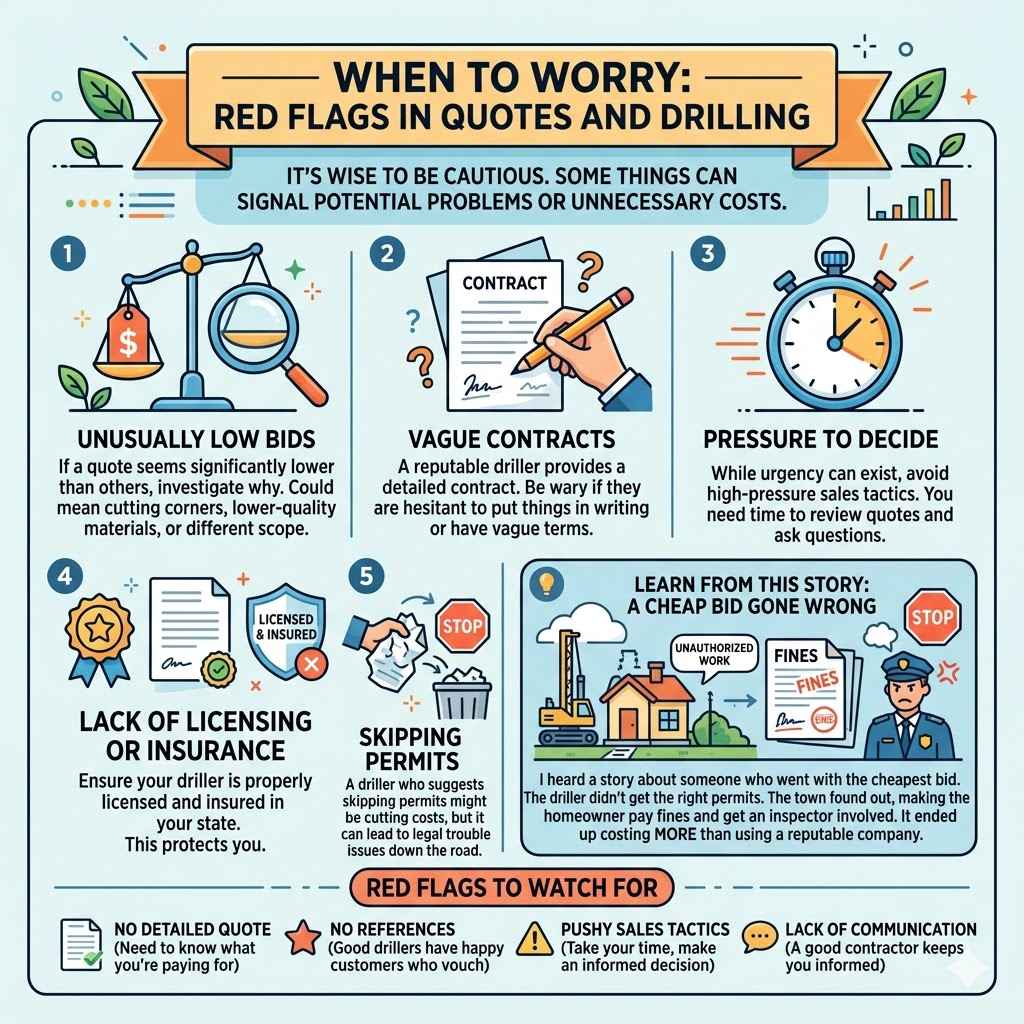
Unusually Low Bids: If a quote seems significantly lower than others, investigate why. It could mean they’re cutting corners, using lower-quality materials, or that the scope of work is different. Sometimes a cheap bid is just a cheap bid, but often there’s a reason.
Vague Contracts: A reputable driller will provide a detailed contract outlining all services, materials, costs, and timelines. If they are hesitant to put things in writing or their contract is vague, be wary.
Pressure to Decide Quickly: While urgency can sometimes be real, avoid high-pressure sales tactics. You need time to review quotes and ask questions.
Lack of Licensing or Insurance: Ensure your driller is properly licensed and insured in your state. This protects you if something goes wrong.
Skipping Permits: A driller who suggests skipping permits might be cutting costs, but it could lead to legal trouble or issues down the road.
I heard a story about someone who went with the cheapest bid. The driller didn’t get the right permits. When the town found out, they made the homeowner pay fines and get an inspector involved. It ended up costing more than if they had used a reputable company from the start.
Red Flags to Watch For
No Detailed Quote: You need to know what you’re paying for.
No References: Good drillers have happy customers who can vouch for them.
Pushy Sales Tactics: Take your time and make an informed decision.
Lack of Communication: A good contractor keeps you informed.
Frequently Asked Questions About Well Drilling Costs
How long does it take to drill a well?
Drilling itself can take anywhere from a few days to over a week, depending on depth, geology, and rig availability. Factor in time for permits, inspections, and pump installation, and the whole process can take several weeks.
Can I drill a well myself?
While DIY drilling might seem appealing, it’s generally not recommended for residential water wells. Professional drillers have the specialized equipment, knowledge of geology, and understanding of safety and regulatory requirements. Improper drilling can lead to contamination, dry wells, or structural failure.
What is the lifespan of a well and pump?
A properly maintained well can last 50 years or more. The pump system, however, typically has a shorter lifespan. Submersible pumps usually last 10-15 years, while jet pumps might last 5-10 years. Regular maintenance can help extend their life.
Does the season affect well drilling costs?
In some regions, drilling during the wet season can be difficult due to muddy conditions, potentially slowing down work and increasing costs. Conversely, extremely cold weather can also halt drilling operations. The shoulder seasons (spring and fall) are often ideal.
What if my well doesn’t produce enough water?
This can happen if the well is too shallow, drilled into a depleted aquifer, or if there’s a problem with the pump or casing. A professional driller can assess the situation. Solutions might include drilling deeper, installing a larger pump, or exploring other water sources.
Is a water treatment system always needed?
Not always, but it’s highly recommended to test your water. Many areas have naturally occurring minerals (like iron or sulfur) that can affect taste, smell, or stain fixtures. Sometimes, contamination from nearby sources requires treatment. Water testing will reveal if a system is necessary.
Conclusion: Investing in Your Water Future
Drilling a water well is a significant undertaking, both in effort and in cost. Understanding the various factors—from depth and geology to pump systems and permits—is key to budgeting accurately. While the average cost can be anywhere from $1,500 to $10,000+, your specific situation will determine the final price.
By getting multiple detailed quotes, asking the right questions, and choosing a reputable driller, you can navigate this process with confidence. It’s an investment that provides independence and a reliable water source for years to come.
Sponsored / affiliate links. As an Amazon Associate I earn from qualifying purchases. I may earn additional commission from eligible campaigns.