Best Cedar Species for Raised Beds (2026): research shows
Western red cedar is the best all-around cedar for raised garden beds because it balances durability, weight, availability, and price. Choose Alaska yellow cedar for wet climates, Northern white cedar for tighter budgets, and untreated cedar only when the lumber is the right species and grade for outdoor contact. The wrong species can warp sooner, loosen fasteners, and force a rebuild before the bed should fail.
Quick comparison
| Product | Badge | Best for | Price | ||
|---|---|---|---|---|---|
 |
Woodchucks Wood 3/4 Inch x 2 Inch x 16 Inch Solid Red CedarWoodchucks Wood | Budget pick | 3/4" thick solid red cedar lumber, 6 pack. | $22.30
Price as of 12 Oct 2026
|
View |
 |
Infinite Cedar Deep Root Cedar Raised Bed Garden KitInfinite Cedar | Our pick | 16.5-inch deep cedar kit for large-rooted plants. | $288.00
Price as of 12 Oct 2026
|
View |
 |
EYDHCN 63×83 Inch Planter Box Liner, Garden Raised BedEYDHCN | Pair with it | Heavy-duty 63×83 inch non-woven fabric liner. | $7.99
Price as of 12 Oct 2026
|
View |
 |
Ready Seal Exterior Wood Stain & Sealer, Natural Cedar, 5Ready Seal | Upgrade pick | 5-gallon exterior stain and sealer for wood. | $199.00
Price as of 12 Oct 2026
|
View |
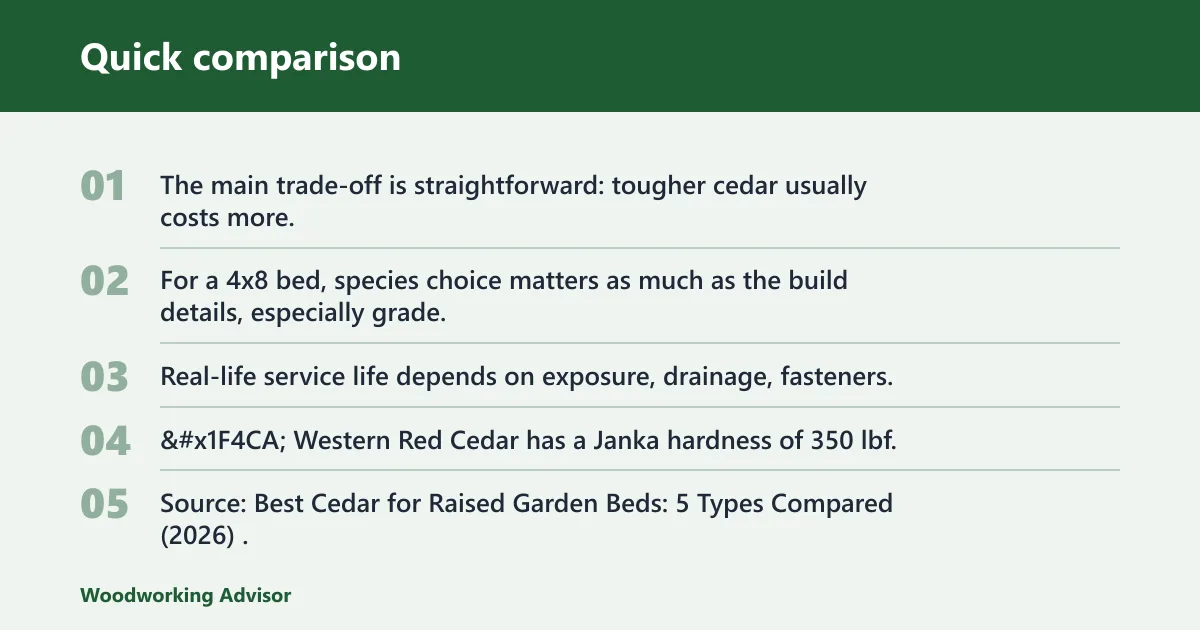
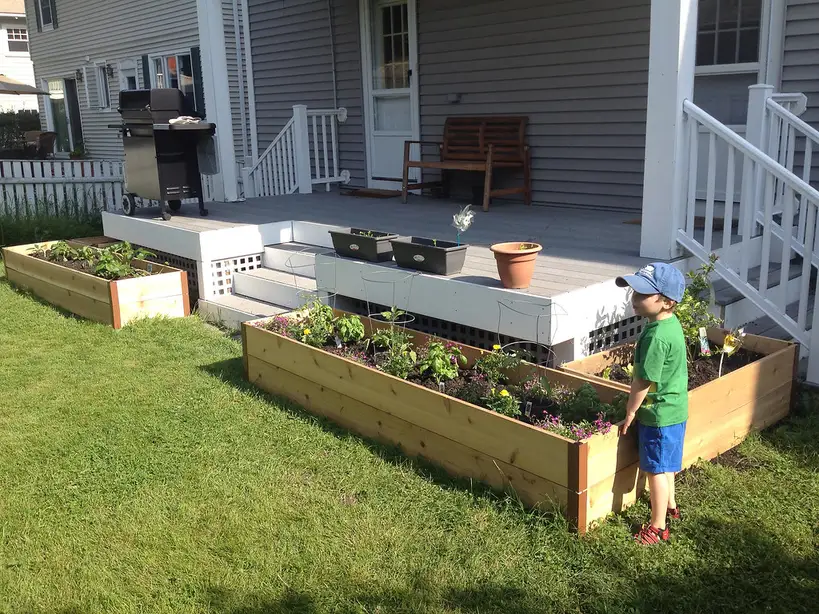
The main trade-off is straightforward: tougher cedar usually costs more, while lighter cedar is easier to move but may last less time in exposed conditions. For a 4×8 bed, species choice matters as much as the build details, especially grade, moisture content, and whether you are buying heartwood or sapwood.
Use the table below as a buying filter. It is not a promise. Real-life service life depends on exposure, drainage, fasteners, and how much heartwood is in the boards.
| Species | Climate fit | Budget tier | Expected longevity | Handling weight | Recommended wood grade |
|---|---|---|---|---|---|
| Western Red Cedar | Most regions, mixed use | Mid to premium | High | Moderate | Clear or near-clear heartwood boards |
| Eastern Red Cedar | Insect-prone sites, smaller beds | Mid | High where properly built | Heavy | Heartwood with tight grain |
| Northern White Cedar | Dry to average climates | Budget | Moderate | Light | Appearance grade acceptable if heartwood-rich |
| Alaska Yellow Cedar | Wet and coastal sites | Premium | High | Heavy | Clear or premium exterior grade |
| Port Orford Cedar | High-end, exposed projects | Premium plus | High | Moderate to heavy | Architect Clear or boatbuilding-grade stock |
📊 Western Red Cedar has a Janka hardness of 350 lbf. Source: Best Cedar for Raised Garden Beds: 5 Types Compared (2026).
How we chose
We ranked species using four practical filters: decay resistance in outdoor contact, handling weight for a DIY build, board-foot price and source availability, and the amount of heartwood versus sapwood available in typical stock. Kiln drying and grade labels matter too, because movement and appearance can change the outcome as much as species.
Board-foot cost matters because cedar is sold by volume, not by bed. A 4×8 bed usually needs enough lumber that a small change in board-foot price can swing the total by a meaningful amount.
We also separated edible beds from ornamental beds. In a vegetable bed, you care more about clean construction, stable lumber, and long service life than about scent or color alone.
Which cedar species is best for your bed size and climate?
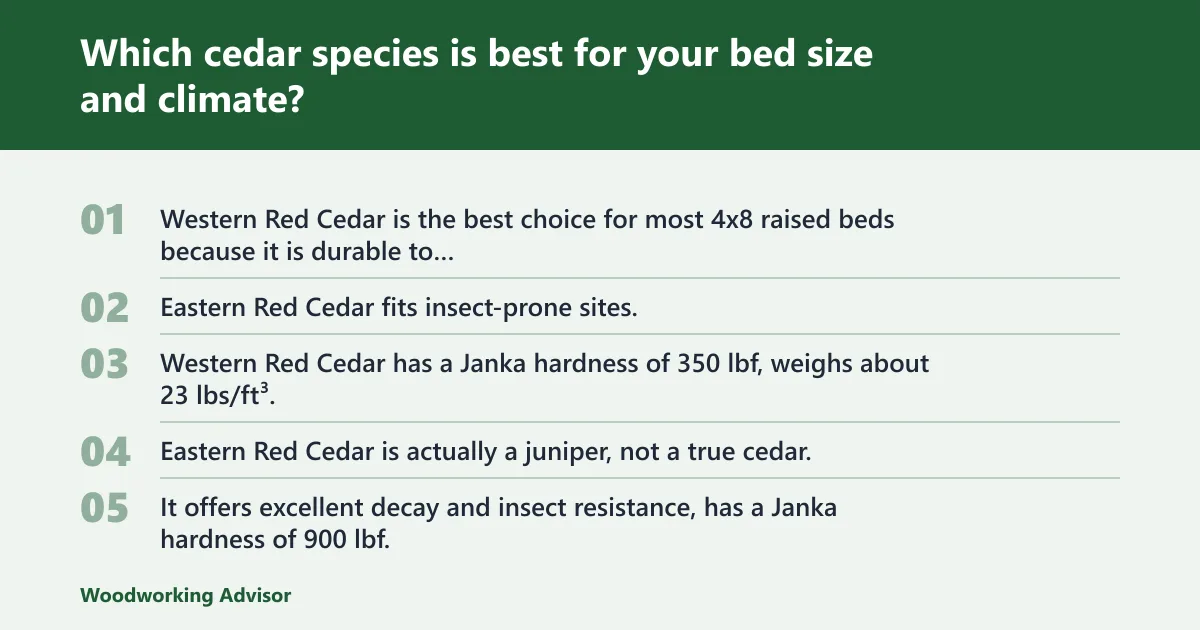
Western Red Cedar is the best choice for most 4×8 raised beds because it is durable to very durable, reasonably light at 23 lbs/ft³, and widely available. Eastern Red Cedar fits insect-prone sites, Northern White Cedar fits lighter budget builds, Alaska Yellow Cedar suits wet and coastal exposure, and Port Orford Cedar makes sense when price is secondary to premium stock.
Western Red Cedar for most regions and mixed-use beds
If you want one safe default, start here. Western Red Cedar has a Janka hardness of 350 lbf, weighs about 23 lbs/ft³, and commonly sells for $2.00-$8.00 per board foot in 2026, with broad availability that makes it easier to sort through grades and lengths.
Eastern Red Cedar for insect-prone sites and smaller builds
Eastern Red Cedar is actually a juniper, not a true cedar. It offers excellent decay and insect resistance, has a Janka hardness of 900 lbf, weighs about 33 lbs/ft³, and typically costs $3.00-$7.50 per board foot, so it can be a smart choice where insects are a concern and the heavier weight is manageable.
Northern White Cedar for lightweight budget builds
Northern White Cedar is the lightweight budget-grade option. It is often chosen when easy handling matters more than top-tier longevity, and its lower density makes assembly friendlier for a solo builder, especially on smaller beds or shorter runs of lumber.
Alaska Yellow Cedar for wet and coastal climates
Alaska Yellow Cedar is recommended for wet, coastal climates. Its Janka hardness is around the high-500s lbf, its weight is about 31 lbs/ft³, and pricing is often not publicly listed, so sourcing may depend on local mills or quote-based yards rather than shelf pricing.
Port Orford Cedar starts at $6/board foot and is quote-only for many suppliers. It sits in a premium, boatbuilding-grade position, with a Janka hardness of 590 lbf and a weight of about 29 lbs/ft³, so it fits specialty builds more than budget garden projects.
Western Red Cedar: best overall for raised beds
Western Red Cedar is the best overall pick for raised garden beds because it balances durability, weight, availability, and price. It is described as durable to very durable, which is exactly what you want for a bed that stays in contact with damp soil and sees seasonal movement.
Its 350 lbf Janka hardness is not the highest in this group, but hardness is only one part of outdoor performance. For beds, the useful mix is enough stiffness for fastening and enough natural decay resistance for long service in contact with soil.
Price range and what board-foot cost means here
At $2.00-$8.00 per board foot, Western Red Cedar spans a wide market. Lower prices usually reflect lower grade, smaller lengths, or more sapwood. Higher prices often track clear stock, better appearance, and cleaner heartwood content.
For a 4×8 bed, that range matters because the lumber total can move fast as board-foot pricing changes. A bed built from clear stock costs much more than one built from common grade, even when the footprint is identical.
Best grade and moisture content to look for
Look for kiln-dried stock when possible. Lower moisture content means less movement, less checking, and fewer loose fasteners after assembly. For a garden bed, that stability matters more than chasing the cheapest bundle on the rack.
Grade labels matter too. Architect Clear usually signals cleaner appearance, fewer knots, and more usable heartwood. Common grades can still work, but they may bring more sapwood, more knots, and more variation in board width or straightness.
Eastern Red Cedar: best for insect resistance
Eastern Red Cedar is a strong choice when insect resistance matters and the heavier weight is acceptable. Its decay and insect resistance are excellent, and the high Janka rating of 900 lbf tells you it is a harder, denser wood than Western Red Cedar.
Why it is actually a juniper
Despite the name, Eastern Red Cedar is botanically a juniper. That matters mainly because buyers often assume all cedars behave the same, when the species, density, and source can differ a lot.
That density is useful outdoors, but it also makes boards heavier to move and harder to cut by hand. For large beds, that extra mass can slow assembly and make dry-fitting more awkward.
Where it makes sense for garden beds
It makes sense for smaller beds, insect-prone zones, and gardeners who want a stronger aroma and a harder board. It is less attractive when the build is large, the site is far from the lumber source, or you need to move every board alone.
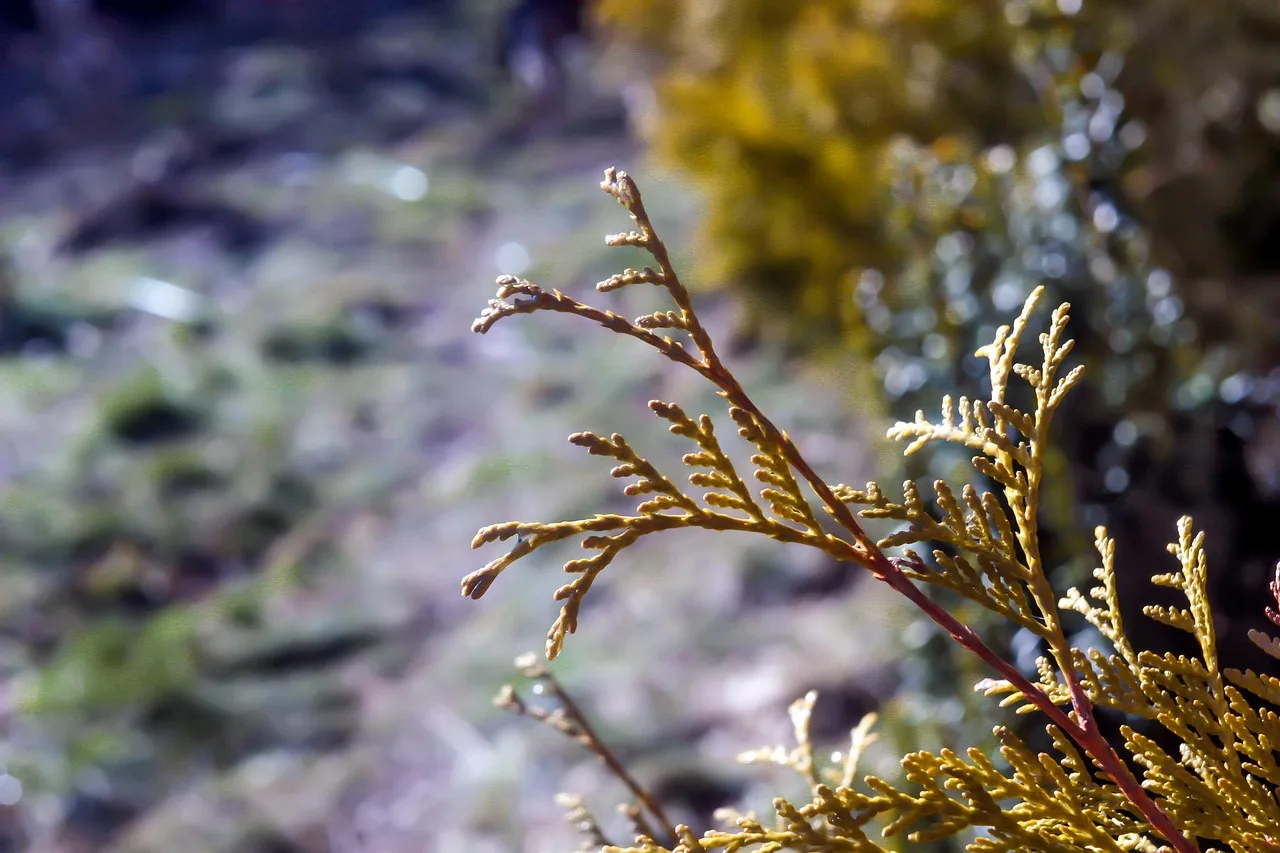
These species are worth considering when the site conditions, handling needs, or budget push you away from the default pick. Northern White Cedar is the lightest-feeling option, Alaska Yellow Cedar fits wet or coastal exposure, and Port Orford Cedar belongs in premium, quote-only builds.
Northern White Cedar for light handling and tighter budgets
Northern White Cedar is the budget-leaning choice when weight matters. It is useful for gardeners who want easier lifting, quicker assembly, and lower strain during a small to medium build.
The trade-off is that budget positioning usually means more attention to grade and board selection. If you buy too much sapwood or choose rough, twisted stock, any cost savings can disappear in wasted cuts.
Alaska Yellow Cedar for wet or coastal exposure
Alaska Yellow Cedar is a good fit when rain, salt air, or persistent moisture are part of the setting. It is the species in this group most directly tied to wet, coastal climates, which is why it belongs on the short list for exposed beds.
Its weight is higher than Western Red Cedar, so handling takes more effort. That matters if you are working on uneven ground or assembling the bed solo.
Port Orford Cedar for high-end, hard-to-source builds
Port Orford Cedar belongs in high-end, hard-to-source builds where premium stock and a clean appearance justify the search. It is a specialty choice, not a default one.
The drawback is practical: quote-only sourcing slows the project, and the material cost can move enough that the final bed may stop making sense against a simpler cedar species.
What should you buy: heartwood, sapwood, kiln-dried, or green?
Buy heartwood whenever you can. Heartwood resists decay much better than sapwood, and that difference matters more than the species name on the rack if the board will live in damp soil contact for years.
Heartwood versus sapwood
Heartwood is the older inner wood of the tree. Sapwood is the younger outer layer and is generally less decay resistant. For raised beds, heartwood is the part you want in the soil zone and along the most exposed faces.
A board that is mostly sapwood can look fine at purchase and still fail early. That is why “cedar” alone is not enough as a buying rule.
Kiln-dried versus green cedar
Kiln-dried cedar is usually the safer construction choice because lower moisture content reduces movement, warping, and fastener loosening after assembly. Green cedar can shrink as it dries, which opens joints and can pull screws out of alignment.
For a 4×8 bed, that movement shows up quickly in corners and long side panels. If you have a choice, kiln-dried boards are easier to square, fasten, and keep aligned.
Grade labels such as Architect Clear
Architect Clear usually means cleaner faces, fewer knots, and a more premium appearance. That does not guarantee better longevity by itself, but it often tracks better heartwood content and more consistent stock.
Common grades are more affordable and can still last well if they are heartwood-rich and properly dried. For an ornamental bed, appearance may justify clear stock. For a vegetable bed, stable lumber matters more than showroom looks.
Real cost to build a 4×8 cedar raised bed
A 4×8 raised bed gives you a practical way to compare species without hiding behind vague price talk. Material cost changes with board-foot price, grade, and whether you choose common lumber or premium clear stock.
For a typical 4×8 bed, expect the lumber bill to rise quickly when you move from Northern White Cedar or common-grade Western Red Cedar to Alaska Yellow Cedar or Port Orford Cedar. Hardware, liner, and finish are separate costs.
- Measure the footprint and side height before buying lumber.
- Choose the species based on climate first, then budget.
- Pick kiln-dried heartwood boards when stability matters.
- Buy enough extra length for trims, checks, and bad cuts.
- Use corrosion-resistant fasteners so the frame stays tight.
Say your bed sits in a damp yard with poor airflow. Western Red Cedar or Alaska Yellow Cedar makes more sense than a cheaper, lighter board that may check faster and loosen at the corners.
Suppose your goal is a small 4×8 herb bed near a patio. Northern White Cedar can make the build easier to handle, especially if the bed does not face full-season saturation.
Food safety for edible beds
Cedar is generally suitable for edible gardens when you use untreated lumber and avoid coatings that are not meant for soil-contact use. What to avoid is just as important: pressure-treated lumber for the bed walls, unknown preservatives, and interior liners that trap water against the wood.
If you line the bed, use the liner to manage soil loss, not to keep rotten wood alive. A liner that blocks drainage can shorten the life of even good cedar.
For vegetable beds, the safest path is untreated cedar, stainless or coated exterior fasteners, and a simple finish only on exposed faces if you choose to finish at all.
Woodchucks Wood 3/4 Inch x 2 Inch x 16 Inch Solid Red Cedar Lumber Boards as Cutting Board Wood (6 Pack): best for small cedar offcuts
This is best for small, clean cedar cuts where you want kiln-dried boards ready for immediate use. Based on the spec sheet and reviews, it fits smaller woodworking tasks better than a full bed build.
The drawback is obvious: these are short boards, so they do not solve a 4×8 raised bed material list. They are useful as sample stock, trim pieces, or small projects, not as primary bed lumber.
Infinite Cedar Deep Root Cedar Raised Bed Garden Kit: best for a quick assembled bed
This kit is for gardeners who want a fast path to a deep bed without sourcing every board separately. The 16.5-inch height suits deep-rooted plants, and the included hardware reduces the number of moving parts in the build.
The drawback is price and flexibility. You get convenience, but you give up control over species selection, grade sorting, and the exact board count that a custom build can provide.
EYDHCN 63×83 Inch Planter Box Liner: best for lining large beds
This liner is useful when you want erosion control or a reusable barrier for a large bed. It folds for storage and installs without complex tools, which makes it a practical add-on rather than a structural part.
The drawback is that a liner does not fix poor lumber choices. If the bed frame is warped or underbuilt, the fabric only manages soil, not structure.
Ready Seal Exterior Wood Stain & Sealer, Natural Cedar, 5 Gallon: best for exposed exterior faces
This sealer is aimed at exterior moisture and UV protection, which matters for bed faces above grade. It is a maintenance product, not a rot cure, and its no-sand application can simplify prep on larger surfaces.
The drawback is that any coating adds cost and maintenance. It also does not make sapwood behave like heartwood, so species and grade still matter first.
Which one should you buy
If you want the shortest route to a good result, buy Western Red Cedar in kiln-dried, heartwood-heavy boards and keep the build simple. If your site is wet or coastal, move to Alaska Yellow Cedar. If you need easier handling and lower upfront cost, Northern White Cedar is the budget-leaning pick.
Choose Eastern Red Cedar when insects are a bigger concern than weight. Choose Port Orford Cedar only if you want a premium, quote-only build and the budget can absorb it. For ornamental beds, cleaner grades and appearance matter more. For edible beds, stable, untreated, kiln-dried stock matters more.
Raised garden beds cedar vs pine: cedar usually lasts longer than pine in outdoor contact, especially when you compare heartwood cedar to ordinary softwood pine. Pine can be cheaper per board foot, but its shorter service life often reduces the years-per-dollar advantage unless you are building a temporary bed.
A common first-timer mistake is buying the cheapest cedar boards without checking for sapwood, twist, or green moisture. That can lead to checking, fastener loosening, and corners that open before the bed has had a fair run.
Frequently asked questions
Is cedar good for raised garden beds?
Yes. Cedar is a strong choice for raised garden beds because it resists decay better than many common softwoods and is available in species that fit different climates and budgets. The key is choosing the right cedar species, grade, and moisture content, not just buying any board labeled cedar.
Is cedar good for raised beds?
Yes, cedar is good for raised beds when you use untreated, heartwood-rich boards and build with corrosion-resistant fasteners. It is not maintenance-free, though. Warping, checking, and loose screws can still happen, especially with green lumber or low-grade sapwood-heavy stock.
Raised garden beds cedar vs pine: which lasts longer?
Cedar usually lasts longer than pine in raised garden beds, especially when you compare durable cedar heartwood with standard construction pine. Pine can save money upfront, but the shorter service life often makes cedar the better value for gardeners who want more years before a rebuild.
Why use cedar for raised gardens?
You use cedar because it combines outdoor durability, workable weight, and broad availability in forms that suit both ornamental and vegetable beds. It also comes in species that solve different problems, from wet-climate exposure to lighter handling or stronger insect resistance.
Should I buy heartwood or sapwood cedar?
Buy heartwood. Heartwood lasts longer because it resists decay better than sapwood, and that matters most where boards touch damp soil or sit in splash zones. Sapwood can be cheaper, but it is the weaker buy if longevity is the goal.
Should cedar raised beds be kiln-dried or green?
Kiln-dried is usually the better choice for raised beds because lower moisture content reduces warping, shrinkage, and fastener loosening after assembly. Green cedar can work, but you should expect more movement as it dries, especially in long side panels and corner joints.
Sponsored / affiliate links. As an Amazon Associate I earn from qualifying purchases. I may earn additional commission from eligible campaigns.