Best Cedar Woods for Building a Chicken Coop (2026): Based on Specs and Reviews
For a chicken coop, choose heartwood from durable cedar species, especially eastern red cedar or western red cedar, for exterior framing, trim, and roof parts, while keeping aromatic cedar planks out of areas birds peck or roost on. Wrong species or sapwood-heavy stock can warp, split, or off-gas more strongly, turning a weather-resistant wood into a short-lived risk. This guide shows which cedar types fit a coop, where to place them, and which cedar products to avoid.
Western red cedar is the cedar species that most often makes sense when you want long service life and low maintenance on exterior coop parts. It is naturally rot resistant, lightweight, and dimensionally stable, and published product guidance puts western red cedar at 10-15 years or longer outdoors when the build is detailed well.
That does not make it a universal answer. Cedar costs more than pine or fir, and the value only shows up when the wood actually sees weather, splashback, and seasonal movement. Put it where moisture is highest, and use less costly lumber where the wood is protected.
Where cedar is worth the extra cost
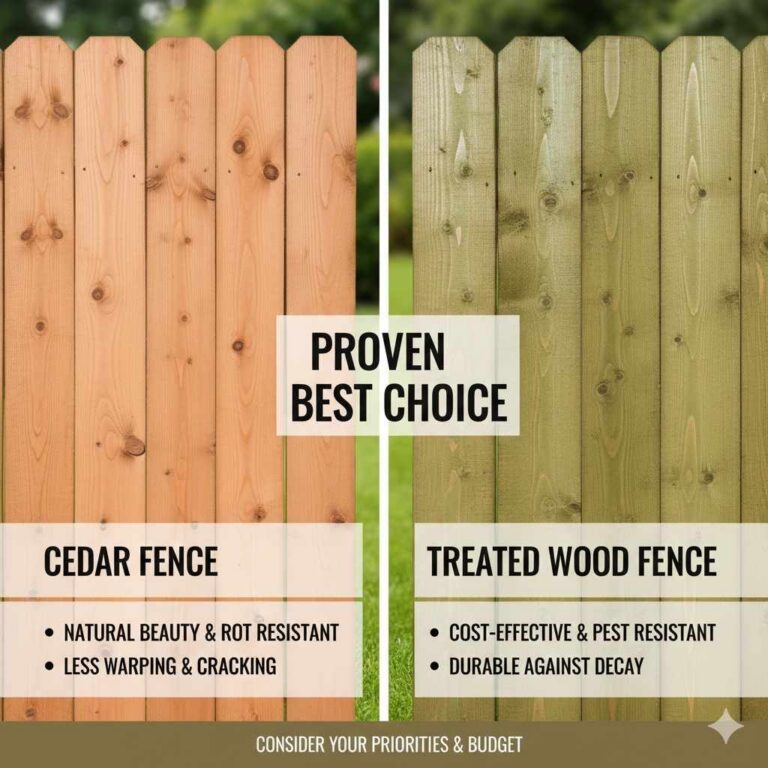
Use cedar on exterior boards, trim, and other exposed parts that take rain, sun, and repeated damp-dry cycles. The species’ natural oils help resist bacterial and fungal attack, and the wood’s stability helps reduce cupping and seasonal twist.
That matters most on coop siding, fascia, and roof edges. These are the places where cheaper lumber often fails first. A roof overhang still helps, but cedar gives you more margin when runoff, wind-driven rain, and wet bedding raise humidity around the coop.
Where another wood makes more sense
For protected framing, pine or fir usually gives the better cost-to-life balance. For most chicken coops, pine or fir lumber provides the best balance of cost and durability, and it is a safe untreated option for frames and siding.
If the part is hidden, fully covered, or easy to replace, cedar’s premium is harder to justify. Save cedar for the weather-exposed skin of the coop, and keep the structural budget in check with pine or fir where conditions are milder.
Quick comparison
| Product | Badge | Best for | Price | ||
|---|---|---|---|---|---|
 |
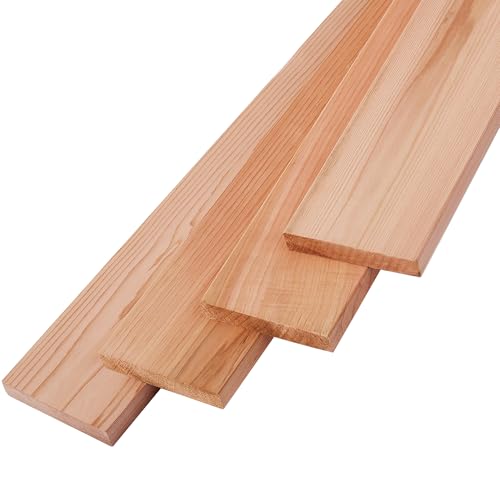
Eastern Red Cedar Lumber – 3/4" x 6" (2pcs) (3/4" x 6" xBarrington Hardwoods | Our pick | 3/4" x 6" x 48" · eastern red cedar · lumber | $85.00
Price as of 28 Oct 2026
|
View |
 |
bingaai 7ft Western Red Cedar Decking Boards (4-Pack)bingaai | Pair with it | 1x6x7′ · western red cedar · decking boards | $239.99
Price as of 28 Oct 2026
|
View |
This comparison helps most when you separate failure mode from sticker price. A cheap panel that swells apart in a wet season can cost more than a pricier board that stays straight for years.
The table below shows where each material belongs, how it fails, and how it fits chicken contact. That is the part many buying guides skip.
How we chose
Three questions matter most here: how the material behaves in wet weather, whether chickens will touch it directly, and how much life you get for the money. Those filters keep cedar from being treated as a blanket answer.
Sealing, staining, and painting matter too. A low-VOC exterior finish can slow moisture ingress and extend service life, but it only works if you reapply it on schedule.
Finally, coop design changes the result. More vent area, deeper roof overhangs, and predator-proof mesh at openings all reduce stress on the wood. A dry coop outlasts a damp one, even when the species is the same.
| Species/type | Use case | Expected durability | Moisture resistance | Odor level | Chicken-contact suitability | Red-flag use cases |
|---|---|---|---|---|---|---|
| Western red cedar | Frame, siding, roof trim | 10-15+ years outdoors | High | Naturally aromatic | Best for exterior surfaces; avoid bedding and roost-contact surfaces if odor is strong | Interior bedding, nest box litter, tightly enclosed areas with poor ventilation |
| Eastern red cedar | Exterior boards, trim, small components | Long-lasting when kept dry and sealed | High | Strongly aromatic | Fine for exterior use; use caution on interior contact surfaces | Bedding, roost bars, enclosed interior panels with limited airflow |
| Pine/fir lumber | Frame, siding, general build-out | 4 to 10 years | Moderate | Low | Safe for chickens when untreated | Unsealed exterior exposure in very wet climates |
| Plywood | Roof and walls | 3 to 7 years | Moderate when protected; weak at edges | Low to moderate | Acceptable for sheathing if kept dry and sealed | Unsealed edges, constant splashback, floor contact in wet runs |
| Pressure-treated lumber | Exterior framing only | 5 to 15 years | High | Low | Better kept away from interior contact surfaces because of chemical treatment | Roosts, nest boxes, bedding-contact areas, interior trim |
| OSB | Temporary walls only, if used at all | 1 to 3 years | Low | Low | Not recommended for coop interiors | Floors, wall liners, nest boxes, any wet or exposed area |
Barrington Hardwoods eastern red cedar lumber: best for small exterior parts
This Barrington Hardwoods eastern red cedar lumber makes sense for small exterior coop parts where appearance and rot resistance both matter. Based on the published product details, it is kiln dried, sanded on two sides, and sold as 3/4″ x 6″ x 48″ stock, which suits trim, trim boards, and accent panels.
It is a better fit for builders who want cedar’s look and outdoor durability in smaller, manageable pieces. The drawback is obvious: this is a specialty, higher-cost option, and eastern red cedar’s strong aroma makes it a poor choice for bedding, roost bars, or any area with constant bird contact.
Use it where you want cedar’s weather resistance without committing to a full cedar shell. It is a practical pick for repair work, trim replacement, and short spans that need stable, attractive boards.
Bingaai western red cedar decking boards: best for exterior siding
The bingaai western red cedar decking boards are the stronger match for full exterior coop use. The published details describe clear-grade, virtually knot-free western red cedar decking, and that matters for siding and trim because fewer knots usually mean fewer weak spots and less waste during layout.
It is the better choice when you want a consistent cedar look across larger areas and plan to use the wood on weather-facing surfaces. The drawback is cost: it is the most expensive option in this group, and its size and decking format may be more wood than you need for a small coop.
For a coop that will sit in rain, sun, and wind, this product lines up well with the premium use case. It should still be paired with good ventilation, sealed end grain, and predator-proof mesh on vents and run openings.
Is cedar ok for chickens?
Cedar lumber can be okay for chickens when you use the right species and place it on exterior parts, not in bedding or on frequent-contact surfaces. The main caution is aromatic cedar: the smell is not the same as rot resistance, and poor ventilation makes that odor more noticeable inside a coop.
Use cedar boards for siding, roof trim, and protected exterior framing. Keep roosts, nest boxes, and floor surfaces to more neutral woods unless you have a specific reason to use cedar there. Good airflow lowers moisture and also helps disperse cedar odor.
Cedar lumber versus cedar bedding
Cedar lumber and cedar bedding are not the same decision. Roost & Root specifically warns not to confuse cedar lumber with eastern white cedar shavings, and that distinction matters because bedding sits in constant contact with birds, droppings, and dust.
For lumber, the question is weather resistance and placement. For bedding, the question is particle exposure and respiratory comfort. Those are different problems, so they should not get the same answer.
Aromatic wood and ventilation
Aromatic cedar is less of a problem in open, exterior locations and more of a concern in enclosed spaces with weak airflow. Ventilation is needed for fresh air, moisture control, and predator-proof design, and it becomes more important when cedar is used near enclosed surfaces.
Good vent placement helps the coop stay dry and limits condensation on wood. That lowers rot risk and also reduces the chance that cedar odor lingers where birds spend long periods.
Safe places to use cedar
Use cedar on exterior boards, trim, gable ends, and sheltered siding. If you use it inside at all, keep it away from roost bars, bedding trays, and nesting surfaces that birds touch every day.
If the coop is small or poorly ventilated, pine or fir is the safer practical choice for interior-facing wood. Cedar’s value is highest on the outside skin of the building.
Which cedar is right for your coop?
Western red cedar is usually the better coop lumber choice when you want a durable exterior skin and a stable board that handles weather well. Eastern red cedar can also work for exterior pieces, but aromatic cedar products meant for closets, storage, or bedding should stay out of the coop interior.
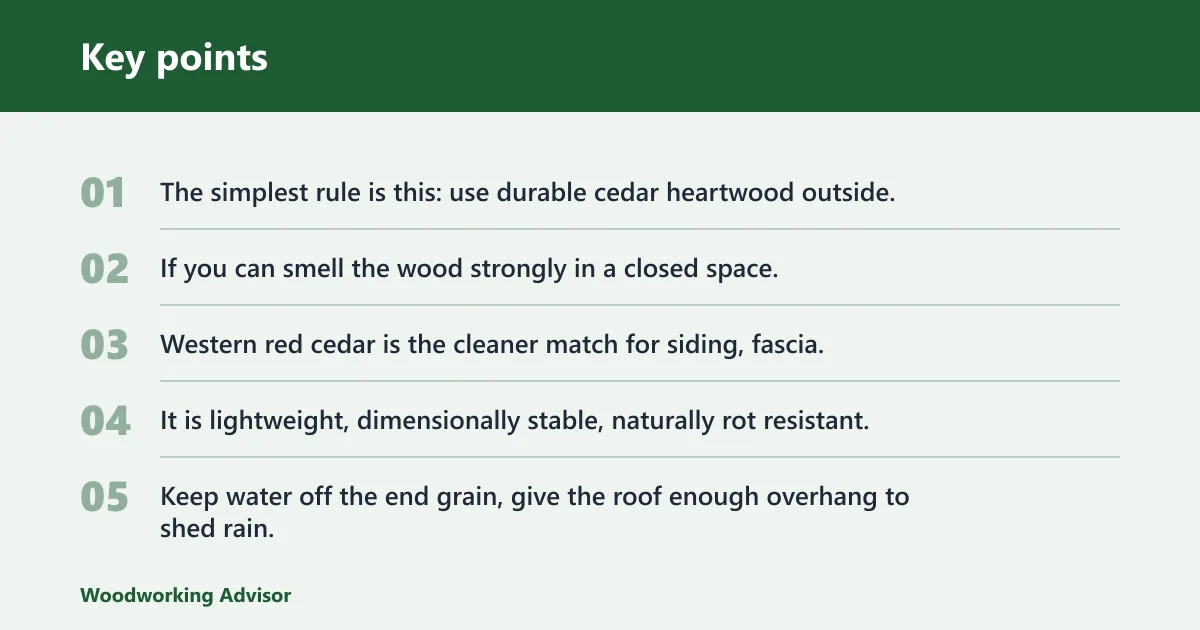
The simplest rule is this: use durable cedar heartwood outside, and do not assume all cedar products are interchangeable inside the coop. If you can smell the wood strongly in a closed space, that is a cue to keep it out of bedding and roost zones.
Western red cedar for siding and trim
Western red cedar is the cleaner match for siding, fascia, and other exposed exterior parts. It is lightweight, dimensionally stable, naturally rot resistant, and usually priced above pine or fir, so it makes the most sense where replacement would be annoying or costly.
Its long outdoor life depends on details. Keep water off the end grain, give the roof enough overhang to shed rain, and recoat exposed surfaces with a low-VOC exterior finish as needed.
Aromatic cedar products to avoid indoors
Keep aromatic cedar products away from nest boxes, bedding, and roost surfaces. Cedar oils can be useful outdoors, but an enclosed interior is a different environment, especially when humidity rises from droppings, litter, and poor airflow.
A common first-timer mistake is buying “cedar” because it sounds coop-friendly, then discovering later that the product was meant for storage or decorative use. Always check whether the stock is intended as lumber, shavings, or a scented interior product.
When cedar shavings are the wrong choice
Cedar shavings are not the same as cedar lumber, and they are not the material to reach for just because a coop needs bedding. Bedding sits in constant contact with birds, and the safer move is to keep aromatic wood products out unless a veterinarian or poultry specialist has given different guidance for a specific case.
If the goal is odor control, ventilation and dry litter management are the first tools to use. Do not solve a moisture problem by adding a strongly aromatic bedding product.
Pine, plywood, OSB, and pressure-treated lumber
Pine or fir is the practical standard for many coops because it balances price and lifespan well. Plywood can work for roofs and walls, OSB is weak in wet conditions, and pressure-treated lumber is best left to exterior framing because of interior safety concerns.
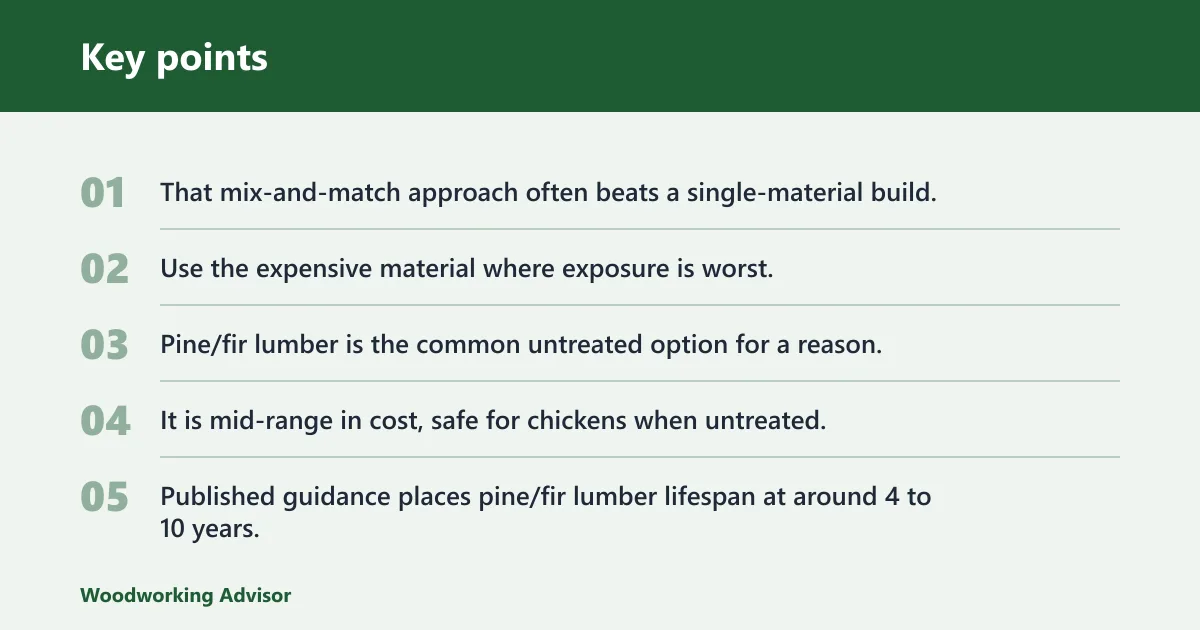
That mix-and-match approach often beats a single-material build. Use the expensive material where exposure is worst, and the cheaper one where the wood stays protected.
Pine and fir as the practical budget standard
Pine/fir lumber is the common untreated option for a reason. It is mid-range in cost, safe for chickens when untreated, and usually good for both frame and siding. Published guidance places pine/fir lumber lifespan at around 4 to 10 years, depending on climate and care.
For a standard backyard coop, that can be the smart buy. If you seal, paint, or stain it, and keep water moving away from the structure, you can get solid service without paying cedar prices.
Plywood for roofs and walls
Plywood is a budget sheet good that can work well for roof and wall sheathing. Its listed lifespan is 3 to 7 years, but edge protection matters a lot because moisture enters fast at cut edges and fastener holes.
Untreated plywood is the version most builders should think about for coop walls and roofs. Pressure-treated sheet goods are a different category and should still be kept away from interior contact zones unless the manufacturer says otherwise for your exact use.
Why OSB fails early in moisture
OSB is the weakest fit for a coop that sees water. It is listed at just 1 to 3 years of lifespan, and when it gets wet, it tends to swell, soften, and become crumbly at edges and seams.
That failure mode matters. Once OSB starts breaking down, it loses fastener grip and can leave rough surfaces that are hard to clean and hard to keep predator-tight. It is not recommended for coop interiors.
Pressure-treated lumber for exterior framing only
Pressure-treated lumber has chemical treatment and a listed lifespan of 5 to 15 years, so it offers real durability. The tradeoff is safety caution inside the coop, where birds can peck, perch, and rub against the wood for long periods.
Use it for exterior framing, sill pieces, or other locations that stay outside the bird-contact zone. Do not use it for roosts, nesting surfaces, or interior trim where chickens spend time daily.
Which one should you buy?
If your budget is tight, start with pine or fir for the frame and use plywood only where sheet goods make sense. That gets you a workable coop without paying for cedar everywhere.
If your coop sits in a wet climate, spend the extra money on western red cedar for the exterior skin, then pair it with good roof overhang, sealed cut edges, and low-VOC finish. The added front-end cost is easier to justify when replacement labor is high.
If you want the longest-lived coop, prioritize cedar on exposed surfaces and keep OSB out of the design. The highest-cost wood in the list is also the highest-lifespan option, but only when the detail work supports it.
If the question is interior surfaces, pine or fir remains the better default. Pressure-treated lumber belongs outside the bird-contact zone, and aromatic cedar products should stay away from bedding, roosts, and enclosed interior panels.
Say your coop is a 4-foot-by-8-foot backyard build in a rainy area with a shallow roof overhang. The smartest split is pine framing, cedar siding on the weather side, plywood on the roof deck, and sealed edges everywhere exposed.
Suppose you are repairing only one warped wall panel after a storm. Replacing that section with western red cedar makes more sense than rebuilding the whole structure in a premium species, because you are targeting the failure point instead of overspending on the entire coop.
Frequently asked questions
Is cedar bedding ok for chickens?
Cedar bedding is a separate question from cedar lumber, and the two should not be mixed up. Aromatic cedar products can be too strong for enclosed coop use, especially when ventilation is poor. Bedding should stay dry, low-dust, and suitable for constant bird contact.
What is the best wood for a chicken coop?
For most chicken coops, pine or fir lumber gives the best balance of cost and durability. If you want a premium exterior skin, western red cedar is a strong upgrade for exposed parts. The best answer depends on budget, climate, and how much weather the wood will take.
Is pressure-treated lumber safe inside a chicken coop?
Pressure-treated lumber is better kept outside the interior contact zone. It has higher durability and a 5 to 15 year lifespan, but its chemical treatment makes it a poor choice for roosts, nest boxes, and other places where chickens spend time and may peck at the surface.
What should I use for chicken coop siding?
For siding, western red cedar is the premium choice, while pine/fir and plywood are the practical budget choices. Plywood should be sealed and protected from edge moisture, and OSB should be avoided in interior or wet locations. Siding choice should always follow ventilation and predator-proof construction.
What is the best material for a chicken coop?
There is no single best material for every coop part. Cedar is best on exposed exterior surfaces, pine or fir is usually best for the frame, plywood can work for roofs and walls, and OSB is a poor fit for moisture. The best coop uses each material where it fails least.
Sponsored / affiliate links. As an Amazon Associate I earn from qualifying purchases. I may earn additional commission from eligible campaigns.