Staining Wood Indoors in Winter: Fumes, Ventilation and Safe Heat
Stain wood indoors in winter only if you can keep air moving from one exterior opening to another and keep ignition sources out of the work area; if that is not possible, use a low-odor, water-based product and delay oil-based stains. Poor airflow traps fumes, slows drying, and raises fire risk around heaters, pilot lights, and rags. This guide covers ventilation setups, safe heat choices, product selection, and cleanup that reduces indoor exposure.
This guide is part of our Cold Weather Wood Finishing: What Works Below 50°F series.
When indoor winter staining is unsafe


Indoor winter staining can be safe in a room that vents directly outdoors, has no ignition source nearby, and lets you leave the space while fumes dissipate. It becomes unsafe when the room is sealed, when air has nowhere to go, or when stain vapors can migrate to a heater, furnace, boiler, water heater, or pilot light.
When the room is too enclosed to use
If the room has no openable exterior window or door, do not stain there with solvent-based products. A single closed room acts like a trap for volatile organic compounds, which can irritate eyes, throat, and lungs and can linger long after the wood feels dry.
Picture a small apartment bedroom with the door shut and one window cracked only a few inches. That is not enough if the stain is oil-based and a nearby closet holds a gas water heater. The fumes have nowhere to go, and the ignition risk stays in the room.
What makes a heat source unsafe
A heat source becomes unsafe when it can ignite vapors or when its operating parts sit in the same air path as stain fumes. Space heaters, furnaces, boilers, water heaters, pilot lights, and any hot element near the work area are all reasons to stop and move the project.
If the room contains a heat source that shares air with the work area, treat it as off-limits until the fumes clear. Do not rely on “it seems far enough away” judgment in a winter room where air tends to stay still.
When you should move the project outdoors or wait
Move the project outdoors, into a detached shop, or to another day when you cannot keep fresh air moving in and exhaust moving out at the same time. If the room cannot be aired out without affecting combustion appliances or the rest of the house, wait rather than forcing the issue.
Winter stain safety checklist
Use this checklist before you open the can. It separates the room, the stain, and the heat source so you can decide quickly whether the setup is workable.
| Check | Safe setup | Stop and change plans |
|---|---|---|
| Room type | Room with an openable exterior window or door and a direct path for air out | Windowless room, sealed room, or room with no way to exhaust fumes outdoors |
| Ventilation | Openings on opposite sides of the room for cross-ventilation | One small cracked opening with no clear exhaust path |
| Stain type | Water-based stain for the lower-odor option | Oil-based stain if the room is poorly vented or has combustion equipment nearby |
| Heat source | No space heater, pilot light, furnace, boiler, or water heater in the fume path | Any ignition source in the same room or adjacent space that can draw fumes |
| PPE | Organic vapor respirator, nitrile gloves, and eye protection | Dust mask only, bare hands, or no eye protection |
| Cleanup | Rags placed in a sealed metal container filled with water | Oil-soaked rags left in a pile, trash can, or laundry basket |
Room type and ventilation setup
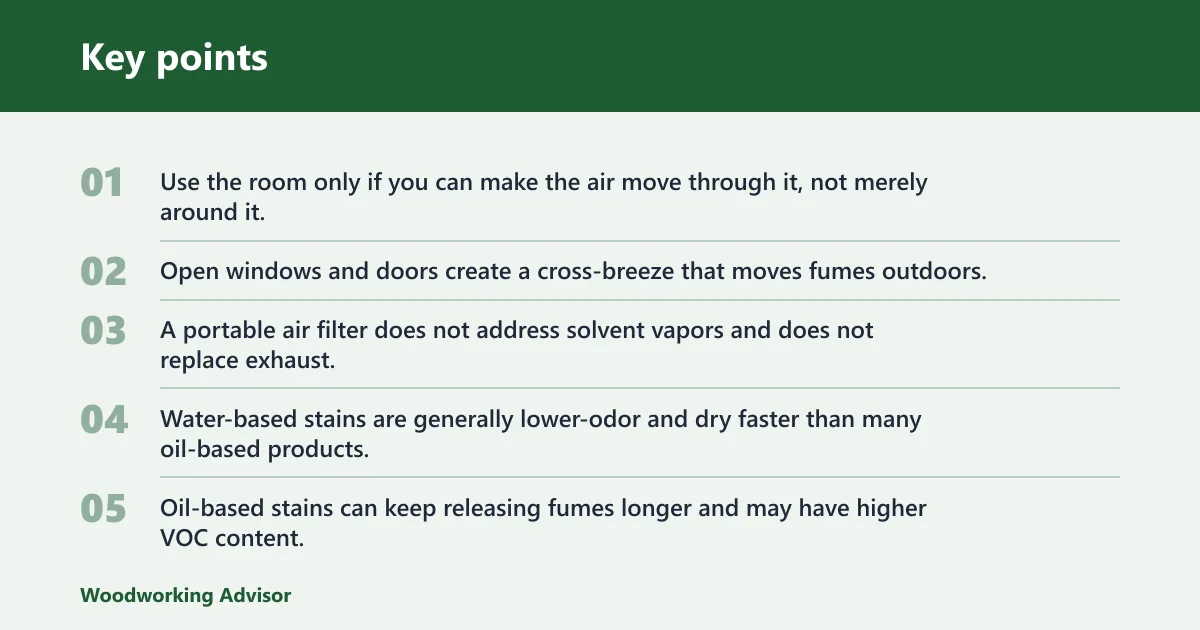
Use the room only if you can make the air move through it, not merely around it. Open windows and doors create a cross-breeze that moves fumes outdoors. A portable air filter does not address solvent vapors and does not replace exhaust.
Stain type and heat source check
Water-based stains are generally lower-odor and dry faster than many oil-based products, but exact VOC content and drying time vary widely by product. Oil-based stains can keep releasing fumes longer and may have higher VOC content. The higher-fume option needs more caution, more time, and a stricter room check.
Go/no-go decision table
| Room type | Stain type | Heat source | Ventilation setup | Decision |
|---|---|---|---|---|
| Small room with two operable exterior openings | Water-based | No ignition source nearby | Cross-ventilation with exhaust to outdoors | Go, with monitoring |
| Small room with two operable exterior openings | Oil-based | No ignition source nearby | Cross-ventilation plus respirator and rags controlled immediately | Go only if you can stay out until odor drops |
| Basement with one exterior window | Water-based | Gas furnace or water heater present | Single opening only, no direct exhaust path | No-go |
| Attached garage | Oil-based | Pilot light or heater in the space | Garage door partly open but no separate exhaust | No-go |
| Detached garage | Water-based | No combustion appliance | Open door and opposite opening to move air out | Go, if temperature matches label guidance |
| Apartment spare room | Oil-based | Radiator, furnace return, or nearby appliance | Window cracked with no outbound airflow | No-go |
How do I ventilate a room while staining wood?
Use cross-ventilation when you can: one opening pulls fresh air in, another sends fumes outdoors. The goal is to move vapor out of the room, not to leave it hanging in place. If you only have one opening, that room is usually a poor choice for solvent-based stain.
Use cross-ventilation when you can
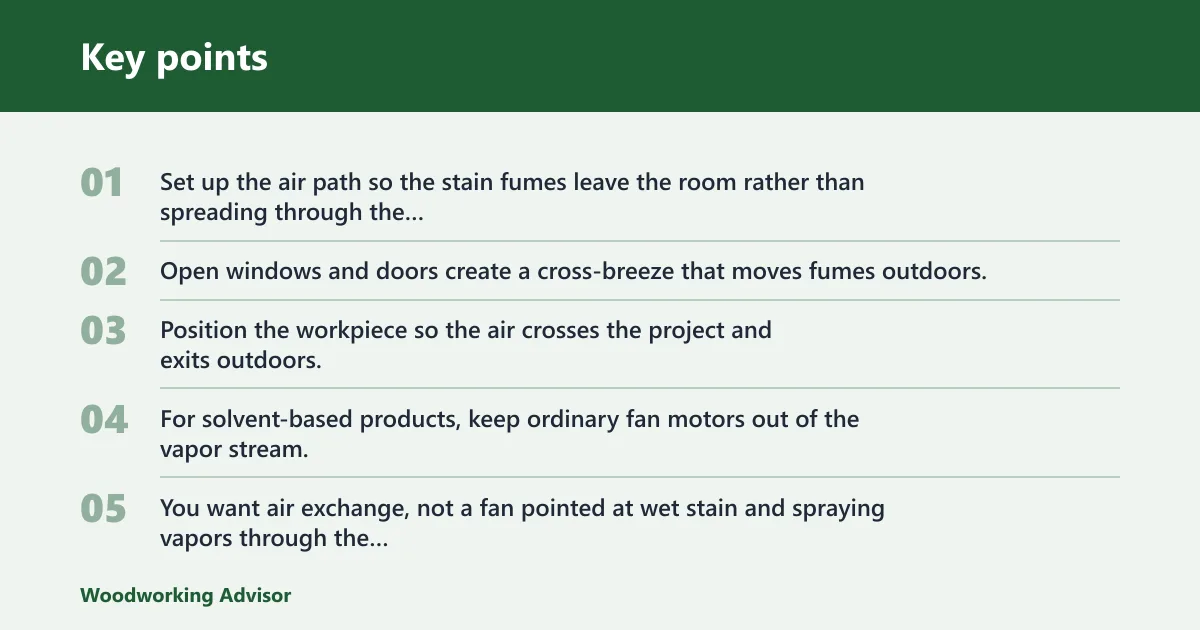
Set up the air path so the stain fumes leave the room rather than spreading through the house. Open windows and doors create a cross-breeze that moves fumes outdoors. Position the workpiece so the air crosses the project and exits outdoors, not toward the hallway or stairwell.
For solvent-based products, keep ordinary fan motors out of the vapor stream. The safe idea is direction, not turbulence. You want air exchange, not a fan pointed at wet stain and spraying vapors through the room.
What to do with only one exterior opening
If only one exterior opening exists, use that setup only for the lowest-fume project you can manage, and keep the room time as short as possible. A single cracked window without an exhaust path is weak ventilation, not true cross-ventilation.
In that situation, a room may be suitable for a very small water-based touch-up if the label supports indoor use and no heat source is present. It is a poor choice for oil-based stain because the odor and vapor release window is longer.
How to keep fumes away from the rest of the house
Close interior doors that lead to occupied areas, but do not block the outdoor air path. If the house has forced-air HVAC, keep the room from sending fumes into returns or shared duct paths. The safest move is to isolate the room from household airflow while still exhausting outdoors.
Suppose a hallway leads from the stain room to a family room with a gas fireplace. Even with a window open, the project should stop if vapor can drift into the hall. Venting that reaches the living area defeats the point.
What respirator and gloves do you need?
Use an organic vapor respirator with cartridges approved for the product you are using, according to the product label or SDS, not a dust mask, when stain fumes are present. Add nitrile gloves and eye protection. A dust mask can catch dust, but it is not sufficient for chemical vapors, and latex can break down with solvent exposure.
Organic vapor cartridges, not dust masks
An organic vapor respirator is the correct respirator type for stain fumes. It uses activated charcoal or organic vapor cartridges to reduce inhalation exposure. Fit matters. If the seal leaks around the face, the respirator cannot do its job.
Why nitrile beats latex for stain work
Nitrile gloves are recommended because latex can degrade with solvents. Nitrile also gives you a better barrier for wiping, brushing, and rag handling during stain work. Keep a spare pair nearby so you do not keep using gloves that have softened or torn.
Eye protection and skin cleanup
Use eye protection when wiping or pouring stain, especially indoors where splashes can linger on nearby surfaces. If stain gets on skin, clean it promptly according to the product label. Do not use solvent wipes as a substitute for gloves during the job.
Are water-based stains safer indoors than oil-based stains?
Water-based stains are usually the better indoor choice because they have lower odor, often lower VOC content, and faster dry times than many oil-based products. They still need ventilation, but they reduce the length and intensity of the fume problem. Oil-based stain needs more room control.
Lower-odor indoor choices
Water-based stains often dry faster than many oil-based products, and clean up with soap and water where the label allows it. That faster drying window helps when you are managing winter heat, short ventilation windows, and a room that must return to use the same day.
Where oil-based stain still needs extra caution
Oil-based stain can be useful when you need a particular color or working time, but it carries a longer odor release period and added fire risk from solvent-soaked rags. If you choose it indoors, the room needs stronger ventilation and a stricter no-ignition zone.
What the label tells you about drying and ventilation
Do not use a single universal temperature target. Product labels vary, and the label is the first source for application range, dry-to-touch time, recoat time, and cure guidance. Ventilation should continue until the solvent smell drops, and full cure can take days.
Can I use a space heater while staining wood indoors?
A space heater can be unsafe around stain fumes because many common units have hot elements, switching components, or surfaces that should not be near solvent vapors. If the room needs heat, use a safer room or wait for warmer conditions rather than trying to heat through the fumes.
Space heaters and hot elements
Do not place a space heater in the stain room if the product gives off flammable vapors. Even a small heater can create ignition risk in a poorly vented room. The same caution applies to any device that heats air, glows, or cycles on and off near the work.
Pilot lights, furnaces, boilers, and water heaters
Keep stain fumes away from pilot lights, furnaces, boilers, and water heaters. These are common winter ignition sources, especially in basements, utility rooms, and attached garages. If any of them share air with the staining area, stop and choose a different location.
HVAC and combustion safety checks
Check where air returns, combustion appliances, and ducts sit before you open the stain can. If the room can feed vapors into another part of the house or into an appliance intake, the setup is wrong. Isolation matters more than comfort during the staining step.
What should I do with stain-soaked rags?
Oil-soaked rags can ignite on their own if they are left in a pile. Put them in a sealed metal container filled with water, then dispose of them according to local waste rules. Never leave solvent-soaked rags near heat, sparks, or sun.
Why oil-soaked rags can ignite
Some oil-based stains can generate heat as they cure, and a crumpled rag traps that heat. That can lead to fire even after the staining is finished. The risk is highest when rags are stacked, bunched, or left in a trash can indoors. (Consumerreports)
Safer temporary storage before disposal
Use a sealed metal container filled with water for oil-soaked rags until they can be taken out. Keep the container away from the work area and away from children, pets, and any appliance. For water-based stain, follow the label, but do not assume rag safety without reading it.
Staining wood indoors checklist
- Stop applying stain before the room becomes stagnant.
- Move used rags immediately into a sealed metal container filled with water if the stain is oil-based.
- Wipe drips from tools, trim, and the floor while they are still manageable.
- Keep doors open to the exterior path until the odor drops.
- Do not restart HVAC that could pull fumes into occupied rooms.
- Remove gloves carefully and wash hands after cleanup.
- Leave the room ventilated until the product no longer gives off a strong odor.
Can I stain wood in a basement or garage in winter?
Yes, but only if the space has outdoor air exchange and no combustion appliance or heater in the vapor path. A detached garage with open airflow is easier to manage than an attached garage or basement with a furnace, boiler, or water heater nearby.
Basements
Basements are often risky because they commonly contain utility equipment and limited natural air movement. If the only exterior opening is small and a furnace or water heater sits nearby, do not use oil-based stain there. Even water-based stain needs a real exhaust path.
Garages
Detached garages can work better than basements because they usually open directly outdoors. Attached garages need more caution because fumes can migrate toward living space. If the garage has a pilot light, heater, or shared wall to the house, treat it as a no-go for solvent-heavy work.
Winter dryness and humidity
Winter air is often dry indoors, which can speed surface drying but also make odor seem sharper and linger in the room fabric. Higher humidity can slow drying and may extend the time fumes remain noticeable. Let the product label and the room conditions guide the wait, not the clock alone.
Frequently asked questions
Is it safe to stain wood indoors in winter?
It can be safe if you can keep the room ventilated from one exterior opening to another, use the right respirator, and keep ignition sources away. If the room is sealed, has poor air exchange, or contains a heater or pilot light, choose another space or wait.
What kind of mask do I need for wood stain fumes?
Use an organic vapor respirator with activated charcoal cartridges. A dust mask is not enough for chemical vapors. Make sure the respirator fits tightly to your face, because a poor seal lets fumes bypass the filter and reach your lungs.
Sponsored / affiliate links. As an Amazon Associate I earn from qualifying purchases. I may earn additional commission from eligible campaigns.