Big Leaf Maple: Properties and Best Woodworking Uses
Bigleaf maple is a strong fit for furniture, cabinets, veneers, turnings, and interior trim when you match board figure and moisture content to the job. Use clear, straight stock for stable casework, figured or curly stock for visible surfaces, and properly dried lumber near 6% to 8% MC for interior use. Choose badly, and you invite movement, tear-out, poor glue joints, and costly replacement. This guide compares board types, explains how moisture changes machining and stability, and maps each grade to the best woodworking uses.
What bigleaf maple

Bigleaf maple, Acer macrophyllum, is also called Oregon maple. It is a North American hardwood native to the Pacific coast, and that range matters because supply often tracks regional milling and appearance-grade sorting. The tree can reach 36 metres in height on good sites, but the lumber buyer is usually looking at board character, not tree size. (NPS)
Use it where clean appearance matters more than maximum wear resistance. Bigleaf maple is commonly used for higher-value flooring, cabinetry, and furniture, and it also appears in veneers, musical instruments, turnings, and interior millwork. It is attractive and common enough to be practical, yet it is not the same wear-resistant choice as hard maple.
What the lumber yard often shows you
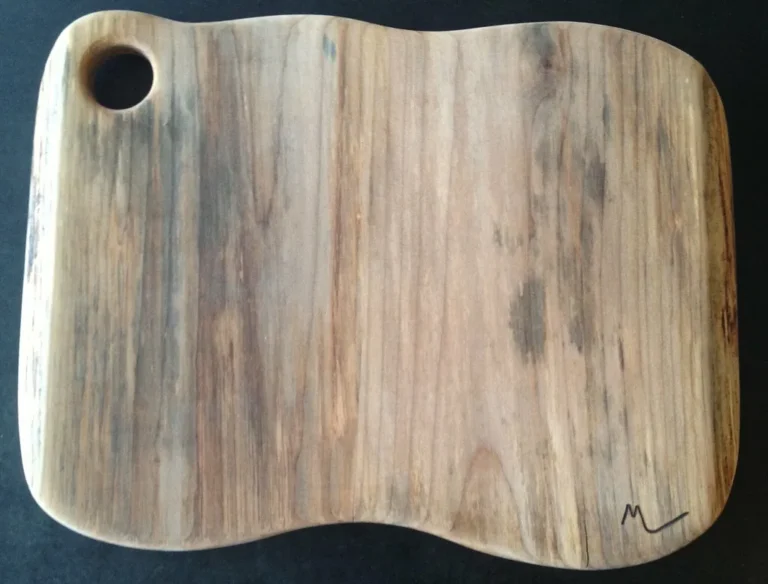
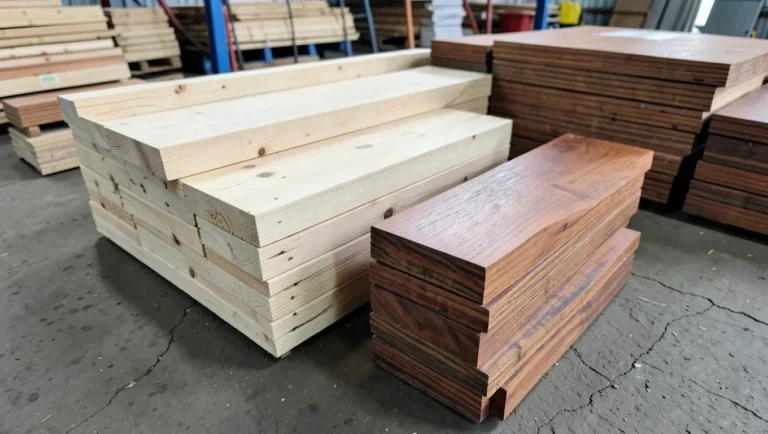
In the lumber yard, bigleaf maple usually appears as light reddish-brown wood with little contrast between heartwood and sapwood. Straight-grain boards are often sold for utility work, while boards with curl, quilt, or wave are pulled for visible parts, veneers, and instruments. The figured stock is the same species, but it behaves differently under a plane and under finish.
That difference is the first buying decision. A cabinet side, drawer part, or shelf can often use straight, moderately plain stock. A guitar top, panel, or decorative lid benefits from figured stock if you can handle the extra machining and finishing care it demands.
Bigleaf maple properties

Bigleaf maple is moderately heavy, hard, and of medium strength. A common Janka figure listed for it is 850 lbf, and some guides place it around 900 to 1,000 lbf. That puts it on the softer side of maple species, especially when you compare it with hard maple for dent resistance and edge wear.
The wood has a specific gravity of 0.47 at 12% moisture content, and it shrinks 4.1% radially and 7.6% tangentially. Those numbers do not make it unstable by themselves, but they do explain why wide flatsawn parts can move enough to matter in furniture panels, door parts, and long shelves.
How to read the hardness number
The Janka number is a dent-resistance measure, not a full durability score. Bigleaf maple’s 850 lbf rating means it can handle ordinary furniture use well, but it is not the best pick for surfaces that need serious abrasion resistance. For tabletops, desks, and cabinet faces, it is still a sound choice if the design is indoors and the finish is protected.
Density, movement, and indoor limits
The species dries without difficulty, but rather slowly. That matters because drying quality affects checking and warping, especially on thicker stock and on boards with mixed grain direction. Its movement is moderate, so indoor furniture is the right setting, while harsh outdoor exposure is the wrong one.
For wide panels, movement is not a side note. A flatsawn 24-inch panel is listed by TheWoodworkingBench as moving roughly 0.36 inch across a typical seasonal humidity swing. That is enough to affect frame-and-panel design, slot sizes, and how you glue or pin trim to a larger assembly.
How figure changes the wood
Bigleaf maple ranges from plain straight grain to highly figured stock with curl, quilt, and wave. Straight boards are the safest choice for case parts and other dimensionally sensitive work. Figured boards belong in visible, lower-stress parts where the grain pattern is the point of the piece.
Quilted figure
Quilted figure shows broad, irregular waves and rounded patterns. It is highly decorative and is commonly used in guitar tops and veneers. The same visual depth that makes quilt attractive can make planing less forgiving, because the grain direction changes across short distances and can lift under a cutter.
Flame and curly figure
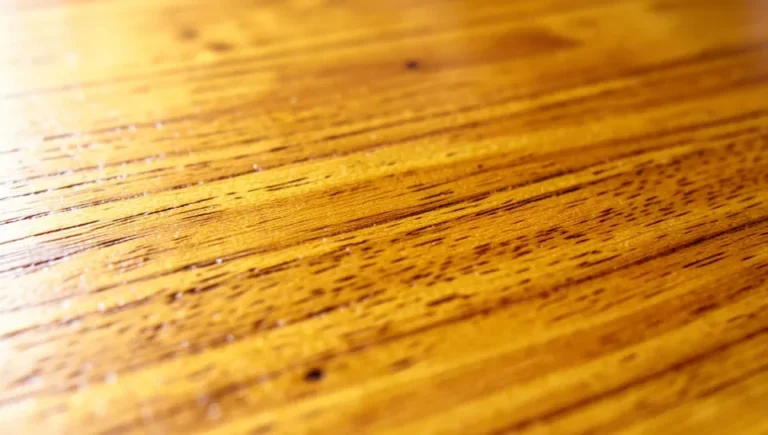
Flame or curly figure creates ribbon-like stripes or a tiger-stripe appearance that shifts with viewing angle. It is prized in decorative tops, neck components, and veneer work because the surface changes as light moves across it. That visual movement is the point, but it also means you need sharper tooling and lighter cuts.
Suppose you have two 3/4-inch boards from the same stack. One is plain, straight-grained maple for cabinet sides. The other has tight curl across its face. The first board is the better candidate for a shelf or carcase side; the second is the one to save for a display panel, a drawer front, or a small decorative lid.
Is Bigleaf Maple harder than hard maple?
No. Bigleaf maple is generally lighter and less hard than hard maple, so it does not give the same dent resistance or wear margin. If your project depends on a very hard service surface, hard maple usually has the edge. Bigleaf maple still works well for furniture, cabinetry, and decorative parts that do not take heavy abrasion.
That softer character can still be useful. It accepts sharp cutters well, glues without fuss, sands to a smooth surface, and takes a good finish. For drawer fronts, case parts, panels, and many interior millwork jobs, the balance of workability and appearance can be a better fit than harder stock.
Where the softer side still fits
Bigleaf maple is a good choice when the project values figure, color control, and clean machining more than maximum dent resistance. It is especially useful for interior furniture, veneered panels, musical parts, and shaped components. If the part will be handled often but not abused, the species is usually strong enough.
Workability and tear-out
Bigleaf maple is relatively easy to work, and it machines cleanly with sharp cutters. The trouble begins with figured boards, where curly or quilted grain can tear out during planing. That risk is manageable, but only if you slow down, keep cutters keen, and change technique when the grain starts to chatter.
How to avoid tear-out on figured stock
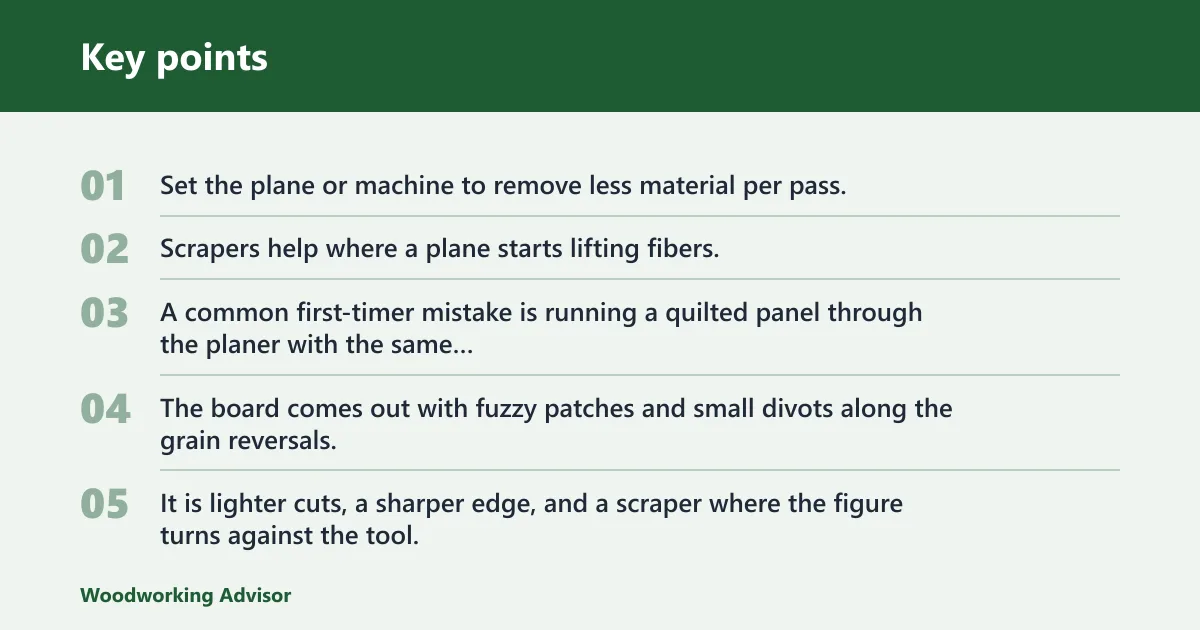
Use light cuts. Set the plane or machine to remove less material per pass, and do not chase a perfect surface in one pass on curly stock. Scrapers help where a plane starts lifting fibers, and finish sanding is often the safest way to clean up the last trace of tear-out on highly figured sections.
A common first-timer mistake is running a quilted panel through the planer with the same setup used on straight stock. The board comes out with fuzzy patches and small divots along the grain reversals. The fix is not more pressure. It is lighter cuts, a sharper edge, and a scraper where the figure turns against the tool.
Glue, sanding, and fasteners
The wood glues easily and sands well, which makes it a practical species for casework and fine joinery. Nailing and screwing are generally straightforward, but pilot holes are still sensible near edges and in smaller parts. Use clean tooling and sharp points, because a bruised edge is more likely on a softer maple than on a harder one.
Moisture and movement control
For many interior furniture uses, a moisture content target near 6% to 8% MC is a sound goal. Acclimation before installation reduces movement, and drying quality affects checking and warping. Bigleaf maple is not a species you want to install green or partially dried and then hope it settles quietly.
Quartersawn versus flatsawn
Quartersawn stock is generally more stable than flatsawn stock, especially for wider parts. That matters in doors, wide rails, and panels that need a flatter seasonal response. Flatsawn stock can be fine, but it asks for more attention to panel width, joinery clearance, and the direction of grain across the assembly.
- Check the board’s moisture content before milling, especially for interior furniture.
- Let the lumber acclimate in the shop before final sizing and joinery.
- Choose quartersawn stock for parts where flatness matters most.
- Limit wide flatsawn parts unless the design allows for seasonal change.
- Leave room in joinery for movement in panels, doors, and long shelves.
Bigleaf maple for furniture and cabinets
Bigleaf maple is well suited to furniture, cabinetry, and interior millwork when you choose the right board type. Straight stock works well for carcases, rails, stiles, drawer sides, and shelves. Figured boards make better face frames, drawer fronts, door panels, and accent parts that will be seen more than stressed.
Best uses by part type
Use clear, straight stock for carcass sides, case bottoms, shelf cleats, and hidden framing. Use figure for visible doors, end panels, tabletops with controlled movement, and decorative trims. For wide cabinet doors, quartersawn material is usually the safer choice because it helps limit seasonal gap risk and face distortion.
When another maple makes more sense
If the part is likely to be pounded, dragged, or heavily worn, hard maple may be the safer material. Bigleaf maple is a stronger pick when the goal is appearance, moderate use, and good machining. It can be overkill for hidden parts and underkill for high-abuse work surfaces.
For a roughly 30-inch-wide cabinet door, a quartersawn or carefully matched board set is often more reliable through seasonal swings. A flat panel of highly figured maple would be visually striking, but a quartersawn or carefully matched board set will be more reliable over seasonal swings. That choice lowers the chance of a sticky door in summer and gapped joints in winter.
How do you finish figured Bigleaf Maple without tear-out?
Start with surface control, not color. Bigleaf maple can blotch like other maples, so a sealer or washcoat helps even out uptake. Clear or lightly tinted finishes usually preserve the wood’s light reddish-brown color best, and test boards are worth making before full application.
Sealer and washcoat strategy
A thin sealer reduces blotching by slowing uneven absorption, especially on end grain and mixed-density figure. That is helpful on curly and quilted stock, where one pass of stain can go dark in one band and pale in the next. Use the lightest effective prep, then build color in controlled layers if the design calls for tint.
Clear versus tinted topcoats
Clear finishes keep the figure readable and avoid muddying the color. Light tint can warm the tone without burying the grain pattern, but heavy staining often exaggerates blotch on maple. If the board is especially figured, a test panel should tell you more than a guess about how the final coat will read.
A practical finishing workflow
Start with sanding that follows the grain as much as the board allows, then stop before you overwork a figured section. Apply a sealer or washcoat, let it set, and inspect for uneven uptake. If the board still looks patchy, adjust the stain strength or move to a clearer finish instead of forcing color into the grain.
Bigleaf maple decision table
This table matches board type to project type and shows where the species is safest. Use it to separate utility stock from appearance-grade stock before you commit to a cut list or finish schedule.
| Board type | Best project type | Grain figure | Tear-out risk | Finishing risk | Movement sensitivity | Recommended tooling or finish approach |
|---|---|---|---|---|---|---|
| Straight, clear flatsawn | Cabinet sides, shelves, casework, trim | Low | Low | Moderate blotch risk | Moderate | Sharp cutters, standard sanding, sealer before clear topcoat |
| Quartersawn straight-grain | Doors, rails, stiles, wide furniture parts | Low to moderate | Low | Moderate blotch risk | Lower than flatsawn | Preferred for stable joinery; clear or lightly tinted finish with test board |
| Curly or flame figured | Drawer fronts, tops, neck components, veneers | High | High | Moderate to high | Moderate | Light cuts, scraper cleanup, sanding with the grain, seal before color |
| Quilted figured | Decorative panels, guitar tops, veneer work | Very high | High | High | Moderate | Use the sharpest cutters available, scrape where needed, test finish on offcuts |
| Mixed figure utility stock | Interior millwork, hidden structural parts | Variable | Moderate | Moderate | Moderate | Sort boards by grain direction before milling; keep the finish simple and even |
Frequently asked questions
What is Bigleaf Maple wood good for?
Bigleaf maple is good for furniture, cabinetry, veneers, turnings, musical instruments, and interior millwork. Straight-grain boards suit casework and shelves. Figured boards are better reserved for visible parts such as tops, drawer fronts, panels, and decorative accents where grain movement is part of the design.
Does Bigleaf Maple blotch when stained?
Yes, it can blotch like other maples. The risk is higher on uneven or figured grain, where stain uptake varies across the board. A sealer or washcoat helps control absorption, and a test board is the safest way to check whether a clear, lightly tinted, or toned finish will read evenly.
Is Bigleaf Maple stable enough for furniture?
Yes, for indoor furniture it usually is, provided the lumber is properly dried and acclimated. A common target is 6% to 8% MC for interior work. Use quartersawn stock for wider parts when possible, and design joints so panels and doors can move with the seasons.
What does Bigleaf Maple look like in the lumber yard?
It usually shows as light reddish-brown wood with little contrast between heartwood and sapwood. Plain stock looks calm and even. Figured boards stand out quickly because the surface shows curl, flame, quilt, or wave, often with a shifting look as the board is moved under light.
Sponsored / affiliate links. As an Amazon Associate I earn from qualifying purchases. I may earn additional commission from eligible campaigns.