Best Deck Cleaners for Wood (2026): Based on Specs and Reviews
For most wood decks, the best cleaner is a low-alkaline, oxygen-bleach deck cleaner; use a wood brightener only after heavy stripping or weathering, and avoid strong sodium-hypochlorite blends on softwoods or fuzzy wood. The wrong cleaner can etch fibers, raise grain, strip finish unevenly, or leave stain that hides future coating failure. This guide sorts cleaners by wood type, deck condition, and stain problem, then compares formulas so you choose the right product.
For most wood decks, a low-alkaline oxygen-bleach deck cleaner is often a good choice; a wood brightener is commonly used only after heavy stripping or weathering, and stronger sodium hypochlorite blends are often avoided on softwoods or fuzzy wood. The wrong cleaner can etch fibers, raise grain, strip finish unevenly, or leave stain that hides future coating failure. This guide sorts cleaners by wood species, deck condition, and stain problem, then compares formulas so you choose the right product.
Quick comparison
| Product | Badge | Best for | Price | ||
|---|---|---|---|---|---|
 |
Simple Green Oxy Solve Deck and Fence Pressure WasherSimple Green | Our pick | 128 fl oz concentrate · pressure washer | $23.99
Price as of 27 Oct 2026
|
View |
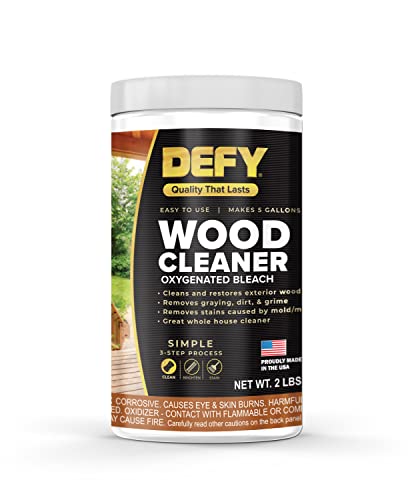 |
DEFY 2 LB Wood Deck Cleaner Powdered Concentrate – ForDEFY | Also great | 2 lb concentrate · wood cleaner | $28.87
Price as of 27 Oct 2026
|
View |
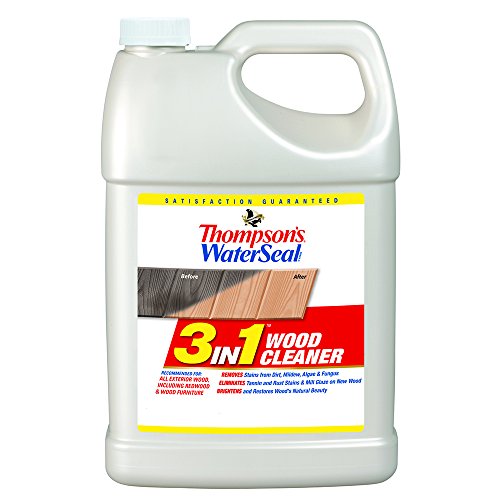 |
Thompson’s WaterSeal 3-in-1 Wood Deck Cleaner, 1 GallonThompson’s | Also great | $129.99
Price as of 27 Oct 2026
|
View |
For most homeowners, the main choice is between an oxygenated cleaner that removes grime and gray wood without harsh fiber damage, or a bleach-based cleaner that can whiten faster but carries more risk on softwoods and weathered fibers. The table below keeps the decision tied to deck condition, because wood species and finish history matter more than brand name.
How we chose
Wood compatibility came first. A cleaner that is acceptable on pressure-treated pine may be a poor fit for cedar, redwood, or ipe.
Stain type came next. Dirt, mold, gray weathering, and old finish residue do not all need the same chemistry.
Application method also counted. A concentrate that works with a pump sprayer, a stiff bristle brush, and a rinse is easier to control than a harsh formula that demands heavy scrubbing.
Cost per mixed gallon mattered too. Published coverage and mixed cost let you estimate real job cost before you buy.
Restore-A-Deck Wood Cleaner: best for most wood decks
Based on the manufacturer’s specs and buyer feedback, Restore-A-Deck Wood Cleaner is the safest broad pick for most wood decks because it is a powdered concentrate that mixes into a cleaning solution for weathered wood, mold, mildew, algae, and UV graying. It also gives you a practical coverage figure: 750-1000 sq. feet per container, with a mixed cost described as under $7 a gallon.
It stands out for deck prep. Armstrong Clark lists it as Step 1 of the Restore-A-Deck system, and the product is positioned to clean and open the wood pores before staining. That makes it a strong fit when the goal is prep, not stripping old finish.
The drawback is simple. A cleaner with this profile can help with surface grime and gray wood, but it will not remove a sound old coating the way a stripper does. If the deck still has failing film finish, cleaning alone is not enough.
Simple Green Oxy Solve Deck and Fence pressure washer cleaner: best for pressure-washer cleanup
Simple Green Oxy Solve is commonly described as a peroxide-based, oxygenated cleaner sold as a 128 fl oz concentrate for pressure washer use. It fits homeowners who want a cleaner aimed at grime, oils, grease, and stains without jumping straight to a sodium hypochlorite blend.
Its main strength is convenience for large rinse-down jobs. The product is built for decks, fences, and other outdoor surfaces, so it fits routine cleanup when the wood is not heavily coated or painted.
The limitation is that pressure-washer formats can tempt users to rely on the machine instead of the chemistry. On softwood or fuzzy grain, the washer must stay in the rinse role, not the stripping role.
Thompson’s WaterSeal 3-in-1 Wood Deck Cleaner: best for all-in-one convenience
Thompson’s WaterSeal 3-in-1 Wood Deck Cleaner is aimed at buyers who want one product for cleaning and prep. It is priced as a 1 gallon cleaner and is positioned as an easier grab-and-go option than a powder that must be mixed first.
The upside is simplicity. A ready-to-use style product can be easier for smaller decks or for homeowners who want a straightforward cleaning step before sealing.
The drawback is cost. At the listed price of $129.99, it is much harder to justify on a large deck than a powdered concentrate with published coverage and lower mixed cost.
What cleaner matches your deck condition?
The best deck cleaner for wood depends on both species and surface condition. Pressure-treated pine, cedar, redwood, ipe, painted boards, old gray boards, and mold-heavy decks need different levels of cleaning power, and some need a brightener after the wash.
Pressure-treated pine
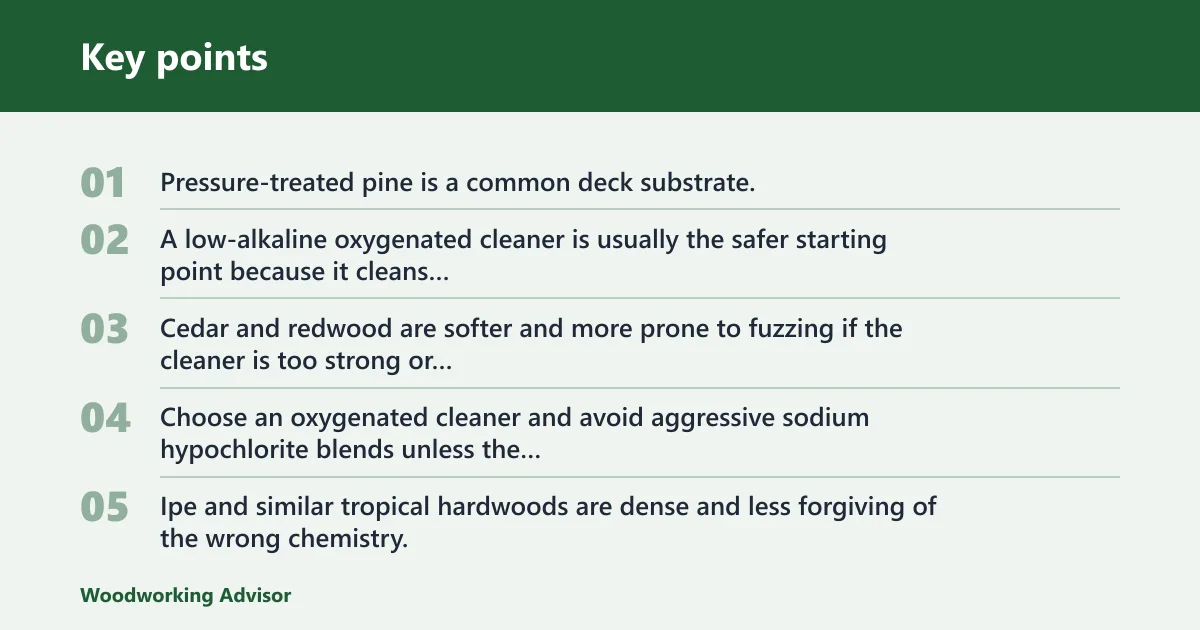
Pressure-treated pine is a common deck substrate, and many cleaner labels treat it as a standard use case. A low-alkaline oxygenated cleaner is usually the safer starting point because it cleans without being as aggressive as bleach-based formulas.
Cedar and redwood
Cedar and redwood are softer and more prone to fuzzing if the cleaner is too strong or the rinse is too hard. Choose an oxygenated cleaner and avoid aggressive sodium hypochlorite blends unless the label specifically approves that wood type and the stain problem truly calls for it.
Ipe and other tropical hardwoods
Ipe and similar tropical hardwoods are dense and less forgiving of the wrong chemistry. Many cleaner makers and competitors call out these woods separately, which is a clue that one-size-fits-all advice is weak here; use a product that explicitly lists tropical hardwoods or ipe, and keep the rinse gentle.
Painted and stained wood
Painted or film-stained wood often needs more than cleaning if the coating is failing. If the finish is intact and the issue is surface dirt, a cleaner may be enough. If the coating is peeling, a cleaner will not replace stripping.
Old gray wood
Old gray wood usually needs an oxygenated cleaner first, then a wood brightener if the cleaner was alkaline or the wood still looks flat and weathered. Gray color from UV exposure is not the same as embedded stain, so the fix should match the cause.
Mold-heavy decks
Mold-heavy decks need a product that targets biological growth on wood surfaces, not just dirt. An oxygenated deck cleaner with sodium percarbonate is often the better first pass because it is built to remove mold and mildew staining while being less harsh than bleach-based alternatives.
Restore-A-Deck Wood Cleaner: best for most wood decks
The best use case for this cleaner is a weathered wood deck that needs cleaning before sealing or staining. It fits pressure-treated wood, cedar, redwood, and other common deck types when the goal is to remove gray oxidation, mildew staining, and surface grime without overcutting the fibers.
Its powdered concentrate format also helps on cost. One container makes 5 liquid gallons, and the published coverage of 750-1000 sq. feet lets you estimate cost by area instead of guessing. That is useful on larger decks where a few dollars per gallon mixed changes the whole job budget.
The weakness is that it is still a cleaner, not a finish remover. If old sealer remains in patches, the result can look uneven because the product is doing cleanup, not stripping.
Bleach-based deck cleaner: best for whitening, with caution
Bleach-based cleaners use sodium hypochlorite and can whiten wood quickly. They can help when the main goal is a brighter look and biological staining is heavy, but they are more likely than oxygenated cleaners to damage lignin in the wood fibers, especially on softwoods and weathered surfaces.
When sodium hypochlorite can help
A bleach-based cleaner can make sense when mold or mildew is widespread and the deck is already in rough shape. It may also help when a homeowner wants a stronger whitening effect than a standard oxygenated cleaner can deliver in one pass.
Why it can damage wood fibers
The risk is not subtle. Strong bleach solutions can attack lignin, the part of the wood structure that helps hold fibers together, which can leave the surface rougher and more vulnerable to fuzzing. That risk is higher on cedar, redwood, and other softwoods.
How it compares with oxygenated cleaners
Oxygenated cleaners use sodium percarbonate and are the top choice for most decks because they clean grime and biological staining with less chance of fiber damage. Bleach-based cleaners can look stronger on paper, but stronger is not the same as better for the wood.
What cleaner matches your deck condition?

The decision is easier when you pair the cleaner with the exact condition, not just the wood species. A deck with mildew, an old coat, or a thin gray film each needs a different level of chemical force.
Cedar and redwood: for cedar and redwood, avoid
For cedar and redwood, avoid heavy-handed bleach mixes and avoid hard scrubbing that lifts fibers. A pump sprayer, light agitation with a stiff bristle brush, and a careful rinse are usually enough when the problem is surface dirt or mildew.
Do you need a pressure washer to clean a wood deck?
No. A pressure washer is a rinsing tool, not a stripping tool, and many decks can be cleaned with a pump sprayer, a brush, and a hose rinse. If you do use one, the low-pressure guidance is below 1,500 PSI, because more pressure raises the risk of gouging, fuzzing, and uneven grain.
Low PSI guidance below 1,500
Keep the nozzle moving and the fan wide. The goal is to remove loosened soil and cleaner residue, not to carve into softwood fibers or drive water deep into checks and cracks.
Use it to rinse, not strip
A pressure washer can make the final rinse faster, but it should not be the main removal method for old finish. If a coating is failing, the right fix is a stripper or a full refinish plan, not more pressure.
When a pump sprayer and brush are enough
For routine cleaning, a pump sprayer and stiff bristle brush are often enough. They give you control over dwell time and scrubbing force, which matters more than raw spray power on cedar, redwood, and other softwoods.
Should you brighten wood after cleaning?
Yes, when the cleaner is alkaline or the deck still looks dull after washing. A wood brightener neutralizes pH after cleaning and helps restore wood color, especially after stronger cleaners or after heavy weathering has left the surface flat and gray.
When an alkaline cleaner needs a brightener
If the cleaner leaves the wood looking slightly dark, blotchy, or chalky, a brightener is often the next step. That is common after alkaline cleaning because the wood surface can stay out of balance even when it is technically clean.
What pH neutralizing does
pH neutralizing helps reset the surface before staining or sealing. It also helps the wood read more naturally, which matters when the deck needs a stain that depends on even color and absorption.
When brightener is optional
Brightener is optional after a mild oxygenated cleaner if the wood already looks even and the stain is not blotchy. If the goal is only to remove surface dirt before a later coating, you may not need the extra step.
Wood cleaner decision table
This table puts the choice where it belongs: by deck condition first, then wood species, then chemistry. It also shows what to avoid so you do not over-clean softwood, under-clean mold, or pick a product that cannot handle the stain problem.
| Deck condition | Wood species | Recommended cleaner type | What to avoid |
|---|---|---|---|
| Routine dirt, light graying | Pressure-treated pine | Oxygenated deck cleaner with sodium percarbonate | Strong sodium hypochlorite mix; heavy pressure washing |
| Weathered surface, light mildew | Cedar / redwood | Mild oxygenated cleaner; follow with brightener if needed | Bleach-based cleaner; stiff blasting with a pressure washer |
| Dense hardwood with embedded grime | Ipe / tropical hardwood | Cleaner labeled for tropical hardwoods or ipe | Generic harsh deck wash; aggressive scrubbing |
| Peeling film, old coating failure | Painted wood | Stripper, then cleaner, then brightener if directed | Using cleaner alone as a stripping substitute |
| Gray oxidation, no peeling finish | Stained wood | Oxygenated cleaner; brightener after alkaline cleaning | Assuming whitening equals finish removal |
| Heavy UV gray, no live coating left | Pressure-treated pine | Powdered oxygenated cleaner, then brightener | Skipping neutralization before staining |
| Black or green biological staining | Any wood deck | Oxygenated mold and mildew cleaner | Over-relying on pressure alone |
Say your 300 sq. ft. pressure-treated deck has gray boards near the steps and black mildew near the railing. One cleaner may handle both if it is an oxygenated mold and mildew cleaner, but if the black staining is active growth plus embedded residue, the surface may need a second pass and a brightener before coating.
Which one should you buy?
If you want the safest default for most decks, buy the oxygenated powdered cleaner. It gives you a better balance of cleaning power and wood safety than a bleach-heavy option, and it is easier to justify when the deck needs prep before staining or sealing.
If your deck is heavily gray, needs better value per mixed gallon, or you are cleaning a large area, Restore-A-Deck Wood Cleaner is the strongest pick in this group. If you want a ready-to-use style cleaner and are focusing on pressure-washer cleanup, Simple Green Oxy Solve makes more sense.
If your main goal is whitening and the deck can tolerate more risk, a bleach-based cleaner can help, but only when the wood species and condition support that choice. For painted decks or peeling finish, none of these is a substitute for stripping.
Frequently asked questions
What is the best deck cleaner for wood?
For most wood decks, the best choice is an oxygenated deck cleaner with sodium percarbonate. It handles dirt, mildew staining, algae, and gray weathering with less risk to wood fibers than a bleach-based formula. Use a brightener after cleaning only when the surface still looks dull or the cleaner was alkaline.
What can I use to clean wood deck?
You can use an oxygenated deck cleaner, a mold and mildew cleaner for biological staining, or a bleach-based cleaner when whitening is the main goal and the wood can handle it. Add a brush, a pump sprayer, and careful rinsing. The right cleaner depends on species, finish history, and stain type.
Will a deck cleaner remove mold and mildew?
Yes, if the cleaner is designed for biological growth. Oxygenated deck cleaners often remove mold and mildew staining well, especially on pressure-treated wood and weathered boards. Deep black staining may need a second pass or a brighter finish step, while live growth on heavily shaded decks can return if the cause is not fixed.
Should I brighten wood after cleaning a deck?
Use a wood brightener after alkaline cleaning, heavy weathering, or when the deck still looks flat after the wash. It neutralizes surface pH and helps restore color before stain or sealer. If the wood already looks even and the cleaner was mild, brightener is optional.
What is the best deck cleaner to revive a dirty old deck?
A dirty old deck usually responds best to a powdered oxygenated cleaner followed by a brightener if the wood is still gray or blotchy. That combination cleans surface contamination and resets the wood before staining. If old finish is peeling, though, stripping comes before cleaning.
Sponsored / affiliate links. As an Amazon Associate I earn from qualifying purchases. I may earn additional commission from eligible campaigns.
 Wood Interlocking Deck Tiles, 12"X12" 36 PCS Patio Wooden Deck Flooring Waterproof for Balcony, Backyard, Garden & Poolside, All Weather Use, Natural Wood
 East West Furniture SP-7HH02 Sango Premier Engineered Hardwood Flooring - European Oak - 1/2 in x 7 in x Random Length Handscraped, 26.24 sqft/box, Special Walnut