Best Wood for High-Moisture Areas (Plus What to Avoid)
Teak, cedar, and engineered hardwood with a moisture-resistant core hold up best in high-moisture rooms — but standard MDF and particleboard absorb water fast and can swell out of shape within weeks. At 70% relative humidity, common in an unvented bathroom after a hot shower, wood’s equilibrium moisture content climbs to roughly 13%, nearly double the 6–9% range it holds in a typical living room, per USDA Forest Products Laboratory data. This guide covers which species and materials to pick for bathrooms, basements, and humid climates, what to avoid, and how to seal what you already have.
Quick Answer
For high-moisture rooms like bathrooms and basements, choose teak, cedar, or engineered hardwood with a moisture-resistant core — all resist swelling and hold a finish well. Avoid standard MDF and particleboard, which absorb water fastest at cut edges. Seal any wood you use with a water-based polyurethane or marine-grade sealer, and reapply every 6–12 months in rooms with daily humidity swings.
Which Wood Species Handle High-Moisture Rooms Best?
Best Wood Sealer for Humid Rooms
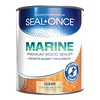
SEAL-ONCE Marine Penetrating Wood Sealer, 1 Gallon
A water-based, ultra-low-VOC penetrating sealer built for constant-moisture exposure — strong enough for docks and piers, mild enough for interior bathroom trim.
- Best for: bathroom vanities, sills, and trim exposed to daily humidity
- Why we picked it: low-VOC formula is safe to use indoors without heavy odor, unlike oil-based options
- Main drawback: needs more frequent reapplication in constant-splash spots
Compare more moisture-protection options
 Option 1 General Tools MMD4E Digital Moisture Meter
|
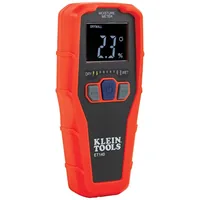 Option 2 Klein Tools ET140 Pinless Moisture Meter
|
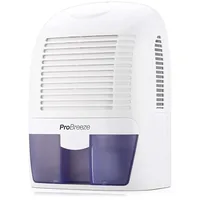 Option 3 Pro Breeze Electric Mini Dehumidifier (250 sq ft)
|
As an Amazon Associate we earn from qualifying purchases.
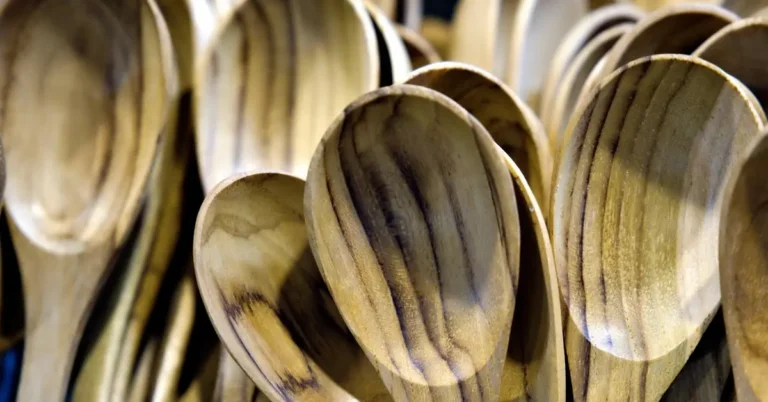
Teak resists moisture better than almost any other wood species because it naturally contains high levels of oils, silica, and rubber — the same properties that made it the standard for ship decks for centuries. It needs little to no sealing indoors, though an occasional light oiling keeps its color from graying.
Cedar is the more affordable middle ground. Its aromatic oils resist decay and mildew, making it a solid pick for closets, laundry shelving, and sauna-adjacent rooms, though it’s softer and less durable underfoot than teak or oak. See our full breakdown of how long cedar actually lasts against rot before choosing it for a load-bearing application.
White oak earned its reputation in boat-building and wine barrels because its cell structure (tyloses) blocks liquid from moving through the grain, giving it real water resistance without any finish at all — though a sealed finish still extends its life indoors.
Engineered hardwood with an HDF or marine-grade plywood core is often the practical winner for bathroom and basement flooring or cabinetry: its cross-grain layered construction resists the expansion and contraction that warps solid boards, as long as every cut edge gets sealed. For flooring specifically, see how to care for engineered wood floors in humid rooms.
| Wood / Material | Natural Moisture Resistance | Best Indoor Use | Sealing Needed |
|---|---|---|---|
| Teak | Very high (natural oils/silica) | Bathroom vanities, shower benches | Optional |
| White oak | High (closed-cell tyloses structure) | Flooring, trim in humid climates | Recommended |
| Cedar | High (aromatic natural oils) | Closets, laundry shelving | Light oiling |
| Engineered hardwood (HDF/marine core) | Moderate–high (cross-grain core) | Basement/bathroom flooring & cabinets | Sealed edges required |
| Standard MDF | Low (absorbs fastest at cut edges) | Avoid in high-moisture rooms | Not sufficient protection |
What Wood to Avoid in High-Moisture Rooms
Standard MDF is the most common mistake in bathroom and basement builds. It absorbs water fastest at cut edges, where compressed wood fibers are directly exposed — and once saturated, it swells permanently rather than drying back to its original shape the way solid wood often can. See MDF vs. OSB board for how the two compare on moisture handling specifically.
Medium-density fiberboard (MDF) is an engineered wood panel made from compressed wood fibers bonded with resin. Standard MDF swells and loses structural strength when saturated, especially at cut edges where fibers are exposed. Moisture-resistant (MR) MDF exists for kitchens and bathrooms, but even MR-rated boards aren’t fully waterproof and shouldn’t sit in standing water.
Particleboard performs even worse than MDF — its larger, loosely-bonded wood chips can crumble and disintegrate entirely once saturated, rather than simply swelling. Untreated softwoods like pine, spruce, and fir aren’t disqualified outright, but they warp and grow mold quickly without a real film-forming finish, so treat them as a starting material rather than a finished surface.
Room-by-Room Wood Picks
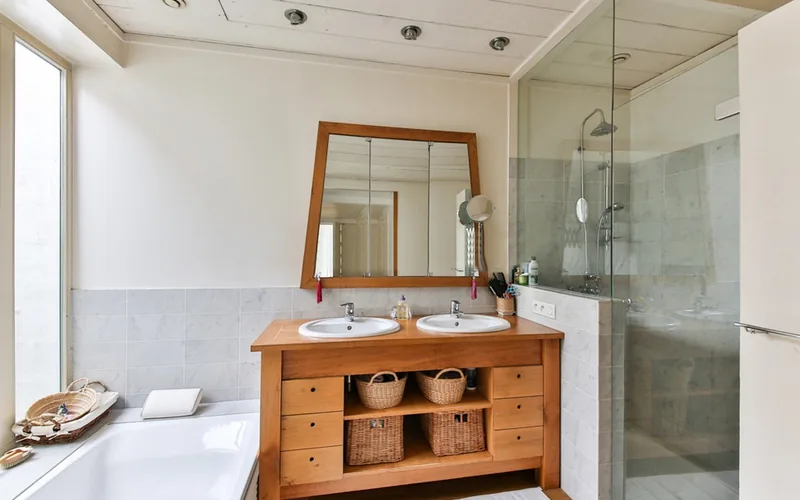
- Bathroom vanities and trim: engineered hardwood or teak with a fully sealed finish. Avoid MDF cabinet boxes unless they’re MR-rated and sealed on all six sides, including the back and bottom.
- Basement furniture and shelving: engineered wood or cedar, kept off the concrete slab on risers — slab moisture wicks upward into direct-contact wood even when the room itself reads dry.
- Laundry rooms: cedar shelving (natural mildew resistance) or sealed plywood; avoid particleboard shelving near washers and water heaters.
- Whole-home humid climates: let kiln-dried lumber acclimate in the room for 3–7 days before installing trim or flooring, so it reaches the room’s humidity level before it’s fastened in place.
Why Humidity Damages Wood
Wood doesn’t need standing water to swell — it constantly exchanges moisture with the surrounding air until it reaches equilibrium, which is why the same board behaves differently in a bathroom than it does in a hallway. That movement is also what drives dimensional change; see our wood shrinkage calculator to estimate how much a specific board will move.
📊 At 30–50% relative humidity (typical living-space range), wood’s equilibrium moisture content sits between roughly 6% and 9%. Push a room to 70% RH — common in an unvented bathroom after a hot shower — and that climbs to around 13%, nearly double. — Source: USDA Forest Products Laboratory, Wood Handbook
“Wood moisture content continuously moves toward equilibrium with the surrounding air’s relative humidity — the same board holds measurably more moisture in a poorly-vented bathroom than it does in a hallway, even with no standing water involved.”
How to Seal Wood for High-Moisture Protection
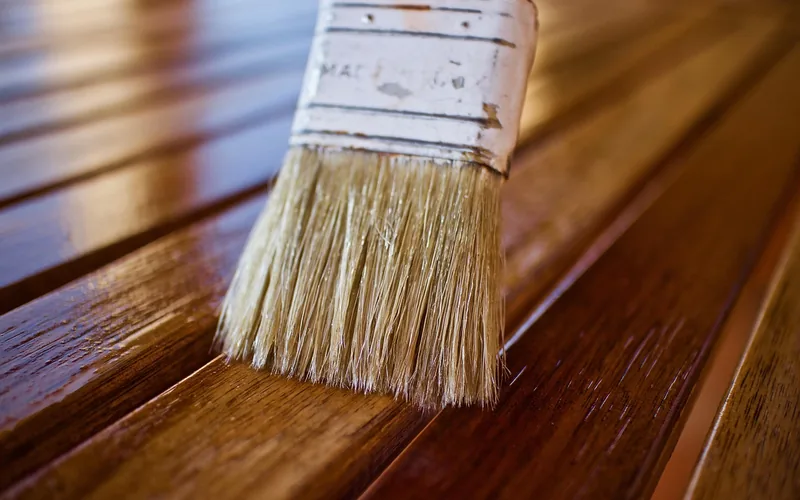
Water-based polyurethane is the most practical choice for interior trim and vanities: three coats minimum, low-VOC, and it cures within about a week — fast enough for a bathroom you can’t take out of use for a month. Oil-based polyurethane forms a more durable film but needs up to 30 days to fully cure and carries a stronger odor, making it a better fit for basement shelving than an occupied bathroom.
Marine or spar varnish takes up to six coats for full protection and holds up 2–5 years even outdoors, so indoors it’s the strongest option for anything that takes direct splash exposure, like a mudroom bench or a utility sink surround. Tung and Danish oils penetrate rather than form a surface film — food-safe and easy to touch up, but they need reapplying every 6–12 months and offer less protection in true high-splash areas. See our full wood finishing guide for application steps on each.
Frequently Asked Questions
Is Engineered Wood Good for Bathrooms?
Yes, engineered hardwood with an HDF or marine-grade plywood core works well in bathrooms when every cut edge is sealed. Its cross-grain layers resist the swelling solid wood suffers from humidity swings. Avoid installing it in a walk-in shower or anywhere it sees standing water — even engineered cores aren’t waterproof, only more moisture-resistant than solid boards.
Can You Use Teak Wood Indoors?
Yes, teak wood works well indoors without any sealing at all. Its natural oils, silica, and rubber content make it inherently resistant to moisture, rot, and mildew — the same properties that made it standard for ship decks for centuries. An occasional light oiling keeps its color from graying but isn’t required for protection.
Is MDF or Plywood Better for a Humid Basement?
Plywood is the better choice for a humid basement. Standard MDF absorbs water fastest at its cut edges, where fibers are exposed, and swells permanently rather than drying back to shape. Exterior-grade or marine plywood, by contrast, is bonded with waterproof glue and holds its shape after brief moisture exposure.
How Often Should You Reseal Wood in a High-Moisture Room?
Reseal oil finishes like tung or Danish oil every 6 to 12 months in rooms with daily humidity swings, such as bathrooms. Film-forming finishes like water-based polyurethane last longer — check yearly for a dulled or worn sheen, since that’s the first visible sign the moisture barrier is thinning.
What Humidity Level Starts to Damage Wood?
Wood starts absorbing meaningfully more moisture once a room sits above roughly 60–70% relative humidity for extended periods — the range many unvented bathrooms and basements reach. Per USDA Forest Products Laboratory data, wood’s equilibrium moisture content roughly doubles between the 30–50% RH of a typical living room and 70% RH, driving swelling and joint failure.
Conclusion
Teak, cedar, white oak, and engineered hardwood with a sealed, moisture-resistant core are the safest picks for bathrooms, basements, and humid climates — standard MDF and particleboard aren’t, no matter how well they’re finished. Match the sealer to the room’s exposure level, reseal on schedule, and check with a moisture meter before assuming a board is fine. For wood built to handle direct water contact outdoors — docks, boat trim, and marine hardware — see our separate guide to water-resistant wood types.
See our complete types of wood guide for a full species-by-species breakdown with Janka hardness ratings.
Sponsored / affiliate links. As an Amazon Associate I earn from qualifying purchases. I may earn additional commission from eligible campaigns.