Router Table vs Handheld Router
Choose a handheld router for edge trimming, template routing, and plunge cuts; choose a router table for repeatable edge profiling, small parts, and bearing-guided work that needs both hands free. Pick the wrong setup and you lose control, waste time on setup, or create unsafe cuts on short stock. This guide maps common jobs to the right setup for the cut and shows when the other tool becomes the bottleneck.
This guide is part of our Woodworking saws: tools, types, and uses series.
| Factor | Router Table | Handheld Router | Winner |
|---|---|---|---|
| Control on repeat edge cuts | Very strong once the fence is locked and aligned | Good, but more dependent on hand control | Router Table |
| Large panels and installed work | Poor fit for oversized or already-installed parts | Better because the tool moves over the workpiece | Handheld Router |
| Setup time | Higher; needs mounting, fence setup, and bit changes | Lower for one-off jobs | Handheld Router |
| Small parts and narrow stock | Safer and more stable when properly supported | Harder to control on tiny pieces | Router Table |
| Interior cuts and plunge work | Not the right tool for the job | Better, especially with a plunge router | Handheld Router |
| Space and storage footprint | Usually larger, especially cabinet-style tables | Smaller and easier to pack away | Handheld Router |
| Total ownership cost | Higher once you add table, insert plate, fence, and dust collection | Lower for a first setup | Handheld Router |
Router table vs handheld router
The core trade-off is simple: a router table holds the router upside down under the table and moves the workpiece past the bit, while a handheld router moves over the workpiece. That difference changes control, safety, setup time, and the kind of work each tool handles best.
A router table is strongest when you need repeatable edge work on small or medium parts. A handheld router is often the better choice when the work is large, already installed, or shaped with a template.
What stays fixed and what moves
With a router table, the router stays fixed and the stock moves across the fence and bit. With handheld routing, the workpiece is clamped and the tool moves instead. That shift matters because the table favors consistency, while the handheld tool favors reach and access.
Say your project is six cabinet door rails cut from 3/4-inch stock. A router table can make the same pass over and over with the same fence setting. Say the same bit has to trim a 7-foot shelf top or an installed laminate edge; the handheld router is the practical choice.
The trade-off in one sentence
Router tables are better for repeat edge profiles and small parts; handheld routers are better for large panels, installed work, and template-guided cuts. That is the decision most beginners should start with, because it follows the project instead of the tool aisle.
Why the first choice depends on your next projects
If your next five jobs are cabinet parts, trim adjustments, or a mortise-and-template mix, a handheld router gets used more often. If your next five jobs are edge profiling on narrow stock and identical grooves, a router table earns its place faster.
Side-by-side comparison
The decision is not about which tool is “better” in the abstract. It is about which setup matches the cuts you actually need to make, with the least setup burden and the least chance of a bad feed direction.
Control and repeatability
A router table gives better repeatability for edge profiles, rabbets, and grooves because the fence can be locked and aligned for the same pass every time. That matters on cabinet parts and face-frame parts where the cut must match across multiple pieces.
A handheld router gives less built-in repeatability, but it wins when the cut line is long, awkward, or already in place. For one-off cuts, the added control of a table often does not justify the setup time.
Portability and setup time
A handheld router is often the faster starting point for many beginners because it mainly needs the bit, the depth setting, and the stock clamped down. A router table typically needs mounting, fence adjustment, and a compatible router before the first cut.
That extra setup is worth it only when the same cut will be repeated enough times to pay it back. If the tool will live in a shared workspace or must pack away after each session, the handheld route is usually the cleaner fit.
Space, storage, and cost
A benchtop router table takes less space than a cabinet-style model, but any table adds footprint, storage, and accessories. The Bosch RA1171 is listed as a cabinet-style router table at $255.99, with a laminated top, fence, and dust-collection ports. That is before you account for a compatible router and bits.
A first handheld setup can stay leaner. The DeWalt DWP611 is presented at $149.00 as a 1-1/4 HP variable-speed router with a 7.7-amp motor, soft-start, and dual LEDs. For a first buy, that price leaves room for bits and clamps before the shop budget has to absorb a table.
Safety, feed direction, and kickback risk
Both tools demand correct feed direction. On a router table, the stock must move against the bit’s rotation, not with it. On a handheld router, the tool must move so it does not climb into the cut unexpectedly.
That is where grab and kickback show up. Short stock on a table can catch if the fence is loose or the piece is too small to control. A handheld router can also lurch if the bit is started in the wrong place or if the base is not fully supported on the work.
Which setup fits which cut?
Use this matrix as a project-first filter. Match the job to the setup that is safer, faster, and less likely to become a fight with the bit, the fence, or the workpiece.
| Project type | Recommended setup | Why it wins | Setup burden | Safety notes | First-bit choice |
|---|---|---|---|---|---|
| Edge profiling on cabinet parts | Router Table | Repeatable fence setting and consistent edge support | Medium | Use featherboards and keep the fence locked | Roundover or chamfer |
| Cabinet-door rails and stiles | Router Table | Best for repeated profiles on narrow stock | Medium | Featherboards help hold short or narrow pieces tight | Rail-and-stile profile or straight bit, depending on the system |
| Shelf grooves | Router Table | Fence control keeps groove location consistent | Medium | Make sure the fence is aligned before every pass | Straight bit |
| Hinge mortises | Handheld Router | Plunge action reaches interior pockets cleanly | Low to medium | Clamp the work and plunge in controlled steps | Plunge router with straight bit |
| Laminate trimming | Handheld Router | Moves along the edge of installed or awkward panels | Low | Support the base and move with the grain or edge direction | Bearing-guided trim bit |
| Live-edge cleanup | Handheld Router | Can follow irregular shapes and awkward outlines | Medium | Clamp securely; irregular edges can catch the bit | Bearing-guided or straight bit with template |
| In-place trim work | Handheld Router | The work stays installed while the tool moves | Low | Check for hidden fasteners, nails, or screws first | Flush-trim or straight bit |
| Rabbets on repeat parts | Router Table | Fence settings make repeated stock removal faster | Medium | Take light passes and keep hands clear of the bit opening | Rabbet bit or straight bit |
| Template-guided cutouts | Handheld Router | Best for following a pattern on a large panel | Low to medium | Keep the bearing against the template at all times | Bearing-guided bit |
| Small decorative edge on short stock | Router Table | Safer than trying to hold a tiny part by hand | Medium | Use featherboards and a push block when needed | Roundover or chamfer |
How to read the setup burden and safety notes
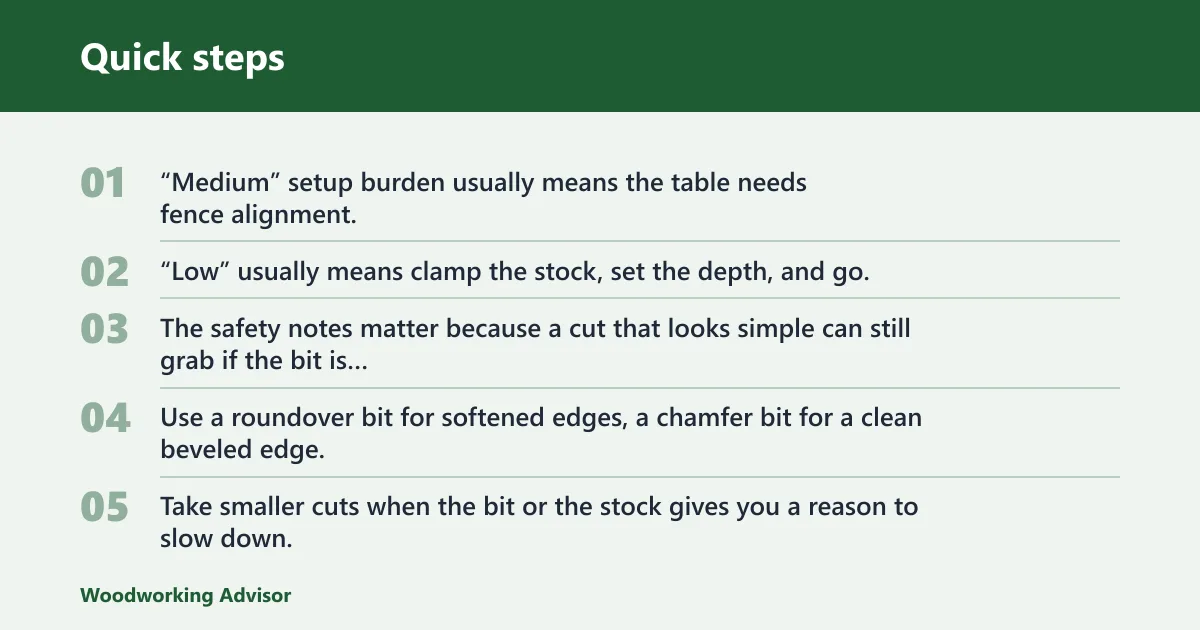
“Medium” setup burden usually means the table needs fence alignment, bit height adjustment, and some test cuts. “Low” usually means clamp the stock, set the depth, and go. The safety notes matter because a cut that looks simple can still grab if the bit is wrong for the grain or if the feed direction is wrong.
First-bit choices for common routing jobs
Use a roundover bit for softened edges, a chamfer bit for a clean beveled edge, a straight bit for grooves and many mortises, a rabbet bit for edge steps, and a bearing-guided bit when the cut must follow a template or an existing edge. Pass depth matters on all of them. Take smaller cuts when the bit or the stock gives you a reason to slow down.
Best uses for a router
A router table is strongest for small parts, repeated edge profiles, grooves, and rabbets. It is also the better setup when you want the workpiece controlled by a fence and the router held rigidly in one place.
Edge profiles on small parts
Small parts are where the table earns its keep. When you are shaping a rail, stile, drawer front, or trim piece, the fixed bit and fence help keep the pass consistent without asking your hands to do all the steering.
Featherboards matter here. They hold stock tight to the fence and table, reduce chatter, and make narrow pieces less likely to tip or drift.
Grooves, rabbets, and repeatable stock removal
Grooves and rabbets are easier to repeat when the fence is locked and the bit height is already dialed in. That is why table work suits cabinet parts and sheet-goods parts that need the same cut multiple times.
Dust collection helps too, especially on MDF and other chip-heavy cuts. A cabinet-style table with dust-collection ports keeps the opening cleaner and gives you better visibility at the bit.
Why fences, featherboards, and dust collection matter
The fence is not optional on this kind of work. It guides the stock and must be aligned before the cut starts. Featherboards add hold-down and side pressure, and dust collection keeps chips from packing around the bit and fence opening.
Best uses for a handheld router
A handheld router is the stronger first buy for large panels, installed work, templates, and plunge cuts. It moves with the job instead of making the job come to the machine.
Large panels and installed work
Big panels do not fit well on most router tables, and installed trim cannot move to the table at all. A handheld router handles both because the work stays in place while the tool follows the edge or the cut line.
Picture a 36-inch-wide plywood panel that needs a flush edge trimmed after assembly. The table is the wrong shape for that task. The handheld tool is the practical one.
Templates, mortises, and plunge cuts
Plunge routers are the best handheld option for interior cuts and recessed hardware pockets because the bit can drop into the stock instead of entering from an edge. That makes them suited to hinge mortises, hinge recesses, and other interior cuts.
A fixed-base router is the simpler beginner choice for edge routing and general-purpose work. A plunge router is better when the work needs interior access. Many woodworkers start with fixed-base simplicity and add plunge capability only when mortises and pockets become common.
Fixed-base vs plunge-base choices for beginners
For edge work, a fixed-base router is usually easier to set and keep set. For recessed hardware and interior cuts, a plunge base is the better tool. If you only need one first handheld router, the fixed-base style is often the more practical start unless your next projects are mortises and pockets.
Choose Router Table if… / Choose Handheld Router if…
Choose a router table if your work is mostly repeat edge profiles, grooves, rabbets, or short stock that is safer when fully supported. Choose a handheld router if your work is large, installed, template-driven, or requires plunge cuts. For most beginners, the handheld router should come first.
Choose router table if…
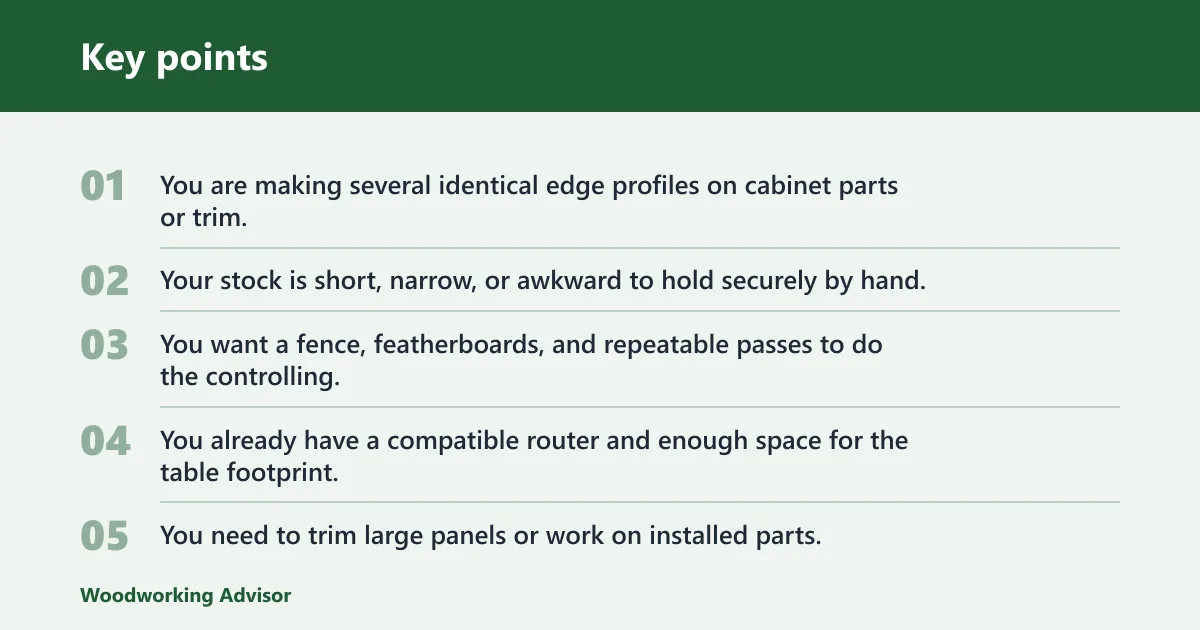
- You are making several identical edge profiles on cabinet parts or trim.
- Your stock is short, narrow, or awkward to hold securely by hand.
- You want a fence, featherboards, and repeatable passes to do the controlling.
- You already have a compatible router and enough space for the table footprint.
Choose handheld router if…
- You need to trim large panels or work on installed parts.
- You plan to cut mortises, hinge recesses, or other interior pockets.
- You need a tool that stores easily and sets up quickly.
- You are buying your first routing setup and want the broader range of use.
Where the other tool becomes the bottleneck
A router table becomes the bottleneck when the work is too large, already mounted, or irregularly shaped. A handheld router becomes the bottleneck when the same edge profile must be repeated many times, especially on short stock that is hard to hold safely.
A common first-timer mistake is buying the table first because it looks more precise, then finding that the first five projects are all installed trim, shelf edges, and template work. In that case, the table sits while the handheld router does the real work.

What should beginners buy first?
Most beginners should buy a handheld router first, usually a fixed-base model unless plunge cuts are already on the project list. It is the more versatile first tool, it needs less setup, and it works on larger pieces, templates, and installed parts that a table cannot reach.
Why a handheld router is usually the first buy
A handheld router covers more of the jobs most new woodworkers actually face. Edge trimming, flush trimming, simple roundovers, and template work all fit into the same tool path, with less setup than a table requires.
The DeWalt DWP611 is a good example of the beginner-sized class: 1-1/4 HP, variable speed, 7.7-amp motor, soft-start, and dual LEDs. Those features matter because they support steady control without forcing the first setup into a full table purchase.
When a router table can wait
A router table can wait if your shop is small, your workspace is shared, or your projects move from one task to the next. It can also wait if you have not yet confirmed that you need repetitive edge profiles often enough to justify the footprint and accessory cost.
The table itself is only part of the bill. Add a compatible router, bits, insert plate or mounting hardware, fence setup, featherboards, and dust collection if the table uses it. That total matters more than the shelf price alone.
What a good starter setup looks like
A practical starter path is a fixed-base handheld router first, then a table later if repeat edge work becomes common. If the table comes first, choose one that fits the router you already own and gives you a fence that locks solidly and aligns easily.
Frequently asked questions
Router table vs palm router
A palm router is a smaller handheld router, and it fills a narrower role than a full-size handheld router. It is useful for light edge work and small rounds, but it is not the same category as a full routing setup. For most beginners, a full-size handheld router offers more reach, bit choice, and future flexibility.
Hand held router vs table router
A hand held router is better when the workpiece is too large, already installed, or shaped with a template. A table router is better when the same edge profile or groove has to be repeated on small parts. The right answer depends on whether the stock moves or the tool moves.
Router table vs handheld
Router Table wins on repeatability, small parts, and edge profiles with a fence. Handheld Router wins on portability, installed work, and plunge cuts. If your projects are mixed, the handheld router is usually the first buy because it covers more jobs with less setup.
Is a router table necessary?
No, a router table is not necessary for most beginner and home-shop projects. You can do edge trimming, template work, and even many groove or rabbet cuts with a handheld router. A table becomes useful when repeated profiles and small parts show up often enough to justify the space and setup time.
Is a router table worth it?
It is worth it when your work includes frequent repeat edge profiles, cabinet parts, and narrow stock that is awkward to handle by hand. It is less worth it if you mostly do large panels, installed trim, or one-off cuts. In that case, the cost and footprint may outrun the benefit.
What is a good router for a router table
A good router for a table should have stable depth adjustment, enough power for the bits you plan to use, and compatibility with table mounting. A variable-speed model is often the safer choice because bit size and cut type matter. Many woodworkers prefer a fixed-base router for table duty because the depth stays easier to lock and repeat.
Sponsored / affiliate links. As an Amazon Associate I earn from qualifying purchases. I may earn additional commission from eligible campaigns.