Can You Glue Particle Board to Wood? Best Glue Choices
Particle board-to-wood glue joints are generally best kept to light to moderate loads, and they tend to work better if the particle board still has firm edges. For stressed joints, add screws, dowels, cleats, or brackets. If you trust glue alone on a crumbly edge, the joint often fails inside the board before the adhesive does, and the repair has to be redone. I use this rule on cabinet fixes all the time. This guide covers the best adhesive choices, surface prep, clamping pressure, and when reinforcement beats glue alone.
Can you glue particle board to wood?


Yes, but the joint holds only when the particle board is sound, dry, and still dense at the bond line. Particle board is made of sawdust, wood chips, and glue, so its holding power depends on the face you are bonding, not on adhesive strength alone.
When the joint can hold
Raw particle board edges, firm veneered faces, and intact cabinet panels can take glue well enough for many indoor repairs. A simple shelf support, a cabinet side patch, or a face-frame repair can hold if the load is modest and the bond area is large.
When the particle board surface is too weak
If the edge is blown out, soft, swollen, or powdery, glue can soak in without making a strong bridge. Particle board drinks water and can puff up like a sponge, so a wet cleanup or over-wet glue-up can turn a weak edge into a failed one fast.
What usually fails first
In many repairs, the adhesive is not the weak link. The board surface breaks apart first, especially on corners, screw holes, and old shelf-pin holes. That is why edge repair, hardening, or a cleat often matters more than choosing a “stronger” glue.
How particle board behaves at the joint
Particle board acts very differently depending on the face. Raw edges drink glue and can crumble; veneered faces give the adhesive a steadier surface; melamine faces are slick and poorly suited to ordinary wood glue. Matching the adhesive to the face matters more than chasing a single best product.
Raw edge versus veneered face
Raw edges can bond well after dust removal and dry-fitting, but only when the edge still has body. Veneered faces usually give better long-grain-like behavior because the skin is more even, though the veneer itself can lift if the board below is damaged.
Melamine face problems
Melamine is a hard, slick face that does not behave like bare wood. Standard PVA wood glue is a poor choice on its own because the surface offers little tooth. For melamine, contact cement or mechanical fastening often makes more sense than using plain wood glue alone.
Why moisture ruins the edge
Moisture is the enemy here. Particle board swells when wet, then stays bent even after drying. That swelling breaks the fit, weakens screw grip, and can keep a clamp from pulling the joint tight enough for the adhesive to cure well.
What is the best glue for particle board to wood?
The best glue depends on the surface and the job. For sound interior wood-to-particle-board repairs, PVA wood glue is often a sensible starting point. For moisture-prone repairs, polyurethane can help. For laminate faces, contact cement is usually the better answer. For large laminate jobs, urea-formaldehyde plastic resin is often the right fit.
PVA wood glue for sound interior repairs
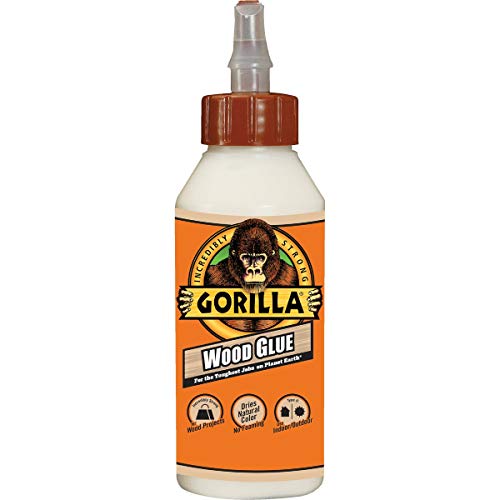
PVA glue comes in white and yellow formulas and is common for interior woodworking use. It works well when both surfaces are sound and the repair can be clamped until the glue sets. White glue can blend with white melamine particle board, while yellow glue usually looks closer to natural wood.
Polyurethane glue for moisture-prone spots
Polyurethane glue can bond wood, stone, concrete, and ceramics, and it is waterproof. That makes it useful when the repair may see occasional moisture, such as a utility cabinet or a damp-area shelf support. It is not a cure for rotten particle board, though.
Contact cement for laminate faces
Contact cement is specially formulated for laminate to particle board. It is applied to both surfaces, bonds instantly, and eliminates clamping. That speed is useful on flat laminate patches, but it is not the right choice for structural joints that need time, pressure, and alignment correction.
Urea-formaldehyde for large laminate jobs
Urea-formaldehyde, also called plastic resin, is useful for laminate to wood work where large surface area coverage matters. It is not an instant bond like contact cement, so there is time to position the parts. It is a better fit for broad, flat assemblies than for quick fixes.
How long should you clamp particle board glue joints?
Clamp time depends on the adhesive, the temperature, and how flat the joint is. PVA joints need clamps until the glue sets, while contact cement usually does not. A cold shop can slow work down, and glue stored in very cold or freezing conditions may lose workable consistency and bonding strength.
Clamp time for PVA
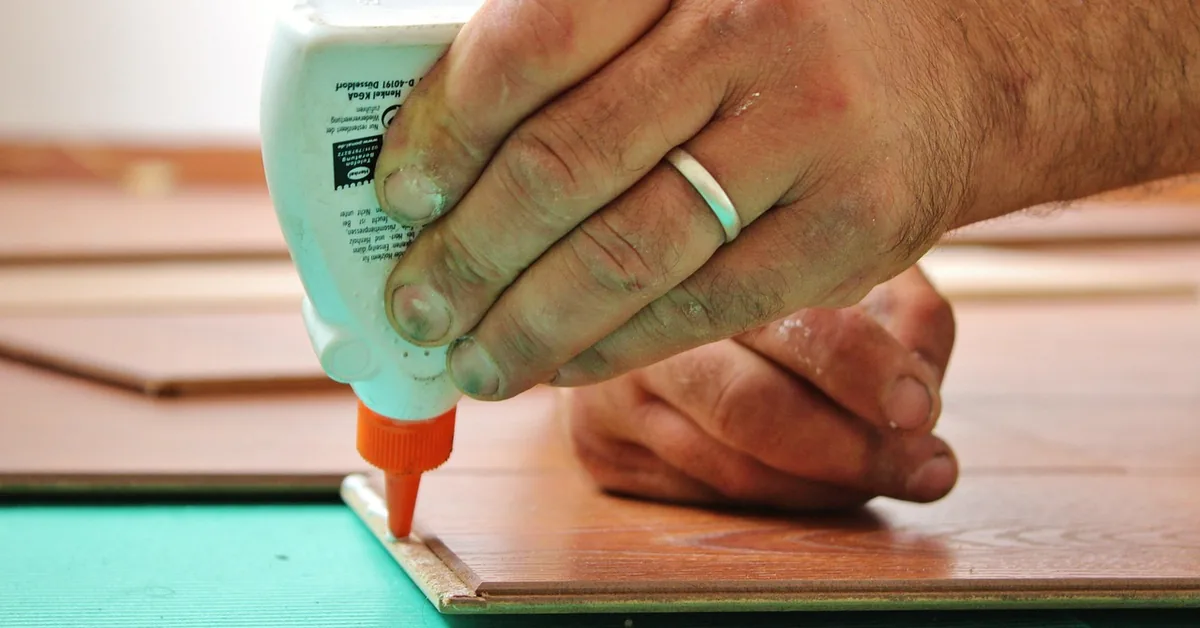
For PVA, keep the clamp on until the glue has set enough to hold the joint without drift. A loose clamp or early movement can starve the bond or open a gap. On particle board, clamp pressure should be firm but not crushing, because the board can crumble if over-tightened.
Why contact cement is different
Contact cement bonds instantly once the coated surfaces meet, so clamp time is usually unnecessary. That said, the parts must be aligned before contact because the bond grabs quickly. There is no real “second chance” the way there is with PVA or plastic resin.
Temperature and storage limits
Some glues require minimum temperatures as low as 45 degrees, and some need 50 or even 60 degrees Fahrenheit. Cold parts slow the set, and glue that has been frozen can become uneven or unreliable. For particle board, cold plus moisture is a bad combination.
How to prep a damaged particle board edge
Prep matters more than brand choice when the edge is tired or fuzzy. The goal is to remove loose material, make a firm bond line, and avoid soaking the board with water. If the edge is already soft, it may need hardening or a reinforcement step before glue.
Clean up loose fibers and dust
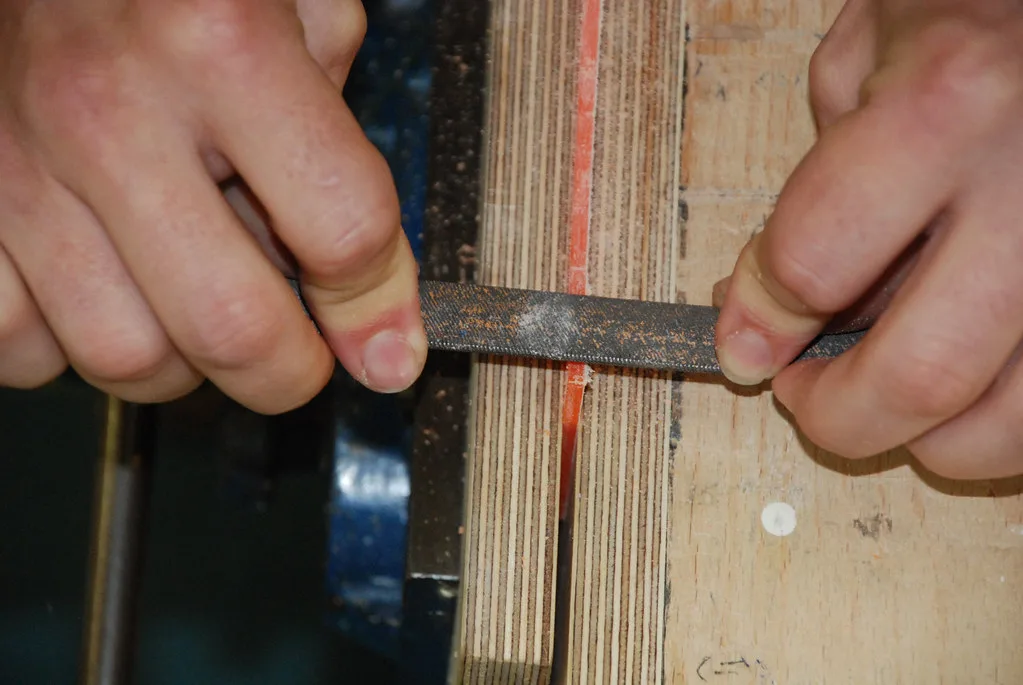
Brush or vacuum the edge until loose dust is gone. A dry scraper or knife can remove crumbled bits, but do not gouge deeper into the panel. Any dust left in the joint weakens the bond and acts like a spacer.
Stabilize crumbly edges
If the edge keeps shedding particles, the repair should not start with glue alone. Trim back to firmer material if possible. When that is not possible, add a cleat, backer strip, or patch block so the adhesive bonds to something that can actually hold.
When to seal before glue
Very porous, weak edges sometimes benefit from a first pass that hardens the surface before final assembly. The key is to keep the treatment light and dry. Heavy liquid application can swell the board and make the edge worse instead of better.
Decision table: glue, clamps, and reinforcement by repair type
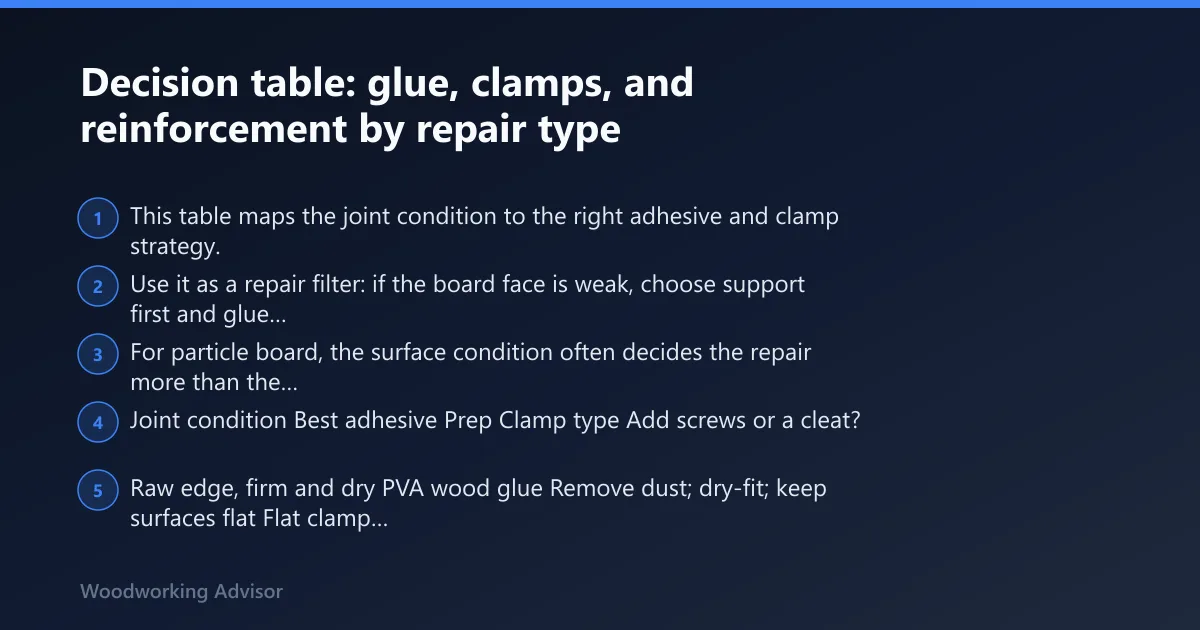
This table maps the joint condition to the right adhesive and clamp strategy. Use it as a repair filter: if the board face is weak, choose support first and glue second. For particle board, the surface condition often decides the repair more than the adhesive label.
| Joint condition | Best adhesive | Prep | Clamp type | Add screws or a cleat? |
|---|---|---|---|---|
| Raw edge, firm and dry | PVA wood glue | Remove dust; dry-fit; keep surfaces flat | Flat clamp or bar clamp with padding | Yes, if the joint carries shelf load or side stress |
| Veneered face, intact skin | PVA wood glue or polyurethane | Lift loose veneer only where needed; clean without soaking | Wide pad clamp to spread pressure | Sometimes, if the core is weak or the panel flexes |
| Melamine face | Contact cement for laminate repair | Clean and degrease carefully; dry the panel fully | No clamp usually; use a roller or hand pressure | Yes, for structural work or edge support |
| Crumbly edge | Polyurethane or PVA only after hardening and support | Trim loose fibers; add a backer or fill with a repair block | Clamp to a cleat or straight edge, not the crumbling corner | Yes, almost always |
| Load-bearing repair | PVA plus reinforcement, or polyurethane where moisture is a concern | Square the joint and pre-fit the support | Even pressure across the full bond line | Yes |
| Cosmetic-only repair | PVA, polyurethane, or contact cement based on face type | Match the surface and color; keep glue thin | Light clamp or press board only as needed | Usually not, unless the edge is fragile |
Should you add screws or a cleat?
Yes, when the joint must carry weight, resist racking, or repair a damaged edge. Glue alone can work for light repairs on firm material, but particle board often needs a second layer of support. A cleat, brace, or screw backed by a sound pilot hole can save the repair.
When glue alone is enough
Glue alone is usually fine on a sound, flat, low-stress joint, such as a loose veneer patch or a cabinet face repair. The board should be dry, firm, and large enough that the adhesive has enough area to spread the load.
When to back up the joint
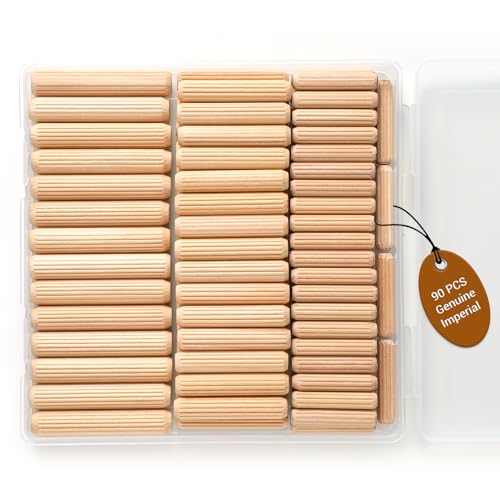
Add screws, dowels, brackets, or a cleat when the board edge is chipped, the part carries shelf weight, or the joint can be twisted in use. If the surface starts to crumble while driving fasteners, stop and switch to a backer or patch block.
How to avoid splitting the board
Use pilot holes, avoid over-driving screws, and place fasteners in the firmer part of the panel whenever possible. On thin or weakened stock, a cleat fastened to sound wood nearby is safer than forcing hardware into a failing particle-board edge.
What glue works for particle board veneer repairs?
For veneer repairs, the best glue depends on whether the veneer is loose, missing, or just lifting at an edge. PVA works for many small veneer fixes on firm cores, while contact cement is useful for laminate-like surfaces. Color matters too, because visible squeeze-out can telegraph through the finish.
Loose veneer edges
A loose veneer edge on a sound core can often be reglued with a thin coat of PVA and clamped flat. If the face is very smooth or plastic-like, contact cement may be better. The key is using just enough adhesive to wet the face without flooding the board.
Patch repairs on visible faces
For visible repairs, the dried glue color matters. White glue can blend with white melamine particle board, while yellow glue tends to disappear better on natural wood tones. Clear-drying products can help too, but color matching is only useful if the surface is already well prepared.
Color choice for the repair line
Glue color will not fix a bad fit, but it can reduce the look of a faint squeeze-out line. On open-grain wood, yellow glue is often less noticeable. On white-faced panels, white glue is usually the safer visual match.
Frequently asked questions
Do you need clamps when gluing particle board to wood?
For PVA, yes. PVA requires clamps until the glue sets, and the joint needs even pressure without crushing the edge. Contact cement is different because it bonds instantly and usually does not require clamps. Polyurethane still benefits from holding the parts steady during cure.
Is wood glue strong enough for particle board?
Wood glue can be strong enough when the particle board is firm and the repair is not carrying heavy stress. The limit is usually the board surface, not the glue. If the edge is blown out or powdery, the bond may pull apart the panel before the glue fails.
Should I use polyurethane glue on particle board?
Use it when moisture resistance matters or when the repair involves mixed materials and needs a waterproof bond. It can bond wood, stone, concrete, and ceramics, so it is versatile. It is not the best first choice for every dry indoor joint, especially if clamping and fit are already good.
Will contact cement work on particle board to wood?
It works well on laminate to particle board and other flat face repairs, but it is not the first choice for a structural wood-to-board joint. Contact cement bonds instantly and eliminates clamping, which is useful on skins and facings, not on joints that need squeeze-out and adjustment time.
Sponsored / affiliate links. As an Amazon Associate I earn from qualifying purchases. I may earn additional commission from eligible campaigns.