DIY Bookshelf Sagging in the Middle: Causes and Fixes
A bookshelf sags in the middle when the span is too long for the shelf’s thickness or material, so check span, thickness, and load placement first, then choose a stiffener, center support, or replacement. Left alone, it can bow farther, dump fasteners, and eventually crack shelves or pull from the cabinet sides. This guide helps you identify the cause, match the fix to the shelf type and span, and repair the least amount of wood possible.
This guide is part of our Woodworking project ideas and plans series.
How to diagnose why your bookshelf sags
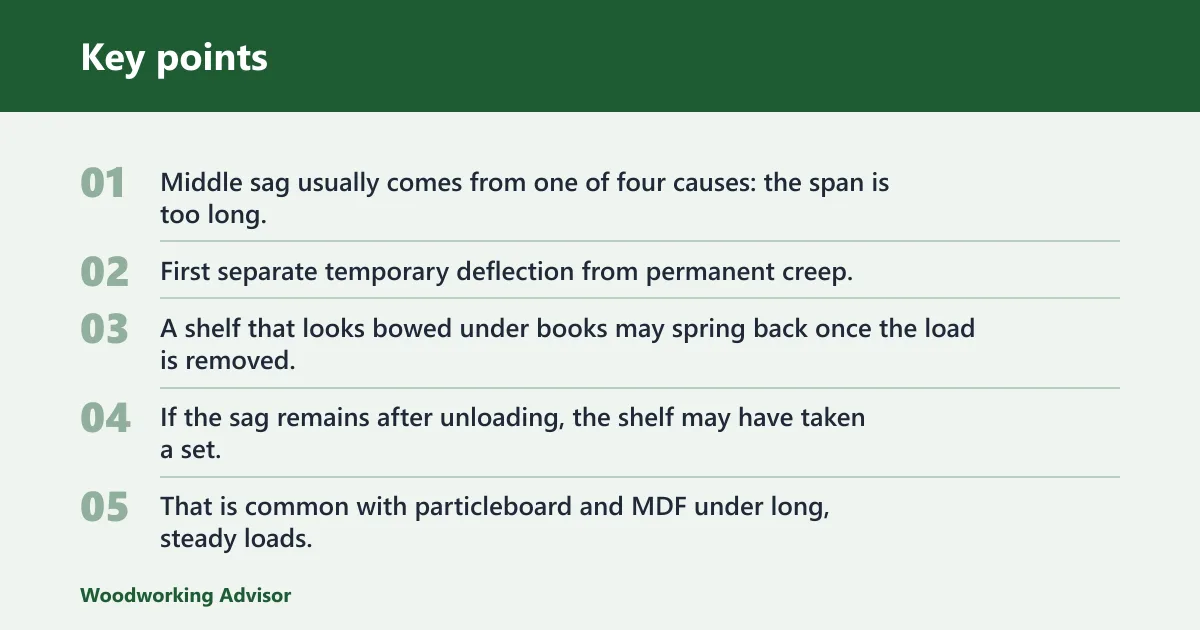


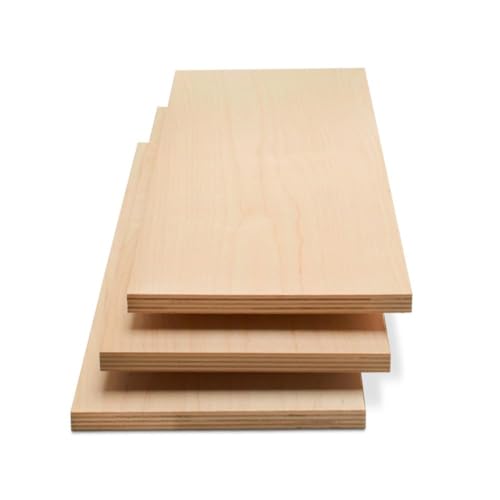
Middle sag usually comes from one of four causes: the span is too long, the shelf material is too flexible, the load is too heavy or too concentrated, or the joinery is not transferring load well. First separate temporary deflection from permanent creep, then check for side-to-side racking that can make a straight shelf look bent.
Check the shelf before you blame the wood
Unload the shelf before you inspect it. A shelf that looks bowed under books may spring back once the load is removed, which means it was deflecting under load rather than permanently deformed.
If the sag remains after unloading, the shelf may have taken a set. That is common with particleboard and MDF under long, steady loads, especially on spans that are too wide for the thickness.
Look for racking, not only bowing
If the bookcase side panels are out of square, the shelf line can appear crooked even when the shelf itself is sound. Check that the case stands flat on the floor and that both sides are plumb. A thin back panel can help hold square, but only if it is attached well enough to resist racking.
A common first-timer mistake is to add a center support to a unit that is actually racked. That can hide the symptom for a while, but it does not fix the real problem if the case is out of square or the shelf is already permanently bent.
Diy bookshelf sagging diagnostic table
This table maps common shelf symptoms to the most likely failure mode, the least invasive fix that fits, and whether the repair is temporary, permanent, or rebuild-required. Use it after unloading the shelf and checking for racking.
| Shelf span | Material type | Load type | Visible sag amount | Likely failure mode | Best corrective action | Repair type |
|---|---|---|---|---|---|---|
| 24–30 in. | 3/4 in. plywood | Uniform books | Under 1/8 in. | Normal deflection from load | Reduce front-edge loading and keep heavy books near the sides | Temporary |
| 30–36 in. | 3/4 in. solid wood | Decor and mixed items | 1/8–1/4 in. | Span is long for the thickness | Add a center support or divider to cut the clear span | Permanent |
| 36–42 in. | 3/4 in. MDF | Books | 1/4 in. or more | Creep plus long-span deflection | Replace the shelf or add a support that shortens the span | Rebuild-required if the sag is permanent |
| 42–48 in. | Particleboard | Records or dense stacks | Visible mid-span dip and loose pins | Material creep and fastener stress | Install a center divider or replace with stronger sheet goods and better support | Permanent or rebuild-required |
| Any span | Any material | Heavy objects at the front edge | Sag is worst at the front line | Concentrated load near the unsupported edge | Move weight back, add a front stiffener, or add a support under the shelf | Temporary or permanent |
| Any span | Any material | Books plus racking case | Shelf looks bowed even when unloaded | Cabinet is out of square | Square the case, secure the back panel correctly, then reassess the shelf | Temporary |
What shelf span and material can handle the load?

Clear span is the distance between vertical supports, and it is the main driver of deflection. As span increases, sag rises quickly. That is why a shelf that looks fine at 24 inches may fail badly at 48 inches, even with the same thickness and material.
How material changes stiffness and creep
Solid wood, plywood, MDF, and particleboard act differently under load. Solid wood can be stiff, but it moves with humidity and can cup or twist. Plywood usually stays flatter across the grain and often handles shelves well. MDF and particleboard may start flat, then creep under steady load more readily than plywood or solid hardwood, especially on long spans.
Thickness matters, but it is not the only variable. A 3/4-inch shelf is common for DIY bookcases, yet the same thickness performs very differently depending on whether the shelf is solid wood, plywood, MDF, or particleboard. A thicker shelf is stiffer, but cutting the span down often helps more than making the shelf only a little thicker.
Why shelf depth changes the load picture
Deeper shelves carry more weight because people tend to place more objects on them, and front-edge loading makes the sag easier to see. A 12-inch-deep shelf loaded at the front puts more bending demand on the shelf than the same shelf loaded close to the back or side supports.
Suppose a 36-inch bookshelf holds hardcovers on a 10-inch-deep shelf. If the books are pushed to the front edge, the shelf can bow sooner than expected. Move the books back so the load sits closer to the side supports, and the visible sag often drops even before any repair is added.
Which fix fits your bookshelf?
The best fix is the one that matches the cause. If the shelf is only deflecting under load, a load change may be enough. If the span is too long, add a support that shortens the clear distance. If the shelf has taken a permanent set, replacement is usually the only durable fix.
Add a center support when the span is the problem
A vertical divider, leg, stretcher, or support bracket reduces effective span and is usually the most direct repair. It is also one of the least invasive permanent fixes when the case layout allows it. Add the support at the point of maximum sag, usually near the center of the span.
Use joinery that transfers load well
Screws alone can hold parts together, but dados, cleats, shelf pins, and glue can improve load transfer when the design allows them. A shelf seated in a dado or on a cleat is less dependent on fasteners alone. That matters on long shelves where the ends need to carry more of the load.
When a new shelf is the only durable fix
If the shelf is already permanently bowed, replacing it is often simpler than trying to force it back flat. That is especially true for MDF and particleboard, which can hold a set after long exposure to load. A stiffener may reduce motion, but it will not erase a permanent bend in many cases.
- Unload the shelf and measure the sag at mid-span.
- Check whether the shelf springs back after unloading.
- Verify that the case is square and the back panel is attached well.
- Identify the shelf material and thickness.
- Match the fix to the span: reduce load, add support, or replace the shelf.
How do you stop a bookshelf from bowing?
To stop bowing, reduce the load, spread the load, and shorten the span if possible. Heavy books, records, and dense objects should sit near supports instead of at the front edge or center of a long shelf. Wall anchoring is for tip safety, not for replacing shelf support.
Load placement matters more than many people expect
Books create a fairly even load when they fill the shelf from side to side, but decor often creates concentrated loads. A stack of cast-iron objects or a row of records in one spot can overload a section even if the total shelf weight seems moderate.
Records are dense and usually stored upright, so a shelf with a long clear span often needs more support than one holding light decor. If the shelf is already marginal, records can push it from minor deflection into permanent sag.
Wall anchoring is safety, not sag repair
Anchor tall bookcases to the wall to reduce tip risk, especially in homes with children or on uneven floors. Wall anchoring can reduce tip risk, but it does not shorten the shelf span or add stiffness to the shelf itself. Use it for safety, then fix the shelf support separately.
How thick should the shelf be so it doesn’t sag?
There is no single thickness that works for every shelf, but 3/4 inch is a common DIY starting point. Thicker stock is stiffer, yet the right thickness depends on span, material, depth, and load. As span grows, thickness matters more, but support changes may still beat simply going thicker.
When 3/4 inch is enough
For short spans with moderate loads, 3/4-inch plywood or solid wood can be adequate. Once the span gets longer, the same thickness may still look fine at first and then sag over time. That is one reason a shelf can pass a quick visual check and still fail under books.
When thicker stock helps most
Thicker stock becomes more useful as shelf depth and span increase, and it is especially helpful with solid wood or plywood. With MDF and particleboard, extra thickness can help, but span reduction still matters a great deal because those materials are more prone to long-term creep under constant load.
A common rule of thumb is that shelf stiffness rises quickly with thickness, but not in a straight line. A small increase in thickness can help, yet a center support that cuts a 48-inch span to 24 inches often changes the outcome far more than a modest thickness change.
Will adding a back panel make a bookshelf stronger?
A back panel can help a bookshelf resist racking, but it is not the main cure for mid-span sag. A thin hardboard or plywood back only contributes if it is attached correctly to the frame. It helps the case stay square, which keeps the shelves aligned and the load path cleaner.
What a back panel can and cannot do
A properly fixed back panel can reduce side-to-side wobble and make the unit feel tighter. It does not significantly shorten shelf span or stop bending across the middle. If the shelves are sagging because of load and unsupported length, the back panel alone will not solve that.
How to tell if the back panel is helping
If the case racks when you push on one corner, the back panel may be loose, undersized, or poorly fastened. Reattach it with fasteners that hold the sheet flat and square. Then recheck the shelves. If the sag remains, the shelf itself still needs support or replacement.
Can I fix sagging shelves without rebuilding the whole bookcase?
Yes, often you can. If the shelf is only deflecting, you may fix it with a support bracket, center divider, cleat, or better load placement. If the shelf has permanent creep or the case is out of square, you may still avoid a full rebuild, but some parts will need replacement.
Least invasive fixes first
Start with reversible changes. Remove excess weight, move dense items closer to supports, and check whether the sag drops once the shelf is unloaded. If the shelf responds, you may not need to rebuild anything.
Next, add a support that fits the design. A center leg or divider is usually cleaner than forcing a bowed shelf flat. Brackets and cleats are visible, but they are simple and often effective.
When repair becomes rebuild work
If the shelf is cracked, badly bowed, or loose in its joinery, replacement is often the more appropriate fix. Fasteners that have pulled out, shelf pins that have enlarged their holes, or dados that have failed under load point to a structural problem, not just a cosmetic one.
How far can a shelf span before it sags?
There is no universal maximum span, because the safe distance depends on material, thickness, depth, and load. A short span can still fail if it carries dense objects, while a longer span can work if the shelf is thicker, better supported, or lightly loaded. Span is the first thing to evaluate.
Use the span as the first design check
If the clear span is long and the shelf is only 3/4 inch thick, expect more deflection. If the shelf will hold books or records, shorten the span or increase support before you rely on thickness alone. The same shelf can behave very differently once the span is cut in half.
Practical span guidance for repairs
For a repair, the useful question is not “How far can it go?” but “What span does this shelf have right now, and can I shorten it?” If you can add a divider, leg, or bracket without changing the whole bookcase, that is usually the best first move.
Frequently asked questions
Why is my bookshelf sagging in the middle?
The most common cause is a shelf span that is too long for the shelf thickness or material. Heavy loads, front-edge loading, weak joinery, and long-term creep can all contribute. Check whether the shelf returns to flat when unloaded, because that tells you whether you are seeing deflection or a permanent bend.
How thick should a bookshelf shelf be so it doesn’t sag?
Many DIY shelves start at 3/4 inch, but that thickness is only part of the answer. Material, depth, and span matter just as much. A 3/4-inch plywood shelf may work well on a short span, while the same thickness may sag on a long span with books or records.
Do I need a center support for a long bookshelf shelf?
If the shelf is long and carries books or other dense items, a center support is often the most effective repair. It reduces the working span immediately and is usually less disruptive than rebuilding the whole case. If the shelf is already permanently bowed, you may still need a replacement shelf.
Is plywood or solid wood better for preventing shelf sag?
Plywood is often the better all-around choice for DIY shelving because it is stable and performs well across the grain. Solid wood can also work well, especially when thicker, but it moves with humidity. For sag control, the span and support layout often matter more than choosing one material in isolation.
Sponsored / affiliate links. As an Amazon Associate I earn from qualifying purchases. I may earn additional commission from eligible campaigns.