Built-In Shelves vs Freestanding Bookcase: Which Is Better?
Built-In Shelves are better if you plan to stay put, need wall-to-wall storage, and can fasten safely into sound framing; choose a Freestanding Bookcase for renters, frequent moves, or uncertain wall conditions. Picking the wrong one can eat budget, shrink layout options, or leave you with shelving that is awkward to install, remove, or keep steady. This guide compares cost, structure, wall prep, woodworking complexity, and long-term flexibility so you can choose with less guesswork.
This guide is part of our Woodworking project ideas and plans series.
| Decision factor | Built-In Shelves | Freestanding Bookcase | Winner |
|---|---|---|---|
| Upfront cost | Typically $2,000 to $7,500+ installed, with built-ins averaging about $2,900 and some projects reaching $15,000 or more. | Often $50 to $1,200 per unit; comparable quality units run $400 to $4,000. | Freestanding Bookcase |
| Timing | Custom millwork can take 8 to 12 weeks from measurement to installation, with built-in lead time ranging from 2 to 6 weeks or more. | Usually same-day setup, often in 1 to 3 hours. | Freestanding Bookcase |
| Fit and permanence | Permanently attached, custom-fit to wall width and ceiling height. | Portable and relocatable. | Built-In Shelves |
| Safety for tall units | Fixed to framing as part of the room. | Can be anchored to studs with a low-cost anti-tip kit. | Tie |
| Customization | Can include trim, crown molding, lighting, or base cabinets. | Available in flat-pack, mid-range, and solid wood versions, but size choices are less exact. | Built-In Shelves |
| Move-out flexibility | Stays with the house. | Moves with you and can change layouts later. | Freestanding Bookcase |
What you gain with permanence
Built-In Shelves win when the wall needs to be part of the storage plan, not a backdrop for furniture. They are custom-fit to wall width and ceiling height, so they work well in alcoves, fireplace surrounds, hallways, home offices, mudrooms, libraries, and entryways where standard furniture leaves awkward gaps.
That fit also lets you add trim, crown molding, lighting, or base cabinets without the unit looking like a separate object. The trade-off is commitment: once they are fastened and finished, they are no longer easy to move, resize, or repurpose.
What you gain with portability
Freestanding Bookcase units are the lower-commitment choice. They are portable, can be flat-pack or solid wood, and are common in apartments, dorms, and smaller homes where layouts change or wall conditions are uncertain.
They also simplify the first day of ownership. Freestanding assembly is usually same-day, and many units can be put in place with minimal tools or skill.
Quick decision criteria
Choose Built-In Shelves if your timeline is long, the room has a wall-specific problem, or you want the storage to feel like part of the architecture. Choose a Freestanding Bookcase if you rent, move often, or want a lower upfront spend with fewer installation constraints.
Wall conditions matter here. Baseboards, outlets, vents, shallow shelf depth, wall irregularities, and awkward TV cutouts can push the answer one way or the other. A built-in can solve those issues cleanly, but it can also become a mistake if the room layout is likely to change.
Built-In vs Freestanding by scenario
The right answer changes with the room, the lease, and how long the owner expects to keep the layout. A wall that suits custom millwork in a long-term home can be a poor choice in a short-stay apartment, even if both options look good on paper.
| Homeowner type | Wall condition | Budget range | Move horizon | Best option | One-sentence reason |
|---|---|---|---|---|---|
| Renter | Standard wall with mixed outlet placement | $50 to $1,200 per unit | 1 to 3 years | Freestanding Bookcase | You need portability and lower commitment, and anchored units can still be made safer without altering the room. |
| Long-term homeowner | Sound framing and a wall that can take custom fit | $2,000 to $7,500+ installed | 3 to 5 years or more | Built-In Shelves | The longer timeline lets custom fit, finish, and room integration pay off. |
| Alcove wall | Deep recess or uneven width | $2,000 to $7,500+ installed | Long-term | Built-In Shelves | Built-ins can use the full opening instead of leaving dead space at the sides. |
| Kids’ room | Open wall with active floor use | $50 to $1,200 per unit | Changing needs over time | Freestanding Bookcase | Anchored shelving gives safer flexibility as storage needs change with age. |
| Small apartment | Limited floor area and possible move-out within a few years | $50 to $1,200 per unit | Short to medium | Freestanding Bookcase | Movable storage protects your budget and avoids sinking money into a fixed installation. |
| Library wall | Long uninterrupted wall with room for full-height storage | $2,000 to $7,500+ installed | Long-term | Built-In Shelves | A custom wall of shelves usually fits book volume better than mixed-size furniture. |
How much each option costs
Built-In Shelves are priced by the job, and linear foot cost is the common way to compare custom millwork. That price changes with materials, finish complexity, trim details, and whether the design includes lighting or base cabinets.
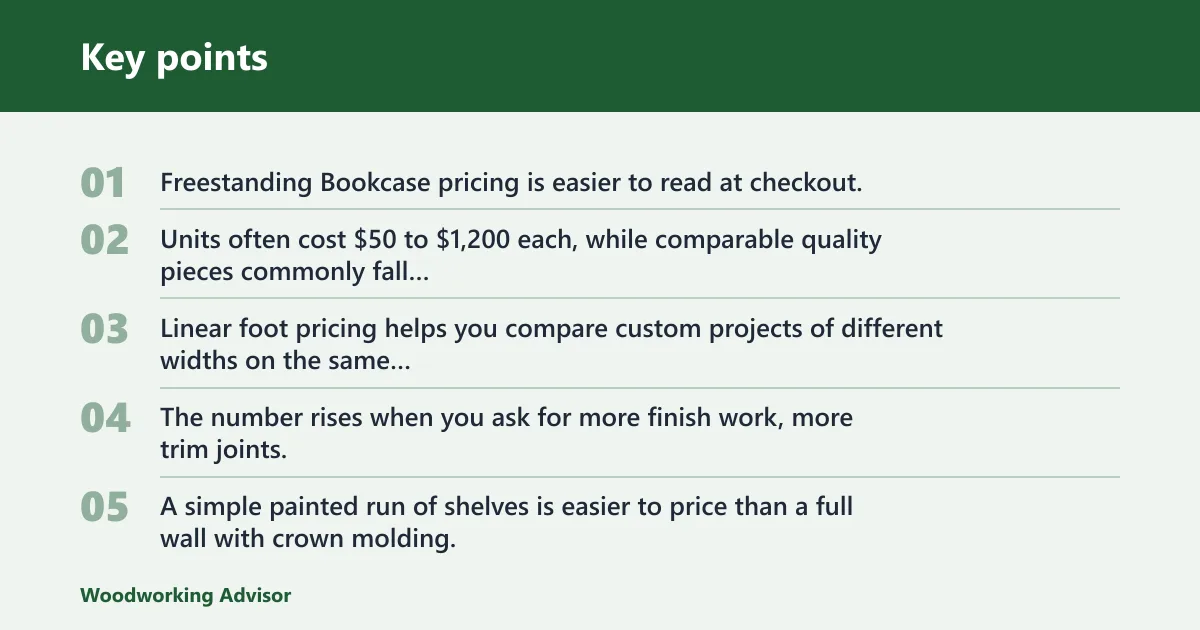
Freestanding Bookcase pricing is easier to read at checkout. Units often cost $50 to $1,200 each, while comparable quality pieces commonly fall between $400 and $4,000, depending on size and material.
Linear foot cost and finish complexity
Linear foot pricing helps you compare custom projects of different widths on the same basis. The number rises when you ask for more finish work, more trim joints, more built-in detailing, or a room that needs careful scribing around uneven walls.
A simple painted run of shelves is easier to price than a full wall with crown molding, base cabinets, and integrated lighting. That is why two projects with similar width can land in very different cost bands.
Hidden costs: trim, anchoring, moving, and repairs
Built-ins can carry extra cost in prep and finish work, while freestanding units can bring extra cost later if you move, replace damaged pieces, or need better anchoring. A low-cost anti-tip kit is cheap insurance for tall freestanding shelving, especially in homes with children.
Suppose you need one 84-inch bookcase in a child’s room. Anchoring it to studs may solve the safety issue for little money, while a built-in would add fabrication and installation cost that may not be necessary for that room.
How long installation and setup take
Built-In Shelves take longer because measurement, fabrication, and installation are separate steps. Freestanding Bookcase units usually win on speed because many arrive ready for same-day assembly.
Measurement and fabrication lead time
Custom millwork can take 8 to 12 weeks from measurement to installation, and built-in lead time can range from 2 to 6 weeks or more. That lag is normal when a unit must fit a specific wall, ceiling line, and finish schedule.
Installation days for built-ins
Once the parts arrive, built-in installation can take days, not hours, depending on trim, scribing, paint, and any repair work needed around the wall. That is a different job from setting furniture against a wall.
Same-day assembly for freestanding units
Freestanding units are typically ready the same day, with 1 to 3 hours often enough for assembly and placement. That shorter timeline matters when you need storage now, not after a fabrication queue.
Do built-in shelves add home value?
Built-In Shelves can help buyer appeal when they fit the room well, look intentional, and do not block future use. They do not guarantee a return on cost, and value depends on how well the shelves match the home’s style and floor plan.
When buyers tend to like them
Buyers usually respond well when built-ins solve a real space problem, such as a fireplace wall, library wall, or awkward alcove. Clean proportions and durable finish work matter more than sheer size.
When custom work can hurt resale
Overbuilt millwork can date a room or narrow its use if the shelves are too shallow, too specialized, or built around a TV cutout that no longer suits modern gear. A built-in that dominates the wall can also limit how future buyers arrange furniture.
Picture a living room where the shelves were built around a 42-inch TV opening and narrow media cubbies. If the next owner wants a wider screen or a different seating plan, that fixed layout can become a drawback rather than an asset.
Why fit and finish matter more than grandeur
Small gaps, uneven paint, or awkward transitions at the baseboard can weaken the effect of even expensive work. A simpler built-in that fits the room cleanly is often more persuasive than a dramatic one that looks forced.
Can you make a freestanding bookcase look built-in?
Yes. You can get much closer to a built-in look by filling the top gap, trimming the sides, and fitting the case to the wall as tightly as possible. The result still remains movable furniture, but it reads as part of the room.
Trim and top fill methods
Basic trim work can hide small clearance gaps above and beside the unit. A top filler strip, crown molding, or a simple painted board across the top can make the bookcase feel planned instead of temporary.
Surrounding casework and wall fit
A surrounding casework approach uses side panels, a face frame, or matching base trim to visually tie the unit to the room. That works best when the wall is reasonably square and the floor is level enough to avoid obvious gaps.
When a hybrid approach makes sense
A hybrid choice makes sense when you want a fixed look without committing to full custom millwork. It is a practical middle ground for owners who want better fit than flat-pack furniture but do not need a permanent wall installation.
Choose Built-In Shelves if… / Choose Freestanding Bookcase if…
Built-In Shelves are the better choice if you own the home, expect to stay at least 3 to 5 years, need a wall-specific solution, or want the room to carry custom storage as part of its structure. Freestanding Bookcase units are better if you rent, move often, need faster setup, or want to keep the budget lower and the layout changeable.
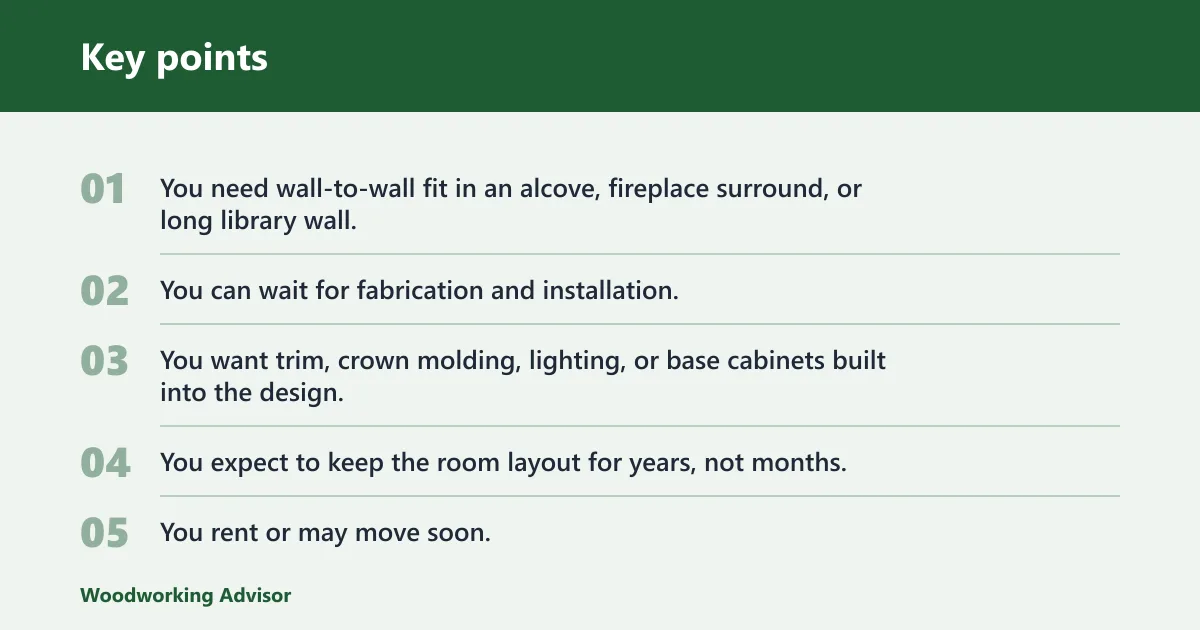
Choose built-In shelves if…
- You need wall-to-wall fit in an alcove, fireplace surround, or long library wall.
- You can wait for fabrication and installation.
- You want trim, crown molding, lighting, or base cabinets built into the design.
- You expect to keep the room layout for years, not months.
Choose freestanding bookcase if…
- You rent or may move soon.
- You want a same-day solution with a lower upfront cost.
- You need shelving that can be relocated or replaced without room repairs.
- You can anchor tall units to studs for child safety.
Safety, kids, and anchoring checks
Nearly 80% of furniture tip-over fatalities involve children age 5 and younger, so tall freestanding shelving should be anchored to studs with an anti-tip kit. That is a small cost compared with the risk, and it matters even when the unit looks steady on its own.
Built-ins avoid tip-over in the same way because they are fixed to the room, but that does not remove the need for sound framing and proper fastening. If the wall is weak, uneven, or full of obstructions, the safer answer may still be the furniture option with stud anchoring.


Frequently asked questions
Is it worth building built-in shelves instead of buying a bookcase?
It is worth building Built-In Shelves when the room will keep the same job for years and the wall needs custom fit. If you only need ordinary storage, a Freestanding Bookcase often gives you lower cost, faster setup, and more flexibility if the room changes later.
Are freestanding bookcases better for renters?
Yes, usually. Freestanding Bookcase units are easier to move, simpler to install, and cheaper to replace if your lease ends or the layout shifts. If the unit is tall, anchor it to studs with an anti-tip kit so you keep the mobility without giving up safety.
How much does a built-in bookshelf cost compared with a freestanding one?
Built-In Shelves typically cost $2,000 to $7,500+ installed, while freestanding units often cost $50 to $1,200 per unit. Comparable quality freestanding pieces commonly run $400 to $4,000, so the built-in premium is mainly about custom fit, fabrication, and finish labor.
How long do built-in shelves take to install?
Custom millwork can take 8 to 12 weeks from measurement to installation, and the built-in lead time can range from 2 to 6 weeks or more. Once the parts arrive, installation can take days, while a Freestanding Bookcase is usually ready in 1 to 3 hours.
Sponsored / affiliate links. As an Amazon Associate I earn from qualifying purchases. I may earn additional commission from eligible campaigns.