Drying Firewood with a Dehumidifier
A dehumidifier can dry small firewood batches indoors if the room is enclosed, airflow is steady, and the wood is already partly seasoned; for green wood, expect weeks to months, not days. Bad setup wastes electricity, keeps wood above the stove-safe moisture range, and can leave you with mold or smoldering burns. This guide explains the setup for a garage, shed, basement, or other enclosed room, how long drying may take, and when buying seasoned wood is the smarter choice.
What you’ll need


- Pin-type moisture meter for checking split interiors, not just the outer surface.
- Dehumidifier sized for the room in pints per day.
- Fan to move moist air toward the dehumidifier and through the stack.
- Thermometer to confirm the room stays in a warm range.
- Pallets, risers, or a rack to keep wood off the floor.
- Hose or pump for continuous drainage on long runs.
Can a dehumidifier dry firewood?
Yes, but only as a room-moisture system, not a wood-drying machine. It works best on small batches in a garage, shed, basement, or other enclosed space, with warm air, low relative humidity, and enough airflow for moisture to leave the wood. Freshly cut wood can be 50% moisture or higher, and burn-ready firewood is below 20% moisture.
How the drying process works
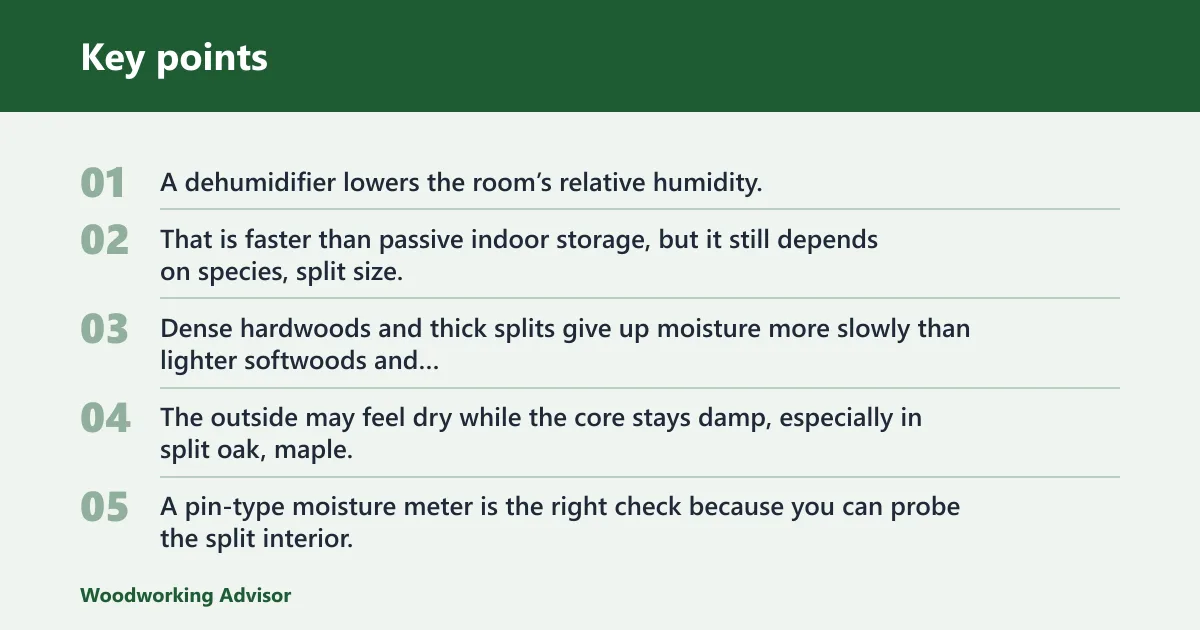
A dehumidifier lowers the room’s relative humidity, which helps moisture move from the wood surface into the air and then out of the room. That is faster than passive indoor storage, but it still depends on species, split size, and how wet the wood starts. Dense hardwoods and thick splits give up moisture more slowly than lighter softwoods and smaller splits.
Surface dryness can fool you. The outside may feel dry while the core stays damp, especially in split oak, maple, or other dense hardwoods. A pin-type moisture meter is the right check because you can probe the split interior. Check several pieces from different spots in the stack before you call it ready.
When it is worth the electricity
It makes the most sense when you already have a modest stack, a room you can keep warm and fairly sealed, and wood that is close enough to seasoned to benefit from indoor drying. If the room is cold, leaky, or oversized, the dehumidifier may run too long for too little gain. In that case, sheltered air-drying or buying seasoned wood is usually the better call.
What humidity should a room be for drying firewood?
Keep the room below about 50% RH, and many setups work best when you set the dehumidifier around 30–40% RH. Warmer air can help the unit pull more water from the air, so a common target is about 60–80°F, with many setups often doing better around 70–85°F. Cold garages are a common failure case because the unit moves less moisture.
How to dry firewood indoors
Set up the room so the dehumidifier dries air that can actually reach the stack. Use a loose stack, keep the wood off the floor, and keep the room warm enough for the unit to pull moisture from the air. Then measure the wood, not the guesswork.
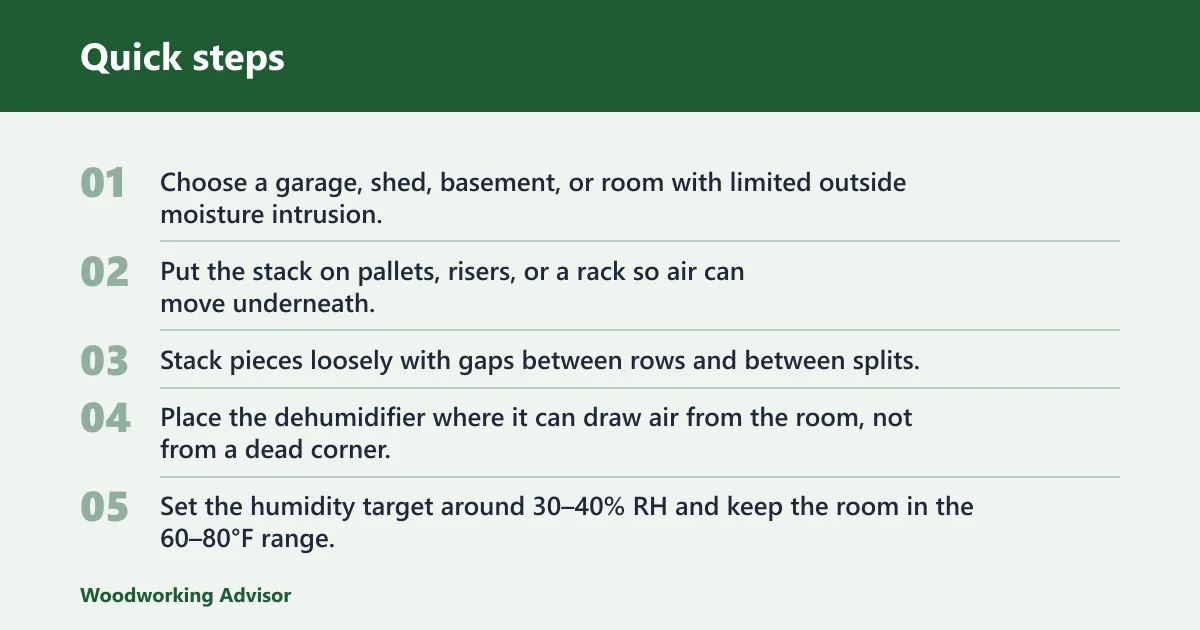
- Choose a garage, shed, basement, or room with limited outside moisture intrusion.
- Put the stack on pallets, risers, or a rack so air can move underneath.
- Stack pieces loosely with gaps between rows and between splits.
- Place the dehumidifier where it can draw air from the room, not from a dead corner.
- Set the humidity target around 30–40% RH and keep the room in the 60–80°F range.
- Add a fan so air moves through the stack and toward the dehumidifier.
- Use continuous drainage with a hose or pump if the unit will run for days.
- Check several pieces with a pin-type moisture meter, including the split interior.
- Keep drying until readings are below 20% moisture across multiple pieces.
- Recheck after adding more wood; do not assume the whole stack dries at the same rate.
Suppose a 200 square foot garage holds a modest stack of split pine that already sits near 25% moisture. A 30–40 ppd unit, a fan, and a steady 70°F room may bring the stack down in a few weeks. Change one variable to dense oak at a much higher starting moisture, and the same setup may take much longer.
A common first-timer mistake is stacking wood tightly to “save space.” That slows air movement, traps damp pockets, and leaves the center of the pile wet even when the outside pieces look dry.
Firewood decision table
Use this table to decide whether dehumidifier drying is worth the effort or whether you should wait or buy seasoned wood instead.
| Starting moisture | Wood species density | Stack size | Room temperature | Room sealing | Estimated drying time band | Electricity risk | Recommended method |
|---|---|---|---|---|---|---|---|
| Under 25% | Softwood or lower-density hardwood | Small batch | 60–80°F | Fairly sealed | Few weeks | Low to moderate | Dehumidifier |
| Under 25% | Dense hardwood | Small batch | 60–80°F | Fairly sealed | A few weeks to a couple of months | Moderate | Dehumidifier |
| 25–35% | Softwood | Small to medium stack | 70–85°F | Well sealed | A few weeks to a couple of months | Moderate | Dehumidifier |
| 25–35% | Dense hardwood | Medium stack | 60–80°F | Well sealed | Couple of months or longer | High | Air-dry first, then dehumidifier if needed |
| Above 35% | Any dense hardwood | Large stack | Below 60°F | Leaky | Unreliable | High | Buy seasoned wood |
| Above 50% | Any species | Any stack bigger than a small batch | Any cold room | Leaky or open | Very long | Very high | Buy seasoned wood or air-dry outdoors first |
How long does it take?
Drying time ranges from a few weeks to a couple of months for small, well-managed batches, and longer for denser hardwoods or larger splits. That lines up with the common advice that a dehumidifier speeds indoor drying but does not match kiln drying. The starting moisture level matters more than the outer appearance of the wood.
What slows the stack down
Big splits, dense species, a cold garage, an oversized stack, and a leaky room all stretch the timeline. A stack that starts near 50% moisture may still need a long indoor run before the core falls below 20%. If the room stays above 50% RH or the dehumidifier cannot keep up, progress stalls.
Signs the stack is stalled
The unit runs almost nonstop, the room feels cool and damp, and repeated meter readings stay flat in the middle of the splits. If that happens, increase warmth, tighten the room against outside air, improve airflow, or reduce the stack size. A larger stack may simply be too much load for the unit.
Common mistakes
Most failures come from poor room conditions, not from the concept itself. If the room is cold, too open, or overloaded with wood, the dehumidifier cannot lower humidity fast enough to matter.

- Using a cold room. Keep the space warm enough for the unit to work better, about 60–80°F.
- Choosing a leaky space. Seal obvious gaps so outside moisture does not keep replacing the dry air.
- Packing the stack tightly. Leave gaps and keep the wood off the floor on pallets or risers.
- Skipping fans. Move moist air through the pile so dry pockets do not form around the unit.
- Ignoring continuous drainage. A full tank can shut the machine off and break the drying cycle.
- Burning by appearance alone. Measure the split interior and keep going until readings are below 20%.
- Trying to rescue fully saturated logs indoors. If the wood was drenched or freshly cut and massive, indoor drying can be too slow and too costly.
Picture a basement with a 70 ppd unit and a tight stack of wet hardwood. If the room stays at 55°F and the meter still shows high moisture after repeated checks, the problem is not the meter. The room is too cold for that load, so the better fix is to reduce the stack, add warmth, or switch to air-drying first.
Prevention: Keep a short log of room temperature, RH, and moisture readings. That makes it easier to see whether the problem is the wood, the room, or the dehumidifier size.
Frequently asked questions
Can you dry firewood with a dehumidifier?
Yes, for small indoor batches in a controlled room. A good setup keeps the space warm, drives RH below about 50%, and uses a pin meter on split interiors until readings are below 20%. It is slower than kiln drying and works best on wood that is already partly seasoned.
Can you use a dehumidifier to dry firewood?
Yes, if you treat it as room conditioning rather than direct drying. Put the stack on pallets, add a fan, and use a hose or pump so the tank does not stop the cycle. A cold, open, or oversized space usually wastes power.
Will a dehumidifier help dry firewood?
It helps when the room is enclosed and warm enough for the unit to pull moisture from the air. That lowers the air’s moisture load and lets moisture leave the wood faster. It is most useful for small batches that are not fully soaked.
What size dehumidifier do I need for firewood?
For smaller rooms, 30–40 ppd is a common starting point. Medium spaces often need 50–70 ppd, and larger spaces may need 70–90 ppd or more. Match the unit to the room and the stack size, not just the floor area.
Do you need fans when drying firewood with a dehumidifier?
Yes. A fan moves moist air from the stack to the dehumidifier and reduces stagnant pockets. Without it, the room may dry unevenly and the center of the stack can stay damp long after the outside pieces look ready.
Will a dehumidifier dry wet wood?
It can help, but only if “wet” means damp or partly seasoned, not fully saturated. Freshly cut wood can be 50% moisture or higher, and that usually takes a long indoor run. If the wood was soaked by rain or stored poorly, air-drying first is often smarter.
Sponsored / affiliate links. As an Amazon Associate I earn from qualifying purchases. I may earn additional commission from eligible campaigns.