Do Wood Stoves Need Electricity?
No, a basic wood stove does not need electricity to burn. It needs dry firewood, steady draft, and safe venting, not power. If you rely on electric blowers, pellet feed systems, or powered circulation, a outage can cut heat output or stop the unit entirely. This guide explains which wood stoves work off-grid, what parts still need power, and how inserts and pellet systems change the answer.
Why the fire burns without power
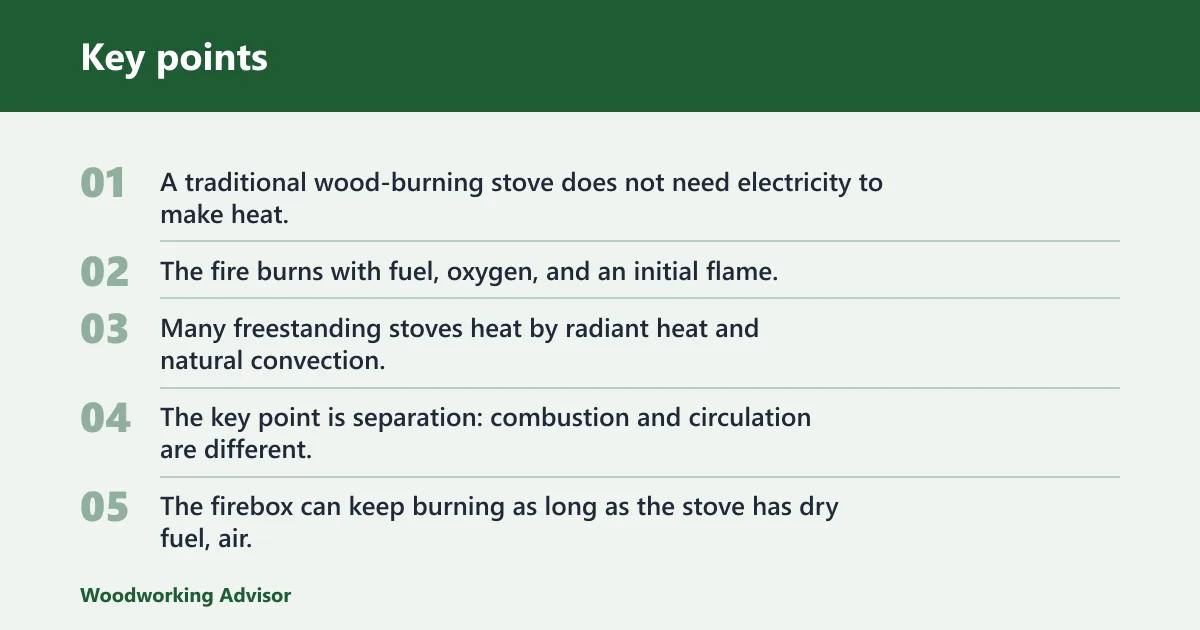

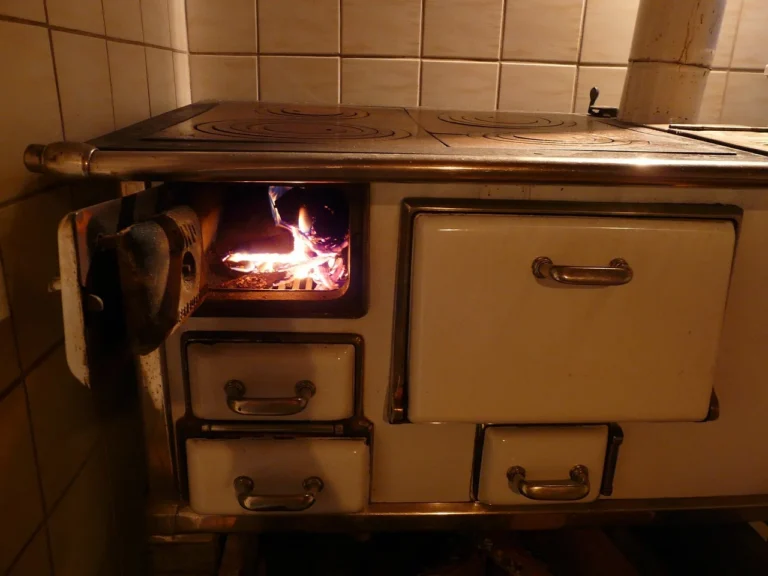
A traditional wood-burning stove does not need electricity to make heat. The fire burns with fuel, oxygen, and an initial flame, while chimney draft pulls combustion gases out of the firebox. Many freestanding stoves heat by radiant heat and natural convection, so they can keep working during a blackout.
Why the fire still burns in a blackout
The key point is separation: combustion and circulation are different. The firebox can keep burning as long as the stove has dry fuel, air, and a clear flue path. Electricity may help move heat around the room, but it is not the source of heat inside the stove.
That is why a power cut usually affects comfort before it affects combustion. The stove body still gets hot. What changes is how quickly that heat spreads beyond the area around the stove.
How a wood stove heats without power
Heat leaves the stove in two main ways. Radiant heat warms nearby surfaces and people directly. Natural convection warms air around the stove, and that warmed air rises on its own. The chimney draft then keeps combustion moving by drawing smoke and fresh air through the firebox.
Dry, seasoned firewood matters here. Wet fuel is harder to light, smokes more, and can make draft less reliable. If the wood is seasoned and the stove is vented correctly, the stove can burn without electric help.
Wood stove electricity table
| Setup | Power needed to make heat | Power needed for heat circulation | Outage behavior | Buyer warning signs |
|---|---|---|---|---|
| Freestanding wood stove | No, for the stove itself | No, unless an added blower is installed | Usually keeps burning and heating by radiation and natural convection | Check whether the model includes an electric blower or powered draft aid |
| Wood stove with blower | No, the fire still burns without grid power | Yes, the blower needs electricity | The firebox can keep heating, but heat movement slows when the blower stops | Look for blower wiring, plug-in requirements, and any thermostat on the fan |
| Wood insert | Usually no | Often yes, if it has a blower | The insert may still burn, but fan-assisted heat delivery can drop off | Watch for retrofit blowers, powered controls, and installation kits |
| Catalytic wood stove | Usually no | Usually no, unless accessories are added | Typically still burns during an outage, but any electric accessory will stop | Check for add-on blowers, thermostats, or draft-assist components |
| Pellet stove | Yes, for mechanical feed and ignition | Yes, fans move air through the unit | Usually stops during a power loss unless backed up by battery or a special feed design | Do not assume it acts like a wood stove |
| Gravity-fed pellet stove | Sometimes less than a standard pellet unit, but check the model | May still need a fan or control power | Partial-power designs vary and may still lose heat output during an outage | Read the manual closely before buying for off-grid use |
| Off-grid manual stove | No | No | Best fit for electricity-free heating, if the venting and installation are correct | Confirm that every part, including airflow aids, is manual |
What parts can use electricity?
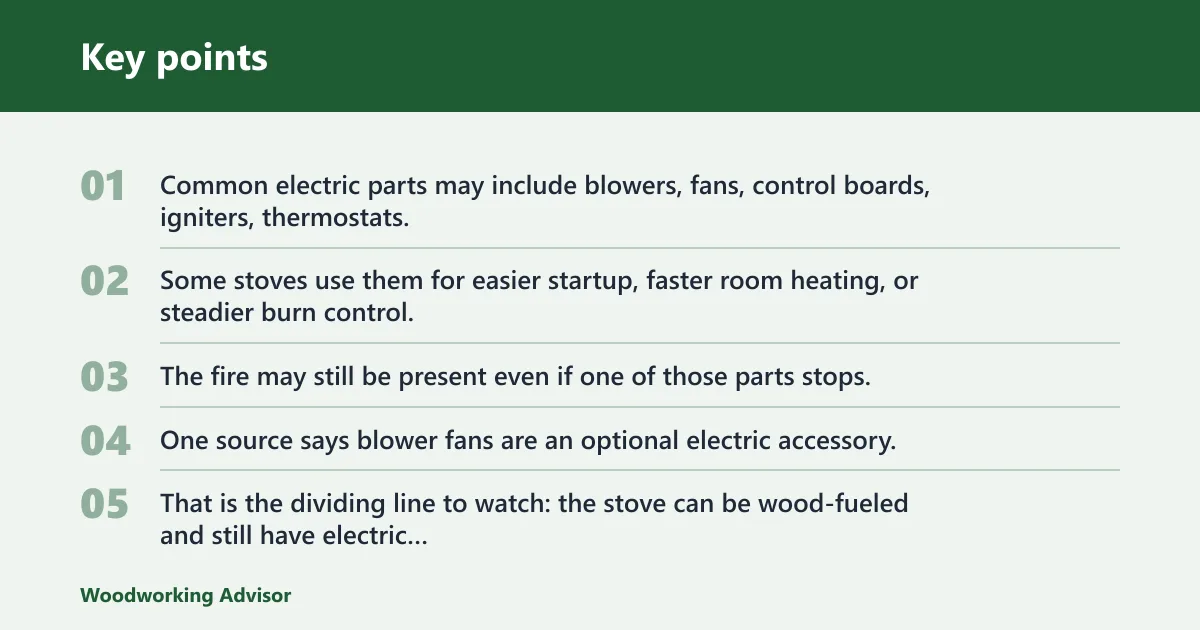
Common electric parts may include blowers, fans, control boards, igniters, thermostats, and powered draft components. Some stoves use them for easier startup, faster room heating, or steadier burn control. The fire may still be present even if one of those parts stops.
Blower fans are an optional electric accessory, and another says most traditional wood-burning stoves do not rely on electric igniters. That is the dividing line to watch: the stove can be wood-fueled and still have electric comfort parts attached to it.
Blowers and fans
A wood stove blower uses electricity to push warm air into the room. That helps distribute heat faster and more evenly. If power fails, the blower stops, but the stove body can still produce heat. A stove fan is different. It sits on top of the stove and does not need electricity.
That makes a stove fan useful for outage-ready setups. It will not move air as aggressively as a powered blower, but it can help spread heat without a plug.
Electric igniters and control boards
Some wood stoves and inserts include controls that regulate blower speed or monitor stove temperature. A few systems may also add powered draft parts. Those extras can improve convenience, but they create a dependence on electricity that a plain manual stove does not have.
If electricity-free use matters, check the exact model label and manual for any electrical accessories. A stove listed as wood-burning is not automatically free of powered parts.
Do wood stove inserts need electricity?
Wood fireplace inserts typically will not require electricity, but that answer changes if the insert has a blower or other powered accessory. Many inserts burn wood without power, yet retrofit fans, thermostatic controls, and some installation kits add an electrical dependency that matters during outages.
Insert blower exceptions
If a wood insert has a blower, it will typically require electricity. The firebox can still burn, but the insert may lose much of its forced-air heat distribution. In practice, that means the room closest to the insert may stay warm while heat transfer to other areas slows down.
Suppose you are choosing between a freestanding stove and a flush insert for a living room. The insert may look cleaner in the wall, but a built-in blower can make it less suitable if you want heat output that keeps working without a plug.
What to check in the manual
- Look for wording on electric blowers, fans, igniters, or thermostats.
- Check whether the insert can burn with no powered parts connected.
- Confirm the venting method and draft requirements.
- Verify whether any optional kit becomes standard in the installed setup.
- Read the outage guidance before you buy, not after installation.
A common first-timer mistake is assuming an insert behaves like a plain stove because it burns wood. The fire source is similar, but the heat delivery package can be very different.
Do pellet stoves need electricity?
Yes. Pellet stoves typically require electricity for the hopper and mechanical components, including the auger, fans, control board, and igniter. That makes them different from a traditional wood stove. Some models may offer battery backup or gravity-fed features, but standard pellet systems depend on power to operate normally.
Auger, fans, control board, and igniter
The pellet stove article lists startup power at 300-600 W and running low power at 50-150 W. That electric demand is tied to mechanical feeding and airflow control. The auger feeds fuel mechanically, while the fans and control board regulate combustion and room heat.
Because of that setup, a pellet stove is not the same as a wood-burning stove for outage planning. If grid power drops, the unit may stop feeding fuel and shut down.
Battery or gravity-fed exceptions
Some pellet models use battery backup, and some gravity-fed designs reduce the amount of powered feed hardware. Those are exceptions, not the norm. Even then, you should check whether the igniter, fans, or controls still need electricity, because partial-power systems can fail in stages.
Do wood pellet stoves need electricity? In most cases, yes. That answer is short because the stove’s feeding and burn control depend on power in a way a traditional wood stove does not.
Will it keep heating during an outage?
A traditional wood stove usually keeps heating during a power outage if the fire is already burning or can be started safely. The firebox, chimney draft, and radiant heat still work. What may stop is the blower, fan, thermostat, or other powered parts that help move heat through the house.
What still works when the blower stops
If the blower fails, the stove does not automatically go cold. The fire can continue, and the stove body still radiates heat. You may simply get less whole-room circulation. In a small open plan, that may be acceptable. In a closed layout, the difference can be large.
Picture a roughly 1,400-square-foot house with one stove in the main room and a door-heavy hallway. The stove can still burn through the outage, but the bedrooms may cool off sooner because the blower is no longer pushing warm air into them.
Outage-ready features to look
For power-outage resilience, look for a plain manual stove, a stove fan, and simple venting. Avoid models that depend on powered draft, electric ignition, or mandatory blower operation. If you want off-grid heating, manual operation matters more than a long feature list.
Wood furnaces need electricity in many configurations because they often rely on blowers and controls, so do not assume every wood-heating appliance fits the same off-grid use case. Check the exact appliance type before you buy.
Buyer warning signs for off-grid use
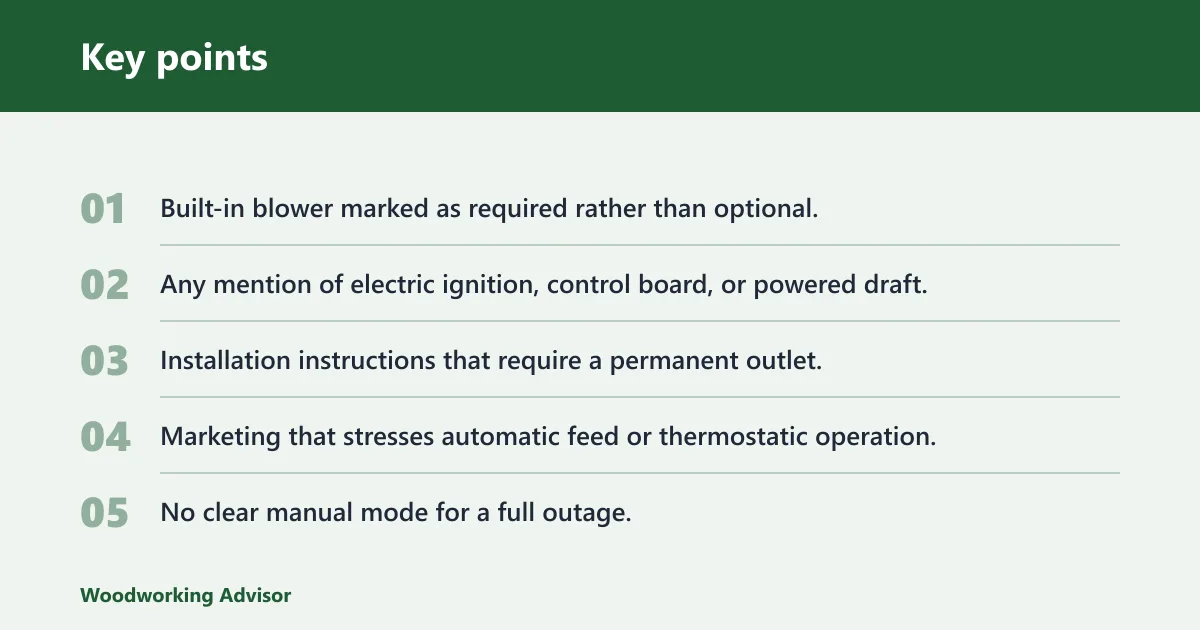
- Built-in blower marked as required rather than optional.
- Any mention of electric ignition, control board, or powered draft.
- Installation instructions that require a permanent outlet.
- Marketing that stresses automatic feed or thermostatic operation.
- No clear manual mode for a full outage.
If electricity-free operation matters, choose the simplest stove that meets your heating needs. The more automation you add, the more likely one failed part will reduce output during an outage.
Frequently asked questions
Do wood stoves use electricity?
Most traditional wood stoves do not use electricity to burn firewood. They rely on fuel, oxygen, draft, and a safe flue. Electricity only enters the picture when you add a blower, fan, thermostat, or other accessory that moves heat or controls airflow.
Does a wood burning stove need electricity?
A basic wood burning stove does not need electricity. It can run on firewood and chimney draft alone. The exception is any model with powered accessories, such as a blower or draft assist, which can change how the stove behaves during a blackout.
Do catalytic wood stoves require electricity?
Usually, no. A catalytic wood stove can still burn without electricity if it is a manual model. The caution is accessories. If the stove has an electric blower, control panel, or powered draft part, those components may still need power even if the catalytic system itself does not.
What parts of a wood stove need power?
The parts most likely to need power are the blower, stove fan on some models, control board, igniter, thermostat, and powered draft equipment. The firebox itself does not need electricity. That is why it helps to separate the stove’s combustion function from its convenience features.
Will a wood stove still heat the house during a power outage?
Yes, a traditional wood stove can still heat during a power outage, but heat delivery may change. The fire continues, yet any blower or powered circulation stops. In a compact, open layout, the difference may be modest. In a larger or divided home, the heat spread can drop fast.
Sponsored / affiliate links. As an Amazon Associate I earn from qualifying purchases. I may earn additional commission from eligible campaigns.