Epoxy Not Curing on Wood: What Went Wrong and Why
If epoxy stays sticky, soft, or rubbery after a day or two, warm the wood gently and give it more time; if it is still tacky after a few days, scrape it off and start over. I have salvaged a few jobs this way. Bad cures waste time, trap a weak bond, and can leave a repair that fails under clamping, sanding, or finish. This guide shows how to diagnose each symptom, find the cause, and choose the fastest fix.
This guide is part of our Wood glue essentials: types, uses, and cure times series.
Why epoxy fails on wood


Epoxy is a family of thermoset materials used as adhesives and coatings. Commercial epoxy adhesives mix resin and hardener, then cure by cross-linking with a curative. On wood, the bond can fail even when the mix looked fine because the surface, moisture, and temperature can interrupt that reaction.
What epoxy needs to cure
Two-part epoxy adhesive keeps resin and hardener in separate containers until use, then they are mixed in the right ratio. After mixing, pot life begins. That working window can run from minutes to hours, while full cure takes longer. Some epoxies reach maximum strength in a few hours; others take about a day or longer.
Why wood changes the outcome
Wood is porous, moves with moisture, and is rarely uniform. End grain drinks more resin than face grain. Old finish, dust, oil, and damp fibers block contact. Oily species can slow wetting. Cold boards can slow the chemical reaction. A mix that cures on a clean bench may misbehave once it meets a dirty, damp plank.
Why a bond can fail even when the mix looked right
A glossy puddle can hide a weak joint. Epoxy may skin over on top while staying soft below. It may also cure unevenly if the hardener was not blended through the resin. If the wood surface was greasy, wet, or sealed with old finish, the epoxy may harden as a film without gripping the wood well.
According to Epoxy: Everything you need to know about it – Loctite — Loctite notes one wood epoxy product sets in about 10 minutes.
Why is my epoxy not curing on wood?
The first things I check are mix ratio, mixing quality, wood temperature, wood moisture, and surface contamination. If the epoxy is still within its normal cure time, warmth may solve it. If it is far past the label’s cure window and still sticky, the mix or substrate likely failed and a reset is usually smarter.
The fastest causes to check first
- Confirm the resin and hardener were mixed in the product’s exact ratio.
- Check whether the parts were stirred until the color and texture were uniform.
- Feel the wood and the room. Cold slows cure.
- Check for damp wood, condensation, dust, grease, finish, or dirt.
- Compare the symptom with the cure stage. Sticky skin is different from a fully uncured mass.
How to separate mix errors from wood problems
Mix errors usually show up through the whole batch. The epoxy stays sticky in the cup, in the joint, and on the spreader. Wood problems often show a surface issue: the top may look partly set while the bond beneath feels weak, rubbery, or uneven. Damp stock and oily wood often point to substrate trouble.
When the clock is still working in your favor
If the repair is only a few hours old, the cure may still be in progress. Pot life and cure time are different. Pot life is the working window after mixing. Cure time is the period until the epoxy hardens. Cold conditions can stretch that time, so a little patience can still save the job.
Sticky, soft, gummy, cracked, or fully uncured: what the symptom means
The symptom tells more than the label does. A sticky surface often means the top layer set faster than the body. A soft or gummy mass points to an incomplete reaction. Cracked or wrinkled skin can mean shrinkage, heat swings, or a skin that cured before the mass beneath. A fully uncured mass usually means a major mix or temperature problem.
Sticky surface only
This often means the top has skin over, but the layer below is still moving. It can happen with cool wood, a thick puddle, or a batch that was only partly mixed. If the lower layer firms up when warmed, the repair may still be salvageable.
Soft or rubbery body
This usually points to incomplete cross-linking. The epoxy may indent under a fingernail and bend rather than chip. Wrong ratio, poor mixing, cold conditions, or damp wood can all leave that rubbery feel. It is a warning sign, not a finish-ready state.
Cracked or wrinkled skin
A cracked skin can form when a thin top layer cures faster than the mass below, or when the joint heats and cools unevenly. It can also happen if excess hardener or resin sits in pockets. The surface may look cured, but the body can still be weak underneath.
Fully uncured mass
If the epoxy still behaves like paste or syrup after a full cure window, the job usually needs removal. That symptom points to a severe mix error, badly blended components, or a substrate and temperature condition that prevented cure from getting started.
| Symptom | Likely causes | Salvage or restart | Next action |
|---|---|---|---|
| Sticky surface only | Cool room, thick film, partial cure, light mix error | Salvage if the mass is firming | Warm to 70–80°F, keep dry, wait 24 hours, then test with a fingernail |
| Soft or gummy epoxy | Wrong ratio, poor mixing, damp wood, cold wood | Salvage only if it is clearly hardening | Warm and recheck; if it stays rubbery after 72 hours, remove and redo |
| Cracked or wrinkled epoxy | Skinning, uneven cure, thick buildup, heat swing | Restart if cracks go through the joint | Scrape loose material, sand to sound edges, and reapply after prep |
| Fully uncured mass | Major ratio error, unmixed resin or hardener, cold and wet substrate | Restart | Remove all uncured epoxy, clean the wood, dry it, then begin again |
What happens if epoxy is mixed wrong?
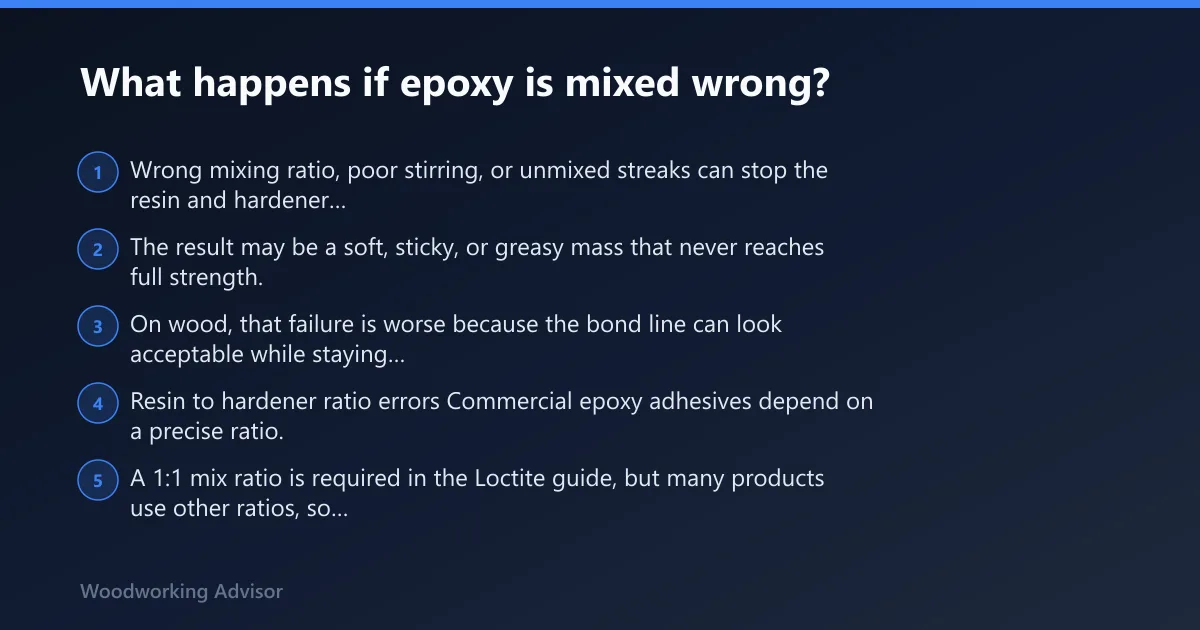
Wrong mixing ratio, poor stirring, or unmixed streaks can stop the resin and hardener from cross-linking properly. The result may be a soft, sticky, or greasy mass that never reaches full strength. On wood, that failure is worse because the bond line can look acceptable while staying weak inside.
Resin to hardener ratio errors
Commercial epoxy adhesives depend on a precise ratio. A 1:1 mix ratio is required in the Loctite guide, but many products use other ratios, so the label comes first. Too much of either component leaves reactive material unbalanced, and the cross-linking reaction may stall.
Poor mixing and unmixed streaks
Even a correct ratio can fail if the sides and bottom of the cup stay unmixed. Hardener / curative must be blended evenly through the resin. If the batch still shows clear swirls, sticky streaks, or cloudy ribbons, those pockets may stay soft long after the rest begins to harden.
What wrong mix looks like on wood
On wood, a bad mix often feels inconsistent. One edge may harden while the center stays tacky. A glue line can dent in one spot and chip in another. If the batch was mixed badly enough, no amount of waiting will fix the chemistry.
Will epoxy cure if the wood is damp or cold?
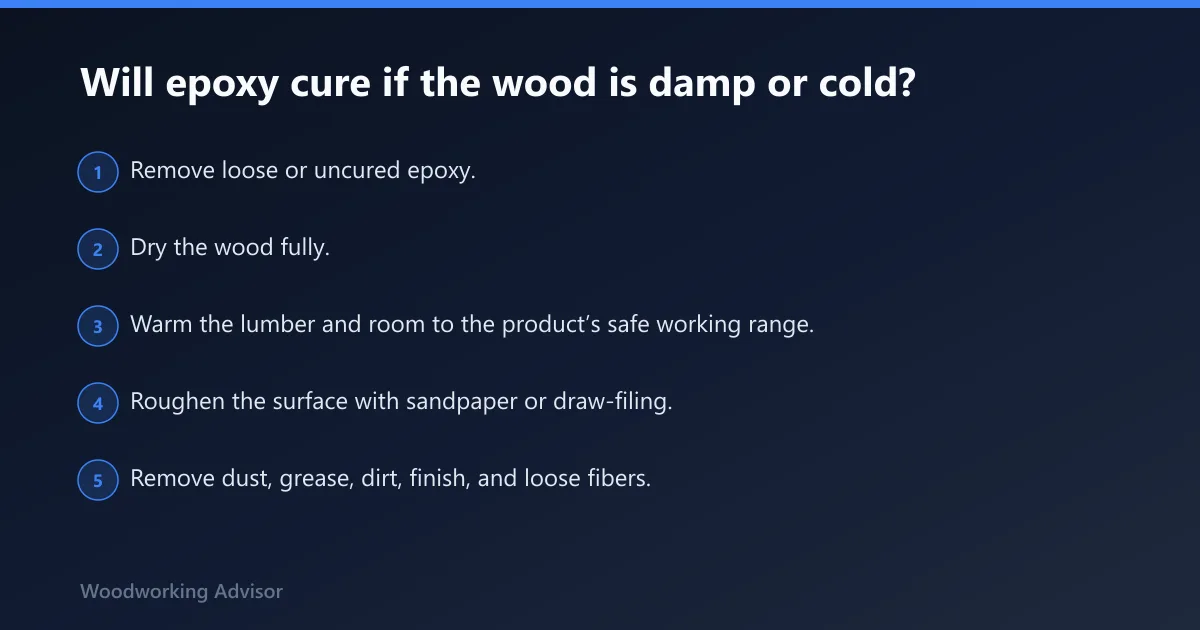
Epoxy may still harden in a damp or cold space, but cure reliability drops fast. Damp wood can interfere with wetting and adhesion. Cold wood and cold air can slow the reaction enough that the repair stays tacky far longer than expected. Dry, warm stock gives the best chance of a clean cure.
How wood moisture blocks adhesion
Wet or damp wood should be treated as a problem, not a minor detail. Moisture can sit on the surface, move through open grain, or get trapped under the epoxy. That interrupts contact between resin and wood fibers. On some pieces, end grain drinks the mix while the damp surface still rejects it.
How low temperature slows or stalls cure
Cold conditions slow the chemical reaction. A shop that feels merely cool can still leave epoxy undercured, especially on cold lumber. The material may seem alive for hours, then stay rubbery because the reaction never got enough heat to keep moving. If the wood is cold, warming the whole repair area matters.
What to do before trying again
- Remove loose or uncured epoxy.
- Dry the wood fully.
- Warm the lumber and room to the product’s safe working range.
- Roughen the surface with sandpaper or draw-filing.
- Remove dust, grease, dirt, finish, and loose fibers.
- Mix a fresh batch and spread it evenly.
How long should epoxy take to cure on wood?
Use the product label first, because cure time varies by formulation. Some epoxies set in about 10 minutes, while others reach full cure in several hours or under 24 hours. Pot life begins right after mixing and is much shorter than full cure. Cold wood, thick films, and damp stock extend both.
Pot life versus cure time
Pot life is the working window after mixing. Cure time is the period until the epoxy reaches usable hardness or full strength. A batch can be out of pot life long before it is fully cured. That is why a repair may stop spreading well, yet still need many hours before sanding.
When waiting longer makes sense
Wait longer if the epoxy is getting firmer each hour, the room is cold, and the wood was dry and clean. If the joint is still improving after 24–48 hours, gentle warmth may finish the cure. If it is still not changing after a few days, waiting longer is often wasted time.
Can I sand or repaint epoxy that never fully cured?
Only sand or paint epoxy that is hard, stable, and no longer gummy under pressure. If it drags on sandpaper or rolls into a sticky ball, it is not ready. Soft epoxy clogs abrasives and traps finish. If it never truly cured, remove it first and start again on sound wood.
When sanding is safe
Sanding is safe when the epoxy is firm enough to produce dust, not strings. The surface should feel hard under a fingernail. At that point, a light scuff can help with recoating. Any soft or rubbery section means the repair is still in failure territory.
When sanding just gums up the surface
If the paper loads instantly, the batch is still undercured. Heat from sanding can make the problem worse by softening the surface further. Stop early rather than grind the same sticky spot into a larger mess. That usually saves more time than pushing through.
When to strip it and start over
If the epoxy stays sticky after 72 hours, or if a screwdriver can still dig through it, strip it off. Scrape first, then sand back to clean wood. Rebuild the joint only after the surface is dry, dull, and free of residue.
Is epoxy good for woodworking repairs?
Yes, epoxy is a strong choice for woodworking repairs when the wood is dry, clean, and properly prepared. Epoxy resins are a family of two-part adhesive resins used in woodworking, including artistic woodworking. It bonds well to many substrates, but it does not forgive bad surface prep or poor curing conditions.
Where epoxy earns its keep
Epoxy can work well for gap filling, cracked edges, damaged corners, and repairs where clamping pressure is limited. It can also work on awkward grain and odd-shaped parts. The bond is only as dependable as the mix, the prep, and the cure conditions.
Where epoxy struggles on wood
It struggles on oily species, damp stock, dust-covered surfaces, and old finish. End grain can soak up too much resin if the surface is not sealed or prepped well. A bad bond line may look fine for a day and fail later when sanding or loading starts.
Frequently asked questions
Will epoxy cure if the wood is damp?
Sometimes it will harden slowly, but damp wood often interferes with adhesion and cure reliability. Moisture on the surface or in the grain can block contact and weaken the bond. For a repair worth keeping, the wood should be dry before epoxy goes on.
Can cold temperatures stop epoxy from curing?
Yes. Cold can slow the reaction enough that the epoxy stays sticky or rubbery far longer than expected. Cold wood is a common culprit because the joint itself stays too cool to cure well. Warm the area before and after application if the product label allows it.
How do I fix sticky epoxy on wood?
If the batch is still improving, warm the wood, keep it dry, and wait. If it is still sticky after 72 hours, do not sand through it or paint over it. Scrape off the failed epoxy, clean the wood, roughen the surface again, and apply a fresh batch.
Sponsored / affiliate links. As an Amazon Associate I earn from qualifying purchases. I may earn additional commission from eligible campaigns.