Health and Safety in a Garage Workshop
A safe garage workshop keeps combustibles away from heat, controls dust at the source, dries floors and stored lumber, and gives every tool its own sound electrical setup. Ignore those basics and winter makes the same space riskier: cold materials sweat, floors stay damp longer, cords get brittle, and enclosed air holds fumes and dust. This guide shows how dust collection, heat, moisture, cords, and storage should work together in a small garage shop.
Why garage workshop safety changes in winter
Winter changes the hazard mix in a garage workshop because cold air, condensation, and heating equipment all affect the same small space. Slippery floors, cluttered walkways, and poor footing cause many garage injuries, and wet surfaces make those dangers worse. Add dust, finishes, and fuel-burning heat, and the room needs a fresh risk check.
Cold weather also changes how materials behave. Lumber brought in from a damp shed can stay wetter longer. Finishes, solvents, and cleaners may evaporate more slowly in cool air, while a heater can push vapours and fine dust toward an ignition source if airflow is poor.
Say your garage door stays shut on a rainy evening and the concrete floor is damp near the bench. A small pile of offcuts near a space heater can turn a routine sanding session into a fire and trip hazard at the same time. The fix is not one action. It is layout, ventilation, heat control, and housekeeping together.
Cold starts, condensation, and slick floors
Condensation often appears first on metal tools, plastic cases, and the slab itself. That moisture can make a floor slick before anyone notices it. Slip-resistant flooring or anti-slip mats at workstations help, but they do not replace prompt cleanup or clear walkways.
Keep a mop, absorbent pads, or rags where spills are likely to happen, then deal with water, finish drips, and tracked-in slush immediately. Good lighting matters too, especially in entry paths and around the bench. If you cannot see a puddle, you cannot avoid it.
Heat sources, dust, and enclosed-air risk
Heat changes the risk picture because warm air can move dust and fumes through the shop. A heater placed too close to stored timber, rags, or solvent containers raises fire risk. In an enclosed garage, poor ventilation can also let fumes build up where you breathe and where ignition can occur.
Fine dust is the part most people miss. A shop vacuum or dust collector rated for fine dust helps at the source, but it works best when you keep sparks, open elements, pilot flames, and hot exhaust out of the same airflow. That separation matters more in winter, when doors stay closed longer.
When a winter setup needs a fresh risk assessment
Review the shop whenever the layout changes, the process changes, or the people using it change. A risk assessment should identify slips, trips, falls, electrical risks, fire hazards, and substances, then assign responsibility for correcting each item. It is not a one-time form.
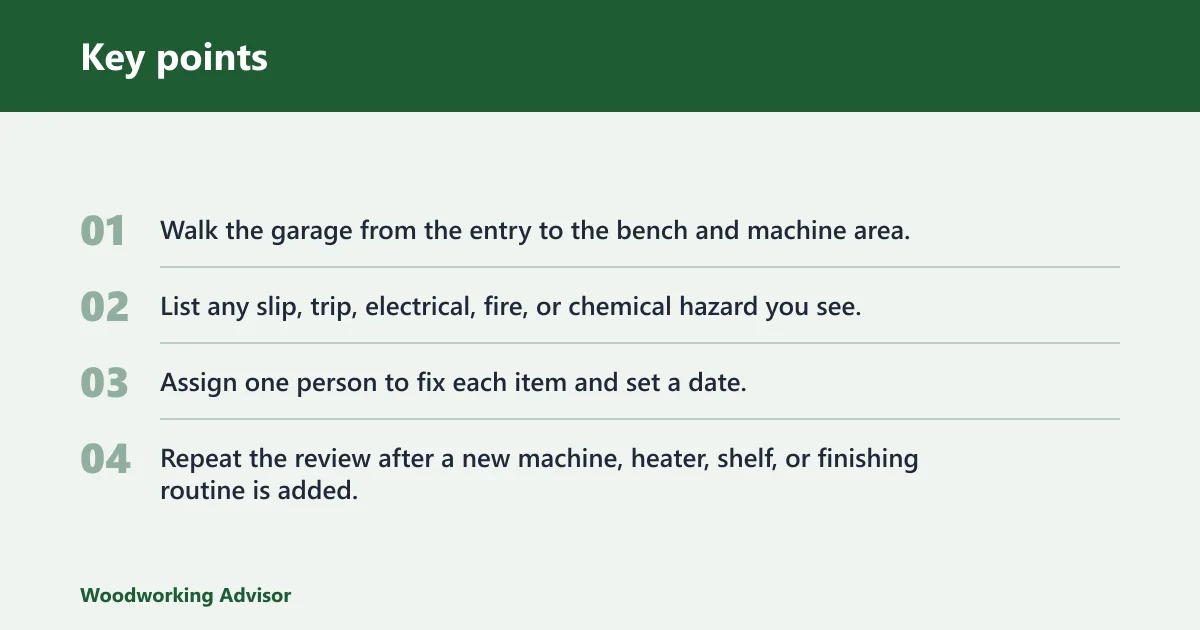
- Walk the garage from the entry to the bench and machine area.
- List any slip, trip, electrical, fire, or chemical hazard you see.
- Assign one person to fix each item and set a date.
- Repeat the review after a new machine, heater, shelf, or finishing routine is added.
Garage workshop safety checklist
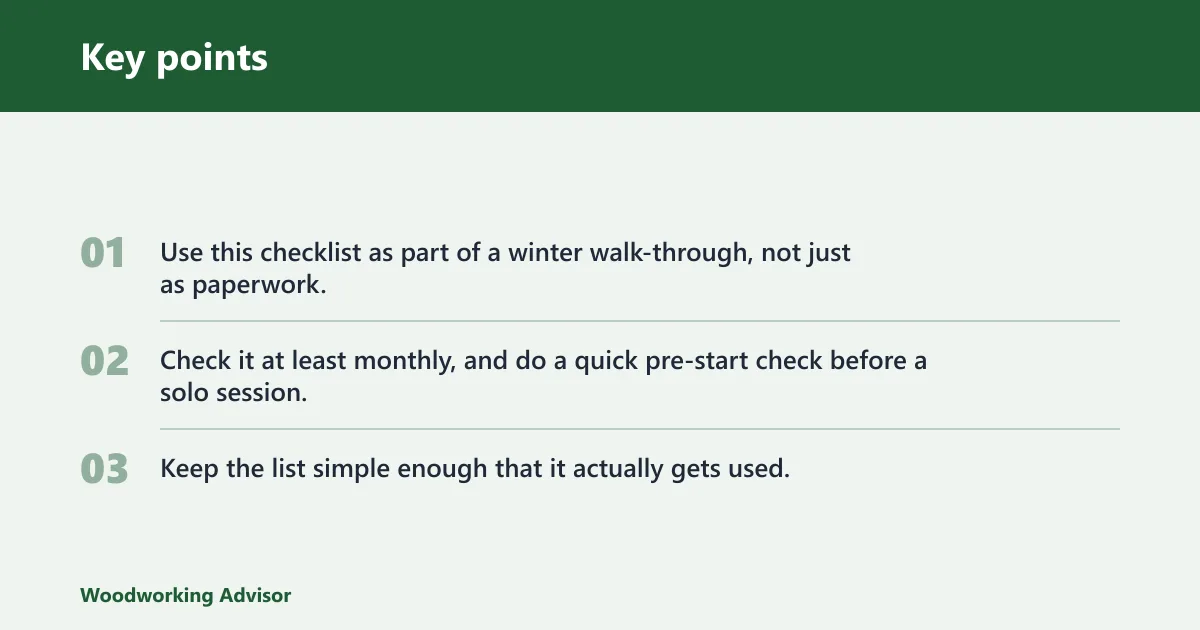
Use this checklist as part of a winter walk-through, not just as paperwork. Check it at least monthly, and do a quick pre-start check before a solo session. Keep the list simple enough that it actually gets used.
| Hazard | Why it is worse in winter | What to check | Pass/fail criteria |
|---|---|---|---|
| Dust ignition | Doors stay closed longer, so fine dust lingers near heaters and tools. | Collector or shop vacuum rated for fine dust; ignition sources kept out of dusty airflow; dust removed from ledges and machine bases. | Pass if dust is captured at source and no heat source sits in dust-laden air. Fail if dust piles near a heater or motor. |
| Heater clearance | Temporary heaters are used more often when the garage is cold. | Clear space around the heater; cords not draped over it; nearby finishes, rags, and lumber moved away. | Pass if nothing combustible is stored close to the heater. Fail if any rag, can, box, or board crowds the unit. |
| Cord management | Wet floors and bulkier winter clothing increase trip risk. | Cords routed away from walkways and cutting paths; no crushed, frayed, or taped-over damage; high-load reels fully unwound when needed. | Pass if cords stay flat, visible, and undamaged. Fail if a cord crosses a wet path or runs under a mat or door. |
| Ventilation and air exchange | Enclosed air traps solvent vapours, dust, and heater exhaust. | Fresh air path available; exhaust or fumes not recirculating; finish work done with ventilation running; no strong lingering odour. | Pass if fumes clear quickly and the workspace does not smell strongly of solvents. Fail if air feels stale or haze remains. |
| Wet floors | Snow, rain, and condensation are tracked in on boots and lumber. | Entry mat, mop, absorbent materials, and clear walkway; no puddles near machines or outlets. | Pass if floors are dry enough for stable footing. Fail if you must step around wet patches to reach the bench. |
| Storage of finishes and solvents | Cool storage areas may be forgotten, while heater use increases fire risk. | Lids tight; containers labeled; storage away from heat; spill kit available; PPE ready for handling and cleanup. | Pass if liquids are sealed and stored away from ignition sources. Fail if open cans, leaking bottles, or loose rags are present. |
| Lone-working emergency readiness | Winter sessions are often done after dark, with fewer people nearby. | Phone charged; emergency contact known; first aid kit accessible; someone told the expected finish time; clear exit path. | Pass if help can be reached quickly and the exit is unobstructed. Fail if the phone is dead or the door is blocked. |
What PPE should you use?
Use PPE for the task, not as a substitute for control measures. Eye and face protection, hearing protection, respiratory protection, task-appropriate gloves, and slip-resistant footwear all have a place in a winter garage shop. Gloves should stay away from rotating tools and pinch points when bare hands are safer for control.
Eye and face protection for cutting and sanding
Use safety goggles or a face shield whenever chips, sawdust, or splinters can fly toward you. Eye protection is especially important when cutting small stock, drilling overhead, or blowing dust out of a machine. For many woodworking tasks, a face shield supplements goggles rather than replacing them.
Hearing and respiratory protection for noisy, dusty work
Table saws, routers, planers, and dust extractors can all push noise into a range that warrants hearing protection. Use hearing protection whenever the tool requires it or when the noise level becomes hard to ignore. Respiratory protection matters most for sanding, sweeping fine dust, and applying finishes in an enclosed space.
The garage workshop article facts list PPE examples such as gloves, safety goggles, and respiratory masks. That is a useful minimum, but the right choice still depends on the task. A sanding session needs different respiratory control from a quick saw cut, and finish work needs better air movement than a dry assembly job.
Gloves, footwear, and when bare hands are safer
Wear slip-resistant footwear because winter floors are more likely to be damp. Gloves help with rough lumber, solvents, and cleanup, but they are not right for every task. A glove caught by a spinning bit or blade can pull a hand toward the cutter, so bare hands are safer whenever the work demands close contact with moving parts.
Picture a small garage with a benchtop planer at one end and a slushy boot track at the door. Slip-resistant shoes help with the floor hazard, while gloves only make sense for handling rough stock or cleaning dried finish. The safe choice changes with the task.
How do you control dust, fumes, and chemicals?
Control starts with source capture and ends with storage. In a garage woodshop, ventilation, safe storage, spill response, and exposure reduction all matter because fuels, oils, solvents, and cleaning agents can create fumes and fire risk in the same room where dust collects.
Ventilation and air exchange in an enclosed garage
Ventilation reduces fumes from chemicals and exhaust, and it matters most in enclosed garages where the air does not move on its own. Open a fresh air path when using solvents, cleaning agents, or finishes, and do not rely on a single fan that merely stirs the same air around.
Where the space is tight, use local extraction at the bench or machine plus general air exchange for the room. That combination helps with dust and vapours at the same time. If the garage smells strongly of finish or cleaner after the job is done, the air exchange is not enough.
Safe storage for finishes, solvents, oils, and cleaning agents
Hazardous substances controls should cover fuels, oils, solvents, and cleaning agents with ventilation, safe storage, spill kits, and PPE. Keep lids closed, containers labeled, and liquids away from heaters or ignition sources. Store rags so they are not left in a heap near dust or heat.
Good housekeeping supports those controls. Put bottles back where they belong, keep the floor clear, and do not let half-used products migrate from the bench to the floor. A simple shelf with marked zones is safer than loose storage under a saw table.
Spill response and exposure reduction
If something spills, mop it or clean it up immediately. Do not walk through it and track it across the room. Keep a spill kit ready for finish drips, solvent leaks, or oily rags, and make sure the kit matches the materials actually stored in the garage.
Exposure reduction also means using the smallest practical amount of product and keeping your face out of the vapour path. If a finish requires more ventilation than the garage can provide, stop and move the task or improve the airflow before continuing.
Fire and heater safety
Fire risk rises when dust, heat, and solvents share the same small space. Keep ignition sources out of dust-laden air, maintain clear access to fire extinguishers, and leave escape routes open. Fire preparedness checks should include extinguishers that are accessible and in working order, plus a simple emergency procedure everyone knows.
Keep ignition sources out of dust-laden air
Dust ignition is a real winter issue in a garage workshop because doors stay shut and fine dust hangs around longer. Keep hot bulbs, open flames, exposed elements, and spark-producing equipment away from the airflow that carries dust. A fine-dust collector works better when the heater is not sharing the same stream.
Do not store sweeping piles or sanded residue near the heater. Clean the machine base, the floor under the bench, and the corners where dust settles. That small routine lowers the amount of fuel available if something does ignite.
Maintain heater clearance and access to extinguishers
Heater clearance should be checked whenever the shop is rearranged. Combustibles belong away from the heater, and nothing should block the route to the door or the fire extinguisher. Fire extinguishers should be accessible and in working order, and they are commonly included in regular fire-preparedness checks.
Clear escape routes matter as much as the extinguisher itself. Valvoline’s fire-safety advice also points to marked escape routes, which fits a garage workshop well. If a door or walkway is blocked by stored stock, the plan has already failed.
Simple emergency actions
Keep emergency procedures short enough to remember under stress: shut off the heat if safe, use the extinguisher only if the fire is small and you have a clear exit, and leave immediately if the fire grows or smoke builds. A home shop does not need a complex plan to need a clear one.
First aid also belongs here. The garage should have an accessible first aid kit, and supplies should be checked regularly. The sourced guidance says at least two first aid kits should be available in the garage, which is a sensible target if one kit is near the door and another stays near the bench.
Electrical safety and cord management
Inspect wiring and equipment for damage, confirm suitable earthing where applicable, use RCD protection where required by local practice, and keep cords out of walkways and cutting paths. Electrical risk climbs in winter because damp floors, temporary heaters, and extra extension leads often appear at the same time.
Inspect cords, plugs, outlets, and tool leads
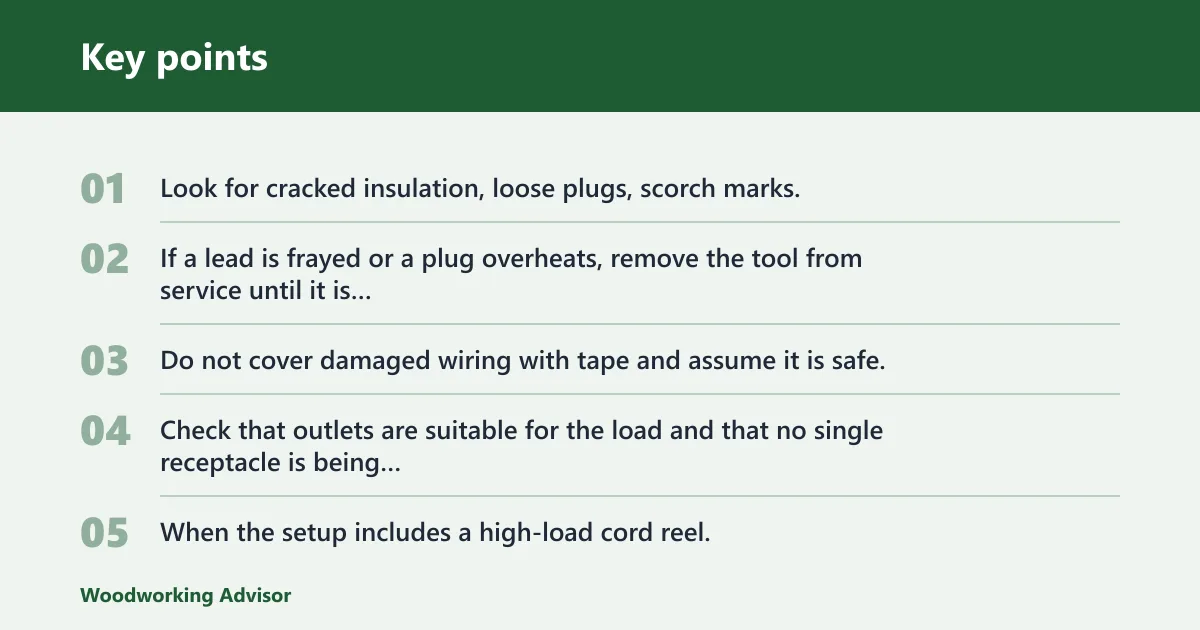
Look for cracked insulation, loose plugs, scorch marks, and damaged tool cords before each session. If a lead is frayed or a plug overheats, remove the tool from service until it is repaired or replaced. Do not cover damaged wiring with tape and assume it is safe.
Check that outlets are suitable for the load and that no single receptacle is being asked to carry too much at once. When the setup includes a high-load cord reel, unwind it fully if the tool load requires that. Read the cord and tool labels, then follow them.
Use the right circuit and cord setup for the load
A safer garage setup is often described as giving each tool circuit its own grounded outlet instead of stacking heavy loads onto one line. Match extension cords to the tool’s demand, and do not use a cord that is too light for the current draw. If the manual calls for a dedicated circuit or a heavier cord, follow that guidance.
Local electrical rules vary, so keep to the manufacturer’s instructions and the relevant code or standard for your area. If you are unsure whether an outlet, breaker, or cord is suitable, stop and verify it before using the tool. That is faster than fixing heat damage or a tripped breaker later.
Keep cables out of walkways and cutting paths
Route cords where they cannot be stepped on, pinched, or cut. Keep them away from door tracks, saw tables, and places where stock will slide. In winter, a damp floor and a trailing cord make a bad pair.
Housekeeping matters here too. Walk the site regularly with a simple checklist, remove clutter, and store tools and parts so they do not force cords into awkward paths. The goal is not a perfect floor. It is a clear, predictable one.
How often should you inspect hazards?
Inspect hazards before each session, then repeat a fuller review weekly and after any layout, process, or staffing change. Check hazards every month at minimum for a home garage workshop, but winter conditions justify more frequent checks for moisture, heat, ventilation, and cord routing.
Daily pre-start checks for solo sessions
Before starting work alone, check the floor, the exit, the heater, the dust collector, the cords, and the first aid kit. Confirm the phone is charged and emergency contacts are easy to reach. That short routine matters because lone working leaves no one else in the building to spot a hazard or call for help.
Suppose you plan a one-hour sanding session after dark. If the garage door is partly blocked by stored sheet goods and the phone is in another room, the session should wait until both problems are fixed. The safe start is the one that does not rely on luck.
Weekly housekeeping and equipment checks
Once a week, sweep or vacuum dust from ledges, machine bases, and floor corners, then inspect tools for damage and storage problems. Fire extinguishers should stay accessible and working, and the first aid kit should be checked for missing supplies. This is also the time to spot a heater that has drifted too close to stock.
Repeat risk review after changes
Review the risk assessment after any new machine, new shelf, new finishing product, or change in who uses the shop. The same applies after a bench moves or the garage is reorganized for winter. New layouts create new slips, new cord paths, and new fire exposure points.
Frequently asked questions
Why is health and safety important in a workshop?
Health and safety matter because a workshop concentrates sharp tools, dust, heat, electricity, and stored materials in one room. In a garage shop, winter adds damp floors, enclosed air, and more heater use. Good controls lower the chance of slips, shock, fire, and breathing problems while keeping the work usable.
What are the main safety rules in a garage workshop?
Keep walkways clear, mop spills immediately, store tools and parts properly, and inspect wiring and equipment before use. Use the right PPE for the task, ventilate when using finishes or solvents, and keep fire extinguishers accessible. Review hazards after any layout or process change.
How do I reduce fire risk in a garage workshop?
Keep combustibles away from heaters, control fine dust at the source, and store finishes and solvents away from ignition sources. Make sure extinguishers are accessible and working, and keep escape routes clear. In winter, the biggest gain often comes from separating heat, dust, and vapours.
What PPE should I use in a garage workshop?
Use eye and face protection for cutting and sanding, hearing protection for noisy tools, respiratory protection for dusty or fume-heavy tasks, slip-resistant footwear, and gloves only when they suit the job. Avoid gloves near rotating tools and pinch points. PPE helps most when it matches the task.
How often should I inspect a workshop for hazards?
Do a quick check before each solo session, a broader housekeeping and equipment review weekly, and a fuller audit at least monthly. Repeat the review after any layout, process, or staffing change. That schedule catches winter problems such as damp floors, heater drift, and new cord routes.
What should be in a garage workshop emergency plan?
Keep it simple: know the exits, keep a charged phone available, post emergency contacts, maintain an accessible first aid kit, and make sure someone knows when you are working alone. Add clear steps for fire, shock, and injury, and keep them short enough to follow under stress.
How do I make a garage workshop safer in winter?
Focus on the winter interactions: dry the floor, improve ventilation, keep heaters clear of dust and combustibles, route cords away from wet paths, and store finishes and solvents safely. Recheck the risk assessment when the shop layout changes. Winter safety is mostly about managing how those hazards overlap.
Sponsored / affiliate links. As an Amazon Associate I earn from qualifying purchases. I may earn additional commission from eligible campaigns.