How Big Does A Walnut Grow? Size And Growth Guide
We’ll dive deep into the world of walnut trees. You’ll learn about their typical heights, their spread, and what influences their growth. We’ll also touch on how they change over the years. By the end, you’ll have a clear picture of what to expect from a walnut tree, from its humble beginnings to its majestic maturity.
Walnut trees are large deciduous trees. They can grow from 50 to 100 feet tall. Their spread can also be quite wide, often reaching 50 to 100 feet. Factors like species, soil, sunlight, and care greatly affect their final size. Young trees grow faster than older ones.
Understanding Walnut Tree Size
So, let’s get down to it: how big does a walnut tree really get? Most people are surprised by the sheer scale these trees can achieve. When we talk about size, we usually mean two things: height and spread. Both are important for planning and understanding the tree’s presence in its environment.
In general, mature walnut trees, especially the commonly cultivated English walnut (Juglans regia) and the native Black walnut (Juglans nigra), are quite impressive. They are considered large trees for a reason. They aren’t the kind of tree you tuck into a small corner of your yard without a second thought.
Height of Walnut Trees
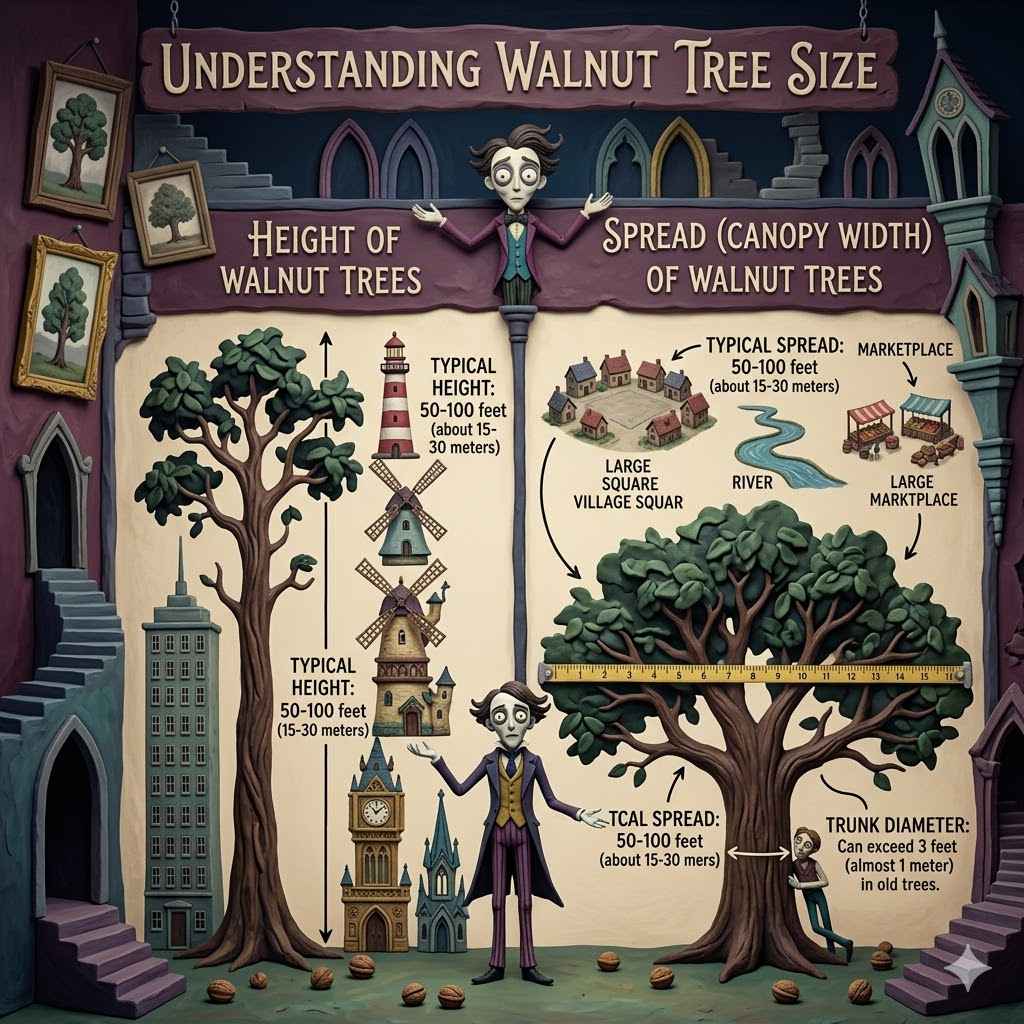
The height of a walnut tree can vary significantly. It depends on the exact type of walnut, its growing conditions, and its age. However, a fully grown, healthy walnut tree can easily reach heights of 50 to 100 feet. Some exceptional specimens, particularly in ideal forest settings with lots of competition for light, can even grow taller, sometimes pushing past 100 feet.
Think about that for a moment. That’s the height of a 5- to 10-story building! This impressive vertical growth is a key characteristic that defines the walnut tree’s place in the landscape.
Spread (Canopy Width) of Walnut Trees
It’s not just the height that’s substantial. The spread, or canopy width, of a walnut tree is often just as remarkable. Mature trees can have a spread of 50 to 100 feet across. This means the branches extend outwards a great distance from the trunk.
This wide canopy creates a significant shaded area underneath. It’s a majestic sight, with branches that can become quite thick and heavy with age. The shape of the canopy can also vary, sometimes being more rounded, other times more vase-shaped or irregular, depending on pruning, wind, and its environment.
Walnut Tree Size Comparison
- Typical Height: 50-100 feet (about 15-30 meters)
- Typical Spread: 50-100 feet (about 15-30 meters)
- Trunk Diameter: Can exceed 3 feet (almost 1 meter) in old trees.
Factors Influencing Walnut Tree Growth
While we’ve given you the general size range, it’s crucial to understand that not all walnut trees will reach these maximum dimensions. Many factors play a role. It’s like asking how tall a person will grow; genetics are key, but so is nutrition, health, and environment.
Let’s explore the most important influences that determine how big a walnut tree grows.
Species and Variety
The first major factor is the species of walnut. While we often group them, different types have different growth habits and maximum sizes. The most common ones in cultivation are:
- English Walnut (Juglans regia): Also known as the Persian walnut. These are the most widely grown for commercial nut production. They tend to be vigorous growers and can reach significant heights and spreads, often in the 50-70 foot range, but can exceed that.
- Black Walnut (Juglans nigra): Native to eastern North America. This is a truly massive tree, often growing taller and larger than the English walnut. It’s prized for its dark, valuable wood and its nuts. Heights of 70-100 feet are common, with spreads of similar magnitude.
- Japanese Walnut (Juglans ailantifolia): Generally smaller than English or Black walnuts, often topping out around 30-50 feet.
- Heartnut (Juglans ailantifolia var. cordiformis): A variety of Japanese walnut, similar in size.
Within each species, there are also different cultivated varieties or cultivars. Some are bred for disease resistance, nut quality, or even growth habit. A specific cultivar might be naturally more compact or more vigorous than others of the same species.
Soil Quality and Drainage
Walnut trees are quite particular about their soil. They thrive in deep, well-drained, fertile loam. This means soil that is rich in organic matter, has a good balance of sand, silt, and clay, and allows water to pass through easily without becoming waterlogged.
Poor soil conditions can severely stunt a walnut tree’s growth. Heavy clay soils that hold too much water can lead to root rot, which is detrimental. Sandy soils may not hold enough nutrients or moisture. If the soil is compacted, roots can’t spread effectively, limiting the tree’s ability to take up water and nutrients needed for robust growth.
Ideal Soil for Walnut Trees
Good Soil Traits
Deep
Well-drained
Fertile (rich in organic matter)
Loamy texture
Poor Soil Traits
Shallow
Waterlogged (heavy clay)
Sandy (poor nutrient/moisture retention)
Compacted
Sunlight Exposure
Walnut trees are sun-lovers. They need plenty of direct sunlight to photosynthesize efficiently and convert that energy into growth. In their natural habitats, they often grow in open areas or at the edges of forests where sunlight is abundant.
Trees planted in shady spots will grow much slower and will likely be less healthy. Their branches may become leggy as they stretch towards the light. Full sun is essential for achieving their full potential height and width. For commercial orchards, this means careful site selection is crucial.
Climate and Water Availability
Walnut trees prefer temperate climates. They need a certain number of chilling hours in the winter to break dormancy and produce flowers and fruit properly. Extreme heat or cold can stress the tree and impact its growth.
Consistent and adequate water is also vital, especially for young trees establishing their root systems. While mature trees can tolerate some drought due to their deep roots, prolonged dry spells will slow their growth and can make them more susceptible to pests and diseases. In arid regions, supplemental irrigation is often necessary.
Pest and Disease Management
Like all trees, walnuts are vulnerable to various pests and diseases. Problems like walnut blight, aphids, borers, and fungal infections can weaken the tree. A tree that is constantly battling these issues will divert energy away from growth and toward defense and repair.
Effective management of these problems is key to ensuring a healthy, vigorous tree that can reach its full size potential. This might involve choosing disease-resistant varieties, proper sanitation, and, if necessary, targeted treatments.
Age of the Tree
The growth rate of a walnut tree changes significantly throughout its life. Young trees, especially in their first 10-20 years, experience rapid growth. This is their establishment phase, where they focus on building a strong root system and rapidly increasing their height and canopy.
As the tree matures, typically after 20-30 years, its growth rate slows down considerably. It still grows, but much more gradually. The focus shifts from rapid expansion to maintaining its large structure, producing nuts, and deepening its root system. Truly ancient walnut trees might even see their growth stagnate or slightly decline.
Growth Stages of a Walnut Tree
Juvenile Stage (0-10 years)
Very rapid growth.
Focus on establishing roots and trunk.
Height increase is significant yearly.
Young Adult Stage (10-30 years)
Still vigorous growth.
Canopy widens considerably.
Begins producing nuts reliably.
Mature Stage (30-100+ years)
Growth rate slows down.
Tree reaches its full potential size.
Focus on maintenance and nut production.
Old Age (100+ years)
Growth may be very slow or minimal.
More susceptible to environmental stress.
Can remain impressive for centuries.
The Growth Journey: From Seedling to Giant
It’s fascinating to watch a walnut tree develop over its many years. The journey from a tiny seed or a small nursery sapling to a massive, fruit-bearing tree is a slow but steady process. Understanding these stages helps appreciate the long-term investment a walnut tree represents.
Let’s trace this journey, from the very beginning.
Starting as a Seedling
A walnut tree begins its life as a seed, which is the nut itself. For successful germination, these nuts often need a period of cold stratification. This mimics winter conditions, signaling the seed that it’s time to sprout.
Once planted in suitable soil and given the right conditions (moisture, warmth), the seed germinates. A root emerges first, anchoring the young plant and seeking water. Then, a shoot pushes upwards, seeking light. This tiny seedling is very vulnerable. It needs protection and consistent care.
The Rapid Growth Phase
For the first decade or so, a walnut sapling is in its most explosive growth phase. If you’ve planted a young tree, you’ll notice it adding significant height each year. The trunk thickens, and the first main branches start to form.
This is the time when the tree is efficiently converting sunlight and nutrients into biomass. It’s building the structural framework that will support its future size. Providing good soil, plenty of water, and full sun during these years is crucial for setting the tree up for future success. Many people focus on pruning and shaping during this period.
Reaching Maturity and Full Size
After about 20 to 30 years, the walnut tree has likely reached a substantial size. It will be well over half its mature height and have a noticeable canopy. It will also start producing nuts in significant quantities, assuming it’s a nut-bearing variety and conditions are right.
From this point on, the growth continues, but at a much slower pace. The tree is now more focused on maintaining its massive structure, producing its yearly crop of nuts, and deepening its root system. This stage can last for many decades, even centuries for some species.
The Elderly Tree
Very old walnut trees, often over 100 years old, are living giants. They are impressive landmarks. Their trunks are thick and gnarled, their branches broad and heavy. While they may not be growing much taller, they are still vital ecosystems, supporting birds, insects, and other wildlife.
These ancient trees are reservoirs of wisdom, having weathered countless seasons and storms. They represent a connection to the past and a testament to nature’s enduring power. Even in old age, they can continue to produce nuts, though perhaps in smaller quantities than in their prime.
Annual Growth Pattern
- Spring: Buds swell and open. New leaves and shoots emerge. Growth is vigorous.
- Summer: Peak growth period. Photosynthesis is high. Fruit (nuts) develops.
- Fall: Growth slows. Leaves change color and drop. Tree prepares for dormancy.
- Winter: Dormant. Resting period. Crucial for chilling requirement.
Real-World Context and Scenarios
Understanding the potential size of a walnut tree is one thing; seeing it in context is another. Where do you typically find these trees, and what does their size mean for their surroundings?
Walnut trees are found in a variety of settings, each influencing their growth and appearance.
Forests and Woodlands
In natural forests, especially mixed deciduous woodlands in North America where Black walnuts are native, these trees often grow exceptionally tall. They compete for sunlight, stretching upwards to reach the canopy. Their impressive height in forests is partly due to the surrounding trees pushing them skyward.
Their large canopies create significant shade on the forest floor, influencing which understory plants can survive. The valuable wood produced in these conditions is often of higher quality due to the straight, clear trunks.
Orchards and Plantations
Commercial walnut orchards are managed spaces. Trees are planted with adequate spacing to allow for their full spread. While they still grow to be large, their size might be slightly managed through pruning compared to a wild tree.
The goal here is efficient nut production. Farmers carefully select varieties known for yield and quality, and they manage soil fertility, water, and pest control to maximize harvest. The trees are still substantial, but their arrangement is orderly and planned for productivity.
Home Gardens and Landscapes
Planting a walnut tree in a typical suburban backyard requires careful consideration. A mature English or Black walnut overwhelm a smaller garden with its size. Its wide canopy can shade out other plants, and its roots can potentially interfere with foundations or underground utilities.
If you have a larger property, a walnut tree can be a magnificent addition, providing shade, beauty, and delicious nuts. For smaller spaces, consider dwarf varieties or alternative nut trees that don’t reach such imposing dimensions. Always research the specific cultivar and its mature size before planting.
Walnut Tree Planting Considerations
Large Properties / Farms
Ideal for full size potential.
Can provide ample shade.
Space for nut collection.
Small to Medium Yards
Consider mature size carefully.
Roots can be extensive.
Shade can limit other plants.
Look for compact varieties if available.
What This Size Means for You
Knowing how big a walnut tree grows has practical implications. Whether you are admiring one, planning to plant one, or dealing with one already on your property, understanding its scale is important.
Let’s break down what its size means in everyday terms.
Space Requirements
This is perhaps the most obvious implication. A mature walnut tree needs a lot of space, both above and below ground. You need to ensure there is ample room for its canopy to spread without hitting structures, power lines, or other desirable trees.
Below ground, the root system of a large walnut tree can spread as wide as its canopy, and sometimes even wider. This extensive root network helps anchor the massive tree and access water and nutrients. This is why planting too close to foundations, septic systems, or driveways can lead to future problems.
Shade Production
The large, dense canopy of a mature walnut tree creates significant shade. This can be a wonderful benefit in warmer climates, offering a cool retreat. It can also reduce cooling costs for nearby buildings.
However, this shade can also be problematic for other plants. Many garden vegetables and flowers require full sun to thrive. You’ll need to plan your garden layout carefully, placing sun-loving plants where they can get enough light, perhaps on the north side of the tree or further away. Some shade-tolerant plants, like certain ferns or hostas, might do well directly under the tree, but you’ll need to check their specific needs.
Nut Production
The size of a walnut tree is directly related to its ability to produce nuts. A larger, more mature tree with a robust root system and ample foliage will generally produce more nuts than a small, young, or struggling tree.
Harvesting nuts from a large tree can be an event. You might find yourself with more nuts than you know what to do with! This is a rewarding problem for many, leading to baking, snacking, and sharing. However, dealing with fallen nuts also means dealing with cleanup, as they can stain surfaces and attract pests.
Wood Value
For species like the Black walnut, their impressive size directly correlates to the value of their wood. Walnut wood is highly prized for its dark color, beautiful grain, and durability. It’s used in fine furniture, cabinetry, and decorative items.
A large, old walnut tree can be worth a significant amount of money for its timber alone. This is a long-term asset that continues to grow in value as the tree ages, provided it remains healthy and free from major defects.
Key Implications of Walnut Tree Size
- Space: Requires significant room above and below ground.
- Shade: Creates dense shade, impacting other plants.
- Nuts: Larger trees produce more nuts.
- Wood: Valuable timber for mature trees.
- Maintenance: Larger trees mean more leaf drop and potential branch cleanup.
Quick Fixes & Tips for Managing Walnut Tree Size
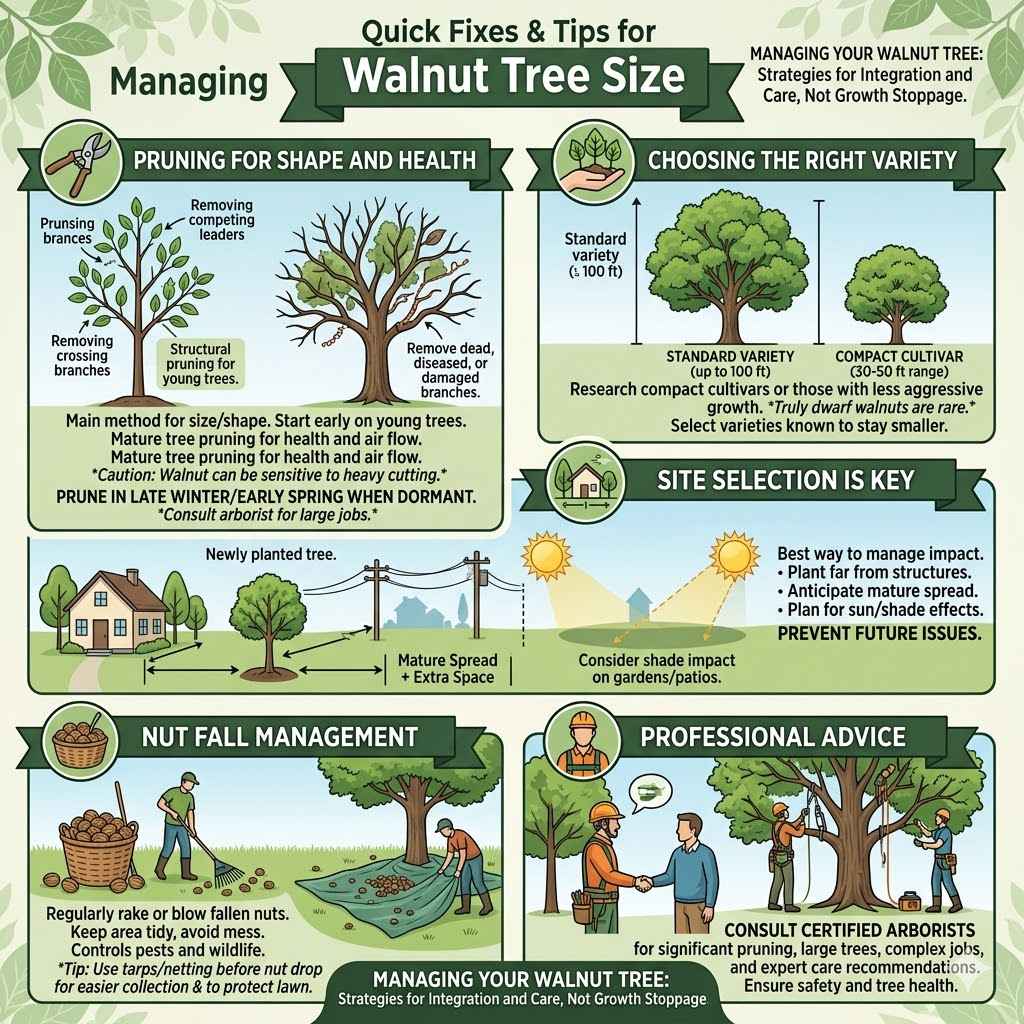
While you can’t fundamentally shrink a mature walnut tree, there are ways to manage its size and impact, especially for younger trees or in specific situations.
These are not “fixes” in the sense of stopping natural growth, but rather strategies for integration and care.
Pruning for Shape and Health
Pruning is the primary method for managing a tree’s size and shape. For young trees, structural pruning during their early years helps establish a strong framework. This involves removing competing leaders, crossing branches, and selecting well-spaced scaffold branches.
For mature trees, pruning is usually done to remove dead, diseased, or damaged branches, or to improve air circulation and light penetration. While heavy pruning can reduce the overall canopy size, it’s important to do so carefully, as walnuts can be sensitive to excessive cutting. Always prune in late winter or early spring when the tree is dormant. Consult an arborist for large or complex pruning jobs.
Choosing the Right Variety
If you are considering planting a walnut tree, one of the best ways to manage its future size is by selecting the right variety. Researching cultivars that are known to be more compact or have a less aggressive growth habit can make a significant difference.
While truly dwarf walnut trees are rare, some varieties might remain in the 30-50 foot range rather than reaching the full 100 feet. Always check the mature size listed for any variety you are considering.
Site Selection is Key
The most effective way to manage a walnut tree’s impact is to choose its location wisely from the start. If you know how big it will get, you can plant it far enough away from buildings, utility lines, and other essential features.
Consider the mature spread of the tree and give it that much space, plus extra. Think about where the sun will be throughout the day and how the shade will affect your garden or patio areas. Proper initial placement avoids difficult problems down the line.
Nut Fall Management
Once nuts fall, they can create a mess and attract wildlife or pests. Regularly raking or blowing fallen nuts can help keep the area tidy. This is a routine maintenance task rather than a size management tip, but it’s important for living with a productive walnut tree.
Consider placing large tarps or netting under the tree before nut drop if you want to collect them easily. This also helps protect your lawn from staining.
Managing Your Walnut Tree
- Pruning: For shape, health, and structure (especially on young trees).
- Variety Choice: Select cultivars with more manageable mature sizes.
- Strategic Planting: Give ample space away from structures.
- Nut Cleanup: Regular raking to keep the area tidy.
- Professional Advice: Consult arborists for significant pruning.
Frequently Asked Questions
How fast does a walnut tree grow?
Click to expand
Young walnut trees grow quite rapidly, often adding 1-3 feet in height per year under good conditions. This rapid growth phase can last for the first 10-20 years. As they mature, their growth rate slows significantly.
What is the largest walnut tree on record?
Click to expand
While specific records vary, some Black walnut trees in North America have been documented to reach heights well over 100 feet (30 meters) with trunk diameters exceeding 4 feet (1.2 meters). Finding the absolute “largest” is challenging as these ancient trees are spread across vast areas.
Can a walnut tree damage a house foundation?
Click to expand
Yes, the extensive root systems of mature walnut trees can potentially cause damage to house foundations, driveways, and underground pipes if planted too close. It’s recommended to plant them at least 50 feet away from structures, though for very large trees, more distance is better.
Do walnut trees need a lot of water?
Click to expand
Young walnut trees need consistent watering to establish their root systems. Mature trees are more drought-tolerant due to their deep roots, but they perform best with adequate moisture, especially during dry periods or fruit development. They do not tolerate waterlogged soil.
When is the best time to plant a walnut tree?
Click to expand
The best time to plant a walnut tree is during its dormant season, which is typically in late fall after the leaves have dropped or in early spring before new growth begins. This allows the tree to establish its roots before the stresses of summer heat.
Are walnut trees messy?
Click to expand
Walnut trees can be considered messy due to falling leaves in autumn, and for nut-bearing varieties, the shedding of nuts and their husks in the fall. The husks can stain surfaces and attract wildlife. Regular cleanup is needed to manage this.
Conclusion
So, how big does a walnut grow? It grows big. We’re talking about trees that can become giants, reaching 50 to 100 feet tall with a similar spread. Their impressive size is a result of species, soil, sun, and care over many years. Understanding this helps you appreciate these majestic trees and plan for them in your landscape.
Whether you’re admiring one in a park or considering planting one yourself, remember the long journey from seed to substantial tree. It’s a testament to nature’s enduring power and patience.
Sponsored / affiliate links. As an Amazon Associate I earn from qualifying purchases. I may earn additional commission from eligible campaigns.