How Cold Can Epoxy Withstand?
Most epoxies should be applied above 60°F, and full cure is generally safest around 70°F to 80°F. Once cured, many epoxies can handle freezing temperatures, often well below 0°F, if the resin system is rated for it. Cold during cure can leave epoxy sticky, weak, or cloudy, and that can ruin a bond or finish. This guide covers cure-stage limits, cured-stage cold tolerance, and a simple go/no-go rule for woodworkers.
What cold does to epoxy
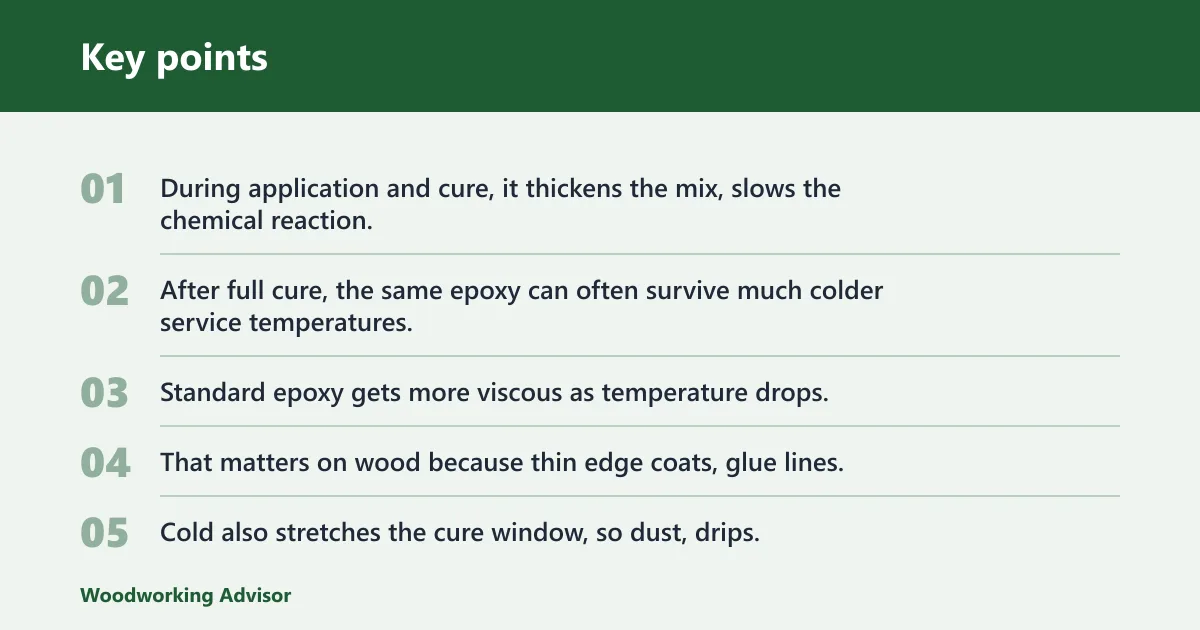


Cold affects epoxy in two ways. During application and cure, it thickens the mix, slows the chemical reaction, and raises the chance of poor wet-out on wood. After full cure, the same epoxy can often survive much colder service temperatures, but freezing, wood movement, and repeated temperature swings still matter.
Why cold thickens epoxy
Standard epoxy gets more viscous as temperature drops, which makes spreading and bubble release harder. That matters on wood because thin edge coats, glue lines, and poured surfaces need the resin to wet the fibers before it starts to gel. Cold also stretches the cure window, so dust, drips, and sagging have more time to show up.
How cold changes cure speed
Most standard epoxy flooring products perform best between 60°F and 90°F. As temperature falls, cure slows sharply. Epoxy coating cure time typically lasts 24 to 72 hours, but cold conditions can push the usable window longer and make the surface stay tacky well past the point where a warm shop would have hardened it.
What cold does to the bond on wood
A cold board can pull heat out of mixed epoxy fast. That lowers flow, weakens penetration, and can leave the bond line undercured near the surface. If the air drops below the minimum threshold within 24 hours, application should be avoided. For wood projects, that matters most on end grain, loose joints, and outdoor repairs.
Application temperature and substrate limits
For new work, the wood temperature matters as much as the room temperature, and often more. Standard epoxies typically need a minimum substrate temperature of 50°F, while the air should stay in the product’s recommended range. If the board is cold, the resin can chill as soon as it touches the surface.
Standard epoxy range
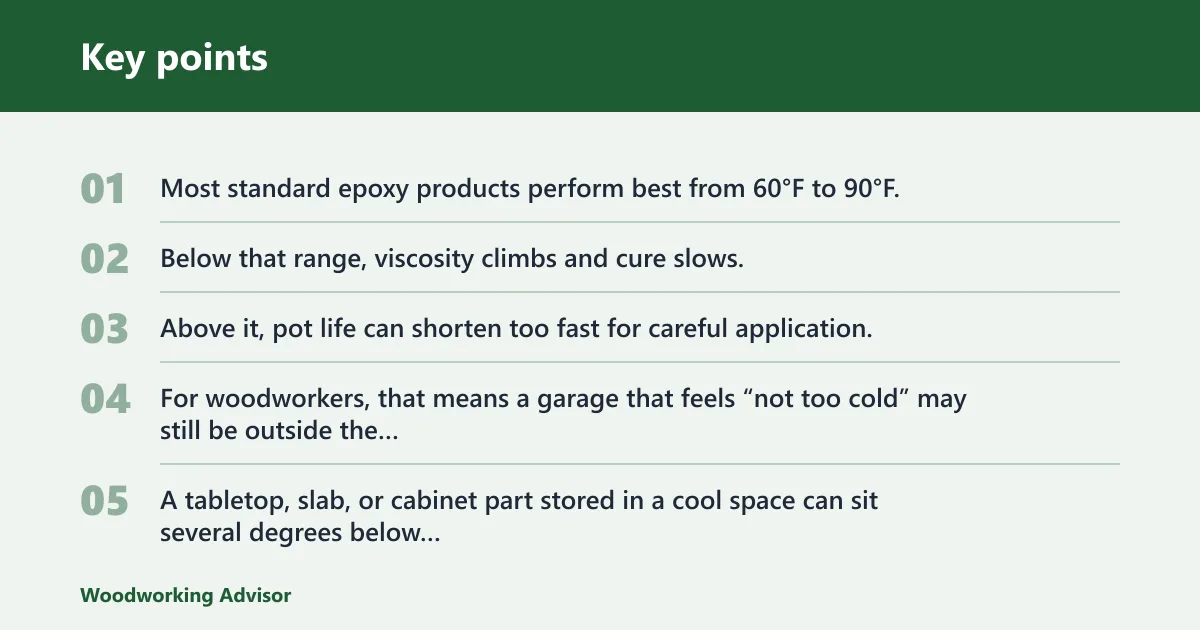
Most standard epoxy products perform best from 60°F to 90°F. Below that range, viscosity climbs and cure slows. Above it, pot life can shorten too fast for careful application. For woodworkers, that means a garage that feels “not too cold” may still be outside the safe band if the boards are colder than the air.
Why wood temperature matters more than room temperature
Wood is a heat sink. A tabletop, slab, or cabinet part stored in a cool space can sit several degrees below the room air, especially in corners, on concrete, or near exterior walls. That is why installers should track temperatures for at least 72 hours before and after application, not only the room reading at mixing time.
Minimum substrate temperature and product instructions
Standard epoxy floor coating often lists 50°F as the minimum substrate temperature. Some cold-weather epoxy formulations can handle temperatures as low as 35°F, but only within the maker’s limits. Always check the data sheet for the exact product class, because tabletop epoxy, marine epoxy, and floor coatings do not share the same low-temperature tolerance.
How cold can cured epoxy survive?
Once epoxy is fully cured, cold survival is usually better than cold curing. Many cured systems can handle freezing temperatures in service, and some can go well below 0°F if the formulation is meant for that exposure. The main limits shift from cure speed to brittleness, thermal cycling, and bond stress on the wood beneath it.
Brittleness and thermal cycling
Cured epoxy can get stiffer in the cold. That does not mean it fails automatically, but it can lose some impact tolerance. Repeated warming and cooling also create expansion and contraction stress. On wood, that can show up as hairline cracks at the edge, corner lifting, or a bond line that lets go where movement concentrates.
Freezing temperatures and crack risk
Freezing is not an automatic failure point for cured epoxy. The real risk depends on cure quality, product type, film thickness, and how much the wood moves. A fully cured marine epoxy on a stable part may survive winter service well, while a thin, undercured tabletop coat on a moving panel may crack or debond sooner.
Say your bench-top repair cured for two full days in a heated room, then moved to an unheated shed. If the epoxy reached full cure first, the cold service condition is usually less risky than if the same part had been left to cure in a near-freezing shed from the start.
Dew point and condensation
Cold wood can sweat even when the air looks dry. If the substrate falls below the dew point, moisture can condense on it and interfere with adhesion, clarity, and cure. That is why you need to watch both temperature and humidity, not just the thermometer on the wall.
Why cold wood sweats
When warm, moist air touches a colder surface, water can form on the wood before you see any obvious wetness. That thin film can cause cloudiness, uneven gloss, fisheyes, or a weak bond. Humidity matters because high moisture levels make condensation more likely and can slow drying in the surrounding space.
The 5°F buffer above dew point
The substrate should be at least 5°F above the dew point. Some guidance allows 3°F above the dew point, but 5°F is the safer target. That buffer helps prevent moisture contamination during mixing, brushing, rolling, or pouring, especially during the first part of cure when the surface is most vulnerable.
Humidity, cloudiness, and adhesion problems
High humidity can fog a clear coat, leave a milky cast, or create an uneven sheen, especially on transparent finishes. A cold surface can also turn condensation into a hidden bond problem. In enclosed spaces, heaters, dehumidifiers, and ventilation can help, but the goal is steady air, a warm enough substrate, and no visible moisture on the wood.
Cold-weather epoxy options
Cold-weather epoxy labeling does not erase the limits. It only means the formulation is built to work at lower temperatures than standard products. Some can handle temperatures as low as 35°F, but the manufacturer’s data sheet still controls the decision. The wrong product at the right temperature can fail just as easily as the right product in the wrong setup.
What the label really means
A cold-weather formulation usually has chemistry tuned for lower-temperature flow and cure. That can help with application, but it does not change dew point rules, wood temperature needs, or the need for stable conditions during cure. It also does not mean every part of the project can sit in freezing air immediately after coating.
Product categories matter
Floor coatings, tabletop epoxy, and marine epoxy are built for different film thicknesses and exposure conditions. A floor product may tolerate foot traffic at one temperature range and a tabletop resin may need a different one. Do not assume that one low-temperature claim applies to every epoxy on the shelf.
Epoxy in cold weather: Proceed, Warm, or Postpone
Epoxy in Cold Weather: Proceed, Warm, or Postpone
| Air temperature | Substrate temperature | Dew point buffer | Product type | Recommended action |
|---|---|---|---|---|
| 60°F to 90°F | 50°F or warmer | At least 5°F above dew point | Standard epoxy | Proceed, lowest risk for spread, wet-out, and cure; keep temperatures stable for 24 to 72 hours. |
| 50°F to 59°F | 50°F or warmer | At least 5°F above dew point | Standard epoxy | Warm, use heaters or climate control before mixing; failure risk rises if the board is colder than the room. |
| 35°F to 49°F | At or above the maker’s minimum | At least 5°F above dew point | Cold-weather epoxy | Warm, proceed only if the data sheet allows it; cure may still slow and viscosity will be higher. |
| Below 50°F | Below 50°F | Less than 5°F above dew point | Standard epoxy | Postpone, cold wood, slow reaction, and condensation risk make bond failure and cloudy finish more likely. |
| Any air temperature after cure | Fully cured part | Not the main issue | Post-cure exposure | Proceed if the epoxy is fully cured and the part is not under heavy movement or shock; watch for thermal cycling on wood. |
Will epoxy crack or fail in freezing weather?
It can, but freezing alone is not the whole story. Cracking and bond failure are more likely when epoxy cures cold, stays undercured, or is bonded to wood that keeps moving. Once cured, many epoxies survive freezing temperatures in service, but the combination of cold, stress, and repeated cycling can still cause problems.
Shrink and expansion on wood
Wood expands and contracts with temperature and moisture changes. Epoxy moves less than the wood around it, so stress can build at the bond line. That mismatch is why a coating that looks fine in a warm room may later show edge cracking, checking, or a small area of lift after a cold snap.
Bond failure versus surface cracking
Surface cracking and bond failure are different problems. Surface cracks may stay cosmetic if the epoxy is fully cured and the substrate is stable. Bond failure usually points to poor prep, moisture, cold cure, or movement. If the wood was below the dew point or the epoxy never reached full cure, the risk rises sharply.
When to use heat and climate control
Heaters and climate control are most useful during application and the first part of cure. In enclosed spaces, warm the air and the substrate before mixing, then keep conditions steady through the cure window. Ventilation matters too, but do not aim airflow directly at the wet surface if it can bring in cold air or dust.
- Check the product data sheet for the minimum application temperature.
- Measure air temperature and substrate temperature separately.
- Confirm the substrate is at least 5°F above dew point.
- Look ahead at the forecast for the next 72 hours.
- Warm the room and the wood if any reading sits near the limit.
- Postpone if the part may fall below the minimum within 24 hours.
Picture a maple tabletop in an attached garage at 48°F air temperature with the slab itself at 44°F. Even if the epoxy bottle says “low temp,” that cold slab can slow wetting and invite condensation. A warmed room and a warmed board change the result more than extra mixing time does.
Frequently asked questions
How cold can epoxy withstand?
That depends on whether you mean application or cured service. Most standard epoxy applies best from 60°F to 90°F and usually needs a 50°F substrate. Once fully cured, many systems can survive freezing temperatures, and some go well below 0°F if the resin system is rated for that exposure.
Can epoxy cure in cold weather?
Yes, but only within the product’s limits, and usually more slowly. Cold temperatures slow the epoxy curing reaction significantly, so cure time can stretch through the 24 to 72 hour range or longer. If temperatures fall below the minimum threshold within 24 hours, application should be avoided.
What temperature is too cold for epoxy?
For standard products, anything below the maker’s minimum is too cold, and many need a 50°F substrate at minimum. Some cold-weather formulations can work down to 35°F, but that is not a universal number. If the wood is near dew point or the forecast drops, postpone.
Will epoxy crack in freezing temperatures?
Fully cured epoxy can often survive freezing temperatures, but cracking risk rises when the coating is undercured, thin, or bonded to moving wood. Thermal cycling and substrate movement matter as much as the cold itself. Freezing is a stress factor, not an automatic failure event.
What is the minimum temperature for epoxy floor coating?
Most standard epoxy flooring products list 50°F as the minimum substrate temperature, and many perform best between 60°F and 90°F. Some cold-weather floor coatings can go lower, but only if the label allows it. The substrate still needs to stay above the dew point.
How long does epoxy take to cure in cold weather?
Typical cure time is 24 to 72 hours, but cold can extend that window. The exact time depends on product type, film thickness, and how stable the temperature stays during cure. Keep the temperature steady through the full cure period, not just during the first hour.
Simple rule: proceed if the epoxy is in its listed application range, the wood is warm enough and at least 5°F above dew point, and the forecast stays stable through cure; warm the space if you are close to the limit; postpone if the substrate is cold, damp, or likely to fall below the minimum within 24 hours.
Sponsored / affiliate links. As an Amazon Associate I earn from qualifying purchases. I may earn additional commission from eligible campaigns.