How Much Does Basswood Cost for Carving Projects?
Basswood for carving is often sold at roughly a few dollars per board foot in rough boards, around the low teens for common blanks, and somewhat more for spoon or kuksa blanks; compare by usable volume, not sticker price. Paying by the piece without checking usable wood can make small, knotty, or waste-heavy stock cost far more per carveable project. This guide breaks down basswood cost by boards, blanks, spoon and kuksa stock, plus how to judge value by size, shape, and condition.
Basswood carving costs by project
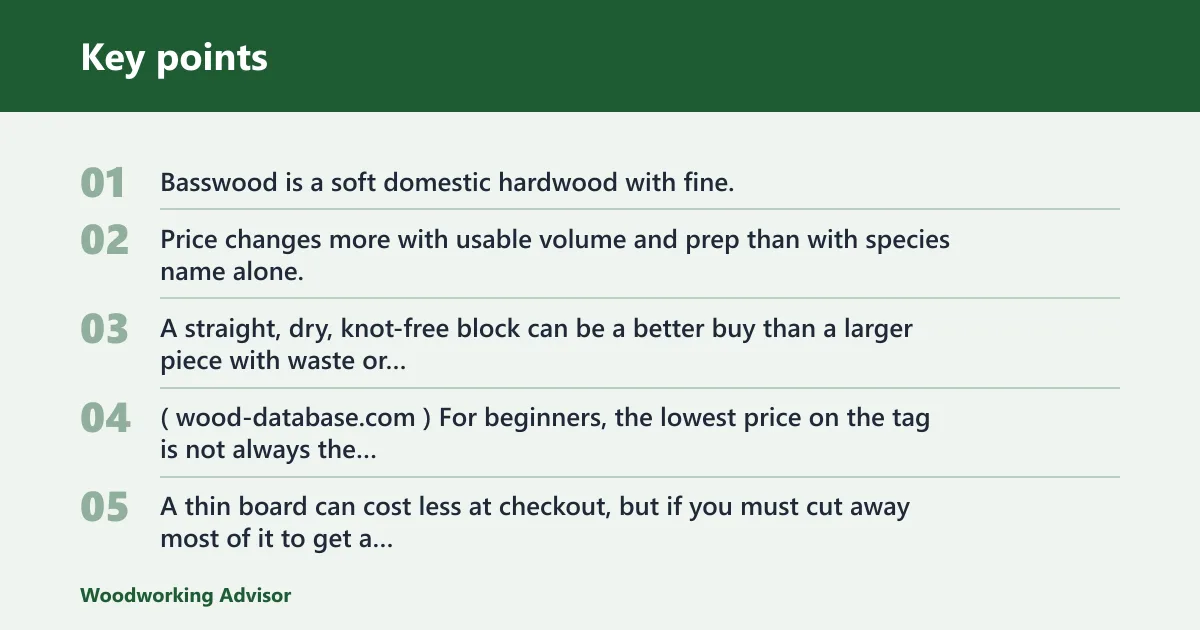

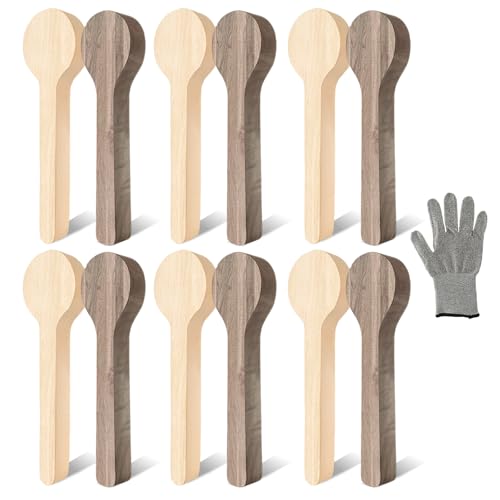

Basswood is a soft domestic hardwood with fine, even grain and a Janka hardness of 410 lbf, so it carves easily by hand. Price changes more with usable volume and prep than with species name alone. A straight, dry, knot-free block can be a better buy than a larger piece with waste or defects. (Wood-database)
For beginners, the lowest price on the tag is not always the lowest project cost. A thin board can cost less at checkout, but if you must cut away most of it to get a spoon or relief panel, the usable cost rises fast. The real question is: how much carveable wood are you paying for?
Say you need a 2 x 2 x 4 in practice block for whittling. If the block is clean and square, you can start carving right away. If the same species comes with bark edge, knots, or a crooked grain line, you may lose enough wood to make the lower sticker price a poor value.
Why usable volume matters more than sticker price
Usable volume is the part of the blank you can safely turn into a finished carving. Basswood blanks are sold in blocks, boards, spoon blanks, kuksa blanks, and sets, so the format matters as much as the species. A blank with less waste often costs more per piece, but less per finished project.
That is why a small, well-cut block can be a stronger buy than a larger piece with defects. Straight grain, no pith, and no knots reduce breakage and wasted layout. Dry stock also matters because it is less likely to move after you start carving.
How block shape changes cost per blank
Rectangular blocks are easy to compare by cubic inches. Boards and practice panels are harder to compare by volume because thickness is only part of the story; the intended pattern, grain direction, and clean carving face also affect value. Spoon and kuksa stock usually costs more because the shape already matches the project.
For that reason, shaped stock often carries a premium even when it is still basswood. You are paying for less rough shaping, less waste, and sometimes better grading. Patterned practice boards and chip-carving boards also cost more because the product is aimed at a specific carving task, not raw stock.
What beginners usually get for the money
Beginners usually get the best value from simple, dry, straight-grain blocks or small sets. Those blanks are easy to control, and the low resistance helps when you are learning knife angle, grain reading, and chip removal. A set can also reduce the cost per piece if you want repeat practice.
Sets are not automatically a bargain, though. If the pack includes small offcuts or uneven pieces you cannot use for your project, the cost per useful blank rises. Check the dimensions first, then compare price by volume and by likely project fit.
📊 Basswood has a Janka hardness of 410 lbf, showing its softness relative to many carving woods. Source: Wood-database.
Basswood cost comparison table
This table compares the supplied basswood items by listed price and implied price per cubic inch when the dimensions are known. Use it to spot overpriced formats and to see when a set makes more sense than a single blank.
| Product type | Dimensions | Listed price | Implied price per cubic inch | Best project fit |
|---|---|---|---|---|
| Mini basswood carving block | 1 x 1 x 4 in | $33 | $8.25 per cu in | Small whittling practice, detail cuts |
| Basswood carving block | 2 x 2 x 4 in | $48 | $3.00 per cu in | Whittling practice, small figures |
| Basswood carving block | 2 x 2 x 6 in | $44 | $1.83 per cu in | Longer whittling projects, spoon practice blanks |
| Basswood carving block | 4 x 2 x 2 in | $26 | $1.63 per cu in | General hand carving, practice relief forms |
| Premium basswood carving block | Dimensions not stated in supplied facts | $18, down from $26 | Not available from supplied facts | General carving stock where exact size must be checked first |
| 5-piece basswood blocks set | Set dimensions not stated in supplied facts | $36, down from $49 | Not available from supplied facts | Repeat whittling practice and test cuts |
| Basswood carving block assortment | Three sizes, exact dimensions not stated in supplied facts | Starts from $45 | Not available from supplied facts | Mixed practice, fit-checking different blank sizes |
| 14-piece wood carving blanks set | Set dimensions not stated in supplied facts | $103, down from $115 | Not available from supplied facts | Frequent practice, varied small projects |
The table shows a clear pattern. The 4 x 2 x 2 in block has the lowest implied cost per cubic inch among the sized single blocks listed, while the 1 x 1 x 4 in block is far more expensive per volume. That tiny block only makes sense when the shape itself matters more than bulk, such as for very small figures or controlled knife practice.
A common first-timer mistake is buying the cheapest-looking small block and then discovering that the larger block would have cost less per usable inch. The 2 x 2 x 6 in block prices lower per cubic inch than the 2 x 2 x 4 in block here, which is exactly why looking at volume beats scanning the shelf tag.
What size basswood block costs the least?
Among the sized blocks listed here, the 4 x 2 x 2 in block has the lowest implied price per cubic inch at $1.63. The 2 x 2 x 6 in block works out to about $1.83 per cubic inch. The 1 x 1 x 4 in and 2 x 2 x 4 in blocks cost much more per volume, so they make sense mainly when the smaller size better matches the project.
Size alone does not set value, but larger blocks usually cost more in total because they contain more wood. Even so, the per-volume price can drop as size increases. That is why a larger blank may be better value for a spoon, small relief panel, or practice figure that needs extra depth.
For pure whittling practice, a 2 x 2 x 4 in or 2 x 2 x 6 in block is often the better buy than a 1 x 1 x 4 in block. The smaller piece can be useful for detail cuts, but it is expensive wood for the amount of carving space it gives you.
Why do some basswood blanks cost more?
Some basswood blanks cost more because you are paying for condition, shape, and convenience, not only species. Dry stock, straight grain, knot-free faces, and no pith all improve carving behavior and reduce waste. Shaped blanks and practice sets also carry a premium because they save prep time.
Dry stock versus green blanks
Dry basswood is usually the safer choice for stable carving projects. Green blanks may be cheaper, but they can move as they dry, which affects fit, symmetry, and surface finish. That matters most for spoon, kuksa, and relief work where shape retention is important.
Dried basswood also gives you a more predictable starting point. If a blank is sold as dry and straight, that can explain a higher price than a green blank of the same species. The extra cost is often about reduced movement and less risk of post-carve distortion.
Straight grain, knots, and pith
Straight grain helps cuts travel cleanly. Knots interrupt the grain and can chip or split under a knife. Pith, the center of the tree, is weak and unstable, so good carving stock avoids it. A block free of these defects is usually worth more because it gives you more usable wood.
Check the face and edges before you buy. If the grain changes direction sharply, or the blank includes knot eyes or center wood, the price should be lower than defect-free stock. A clean blank may cost more upfront, but it often wastes less and carves more predictably.
Spoon blanks and kuksa blanks cost more because someone already removed waste wood and roughed in the form. You are paying for reduced layout work and a shape that fits the project. Patterned practice boards and chip-carving boards also command a premium because they are ready for a specific task.
That premium is reasonable when it matches your goal. If you need a spoon blank, a rough square block is not the same value even if the species is identical. The extra shaping can save time and reduce the chance of ruining the grain orientation.
Which basswood format fits your project?
The best basswood format depends on what you are carving. Whittling usually needs small, clean blocks. Spoon and kuksa work need blanks with enough depth and grain orientation for a curved handle and bowl. Chip carving and relief work benefit from boards or practice panels that provide a flat face and even grain.
Suppose you are starting a simple spoon. A shaped spoon blank can be worth the premium because it gives you the right general mass and reduces rough stock removal. If you only want knife practice, a rectangular block is better value because you can repeat cuts without paying for pre-shaped stock.
Whittling practice blocks
Whittling practice is where basswood gives the clearest value. Its soft feel reduces resistance, and the even grain helps new carvers read the wood. Small blocks are fine if you only need a few cuts, but a slightly larger rectangular blank usually gives better value per carveable inch.
For beginners, the 2 x 2 x 6 in block is a practical sweet spot from the supplied list. It balances usable volume and cost better than the smallest block, while still being easy to handle.
Spoon and kuksa blanks
Spoon blanks and kuksa blanks are priced higher because they are shaped for a curved, hollowed project. The blank should already give you enough stock for the bowl, handle, and rim, so the shape matters as much as the species. Straight grain is especially important in the handle area.
If you plan to carve a spoon from rough stock, choose a blank with enough thickness and length for the bowl and handle layout. That is usually better than buying a random block and hoping there is enough meat left after layout.
Chip-carving and relief boards
Chip carving and relief work need a flat, stable face. Boards or practice panels are the right format because they let you lay out patterns cleanly and control cut depth. Basswood’s fine even texture helps the pattern read cleanly after each cut.
For this work, price per usable face matters more than total thickness. A board with a smooth, defect-free carving surface may be the better buy even if the overall piece is thinner than a block.
Is basswood worth the price for beginners?
Yes, basswood is usually worth the price for beginner carving projects because it is easy to cut, forgiving of light tool pressure, and available in many formats. The low Janka hardness of 410 lbf helps explain why it is so common in hand carving. It can save time and frustration when the goal is learning, not maximizing wood density.
It is not always the cheapest wood in the cart, though. If you only need a few rough practice cuts, a cheaper softwood may be enough. Pay more for basswood when you want cleaner cuts, better grain behavior, and a blank that supports repeat practice or a finished project.
What makes basswood a good beginner buy is its softness, straight grain, fine texture, light weight, and broad availability in carving-friendly shapes. That mix reduces the number of variables you have to fight while learning tool control.
When stock quality is poor, basswood loses value fast. A knotty or pith-heavy blank can frustrate a beginner more than a slightly pricier clean block. In that case, paying for better stock is the more economical choice because it protects your time and your finished result.
What to check before you buy basswood
Check the grain, defects, dryness, and size before you pay. Then compare the listed price to the amount of usable wood. A clean, dry blank with straight grain and no pith is usually the better value, even if the shelf price is a little higher.
- Confirm the exact dimensions and match them to your project.
- Look for straight grain across the face and edges.
- Avoid visible knots, bark inclusions, cracks, and pith.
- Check whether the stock is dry or green.
- Compare price per cubic inch when dimensions are provided.
- For sets, estimate how many pieces are actually useful to you.
Price filters for fair value
A fair basswood price depends on what you can carve, not just what you can hold. Lower-priced rough boards can be a good domestic hardwood buy, but only if the dimensions and condition fit the project. Shaped blanks justify higher pricing when they reduce waste or prep work.
As a quick rule, a plain block should look cheaper per volume than a shaped blank, and a defect-free dry block should cost more than a green or knotty one. If the listing does not give dimensions, ask for them before you compare value.
Frequently asked questions
How much does basswood cost for carving blocks?
In the examples, single basswood carving blocks run from the high teens to the upper 40s, depending on size and whether the listing is discounted. A 4 x 2 x 2 in block is $26, a 2 x 2 x 6 in block is $44, a 2 x 2 x 4 in block is $48, and a 1 x 1 x 4 in block starts at $33.
What size basswood block is cheapest for carving?
In the supplied sized blocks, the 4 x 2 x 2 in block has the lowest implied price per cubic inch at $1.63. The 2 x 2 x 6 in block follows at $1.83 per cubic inch. The cheapest choice depends on whether you need the size or only the lowest cost per usable volume.
Is basswood worth the price for beginner carving projects?
Yes, basswood is usually worth it for beginners because it is very soft and light, with fine even grain and a Janka hardness of 410 lbf. That makes it easier to control by hand than many carving woods. A clean straight-grain block can reduce frustration and waste.
Why are some basswood carving blocks so much more expensive?
Some blocks cost more because of drying, grading, shape, and packaging. Dry stock, straight grain, knot-free faces, and no pith all improve carving results. Shaped products such as spoon blanks, kuksa blanks, and practice sets also cost more because they reduce waste and prep time.
How much does a basswood spoon blank cost?
The supplied pricing set does not give a spoon blank listing with exact dimensions, so a direct per-blank comparison is not available here. Spoon and kuksa blanks usually cost more than plain blocks because the shape is already roughed in and the usable form is closer to the final project.
What should I look for when buying basswood for carving?
Look for straight grain, dry stock, knot-free faces, and no pith. Then match the blank shape to the project: blocks for whittling, spoon or kuksa blanks for curved work, and boards for chip carving or relief. If the listing hides dimensions, ask before you compare value.
Sponsored / affiliate links. As an Amazon Associate I earn from qualifying purchases. I may earn additional commission from eligible campaigns.