How Much Does a Domino Joiner Cost?
Used Domino joiners often cost about $700 to $1,200, while new ones are typically more expensive. Buying the wrong size, or skipping cutter and tenon costs, can turn a low entry price into the wrong tool for the job. This guide breaks down upfront price, ongoing consumables, and the lowest-cost buying path for your projects.
Price ranges for new, used, and consumables

The Domino joiner is a Festool woodworking power tool for loose-tenon joinery. Price depends on model, condition, and how much cutter and tenon stock you need to keep on hand. New units cost the most, used and reconditioned tools can cut that bill sharply, and consumables add a small but real running cost.
Upfront price bands
For most buyers, the DF 500 is the entry point. The DF 700, also sold as the Domino XL, costs more because it handles larger cutters and longer tenons for heavier work. Reconditioned units usually sit between new and used pricing, but condition and included accessories matter as much as the label.
What adds to ownership cost
You also need Domino tenons, cutters, and sometimes guides or dust-control accessories. Tenons are the recurring cost you keep buying. Cutters last a long time in normal use, but they are not free. Optional accessories can raise the starting bill fast if you buy them all at once.
What a Domino joiner does
A Domino joiner cuts mortises in both workpieces for a loose mortise and tenon joint. The tenon is detached from both parts before assembly, then glued into matching mortises. That gives you fast alignment and a joint strength that is usually closer to traditional mortise and tenon work than to biscuits.
How the cutter system works
Festool uses self-made tenons called Domino tenons. They have an oval-shaped cross section that matches the cutter system, so the mortise shape and tenon size work together. That shape helps with alignment while still allowing a little lateral adjustment during assembly.
Where it fits in furniture building
Domino joints are ideal for furniture construction, including chairs, cabinets, tables, and doors. They are also a strong choice for tabletops, where long boards can be awkward to register accurately with a tablesaw or other layout-dependent method. The tool speeds up repeatable joinery without changing the need for good layout.
Say your tabletop uses 6-inch-wide boards and you need several joints to line up cleanly along the length. A Domino lets you cut matching mortises quickly and keep the boards aligned during glue-up, which matters when the assembly is long and awkward to clamp.
Domino joiner cost table
This table separates the price question into new-tool cost, used or reconditioned cost, and recurring ownership cost. The ranges below are practical buying bands, not fixed street prices. Final totals depend on package contents, accessory bundles, and local market supply.
| Tool or cost item | New tool price range | Used or reconditioned price range | Recurring consumable costs | Best buy for |
|---|---|---|---|---|
| Festool Domino DF 500 | $1,100 to $1,600 | $700 to $1,200 | Tenons, cutters, optional angle and fence accessories | Hobbyist and small-shop work, especially furniture and tabletops |
| Festool Domino DF 700 / XL | $1,400 to $2,000+ | $1,000 to $1,600 | Larger tenons, larger cutters, optional support accessories | Furniture maker handling heavier stock, doors, and large assemblies |
| Domino tenons | Included only if bundled | Included only if bundled | Ongoing purchase item; cost rises with size and quantity | Anyone using the tool regularly |
| Cutters | Included only if bundled | May or may not be included | Replacement cost when worn or when you need more sizes | Users who need multiple cutter diameters |
| Optional accessories | Varies by package | Varies by package | Angle fence, stops, and other setup aids if bought later | Users who want faster repeat setups |
Tenons are the recurring cost most buyers will notice often. Cutters are a slower-moving expense, but they matter if you work in several stock thicknesses or switch between models. Optional accessories are easiest to postpone unless your work depends on fast repeatability.
Is a Domino joiner worth the price?
It is worth the price when speed, repeatability, and dead-on alignment matter more than a low starting bill. The tool makes the most sense for furniture work, tabletops, and repeat joinery where a biscuit joiner would be too light and hand-cut mortises would take too long. For occasional light-duty work, the cost is harder to justify.
Best fit for hobbyists
For a hobbyist, the DF 500 is usually the practical ceiling and the practical floor. It covers many cabinet, table, and small casework tasks without forcing you into the larger XL platform. The used market often makes more sense here than buying new, especially if you do not need every cutter size on day one.
Best fit for furniture makers
Furniture makers are the group most likely to recover the cost through time saved and cleaner assemblies. Chairs, cabinets, tables, and doors all benefit from fast loose-tenon layout. If you build these pieces often, the tool cost is easier to justify than if you only need it a few times a year.
Best fit for pro shops
In a pro shop, the argument is usually about output, not novelty. If a team needs repeatable joints across multiple projects, the Domino can reduce setup time and keep assembly consistent. The XL model makes more sense when stock gets larger and joinery needs more bearing area.
Domino DF 500 vs DF 700 / XL
The DF 500 is enough for almost all woodworking activities, and the DF 700 / XL is the larger option for heavier joinery. The right choice depends on board size, joint load, and how often you need deep mortises. For many buyers, the smaller model is the better-value purchase.
Cutter sizes by model
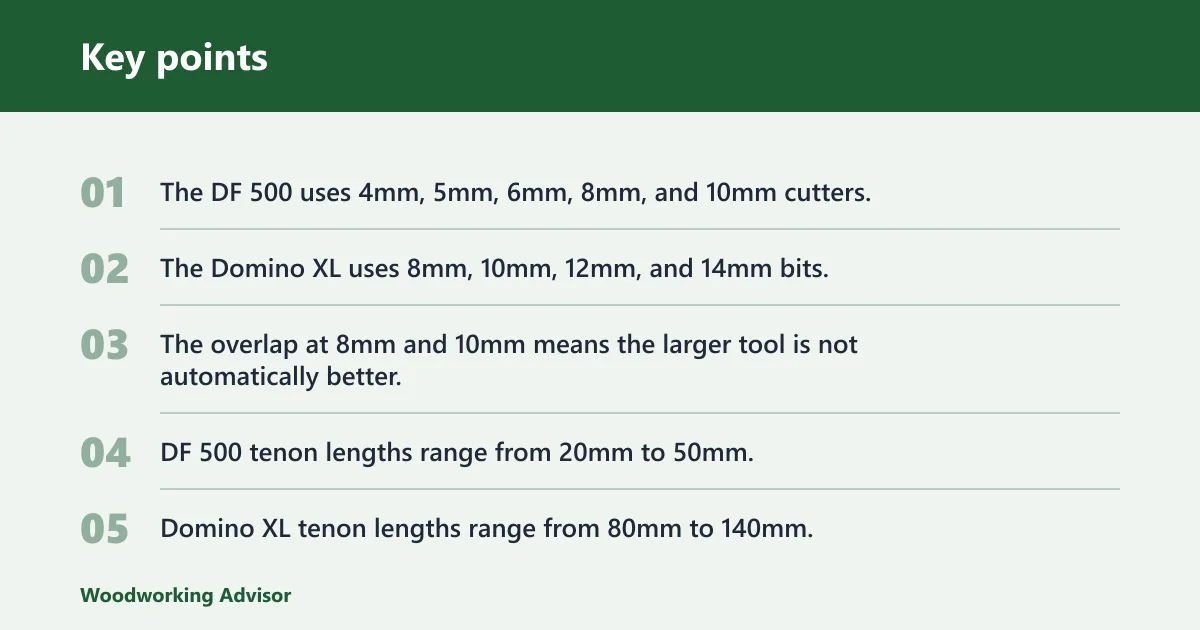
The DF 500 uses 4mm, 5mm, 6mm, 8mm, and 10mm cutters. The Domino XL uses 8mm, 10mm, 12mm, and 14mm bits. The overlap at 8mm and 10mm means the larger tool is not automatically better; it is better when the project needs its larger capacity.
Tenon length ranges by model
DF 500 tenon lengths range from 20mm to 50mm. Domino XL tenon lengths range from 80mm to 140mm. A common rule of thumb is to use tenons about one-third of the board’s thickness, which keeps the joint sized to the work instead of oversized.
Which model covers most projects?
The DF 500 covers most furniture tasks for a lot of woodworkers. The XL earns its keep on larger stock, wider parts, and joinery that needs longer tenons. If you mainly build cabinets, small tables, or casework, the smaller model usually gives the better cost-to-capability balance.
Suppose you build a door from thicker stiles and rails, then move to a long tabletop the next week. The DF 500 can still handle many of those parts, but the XL becomes more attractive when the stock gets too heavy or the joint needs more depth and bearing area.
Domino joiner vs biscuit joiner: what changes in cost and joint strength?
A biscuit joiner is the lower-cost alternative. It cuts a thin slot for an oval-shaped biscuit, while a Domino cuts mortises for a tenon that fits more like a loose mortise and tenon joint. Domino joints are generally stronger and better suited to structural furniture work, while biscuits are often fine for alignment and light reinforcement.
Cut geometry and tenon type
The Domino system uses oval-shaped tenons matched to a mortise cut in both workpieces. A biscuit joiner makes a narrow slot for a compressed biscuit that swells with glue. That difference matters because the Domino joint has more actual wood in the connection and more shoulder area to resist load.
Strength and alignment differences
Domino joints are closer to traditional mortise and tenon joints in strength and accuracy. A biscuit joint is useful for alignment, panel work, and modest reinforcement, but it is not the same category of joint. If the connection must carry real structural load, the Domino is the safer comparison.
When the lower-cost tool is enough
If your work is mostly face frames, panel alignment, or light assembly, a biscuit joiner may be enough. If the project is chairs, tables, doors, or other furniture that depends on strong joints, the Domino is the more appropriate tool. That is where the higher price starts to make sense.
How to buy the cheapest sensible Domino setup
The cheapest sensible setup is not always the cheapest sticker price. It is the tool size that matches your work, with only the cutters and accessories you actually need. A bad-size purchase can cost more than a better-used tool with the right package.
New tool path
Choose new if you want warranty coverage and a known starting point. The DF 500 is the cleaner buy for most first-time owners. Skip extra accessories unless they solve an immediate setup problem, and buy only the cutter sizes your projects truly need at first.
Used or reconditioned path
Used and reconditioned tools are the best way to lower entry cost. Check for included cutters, fences, and stops, because those can change the real value of a listing. A missing accessory can erase much of the savings if you need to replace it right away.
Accessories to buy now and later
- Buy the base machine first, matched to your project size.
- Buy the cutter sizes that fit your current stock thicknesses.
- Add extra tenons in the sizes you use most.
- Postpone specialty fences or stops until a repeat task justifies them.
- Move to the XL only if your projects outgrow the DF 500.
Frequently asked questions
How much does a Domino joiner cost?
A new Domino joiner typically costs about $1,100 to $1,600 for the DF 500 and more for the DF 700 / XL. Used units often fall around $700 to $1,200 for the smaller model, with reconditioned tools usually somewhere between. Tenons and cutters add to the real ownership cost.
What is a Domino joiner used for?
It is used for loose mortise and tenon joinery. The tool cuts mortises in both workpieces, then you glue in a detached Domino tenon. That makes it useful for furniture construction, tabletops, cabinets, chairs, tables, and doors where alignment and joint strength both matter.
What is the difference between a Domino joiner and a biscuit joiner?
A Domino joiner makes a stronger loose mortise and tenon joint. A biscuit joiner cuts a thinner slot for an oval biscuit that mainly helps alignment. Biscuit joiners cost less, but they do not match the Domino for joint strength or for structural furniture work.
Is the Festool Domino DF 500 enough for most projects?
Yes. The DF 500 is described as enough for almost all woodworking activities. Its cutter range and tenon lengths fit a wide span of furniture and cabinet work. The larger XL is better reserved for bigger stock and heavier joinery where the smaller machine starts to feel limited.
What cutter sizes does a Domino joiner use?
The DF 500 uses 4mm, 5mm, 6mm, 8mm, and 10mm cutters. The Domino XL uses 8mm, 10mm, 12mm, and 14mm bits. If you only build smaller furniture, the DF 500 cutter range covers most needs without pushing you into the larger system.
Which projects need a Domino joiner instead of a biscuit joiner?
Use a Domino when the joint has to do more than align parts. Chairs, tables, cabinets, doors, and other furniture construction projects benefit from the stronger loose-tenon joint. A biscuit joiner is usually enough for lighter panel alignment and non-structural work where strength is not the main concern.
Sponsored / affiliate links. As an Amazon Associate I earn from qualifying purchases. I may earn additional commission from eligible campaigns.