MDF vs Particleboard: Which Is Stronger for Shelving?
MDF is usually better for painted, shaped shelf parts. Particleboard often matches or beats it in shelf use when the panel stays flat and is fully covered by laminate. For 3/4-inch stock, a practical support target is about 16 to 24 inches, depending on depth and load. Ignore support, and sag, loose fasteners, and edge breakdown show up first.
| Factor | MDF | Particleboard | Winner |
|---|---|---|---|
| Painted shelf faces | Smooth, grain-free surface makes paint and routed profiles cleaner. | Can be painted, but the face is less forgiving once edges are exposed. | MDF |
| Laminated shelving | Works, but it is not the usual choice for decorative laminate cores. | Commonly used as a flat, stable substrate for decorative surfaces. | Particleboard |
| Screw holding in shelf edges | Can strip or crumble at edges without care and reinforcement. | Often gives more predictable holding in laminated furniture builds. | Particleboard |
| Sag control on long spans | Can sag under load if unsupported; depth and thickness still matter. | Also sags without support; face stiffness can be adequate in short spans. | Tie |
| Moisture exposure | Interior-use panel; standard grades are vulnerable to swelling. | Interior-use panel; standard grades can swell and become unstable with water. | Tie |
MDF vs particleboard for shelving
These panels fail in different ways. MDF, made from cellulosic fibres combined with resin and consolidated under heat and pressure, is a smooth interior panel tied to ANSI A208.2-2022. Particleboard, made by bonding wood particles into a panel and tied to ANSI A208.1-2022, is often chosen as a flat substrate for decorative surfaces.
The shelf question is not “which is stronger” in the abstract. It is which one resists sag, holds fasteners, keeps edges intact, and survives the room you put it in. A shelf can look fine on day one and still be the wrong material if the span, load, or finish style pushes it into a failure mode it handles poorly.
How to read this comparison
For shelving, face stiffness, edge strength, and screw withdrawal do not always point to the same winner. MDF usually gives the cleaner painted edge and better machining for profiles. Particleboard usually fits laminate-faced shelving better and can be the safer pick when the design depends on a flat, covered core rather than exposed edges.
Shelf decision table
The setup matters more than the panel name. Start with the span, then factor in depth, finish, and whether the edge stays visible. The table below uses common shelving situations where 3/4 inch panels are typical.
| Shelf setup | Condition | MDF | Particleboard | Recommendation |
|---|---|---|---|---|
| 12-inch shelf | Short span, painted, visible edge | Good | Fair | MDF |
| 12-inch shelf | Medium span, laminated, edge banded | Good | Better | Particleboard |
| 16-inch shelf | Short span, painted storage shelf | Good | Fair | MDF |
| 16-inch shelf | Medium span, laminate-faced closet unit | Fair | Better | Particleboard |
| 16-inch shelf | Long span, heavy books or dish load | Poor | Poor | Neither |
| 24-inch shelf | Any finish, unsupported span | Poor | Poor | Neither |
| 24-inch shelf | Any finish, with frequent brackets | Fair | Fair | Neither, unless support is upgraded |
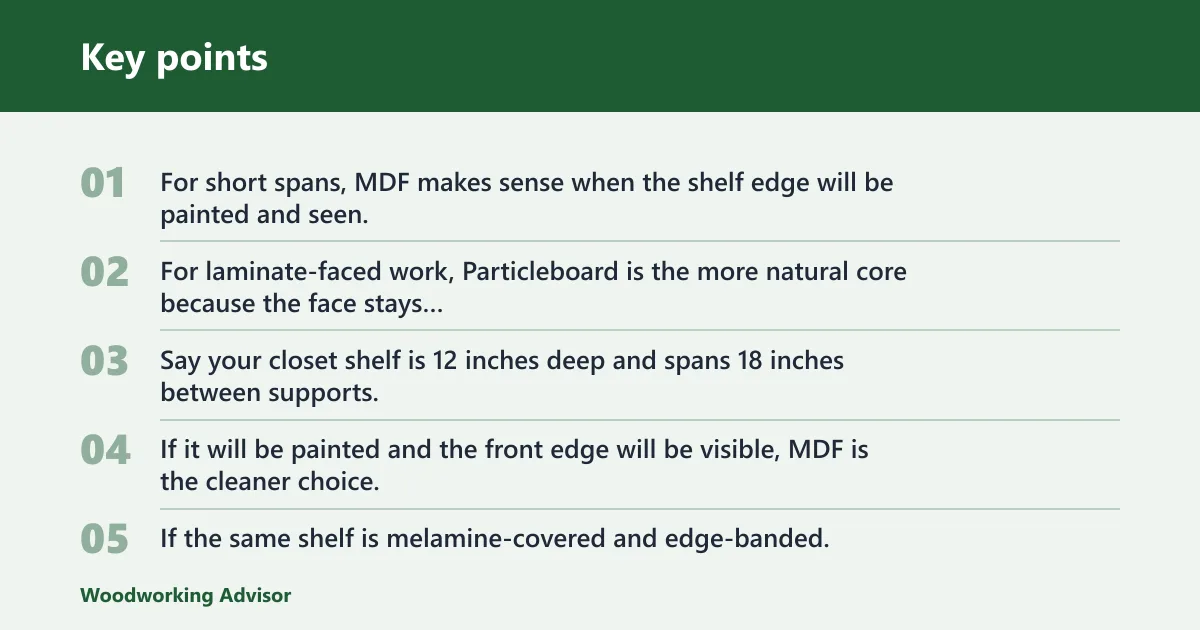
For short spans, MDF makes sense when the shelf edge will be painted and seen. For laminate-faced work, Particleboard is the more natural core because the face stays covered and the panel sits under a decorative skin that protects the surface.
Say your closet shelf is 12 inches deep and spans 18 inches between supports. If it will be painted and the front edge will be visible, MDF is the cleaner choice. If the same shelf is melamine-covered and edge-banded, Particleboard is the better fit because the finish system does more of the work.
Which is stronger on a shelf?
For shelf use, “stronger” splits into two jobs: resisting bending and surviving the edge and fastener loads that real shelving creates. MDF and Particleboard can both work at 3/4 inch, but neither should be treated like a long-span structural panel without support. On equal thickness, Particleboard is not automatically weaker in bending the way many buyers assume.
Bending stiffness and sag resistance
Sag depends on span length, shelf depth, thickness, and load. A 3/4 inch shelf at 12 inches deep can handle a modest load over a short span, but the same panel stretched farther will droop. Because shelf deflection rises fast with span, a 16 inch shelf needs more caution than a 12 inch shelf, and a 24 inch shelf usually needs another material or added support.
Face strength versus edge strength
MDF offers a very smooth, grain-free surface, so it finishes well and routes cleanly. Its edges, though, can crumble under abuse or poorly sized screws. Particleboard is less pleasant to machine, but its laminated face is often a better fit for a shelf where the broad face is covered and the edge is protected with banding.
Which board holds screws better for shelving?
Particleboard often gives more dependable shelf-hardware performance when fasteners stay in the face or when the panel is part of laminated furniture with proper pilot holes. MDF can hold screws adequately in the face with correct drilling, but its edges are easier to strip or blow out if the fastener is close to the edge or driven without care.
Edge fastening and pilot-hole needs
Both materials benefit from pilot holes. That matters more in shelf edges, where the holding area is smaller and repeated load can work fasteners loose. If the bracket or cleat places screws near the edge, reinforcement is a better answer than hoping a panel-grade sheet will behave like solid wood.
When reinforcement is the safer move
Use edge blocks, thicker stock, or a front nosing when the shelf carries books, dishes, or tools. That extra wood at the front edge does more for long-term fastener life than choosing between two sheet goods alone. A common first-timer mistake is putting a long shelf on light-duty brackets and expecting the panel choice to solve the span problem.
How much span can each handle?
There is no single safe span for every shelf, but 3/4 inch MDF or Particleboard works best in the short-to-medium range when the load is moderate and the shelf is supported properly. As a practical guide, about 16 inches is a cautious target for heavier loads, while 24 inches usually calls for more support or a thicker, stiffer system.
Depth, thickness, and load
Deeper shelves carry more bending demand because the usable front edge extends farther from the supports and often gets loaded unevenly. A 24-inch-deep shelf is generally more prone to sag than a 12-inch-deep shelf at the same span. If the shelf is both deep and long, neither MDF nor Particleboard is the safe default.
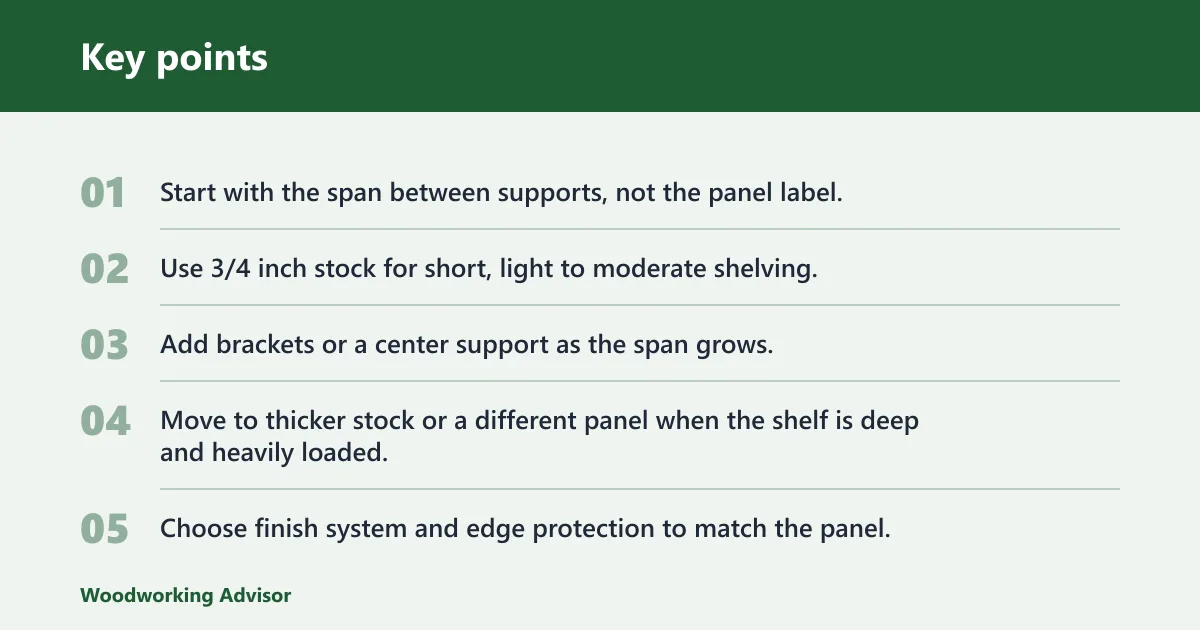
- Start with the span between supports, not the panel label.
- Use 3/4 inch stock for short, light to moderate shelving.
- Add brackets or a center support as the span grows.
- Move to thicker stock or a different panel when the shelf is deep and heavily loaded.
- Choose finish system and edge protection to match the panel.
Suppose a 16 inch-deep pantry shelf is carrying canned goods across a 30 inch opening. Even if the surface is laminated, the span is the weak point. A center bracket or a different shelf build is the safer decision than trying to fix sag with a different sheet type.
Which is better for painted shelves: MDF or particleboard?
MDF is usually the better painted-shelf material because its smooth, grain-free surface accepts paint cleanly and routes without the chip-out common at panel edges. That makes it useful for visible shelving, shaped fronts, and painted built-ins where the finish is part of the design.
Machining and painted edges
Because MDF has homogeneous density, it cuts predictably for profiles and simple routed details. Particleboard can be machined, but its cut edges are less attractive and usually need more careful banding or covering. If the shelf front will be seen, MDF gives you a cleaner path to a painted result.
Which panel is better for laminated shelving units?
Particleboard is usually the better core for laminate-faced shelving because it is commonly used as a flat, stable substrate for decorative surfaces. That is why value-engineered furniture often uses it behind melamine or other decorative faces. The laminate does the visual work, while the core provides the flat base.
Moisture and room conditions
Standard MDF and standard particleboard are generally used for interior applications rather than wet-service conditions. Both fall under EPA TSCA Title VI formaldehyde requirements in the U.S., but emissions compliance is separate from moisture durability. A compliant panel can still swell, soften, or fail if the room exposure is wrong.
Closets and bedrooms
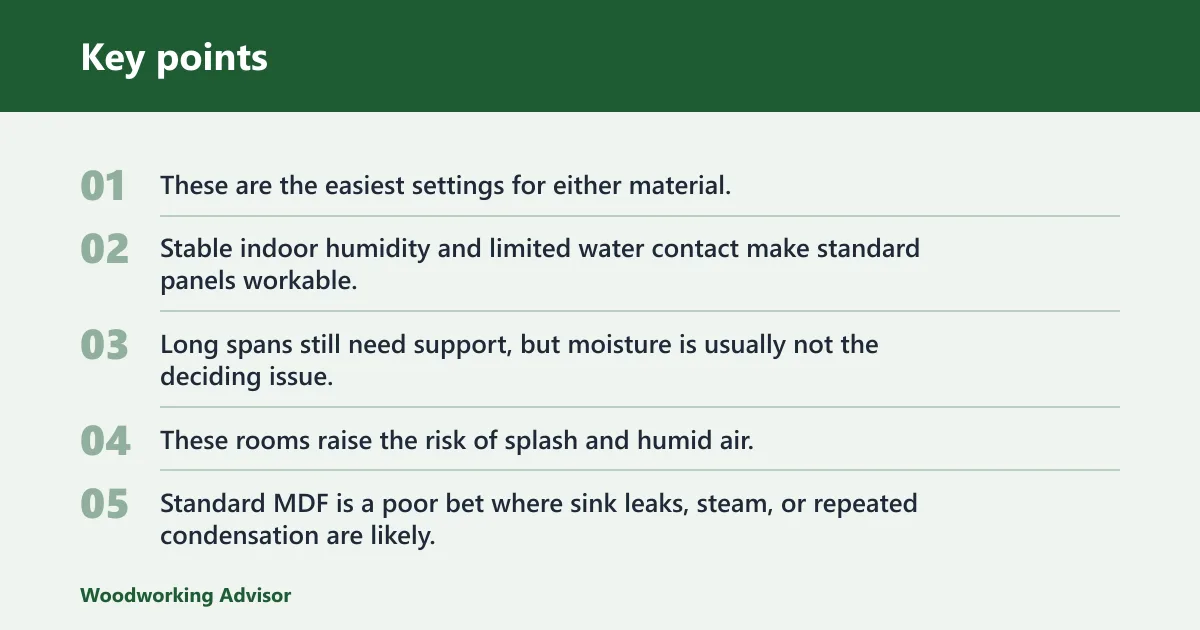
These are the easiest settings for either material. Stable indoor humidity and limited water contact make standard panels workable, especially for painted closet shelving or laminated bedroom storage. Long spans still need support, but moisture is usually not the deciding issue.
Kitchens, laundry rooms, and baths
These rooms raise the risk of splash and humid air. Standard MDF is a poor bet where sink leaks, steam, or repeated condensation are likely. Particleboard also needs caution; product data may list a moisture-resistant grade and a declared exposure limit, but that is not the same thing as wet-service approval.
Garages and basements
Temperature swings and damp air are hard on both materials. If the room sees seasonal moisture or a concrete-wall environment, choose a more moisture-tolerant construction or move to another panel family. The best technical data sheet in the world does not turn standard interior panel stock into outdoor-grade shelving.
Choose MDF if… / Choose particleboard if…
Choose MDF if the shelf will be painted, routed, or shaped, and the edge will be visible enough that a smooth finish matters. Choose Particleboard if the shelf is laminated, budget-focused, and the decorative face will cover the core. Choose neither if the shelf is long, deep, heavily loaded, or exposed to moisture.
- Choose MDF if you need a painted shelf with clean routed edges.
- Choose MDF if the shelf is short to medium span and the front edge will be seen.
- Choose Particleboard if you are building a laminate-faced closet or cabinet shelf.
- Choose Particleboard if the design depends on a flat decorative substrate rather than exposed edges.
- Choose neither if the span is long, the load is heavy, or the room is humid.
Frequently asked questions
Is MDF or particleboard stronger for shelves?
Neither is simply “stronger” in every shelf situation. MDF is usually better for painted, shaped shelves, while Particleboard often fits laminate-faced shelving and can hold screws well in the right setup. For equal thickness, support spacing and shelf depth matter more than the panel name.
How much weight can MDF shelves hold compared with particleboard?
There is no universal weight rating because load capacity depends on thickness, span, depth, bracket spacing, and how the shelf is fixed. At 3/4 inch, both materials can handle modest storage over short spans, but long spans should be treated cautiously. Add support before you count on the panel alone.
Does MDF or particleboard sag less on long shelves?
Neither is a good choice for a long, unsupported shelf. Sag is driven by span, depth, thickness, and load, not just material label. At 3/4 inch, a shorter shelf can work in either panel, but as the span grows, brackets, center supports, or thicker stock become necessary.
Can particleboard be used for shelving in humid rooms?
Only with caution. Standard Particleboard is an interior panel and can swell if it gets wet or stays in humid air. Moisture-resistant grades may help in a damp indoor room, but manufacturer data and declared exposure limits do not make it a wet-service material.
Sponsored / affiliate links. As an Amazon Associate I earn from qualifying purchases. I may earn additional commission from eligible campaigns.