How Much Paint Do You Need for a Wood Fence? (Calculator Guide)
For a standard 6-foot wood privacy fence, plan on about 1 gallon of exterior paint per 100–150 square feet of coated surface per coat, and it is common to add about 10%–15% for waste and touch-ups. Underbuying means extra store runs and mismatched color batches; overbuying leaves you with unused cans and wasted money. This guide shows how to calculate board faces, rails, posts, gates, and waste so you can buy the right amount the first time.
Fence paint calculator table
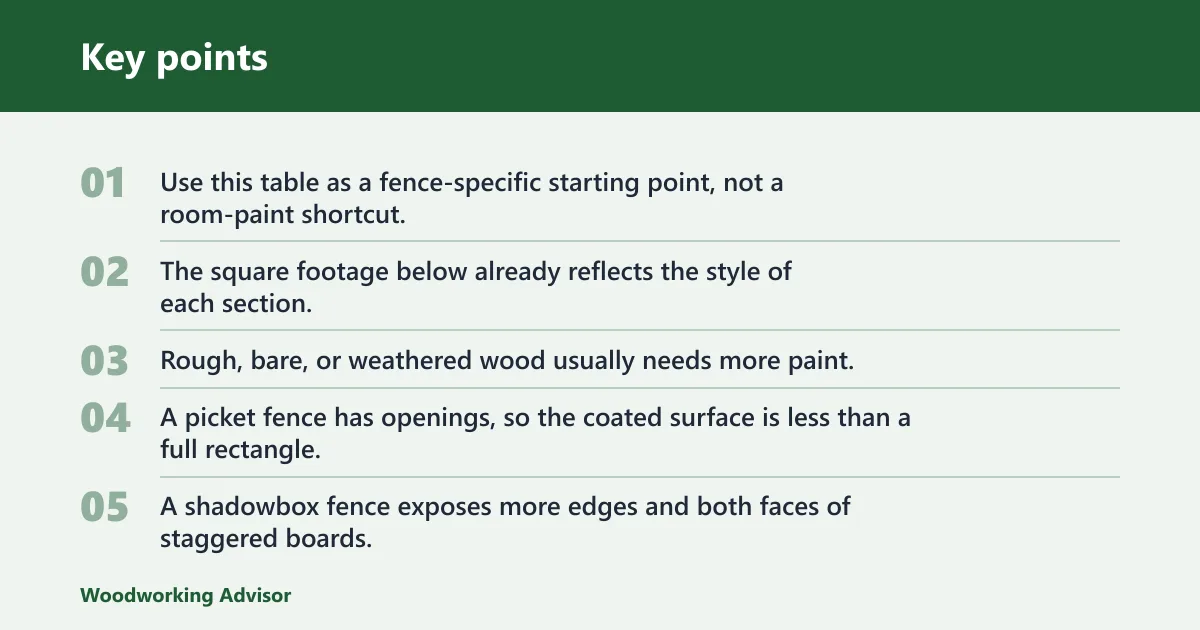


Use this table as a fence-specific starting point, not a room-paint shortcut. The square footage below already reflects the style of each section, and the gallon estimate assumes a starting coverage range of 350 to 400 square feet per gallon on smooth, primed surfaces. Rough, bare, or weathered wood usually needs more paint, so plan at the lower coverage end.
| Fence section | Formula | Paintable square feet | Estimated gallons, 1 coat | Estimated gallons, 2 coats | 10%–15% waste allowance |
|---|---|---|---|---|---|
| Picket section | Length × height × 0.70 | 140 sq. ft. for a 50 × 4 ft section | 0.35–0.40 gal | 0.70–0.80 gal | Add 0.1 gal; buy 1 gal |
| Privacy section | Length × height × 1.00 | 300 sq. ft. for a 50 × 6 ft section | 0.75–0.86 gal | 1.50–1.71 gal | Add 0.1–0.3 gal; buy 2 gal |
| Shadowbox section | Length × height × 1.25 | 375 sq. ft. for a 50 × 6 ft section | 0.94–1.07 gal | 1.88–2.14 gal | Add 0.2–0.3 gal; buy 2–3 gal |
| Gate section | Width × height × 1.00 | 20 sq. ft. for a 4 × 5 ft gate | 0.05–0.06 gal | 0.10–0.11 gal | Add a quart if doing nearby repairs |
The table uses real fence geometry. A picket fence has openings, so the coated surface is less than a full rectangle. A shadowbox fence exposes more edges and both faces of staggered boards, so it usually needs more paint than a solid privacy fence of the same length and height.
Picket fence example
Say your picket fence is 50 feet long and 4 feet tall. A reasonable estimate is 50 × 4 × 0.70 = 140 square feet per side, then divide by 350 to 400 square feet per gallon for the first coat. That works out to about 1 gallon after waste, and often 2 gallons if you want two coats.
Privacy fence example
Suppose your privacy fence is 50 feet long and 6 feet high, and you are coating one side only. The starting area is 300 square feet. At 350 to 400 square feet per gallon, one coat needs about 0.75 to 0.86 gallon, while two coats push the job to about 1.50 to 1.71 gallons before waste.
Shadowbox fence example
Picture a 50-foot shadowbox fence that is 6 feet high. Because the boards overlap and leave more edges exposed, the painted area is greater than a flat privacy fence. Using 50 × 6 × 1.25 gives 375 square feet, which is roughly 1 gallon for one coat and a little over 2 gallons for two coats before waste.
Gate section example
A common first-timer mistake is to treat a gate like a tiny afterthought. A 4 × 5 foot gate has 20 square feet of face area, but hardware, edges, and end grain still need paint, so a quart is often the practical minimum when you are already painting the surrounding fence.
How do you measure a wood fence for paint?
Measure the fence in square feet, not in boards. Start with length times height, then split the job into panels, posts, rails, and gates so you can adjust for openings and double-sided painting before you buy anything. That gives you a paintable area, which is the number that matters.
Length times height
For a straight run, multiply the fence length by the height. A 60-foot run at 6 feet high gives 360 square feet for one side. If you paint both sides, multiply that by 2. If you only paint the visible side, keep the estimate to one face.
Separate panels, posts, and rails
Fence style changes the math. Privacy fences are closer to full rectangles, while picket and shadowbox designs have more edge area and more air space. Posts and rails add paintable surface beyond the panel faces, and those parts often absorb more paint because of end grain and rough cuts.
Count one side or both sides
If you paint both sides, the amount needed nearly doubles. That is the biggest decision in the estimate. A one-sided estimate for a 6-foot fence can look affordable, then jump sharply once the back side, post wraps, and gate frames are added.
- Measure each fence run in feet.
- Measure the height in feet.
- Multiply length × height for one side.
- Adjust for fence style: picket, privacy, or shadowbox.
- Subtract gates and openings.
- Multiply by 2 if you are painting both sides.
- Divide by your coverage rate.
- Add 10%–15% for waste and touch-ups.
How many square feet does one gallon cover?
A good starting point is 350 to 400 square feet per gallon on primed, smooth, non-porous surfaces. One gallon of paint typically covers up to 400 square feet on that kind of surface. On porous wood, rough-sawn lumber, or weathered boards, coverage drops, so the same gallon goes less far.
Use 350 to 400 square feet as the starting range
That range keeps the estimate realistic without pretending every fence takes paint at the same rate. Architectural Digest says divide total square footage by 400 to estimate gallons for one coat, while other calculators use 350 square feet per gallon when coverage is unknown. Start with the lower number when the wood is rough or dry.
Adjust for brand and finish
Coverage changes by brand, sheen, and product type. Livingetc notes that good-quality water-based paint can cover up to 350 square feet per gallon. For exterior fence work, the can label matters because the stated coverage applies under specific conditions, often on smooth surfaces with a proper primer underneath.
Expect less coverage on porous wood
Calctool notes that porous surfaces require more paint than smooth surfaces, and Livingetc says porous and bare plaster surfaces absorb more paint than wallpaper or upcycled furniture. The same logic applies to bare or weathered fence boards: the more open the grain and texture, the less far the paint goes.
How do coats change the amount you need?
One coat is the bare minimum for some maintenance jobs, but two coats are common on exterior fences because the finish needs even color and dependable film build. If you change from dark to light, or cover bare wood, a third coat can appear in spots where the first two sink in unevenly.
One coat versus two coats
Multiply the square footage by the number of coats. Two coats do not just improve appearance; they also help even out coverage on edges and joints.
Color change and coverage
Dark-to-light changes often raise paint usage because the old color can show through after the first coat. A lighter topcoat may need a second pass to hide the previous finish, especially on broad boards and rails. That does not mean every color change needs a third coat, but the risk rises when the underlying color is strong.
When a third coat may appear
A third coat usually shows up on repair spots, patched areas, or mixed surfaces where bare wood, old finish, and primer meet. That is most common on weathered fences with spot repairs. If the fence has uneven absorption, plan for a little extra rather than expecting every board to take the same amount.
What does porosity do to paint use?
Porosity changes the estimate because bare and rough wood absorb more paint than sealed or smooth surfaces. Primer reduces that demand by filling some of the absorbent surface before the topcoat goes on. Weathered boards, end grain, and rough-sawn lumber usually need the largest buffer.
Bare wood
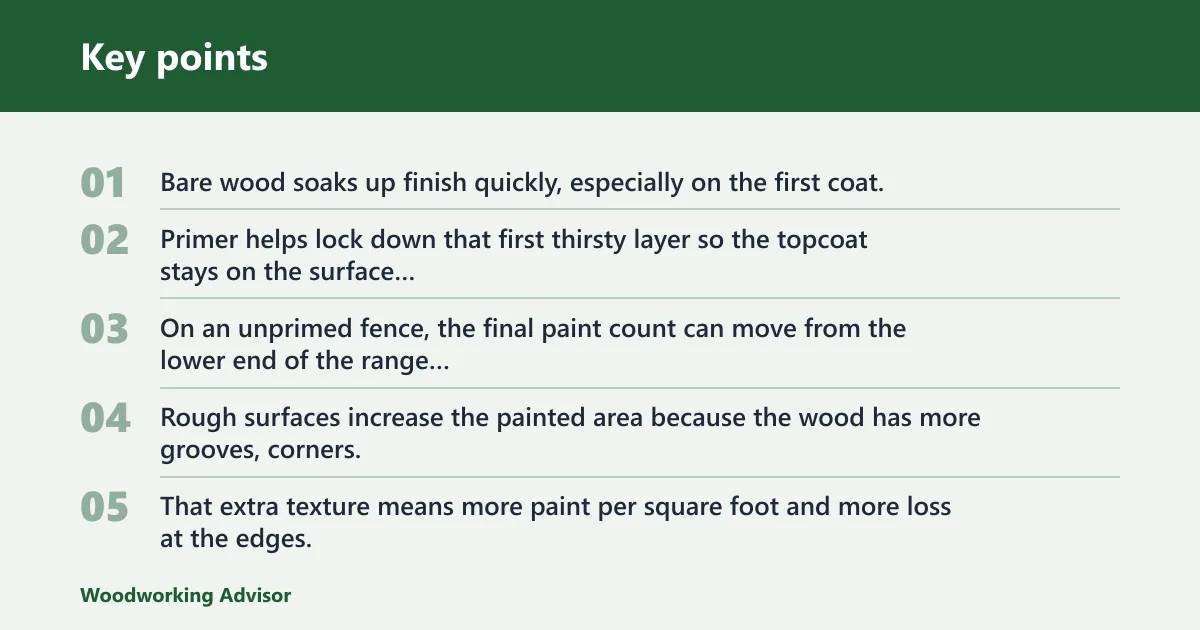
Bare wood soaks up finish quickly, especially on the first coat. Primer helps lock down that first thirsty layer so the topcoat stays on the surface instead of disappearing into the grain. On an unprimed fence, the final paint count can move from the lower end of the range toward the higher end.
Weathered or rough-sawn boards
Rough surfaces increase the painted area because the wood has more grooves, corners, and exposed fiber. That extra texture means more paint per square foot and more loss at the edges. If the fence is weathered, plan for the higher end of the coverage range and keep a waste buffer.
Primed surfaces
Primer usually lowers topcoat demand because the surface becomes less absorbent and more even. It also helps the finish hold a consistent color, which can reduce the chance of a third coat in weak spots. For exterior paint systems, primer plus topcoat is often the safer plan on bare or patched sections.
Should you subtract gates, doors, or openings?
Yes. Subtract gates, doors, and other openings from the total fence measurement so you estimate paintable area instead of the full rectangle. A standard deduction works for simple openings, but custom sizes should be measured directly. Small parts can stay in the total if they are part of the visible painted face and you are already buying extra for touch-ups.
Simple deduction method
For a simple opening, measure height times width and subtract that area from the total. In room painting, Architectural Digest suggests subtracting 20 square feet per door and 15 square feet per window, but a fence gate should be measured by its actual dimensions because the size varies more from project to project.
Custom opening sizes
If a gate is 4 feet wide and 6 feet high, subtract 24 square feet per face. If the opening is irregular, break it into rectangles and triangles, then add those pieces together before subtracting. That method is slower, but it avoids guessing on a section that can throw off a small project.
When to keep small parts in the total
If the gate hardware, latch area, or trim is being coated along with the adjacent posts, it can be simpler to keep those small parts in the total and add a waste allowance. That is especially practical when the job is already small and the leftover paint will also cover future touch-ups.
How much extra paint should you buy?
Add 10% to 15% for waste, lap marks, end grain, overspray, and touch-ups. That buffer keeps you from running short after the first coat, and it helps you avoid color-matching problems if the store lot changes. On a fence, waste is not optional; edges and cut ends always absorb more than flat faces.
Touch-ups and batch matching
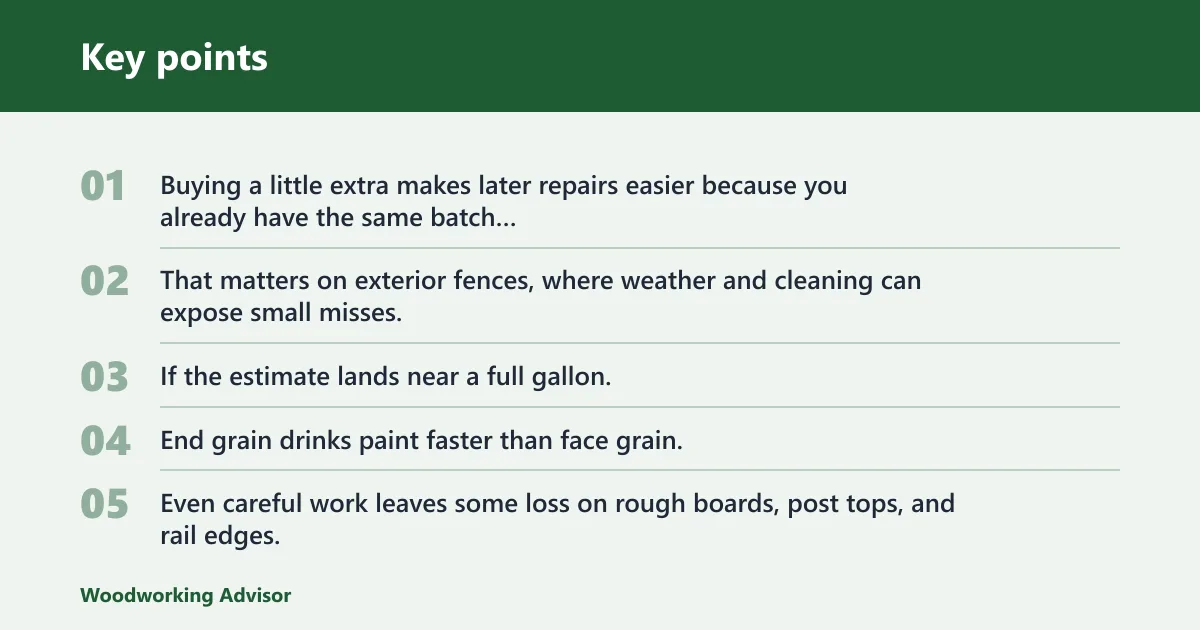
Buying a little extra makes later repairs easier because you already have the same batch on hand. That matters on exterior fences, where weather and cleaning can expose small misses. If the estimate lands near a full gallon, round up to the next whole can instead of relying on a partial can.
Overspray, end grain, and lap marks
End grain drinks paint faster than face grain, and lap marks happen when you roll or brush into drying paint. Even careful work leaves some loss on rough boards, post tops, and rail edges. A 10%–15% buffer is usually enough for a straightforward fence; heavily textured wood may need more.
Suppose you are painting a 48-foot privacy fence that is 6 feet tall, one side only. The area is 288 square feet. At 375 square feet per gallon, that is about 0.77 gallon for one coat and 1.54 gallons for two coats before waste. Add 15%, and the purchase decision becomes 1 gallon for one coat or 2 gallons for two coats.
For cost, multiply the gallons you plan to buy by the price per gallon, then add primer if the fence needs it. If a primer is required on bare sections, count it as a separate product line unless the can is a paint-and-primer formula that specifically lists exterior fence use and the needed coverage.
Frequently asked questions
How do I calculate how much paint I need for a wood fence?
Measure length and height in feet, calculate the paintable square footage, subtract gates and openings, then divide by the can’s coverage rate.
How many square feet does one gallon of exterior paint cover?
One gallon of paint typically covers up to 400 square feet on primed, smooth, non-porous surfaces. On rough, bare, or porous fence wood, the practical coverage is lower. If the label is unclear, 350 square feet per gallon is a cautious planning number for exterior estimating.
Do I need one coat or two coats on a wood fence?
Two coats are common on wood fences because they give more even color and a more uniform film on edges, posts, and rails. One coat may be enough for a lightly weathered repaint, but bare wood, color changes, and exposed end grain often push the job to two coats.
How do I account for porous or rough wood when estimating paint?
Use the lower end of the coverage range, then add waste. Bare wood, rough-sawn boards, and weathered fence surfaces absorb more paint than smooth or primed surfaces. Primer can lower the final topcoat demand because it seals some of that absorption before the finish coat goes on.
Should I subtract gates, doors, or openings from my fence measurement?
Yes. Subtract openings so you estimate only the area that gets painted. For a simple gate, measure width times height and deduct that area from the total. If the opening is irregular, break it into smaller shapes and add them before subtracting, rather than guessing at a single number.
Does a darker-to-lighter color change increase paint usage?
Yes, often it does. A lighter topcoat may need more coverage to hide the previous color, especially on broad boards, rails, and sun-faded sections. That does not always mean a third coat, but it does make the higher end of the coverage range more realistic for planning.
Sponsored / affiliate links. As an Amazon Associate I earn from qualifying purchases. I may earn additional commission from eligible campaigns.