How Much Does a Teak Wood Door with Carving Cost?
A carved teak wood door is commonly priced around $2,500 to $12,000, with large hand-carved, custom-built doors sometimes reaching about $20,000 or more installed. If the bid is too low, you may get thin teak, shallow carving, poor weather sealing, or surprise installation charges. This guide breaks down the cost stack by size, carving method, hardware, finish, and installation so you can compare quotes line by line.
Teak carved door cost breakdown
The biggest pricing mistake is treating a carved teak door as one line item. A fair quote usually separates the slab or base door, carving labor, size premium, finishing, hardware, and installation. That split shows where the money goes and what can still be adjusted.
| Quote line item | Low | Typical | High |
|---|---|---|---|
| Teak slab or base door | $900 | $1,800 | $4,500 |
| Carving labor | $400 | $1,500 | $6,000 |
| Sizing premium and shop drawings | $150 | $500 | $1,500 |
| Finishing and sealing | $250 | $700 | $2,000 |
| Hardware | $200 | $650 | $1,800 |
| Installation and frame work | $500 | $1,500 | $4,500 |
| Estimated total | $2,400 | $6,650 | $20,300 |
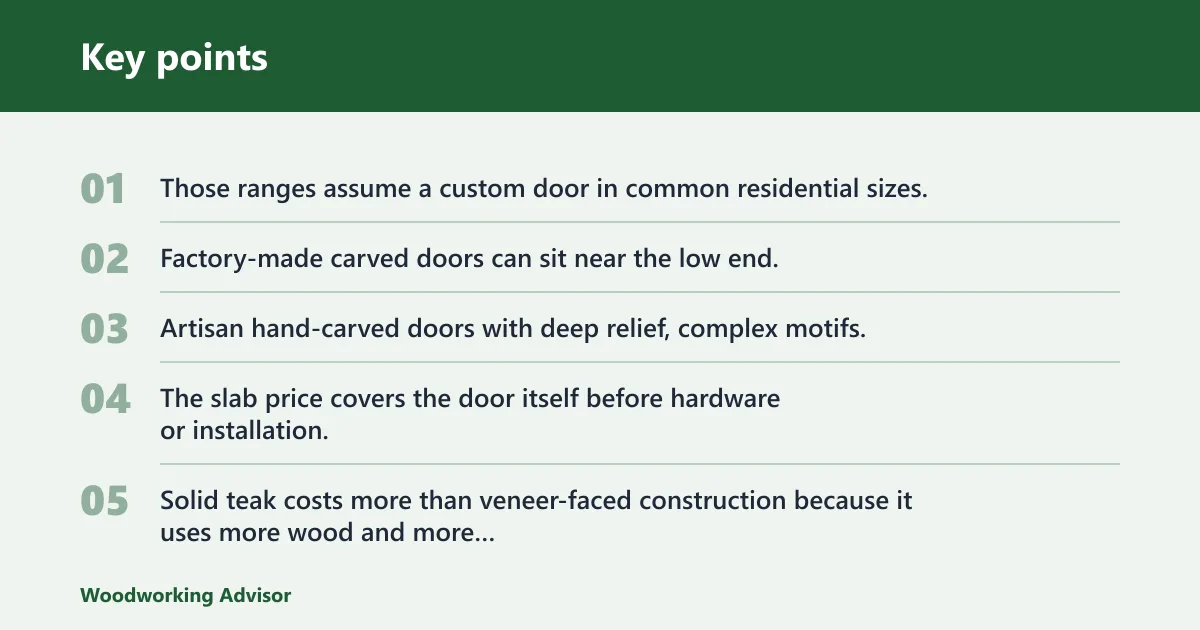
Those ranges assume a custom door in common residential sizes, with thicker material and better finishing for exterior use. Factory-made carved doors can sit near the low end. Artisan hand-carved doors with deep relief, complex motifs, and full installation work can push the total much higher.
Slab or base door
The slab price covers the door itself before hardware or installation. Solid teak costs more than veneer-faced construction because it uses more wood and more labor, but the slab is only one part of the quote. Door thickness, grain selection, and waste from cutting around defects also affect this number.
For many custom jobs, the slab is quoted separately from the frame or jamb package. That matters because a prehung assembly can look cheaper or more expensive depending on what is included.
Carving labor
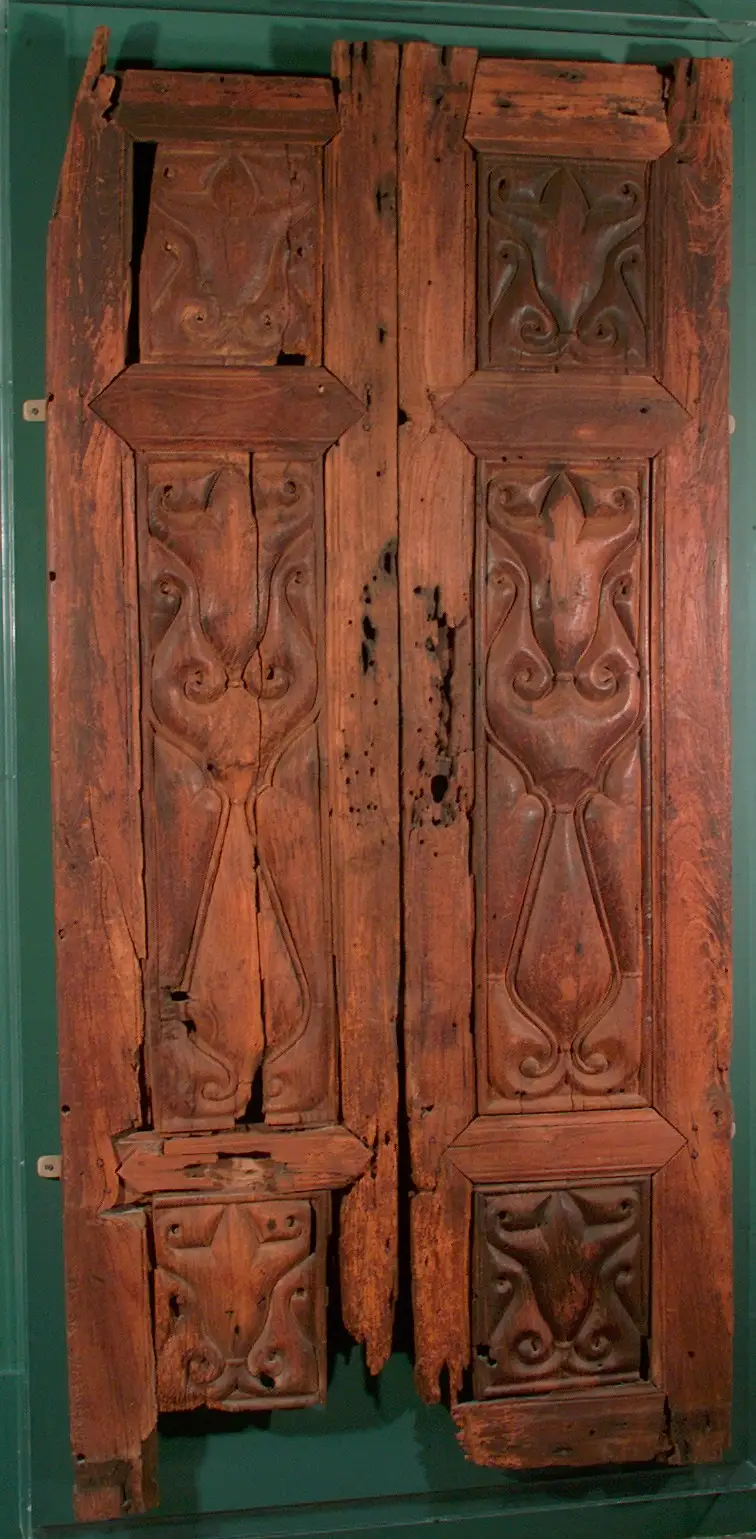
Carving labor is where teak door pricing separates quickly. Shallow CNC work with repeating motifs can cost a few hundred dollars above the base door, while deep hand carving with layered detail may add several thousand dollars because the hours rise fast. Relief depth, panel count, and motif complexity all change the bill.
A simple border pattern is not priced like a full figurative scene. The more the design changes direction, overlaps layers, or requires cleanup in tight corners, the more labor it takes.
Custom sizing adds cost because the shop must cut, square, and often redraw the door for the opening. Oversized doors usually need more material allowance, more waste, and extra time for joinery and fitting. Shop drawings are common on bespoke millwork jobs and should be listed before production starts.
Standard residential doors are often around 1 3/4 inches thick, while exterior custom teak doors may be built thicker for added stability and weather performance. A thicker slab can reduce movement risk, but it also raises material and machining cost.
Finish, hardware, and installation
Finish, hardware, and installation are often where a quote gets stripped down. Exterior teak usually needs a UV-resistant finish or marine-grade sealer, plus periodic maintenance to slow moisture uptake and surface breakdown. Hardware and labor can add more than many buyers expect, especially when the frame needs prep.
Picture a 36-inch by 80-inch carved teak front door with a simple relief pattern. A shop may quote the slab at a modest number, but the final price rises after weather sealing, hinges, lockset, deadbolt, and alignment work are added.
What affects the price of a carved teak door?
The main price drivers are material choice, carving method, design complexity, and size. Solid teak costs more than veneer construction, hand carving costs more than CNC carving, and custom dimensions cost more than stock openings. For exterior doors, finish and movement control also matter because exposure changes the build requirements.
Solid teak vs teak veneer
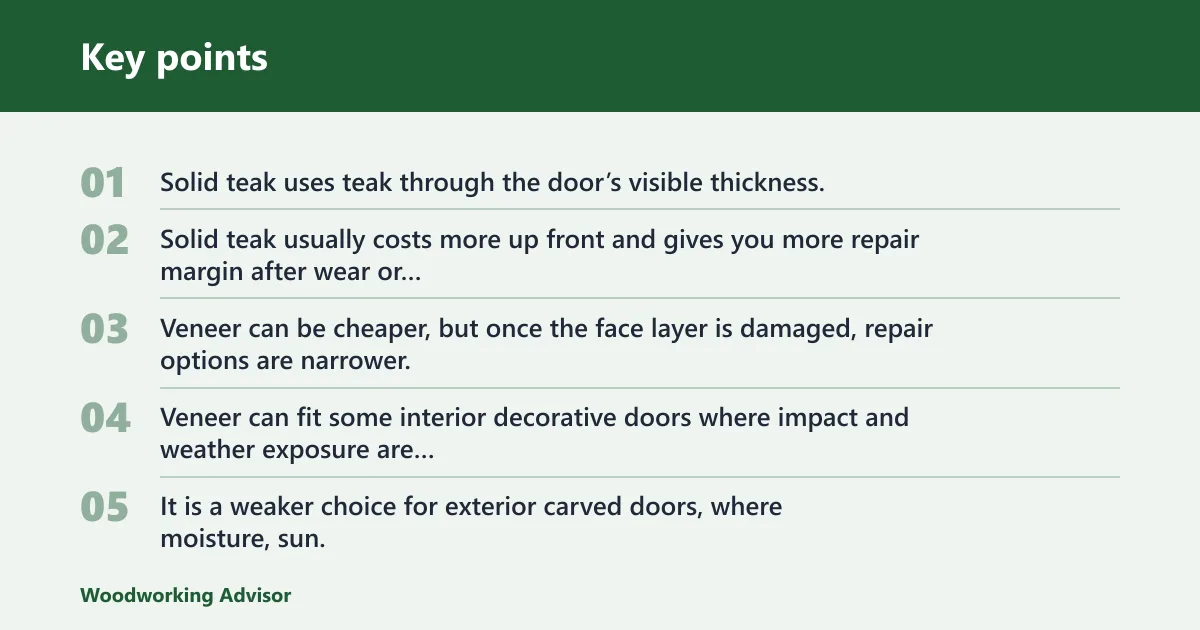
Solid teak uses teak through the door’s visible thickness, while teak veneer places a thin teak face over a different core. Solid teak usually costs more up front and gives you more repair margin after wear or refinish work. Veneer can be cheaper, but once the face layer is damaged, repair options are narrower.
Veneer can fit some interior decorative doors where impact and weather exposure are limited. It is a weaker choice for exterior carved doors, where moisture, sun, and edge wear create more demand on the finish and substrate.
Hand-carved vs CNC-carved
Hand-carved details usually add the most labor cost because the craftsperson shapes each cut manually. CNC-carved doors still require setup, programming, and cleanup, but the machine reduces hours on repetitive patterns. Factory-carved doors can be the least expensive if the design is standardized and production runs are large.
Relief depth matters. A shallow pattern with simple geometry is faster to produce than deep relief with undercut edges, floral scrolls, or intersecting panels. That extra depth also raises waste because more material is removed and more time is spent sanding and refining.
Standard size vs custom size
Standard size doors are cheaper because the shop can build around common dimensions. Custom width, custom height, or an unusual thickness requires more layout time and often more waste. A wider door may also demand stronger hardware and tighter installation tolerances.
Suppose you compare a stock-size 36-inch interior teak door with a 42-inch custom front door. The wider exterior door will usually need more material, more finish, and more time in fitting, so the quote should rise in more than one line.
Is solid teak more expensive than teak veneer for a carved door?
Yes. Solid teak is usually more expensive than teak veneer because it uses more of the actual species and usually involves more material waste during milling and carving. Veneer is cheaper to build, but it generally offers less repair room and is less forgiving where edges, moisture, or impact are involved.
For carved doors, the choice also affects service life. Solid teak can be refinished and repaired more confidently, especially on exterior doors. Veneer works better when the door is interior, the carving is shallow, and the environment stays stable.
Where veneer can and cannot fit
Veneer can make sense for interior decorative doors, closet doors, and some protected interior entry doors. It is a poor fit for a front door that gets direct weather, strong sun, or frequent moisture cycling. On an exterior carve, edge exposure can reveal the substrate and shorten service life.
Buyers should ask whether the quoted door is solid teak, teak-faced veneer, or a mixed construction with teak on visible surfaces only. That one detail can change both price and durability.
What size and thickness should I expect for a custom teak carved door?
Most custom carved teak doors are built around common residential openings, but the thickness often increases for exterior use. A typical interior slab may be near 1 3/4 inches thick, while exterior doors are often thicker to improve rigidity and movement control. Oversized or heavy carved designs may need still more structure.
Thickness is only part of the build. The frame, jamb, and hinge layout must match the weight of the door and the depth of the carving. If the carving is deep, the remaining core needs enough strength to resist twist and sag.
Relief depth and panel complexity
Deeper relief and more panels usually add cost because each surface change must be carved, sanded, and checked for tear-out. A door with multiple recessed fields and border bands takes longer than a flat-panel design with a simple motif. More panel joints also mean more fitting time.
A common first-timer mistake is choosing a complex design without asking how many labor hours it adds. That can turn a midrange quote into a high-end one before finish or hardware is counted.
Does a teak carved door cost more for exterior use?
Yes. Exterior teak carved doors usually cost more because they need better movement control, more careful sealing, and hardware that can handle weather exposure. Sun and moisture can move wood, break down finish, and open joints if the door is not built and maintained for the site.
Exterior work often adds thicker material, more stable construction, and a higher-grade finish system. It may also require a better jamb, weatherstripping, and closer installation tolerances to keep water out and operation smooth.
Finish systems and maintenance
A typical exterior package may include a UV-resistant finish, a marine-grade sealer, and either a stain or clear coat. Clear coats show grain better, while stains can even out color and reduce visual contrast. Either system needs maintenance, and the interval depends on sun and rain exposure.
Unprotected carving edges fail sooner than flat surfaces. Once finish breaks down, moisture enters the fibers faster, and repair often costs more than prevention.
What hardware and finishing costs should I budget for a teak carved door?
Budget for hinges, a lockset, a handle set, a deadbolt for entry doors, and weatherstripping where the door meets the frame. Finishing can be a major line item too, especially for exterior doors that need sealing and repeated coats. Hardware and finish are not small extras on a carved teak build.
| Item | Low | Typical | High |
|---|---|---|---|
| Hinges | $30 | $90 | $250 |
| Lockset | $75 | $250 | $700 |
| Handle set | $60 | $200 | $600 |
| Deadbolt | $40 | $120 | $300 |
| Weatherstripping | $25 | $75 | $200 |
| Exterior finish and sealing | $250 | $700 | $2,000 |
The finish line item can rise if the door needs stain, clear coat, UV protection, multiple seal coats, or a more careful curing schedule. Hardware cost also climbs when the buyer wants architectural-grade pulls or higher-security locksets.
How much do installation and frame work add to a carved teak door?
Installation and frame work often add $500 to $4,500 depending on the opening, the door weight, and whether a new jamb is needed. The labor can include frame or jamb preparation, hinge mortising, shimming, alignment, trimming, and final sealing. Regional labor rates also move the total.
Prehung assemblies usually cost more to install than a bare slab because the frame is part of the job. If the opening is out of square, the installer may need extra time to correct it before the carved door can hang properly.
Frame and jamb preparation
The existing opening must be sound enough to carry a heavy carved door. If the jamb is damaged, loose, or out of square, the installer may need to rebuild or replace part of it. That work is separate from the door price and should be listed in the quote.
Hinge mortising, shimming, and alignment are time-sensitive on carved teak because weight and ornament can make the door harder to balance. A bad fit can lead to rubbing, sag, or latch problems, which then turn into repair costs.
How do you tell if a quote is fair?
A fair quote names the slab, carving method, size, finish system, hardware, and installation separately. It should also state whether the door is solid teak or veneer, whether the job is interior or exterior, and whether shop drawings or lead time are included. Missing line items are a warning sign.
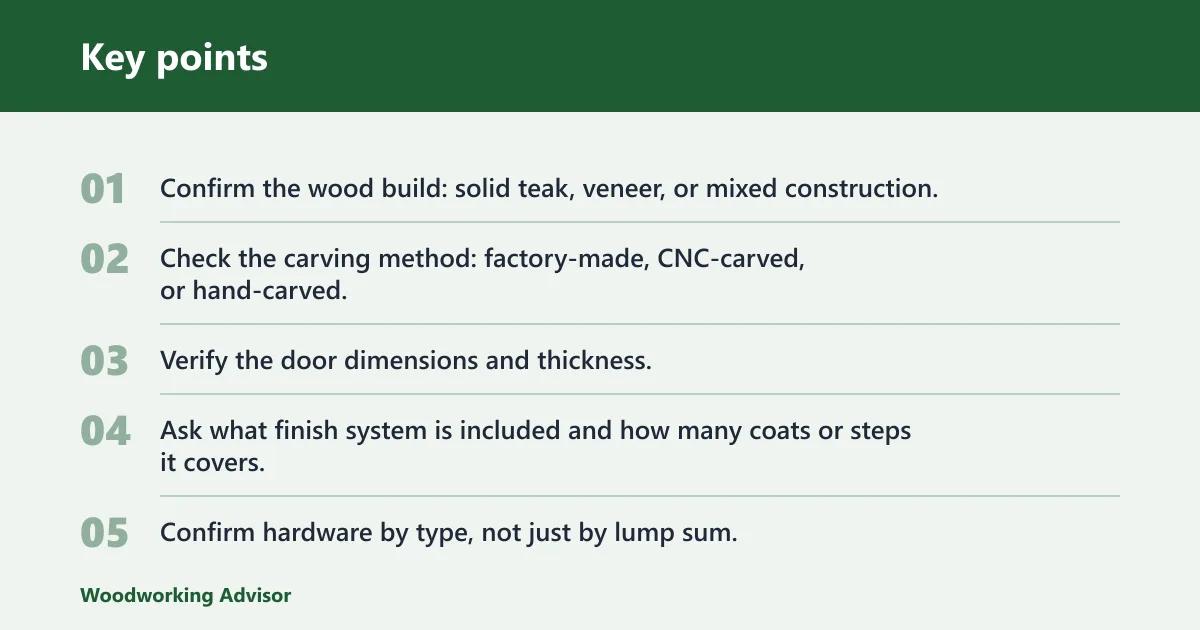
- Confirm the wood build: solid teak, veneer, or mixed construction.
- Check the carving method: factory-made, CNC-carved, or hand-carved.
- Verify the door dimensions and thickness.
- Ask what finish system is included and how many coats or steps it covers.
- Confirm hardware by type, not just by lump sum.
- Ask whether installation includes frame prep, mortising, shimming, and sealing.
- Look for lead time, shop drawings, and any waste or yield loss allowance.
- Compare warranty terms for finish failure, movement, and carving repair.
Say your quote says “custom teak carved door, installed” with one price only. That may hide the fact that the bid excludes weatherstripping, finish work, or jamb correction. A line-by-line quote is easier to compare and easier to challenge if something goes missing later.
Ask whether the shop has allowed for waste and yield loss on the selected design. Deep carving, wide rails, and defect-free grain selection can increase material waste, and that cost often appears only in a detailed millwork quote.
Frequently asked questions
How much does a teak wood door with carving cost?
The total depends on whether you are buying a slab or a prehung assembly, how deep the carving is, and whether exterior finish and frame work are included.
What affects the price of a carved teak front door?
Price moves with wood construction, carving method, size, finish, hardware, and installation scope. Solid teak costs more than veneer, hand-carved work costs more than CNC work, and exterior front doors usually need thicker material, better sealing, and tighter fitting than interior decorative doors.
How much do hand-carved details add to a teak door price?
Hand-carved details often add hundreds to several thousand dollars because labor rises with relief depth, motif complexity, and the number of panels. Deep floral work, layered borders, and undercut details take longer than shallow repeat patterns, and that time is a major part of the quote.
How do I tell if a teak carved door price is fair?
A fair price breaks out the slab, carving, finish, hardware, and installation instead of hiding everything in one lump sum. It should also state whether the door is solid teak or veneer, whether shop drawings are included, and whether frame prep or weather sealing is part of the job.
Sponsored / affiliate links. As an Amazon Associate I earn from qualifying purchases. I may earn additional commission from eligible campaigns.