How to Find a 45-Degree Angle on Wood (5 Methods)
A 45-degree angle is exactly half of a 90-degree corner — and the fastest way to mark one on wood is with a speed square, which has a pre-set 45° hypotenuse built into its design. Getting it wrong by even a degree causes visible gaps in miter joints and trim. This guide covers how to find a 45-degree angle using a speed square, framing square, measuring tape, and paper — no protractor required.
Quick Answer
Use a speed square — place the lipped fence against the board edge and draw along the hypotenuse for an instant 45° line. No math needed. Alternatively, mark equal distances on both arms of a 90° corner and connect the points diagonally.
How to Find a 45-Degree Angle on Wood
Best Speed Square Pick

SWANSON Tool 7-Inch Speed Square
The classic 7-inch aluminum speed square trusted by carpenters for decades. Pre-set 45° hypotenuse marks angles instantly on lumber, decking, and trim without any calculation.
- Best for: Quick 45° marking on framing lumber and decking
- Why we picked it: Fits the main use case in this guide — instant 45° lines on wood with zero setup
- Main drawback: 7-inch size can feel large for narrow trim pieces
Compare more speed square options

Option 1
SWANSON Speed Square Value Pack (7″)
- Best for: Workshops needing a spare or backup square
- Why we picked it: Bundle value — same trusted Swanson square at lower cost per unit
- Main drawback: Extras are redundant if you only need one square

Option 2
Klein Tools 9357SSQ 7-Inch Rafter Square
- Best for: Electricians and tradespeople who need a durable daily-carry square
- Why we picked it: Double laser-etched markings stay readable after years of job-site use
- Main drawback: Slightly pricier than standard speed squares for the same 45° function

Option 3
Mecurate Rafter Square Die-Cast Aluminum
- Best for: DIYers wanting a budget-friendly accurate square
- Why we picked it: Die-cast aluminum construction gives good rigidity at a lower price point
- Main drawback: Markings may be harder to read in low-light conditions
As an Amazon Associate we earn from qualifying purchases.
A 45-degree angle on wood is a right triangle with two equal legs — meaning the rise equals the run. Every method below exploits this property. Choose based on the tools you have on hand.
Using a Speed Square (Fastest Method)
A speed square has its hypotenuse pre-angled at exactly 45 degrees. Place the lipped fence flat against the board edge, hold it firm, and draw a line along the hypotenuse. That line is your 45° cut mark — no measuring, no calculation.
Using a Combination Square
A combination square has a head with both a 90° and a 45° fence. Slide the head to your desired position on the blade, lock it, and draw along the 45° face. This method is especially useful for marking 45-degree trim cuts on narrow stock where a speed square feels oversized.
Equal-Measurement Method (No Special Tools)
Place a framing square or any straight edge against the board corner. Measure the same distance along both arms — for example, 4 inches along the length and 4 inches across the width. Connect those two points with a straight line. Because both legs are equal, that diagonal line is exactly 45 degrees.
Measuring Tape Method (Wide Boards)
For wide panels or sheet goods, use the board width as your measurement. If the board is 6 inches wide, mark 6 inches from the corner along the long edge, then connect that mark to the corner diagonally. Because rise equals run at 45°, the line is accurate. This is the same principle used for measuring 45-degree cut lengths.
| Method | Tool Required | Best For |
|---|---|---|
| Speed square hypotenuse | Speed square | Framing lumber, decking, fence boards |
| Combination square 45° face | Combination square | Trim, narrow molding |
| Equal-measurement diagonal | Ruler or tape | Any board, no special tools |
| Paper folding | Square-cornered paper | Quick checks, no tools at all |
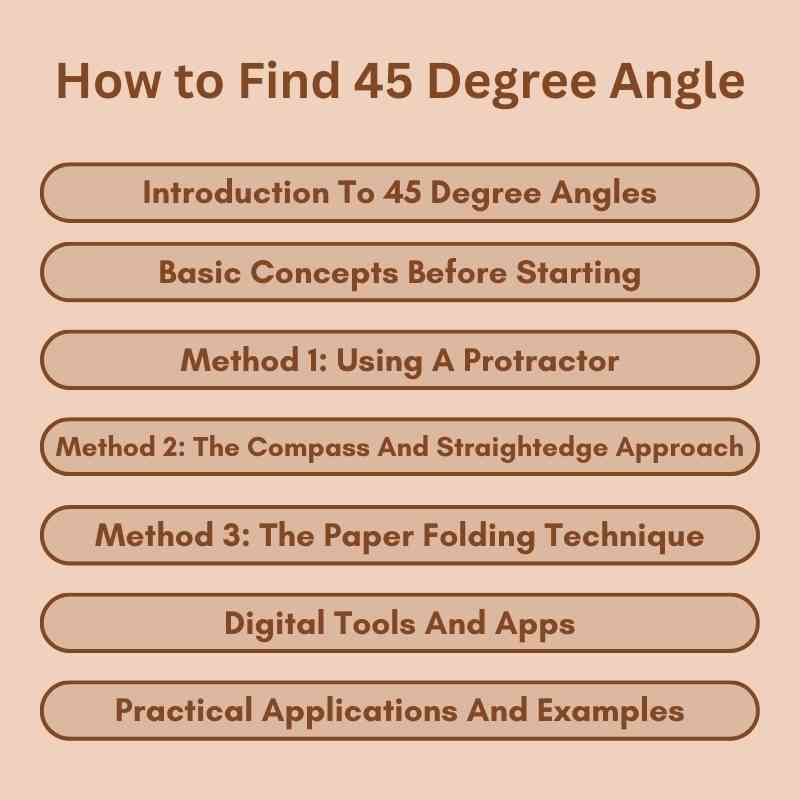
Introduction To 45 Degree Angles
Understanding the importance of 45-degree angles is crucial in both design and construction. They provide a strong structural base for various projects. Designers use them to create aesthetic appeal and ensure balance in their work.
Many challenges arise when working with 45-degree angles. Measuring accurately can be difficult. Using tools like a protractor or set square helps achieve precision. Misalignment can lead to costly mistakes in joints and trim. Proper planning and practice can overcome these hurdles.
Basic Concepts Before Starting
Understanding angles is essential before finding a 45-degree angle. An angle is formed where two lines meet at a point, known as the vertex. The size of an angle is measured in degrees. A 45-degree angle is half of a right angle, which is 90 degrees. In woodworking terms: when rise equals run in a right triangle, both angles off the hypotenuse are exactly 45 degrees.
To measure angles accurately, certain tools are necessary. A speed square is the most common shop tool for marking 45° on lumber. A combination square with a 45° head is ideal for trim and finish work. A protractor works for layout on paper. Finally, a ruler is useful for the equal-measurement diagonal method when no angle tool is nearby.
Method 1: Using A Protractor
To find a 45-degree angle using a protractor, follow this simple guide:
- Place the protractor on the line where you want the angle. The center hole should be on the point where the angle will be.
- Align the baseline of the protractor with one side of the angle.
- Locate the 45-degree mark on the protractor. This is usually on the inner scale.
- Draw a line from the center point to the 45-degree mark. This line represents the second side of the angle.
To ensure accuracy, keep these tips in mind:
- Use a sharp pencil for clear markings.
- Double-check the alignment before drawing.
- Hold the protractor steady while marking.
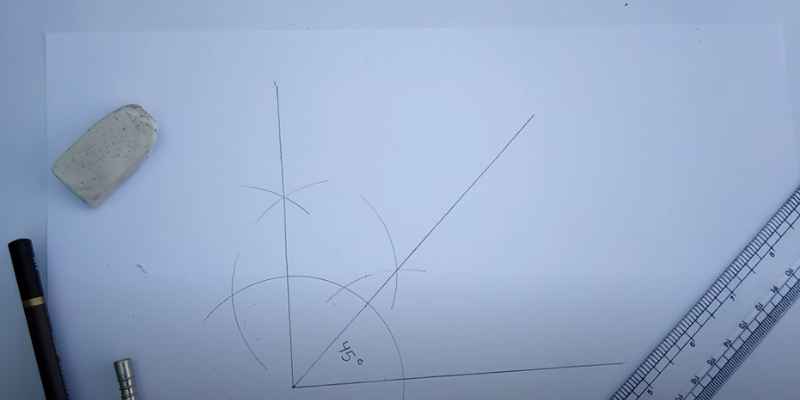
Method 2: The Compass And Straightedge Approach
To create a perfect semicircle, start by drawing a line segment BC of any length. Use point B as the center. Draw a semicircle that bisects line segment BC at point P. This semicircle will help in finding the 45-degree points. Next, mark the points where the arcs intersect the semicircle as X and Y. These points will serve as guides for your next steps.
After marking points X and Y, draw a line from point X to point B. Then, draw another line from point Y to point B. The angle formed between these two lines will be a 45-degree angle. This method is simple and effective for creating accurate angles.
Method 3: The Paper Folding Technique
To find a 45-degree angle using the paper folding technique, follow these simple steps:
- Start with a square piece of paper.
- Fold the paper diagonally to form a triangle.
- Ensure the corners align neatly to create a sharp crease.
- Unfold the paper to see the crease line.
- Next, fold one corner down to meet the crease.
- This new crease will mark a 45-degree angle.
This technique works because folding creates precise angles. Each fold divides the angle, ensuring accuracy. Any square-cornered sheet — notebook paper, cardstock, or scrap cardboard — gives you a built-in 90° reference to start from.
Method 4: Employing A Speed Square
Using a speed square is the fastest shop method to find a 45-degree angle. Start by placing the square on your material with the lipped fence flat against the board edge. The hypotenuse of every speed square is pre-set at exactly 45° — draw a pencil line along this edge and your mark is done. This is the method carpenters use for miter saw setups, decking, framing, and fence boards.
Advantages of this method:
- Instant result — no measurement or calculation required.
- Works on lumber, sheet goods, metal, and drywall.
- Compact and lightweight — fits in any tool bag.
- Accurate to within ±0.5° on quality squares.
Digital Tools And Apps
Finding a 45-degree angle can also be achieved using digital tools and apps. These resources offer precise measurements and step-by-step instructions, making angle verification straightforward on the job site.
Recommended Apps
- Angle Meter — Measure angles with your device’s camera.
- Protractor — Simple interface for angle measurements.
- CAD Apps — Great for precise designs and layout planning.
How To Use Them Effectively
- Open the app and select the angle tool.
- Align your device with the surface you want to measure.
- Read the angle displayed on the screen.
- Use the draw feature for planning layouts before cutting.
Practical Applications And Examples
Woodworking often requires precise angles for strong joints. A 45-degree angle is standard for miter cuts on frames, trim, and furniture corners. Using a miter saw simplifies the cutting process after marking. Mark the cut line clearly using a sharp pencil for accuracy.
In architectural design, a 45-degree angle adds elegance to structures. This angle enhances visual appeal in roofs and windows. It also supports better light flow inside a space. Architects use design software to visualize these angles effectively before any cuts are made on-site.
Troubleshooting Common Issues
Finding a 45-degree angle can sometimes lead to inaccuracies. Here are common issues and solutions:
- Ensure the tools used are properly calibrated — check your speed square against a known reference.
- Double-check measurements before marking, especially on expensive stock.
- Use a protractor or digital angle finder for precise angle verification.
- Verify the alignment of your reference points before drawing the line.
| Method | Best Used For |
|---|---|
| Protractor | Exact angle measurements on paper |
| Speed square | Quick 45° on framing lumber and decking |
| Equal-measurement diagonal | Any material with no angle tool |
| Compass and straightedge | Geometric constructions |
Frequently Asked Questions
How Do You Find a 45-Degree Angle With a Speed Square?
Place the lipped fence of the speed square flat against the edge of the board. The hypotenuse of the square is pre-set at exactly 45 degrees. Hold the square firm and draw a pencil line along the hypotenuse — that line is your 45° mark. No measurement or calculation needed. This works on lumber, decking, and trim.
How to Find a 45-Degree Angle Without a Protractor?
Use the equal-measurement method: place a ruler at a corner and mark the same distance along both edges — say, 4 inches on each side. Connect those two marks with a straight line. Because rise equals run, that diagonal is exactly 45 degrees. A square-cornered piece of paper folded diagonally also gives a reliable 45° reference.
How Do You Calculate a 45-Degree Cut on Wood?
For a 45-degree miter cut, the short side of the cut equals the long side minus the board width. For example, a 2×4 that is 3.5 inches wide cut at 45°: if the long side is 24 inches, the short side measures 20.5 inches (24 − 3.5 = 20.5). Set your miter saw angle to 45°, measure the long point, and cut.
How Can I Get a 45-Degree Angle?
Use a speed square for the fastest result in the workshop. For layout on paper, use a protractor. For construction without tools, draw a right-angle corner and measure equal distances along both edges — the diagonal connecting those points is 45 degrees. A compass-and-straightedge construction also produces a verified 45° angle for precision geometric work.
How Do You Find the Slope of a 45-Degree Angle?
The slope of a 45-degree angle equals 1 — because the tangent of 45° is 1. This means for every unit of horizontal run, the rise is exactly equal. In roofing, a 45° slope means a 12/12 pitch (12 inches of rise per 12 inches of run). In stair framing, equal tread and riser dimensions produce a 45° slope.
Conclusion
Finding a 45-degree angle is straightforward once you match the right method to the tool you have. A speed square gives the fastest result on lumber. The equal-measurement diagonal method works anywhere without special tools. For precise miter cuts, set your saw to 45° and use the board-width formula to calculate the short point. Mastering this skill improves accuracy across framing, trim, and furniture work.
Sponsored / affiliate links. As an Amazon Associate I earn from qualifying purchases. I may earn additional commission from eligible campaigns.