How to Install Bamboo Flooring
Installing bamboo flooring comes down to one of three methods — click-lock floating, glue-down, or nail-down — and the right one depends on your subfloor, not personal preference. Skipping the 14-day acclimation period or the 1/2-inch expansion gap is the single biggest cause of buckling and gapping in bamboo floors within the first year. This guide covers subfloor prep, acclimation, moisture barriers, and the exact steps for all three methods.
Quick Answer
To install bamboo flooring: acclimate planks in the room for at least 14 days, prep and level the subfloor, lay a 6-mil moisture barrier over concrete or crawl spaces, then float (click-lock), glue, or nail the planks down — leaving a 1/2-inch expansion gap at every wall, cabinet, and pipe.
Which Bamboo Flooring Installation Method Should You Choose?
Installation Supplies Worth Having On Hand
 Roberts Moisture Barricade Film – $22.84
|
 4-in-1 Flooring Install Kit – $19.79
|
As an Amazon Associate we earn from qualifying purchases.
Float click-lock bamboo over almost any subfloor for the easiest DIY install, glue it down over concrete or radiant heat for the most stable result, or nail it to a wood subfloor for the most secure fit. Never nail a click-lock product — that voids the manufacturer’s warranty. If you’re still choosing where to buy, see our breakdown of Home Depot’s bamboo flooring brands and real prices, including the click-lock issues buyers report most.
Most installation guides list the three methods as a flat menu and let you guess. The subfloor actually decides it for you — match your subfloor to the row below first, then read the step-by-step section for that method.
| Subfloor Type | Best Installation Method | Why |
|---|---|---|
| Wood subfloor (plywood/OSB) | Nail-down or floating click-lock | Cleats grip a wood subfloor; floating works too without a nailer |
| Concrete slab | Glue-down or floating click-lock | Concrete can’t hold nails or cleats; glue-down is the most stable option |
| Radiant heat (any subfloor) | Glue-down only | Floating floors trap air pockets that block heat transfer; nailing risks the tubing |
| Existing floor (vinyl, tile) | Floating click-lock | Skips demolition — floats directly over a sound, flat existing floor |
Prefinished bamboo planks work with all three methods; if you’re still weighing prefinished versus site-finished bamboo flooring, decide that first since it affects which finish protects the surface during installation.
How Long Does Bamboo Flooring Need to Acclimate Before Installation?
Bamboo flooring needs at least 14 days to acclimate in the room where it will be installed, and up to 21 days in humid or tropical climates. According to Wagner Meters, bamboo is hygroscopic and keeps exchanging moisture with the room until it reaches equilibrium.
Stack unopened boxes flat with spacers between them (not stacked flush) so air reaches every layer, and hold the room at 60–80°F and 40–45% relative humidity for the full period — the same conditions the floor will live in afterward.
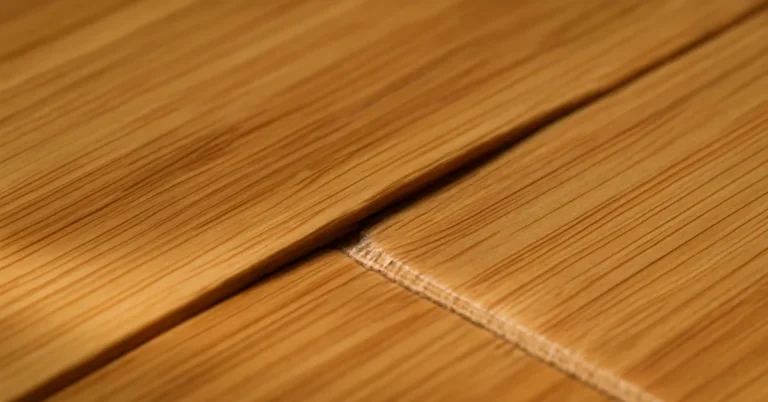
Installers who skip the acclimation period on strand-woven bamboo often see 1/8-inch gaps open at the seams within the first month, once the boards release the extra moisture they picked up in transit.
What Size Expansion Gap Does Bamboo Flooring Need?
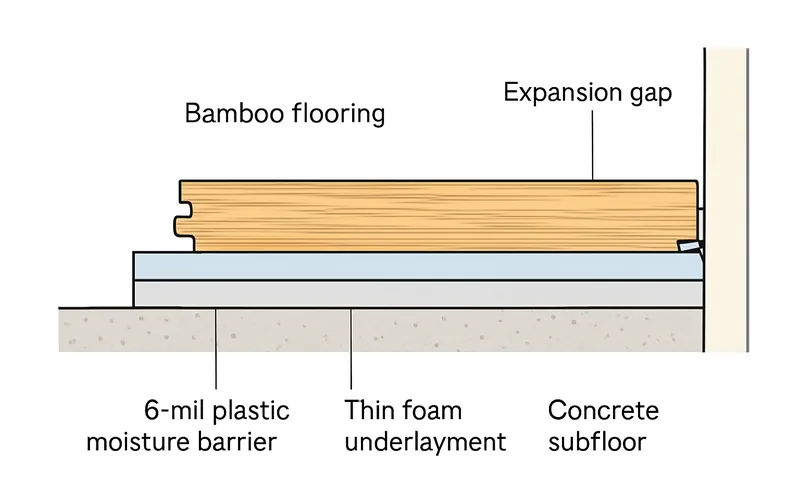
Leave a 1/2-inch expansion gap around the entire perimeter of the room — along every wall, cabinet base, and pipe — and extend it to 3/4 inch if a single continuous run of flooring exceeds 40 feet in any direction.
Hold the gap with wedge spacers while you work, then cover it with baseboard, quarter-round, or shoe molding once the floor is in. Never caulk or fill the expansion gap — that defeats its purpose the first time humidity rises.
Do You Need a Moisture Barrier Under Bamboo Flooring?
Yes — install a 6-mil polyethylene moisture barrier under bamboo flooring over concrete, crawl spaces, or basements. Overlap seams by at least 8 inches and tape them, and run the barrier 2 to 4 inches up the wall before trimming it after installation.
Test a concrete slab’s moisture content with a meter before laying anything down. Above 4.5% moisture content, the slab needs to dry longer or get a sealer — installing over a wet slab is what causes cupping, bubbling, and mold under the floor.
How Do You Prepare the Subfloor for Bamboo Flooring?
Sound subfloor prep means clean, dry, and flat within 3/16 inch over any 10-foot span. Sweep debris, screw down any squeaky or loose panels, sand high spots, and fill low spots with leveling compound before any bamboo plank goes down.
- Check for squeaks by walking the whole floor, and screw loose panels down into the joists.
- Moisture-test concrete slabs; stop and address readings above 4.5% before continuing.
- Remove old carpet tack strips, staples, and adhesive residue completely.
- Confirm flatness with a straightedge or laser level, not just a visual check.
What Tools and Materials Do You Need to Install Bamboo Flooring?
A basic bamboo flooring install needs a moisture meter, 6-mil vapor barrier, foam underlayment, wedge spacers, a tapping block, a pull bar, and a rubber mallet — plus a pneumatic flooring nailer for nail-down or a notched trowel for glue-down installs.
- Moisture meter (for concrete and wood subfloor testing)
- 6-mil polyethylene moisture barrier and tape
- Foam or cork underlayment
- 1/2-inch wedge spacers
- Tapping block, pull bar, and rubber mallet
- Pneumatic flooring nailer with 18-gauge cleats (nail-down only)
- Notched trowel and moisture-resistant urethane adhesive (glue-down only)
- Circular saw or table saw for rip cuts, jigsaw for notches
How Do You Install Click-Lock (Floating) Bamboo Flooring?
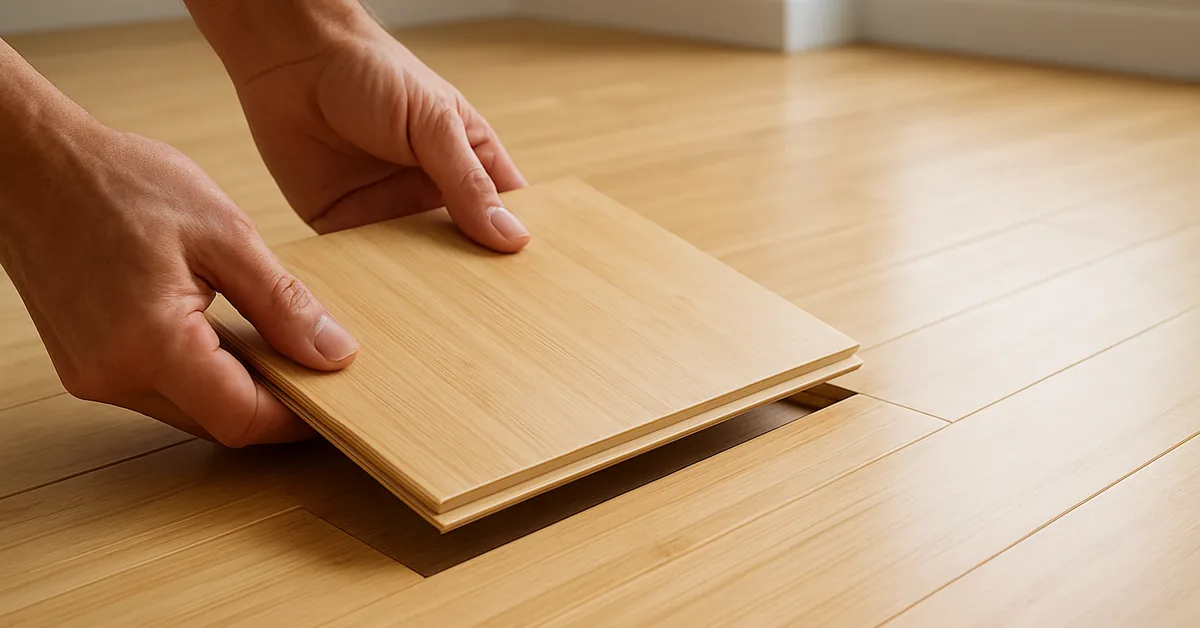
Roll out the underlayment, snap the first row against a spacer-held 1/2-inch gap, then angle each new plank’s short end into the previous row’s groove and press flat until it clicks — working left to right, row by row, staggering end joints by at least 6 inches.
- Roll out foam underlayment, butting seams edge to edge (never overlapping), and tape the seams.
- Set 1/2-inch wedge spacers against the starting wall.
- Lay the first row with the groove side toward the wall and the tongue facing into the room.
- Angle the next plank’s short end into the installed plank at roughly 20–30 degrees, then push it down flat until it clicks into place.
- Stagger end joints between rows by at least 6 inches for strength and a natural look.
- Use a pull bar and rubber mallet within 12 inches of a wall, where a tapping block won’t fit.
- Rip the last row to width, keeping the 1/2-inch gap against the far wall.
- Remove every spacer once the floor is fully installed.
On a typical 200-square-foot room, a click-lock installation over an existing subfloor takes about half a day for one person, most of it spent on the fiddly cuts around door casings and closets.
How Do You Install Glue-Down Bamboo Flooring?
Spread a moisture-resistant urethane adhesive with a notched trowel, then set each bamboo plank into the wet glue within its open time — usually 30 to 45 minutes — locking tongue-and-groove joints tight before the adhesive skins over.
- Snap a working chalk line down the center of the room to keep rows straight.
- Spread adhesive over a 3–4 foot section using the trowel notch size the adhesive manufacturer specifies.
- Set the first row into the wet adhesive, tongue facing the room, with 1/2-inch spacers at the wall.
- Lock each plank’s tongue-and-groove joint tight, wiping excess glue off the surface immediately with a damp cloth.
- Weight or roll the section with a floor roller after every few rows to fully seat the planks.
- Let the adhesive cure fully — typically 24 hours — before foot traffic, per the adhesive’s data sheet.
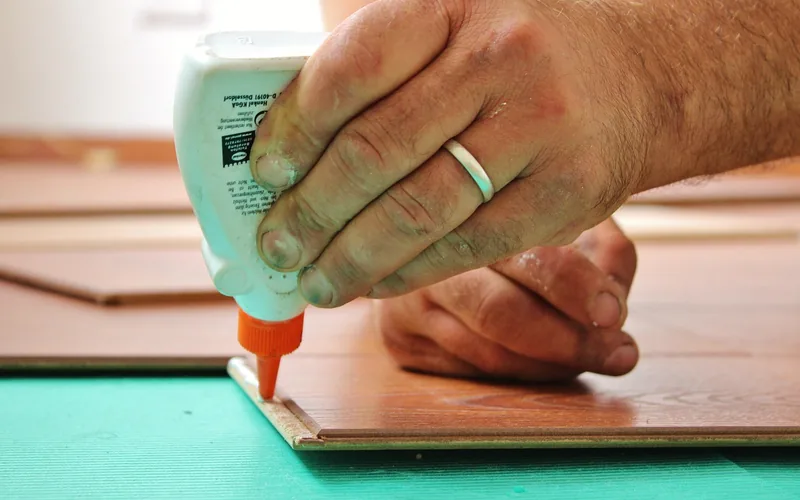
Glue-down is the messiest of the three methods and the hardest to ever remove — it is not the right call for a rental or any floor you expect to replace within a few years.
How Do You Install Nail-Down Bamboo Flooring?
Nail-down installation uses a pneumatic flooring nailer and 18-gauge cleats driven through the plank’s tongue at a 45-degree angle, spaced every 6 to 8 inches, into a wood subfloor — never attempt nail-down over concrete.
- Snap a working line 3/8 inch off the starting wall to account for the plank’s tongue.
- Face-nail the first two or three rows by hand with finish nails, since a nailer can’t reach the wall.
- Switch to the pneumatic nailer once there’s room, driving an 18-gauge cleat through the tongue every 6 to 8 inches.
- Rack planks from multiple boxes at once so color and grain vary naturally across the floor.
- Rip the last row to width and hand-nail or face-nail it, since the nailer won’t fit against the wall.
What Are the Most Common Bamboo Flooring Installation Mistakes?
Most bamboo flooring failures trace back to one of six preventable mistakes — catching them before you start costs nothing; fixing them after the floor is down means tearing it back up.
- Skipping acclimation: causes shrinkage and gaps within weeks, not months.
- No expansion gap: causes buckling the first time indoor humidity rises.
- Installing over a wet slab: causes cupping, bubbling, and mold under the floor.
- Wrong cleat gauge on strand-woven bamboo: use 18-gauge cleats only — heavier cleats dimple this unusually dense material.
- Letting glue dry on the plank face: leaves a permanent cloudy mark that no cleaning removes.
- Skipping the manufacturer’s specific instructions: the single step behind most of the errors above — every brand’s spec sheet varies on cure times, trowel size, and gap tolerances.
Already dealing with one of these symptoms on a floor that’s already down? See our guide to which bamboo flooring problems are fixable versus permanent before you decide whether to repair or replace.
How Do You Finish a Bamboo Flooring Installation?
Cover the expansion gap with baseboard, quarter-round, or shoe molding — never caulk it. Install T-molding at doorways between rooms, and use a reducer strip where bamboo meets a lower flooring surface, so the gap stays free to move.
Once the floor has fully settled — give it a few weeks past installation — staining bamboo floors is a separate process for changing color later, and it goes on far more evenly over a floor that acclimated and gapped correctly the first time.
Frequently Asked Questions
Can You Nail Down Click-Lock Bamboo Flooring?
No. Nailing through a click-lock plank’s locking mechanism voids the manufacturer’s warranty and can crack the tongue-and-groove edge. Click-lock bamboo is engineered to float — install it as a floating floor, or choose a solid nail-down product instead if you want to nail it in place.
Can Bamboo Flooring Be Installed Over Concrete?
Yes. Float click-lock bamboo over a 6-mil moisture barrier and foam underlayment, or glue it down with a moisture-resistant urethane adhesive. Never nail bamboo flooring directly to a concrete slab — cleats can’t grip concrete, and nailing requires a wood subfloor.
Can Bamboo Flooring Go Over Radiant Heat?
Yes, if it’s glued down. Glue-down installation transfers heat evenly through the adhesive layer; floating and nail-down methods trap air pockets that insulate against the heat and can void the radiant-heat system’s warranty. Confirm the specific bamboo product is rated for radiant heat first.
How Long After Installation Can You Walk on a Bamboo Floor?
Floating and nail-down floors take normal foot traffic immediately after the last plank is set. Glue-down floors need the full adhesive cure time — typically 24 hours for light traffic and 3 to 5 days before moving heavy furniture back, per the adhesive manufacturer’s data sheet.
Bamboo flooring rewards patience more than skill — 14 days of acclimation and a consistent 1/2-inch expansion gap prevent more problems than any tool or technique on this page. Match the method to the subfloor, follow the manufacturer’s specific instructions on top of these general rules, and factor the full cost of materials and installation in before you buy, and the floor should stay flat and tight for years.
Sponsored / affiliate links. As an Amazon Associate I earn from qualifying purchases. I may earn additional commission from eligible campaigns.