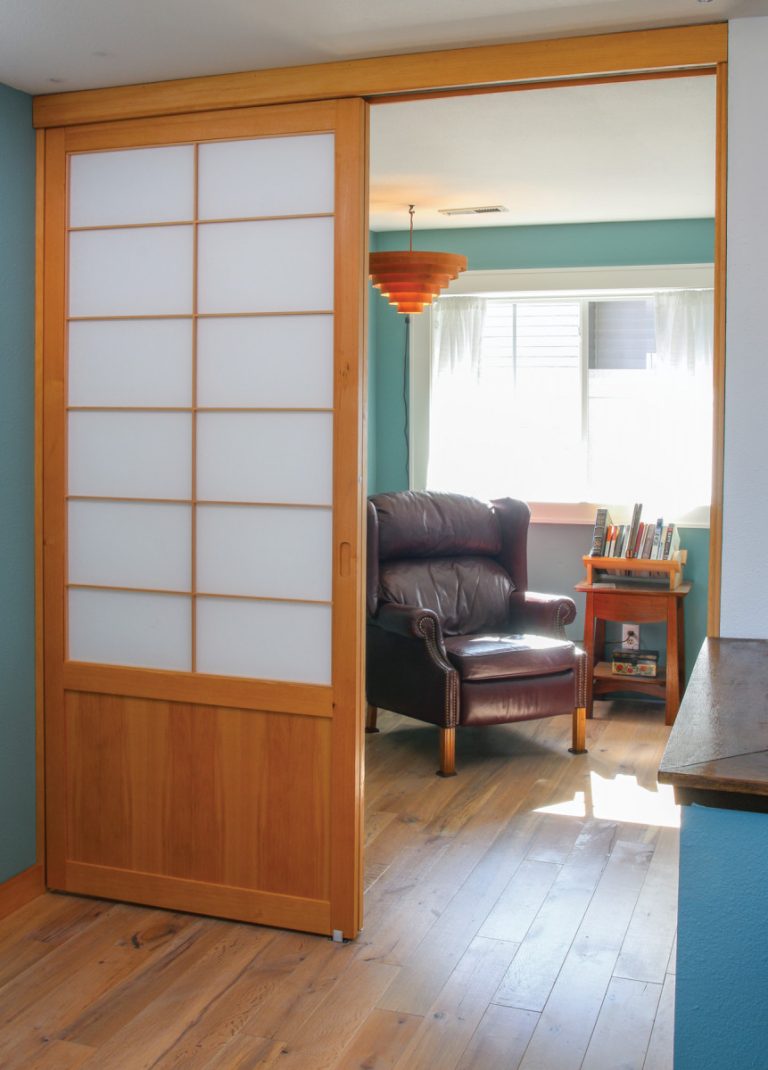
How to Make a Wood Door: 3 Methods, Cut List and Hinge Specs
To make a wood door, pick the method first: a ledged and braced plank door is the easiest, a glued-up slab is the heaviest, and a frame-and-panel door stays flattest. This guide gives a worked cut list for a 30 x 80 inch door, hinge positions, and estimated weights by wood species, so you can choose lumber and hinges before you cut. Wood movement, not joinery, is what ruins most home-built doors.
Types of Wood Doors You Can Make: Three Methods Compared
Best Glue for Door Frame Joints
|
Titebond III Ultimate Wood Glue (4 oz), $4.98 In a frame-and-panel door the only glued joints are the stile-to-rail joints, and they carry the whole door, so a Type I waterproof glue with a longer open time is worth having for the clamp-up described below.
|
As an Amazon Associate we earn from qualifying purchases.
Most guides treat “a wood door” as one project. It is really three, and the one you pick decides your tools, your weight, and how likely the door is to twist after a humid summer. If you want the full exterior-grade, mortise-and-tenon version, our solid wood door build guide covers it step by step. This page is the shorter decision guide for interior and utility doors.
| Method | Tools needed | Skill | Stays flat? | Best for |
|---|---|---|---|---|
| Ledged and braced plank door | Circular saw, drill, clamps | Beginner | Fair, if the Z-brace is correct | Sheds, workshops, rustic and barn-style doors |
| Laminated slab door | Jointer or straight edge, many clamps, sander | Intermediate | Poor on wide spans unless boards are narrow and alternated | Flush modern look, paint-grade interior doors |
| Frame-and-panel door | Table saw or router, clamps, drill or dowel jig | Intermediate | Best, because panels float | Interior room doors and anything that will be stained |
Frame-and-panel wins on stability because the wide panel is free to swell and shrink inside the frame, while the narrow stiles and rails barely move across their width. The cost is more cuts and more joints to get right.
Best Wood for Making a Door
For painted interior doors, poplar and pine are the practical choices: both machine easily and take primer well. Red oak suits a stained interior door. Exterior doors need rot-resistant species such as cedar or white oak, and they need a protected finish from day one. Whatever you buy, check that the boards are dry. Lumber that is still above roughly 9 percent moisture content will keep shrinking indoors, which is how a flat door becomes a bowed one.
Weight matters for hinges, and almost no guide shows it. The estimates below use typical air-dried densities (about 25 lb per cubic foot for eastern white pine, 29 for poplar, 44 for red oak) applied to a 30 x 80 inch door, 1-3/8 inches thick.
| Wood | Slab door (solid, 1-3/8 in.) | Frame-and-panel (1/2 in. panels) |
|---|---|---|
| White pine | About 48 lb | About 30 lb |
| Poplar | About 55 lb | About 35 lb |
| Red oak | About 84 lb | About 53 lb |
The takeaway: a solid oak slab weighs nearly three times what a pine frame-and-panel door does. Panels cut the weight by roughly a third because most of the door face is 1/2 inch thick instead of 1-3/8. These are calculated estimates, not scale readings, so weigh your own door before you pick hinges.
Door Size and Cut List for a 30 x 80 Inch Door
Standard interior doors are 1-3/8 inches thick, and exterior doors are usually 1-3/4 inches. Size the door to the opening, not the other way around: the width is the opening width minus about 1/4 inch (1/8 inch per side), and the height leaves about 1/8 inch at the top and 1/2 to 3/4 inch at the bottom, depending on your flooring. Measure the opening in three places, because old frames are rarely square, and use the smallest number.
Here is a cut list for a two-panel, frame-and-panel door in 1-3/8 inch stock, with 3/8 inch deep grooves and matching stub tenons on the rails:
| Part | Qty | Size (T x W x L) | Note |
|---|---|---|---|
| Stile | 2 | 1-3/8 x 4-1/2 x 80 in. | Full height, grooved along the inside edge |
| Top rail | 1 | 1-3/8 x 5 x 21-3/4 in. | 21 in. between stiles plus two 3/8 in. tenons |
| Middle rail | 1 | 1-3/8 x 5 x 21-3/4 in. | Splits the door into two panels |
| Bottom rail | 1 | 1-3/8 x 9 x 21-3/4 in. | Tall bottom rail resists kicks and moisture |
| Panel | 2 | 1/2 x 21-1/2 x 31 in. | Sized 1/4 in. smaller than the groove-to-groove opening so it can float |
For a door of a different width, subtract both stile widths from the finished door width to get the distance between stiles, then add the tenon lengths. For stronger joints than stub tenons alone, dowels or full mortise and tenon are the usual upgrades, and our mortise and tenon guide shows the sizing rules. The raised panel door calculator can check panel dimensions if you want shaped panels.
How to Make a Frame-and-Panel Door
- Mill the stock: joint and plane all boards flat and to a uniform 1-3/8 inches. Let milled boards rest a day before final cuts, because stress releases when you cut them.
- Cut stiles and rails to length: use the cut list above, and cut all rails from the same setup so the door stays square.
- Cut the grooves: run a 1/4 inch wide, 3/8 inch deep groove along the inside edge of every stile, along both edges of the middle rail, and along one edge of the top and bottom rails.
- Cut the stub tenons: make each rail end 3/8 inch long so it fills the groove. Dry-fit the whole frame first.
- Make the panels: cut them 1/4 inch under the opening size. Finish the panel edges before assembly so bare wood does not show when the panel shrinks.
- Glue only the joints: apply glue to the tenons and stile faces, never to the panel. Clamp, then check the diagonals. They should match within 1/8 inch.
- Let it cure overnight: keep the door flat on sawhorses or a bench, not leaning against a wall.
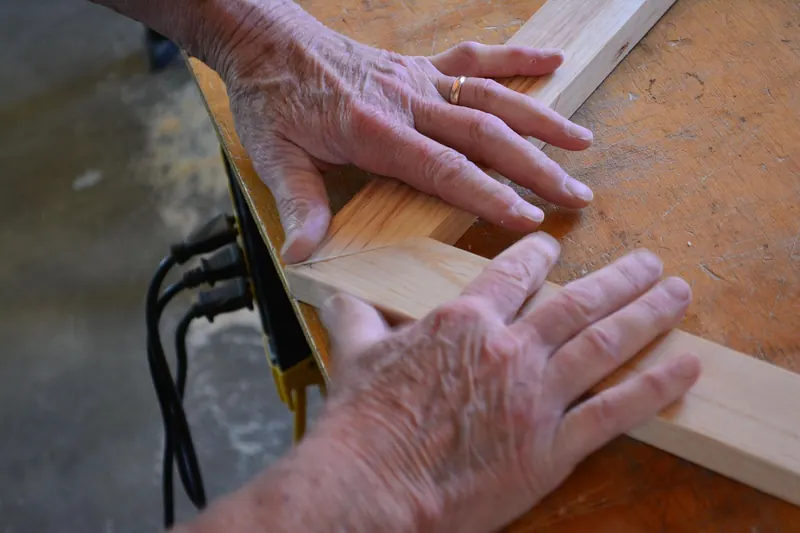
One myth worth correcting: many tutorials say to nail or glue the panel into the frame for rigidity. Do the opposite. A glued panel cannot move, so the first dry winter cracks it or splits the rail. Joint strength comes from the rails and stiles; the panel only fills the space. Dry-fit and rehearse the clamp-up first so no joint skins over while you are still adjusting others.
Safety on the saw: use a push stick for narrow rips, keep the guard on when the cut allows it, and wear eye and hearing protection. When cutting a groove along an 80 inch stile, support the board with a tall fence and an outfeed stand rather than balancing it on end.
How to Make a Ledged and Braced Plank Door
A ledged and braced door is the quickest way to make a sturdy door with a circular saw, a drill, and screws. Three horizontal ledgers (top, middle, bottom) tie the vertical boards together, and a diagonal brace stops the door from sagging.
- Cut the boards: use tongue-and-groove or shiplap boards, 3/4 inch thick or more, cut to the same length.
- Lay them face down and square them: clamp them tightly and check the diagonals before fixing anything.
- Fix the ledgers: screw 1 x 6 ledgers across the boards near the top, middle, and bottom, using two screws per board per ledger.
- Add the brace: run it from the lower corner on the hinge side up to the upper corner on the latch side, and screw it through every board.
- Trim the door to the opening: allow the same gaps listed in the hanging section below.
The brace direction is the part many diagrams get backwards. The brace should work in compression, pushing the weight of the latch side down toward the hinges. Run it the other way and the brace is in tension, the screws pull out, and the door drops at the latch corner. For a related project that uses plywood instead of planks, see how to build a shed door with plywood.
Hinges, Gaps and Hanging the Door
An 80 inch door normally takes three hinges, usually 3-1/2 inch butt hinges for interior doors. Standard placement is 7 inches down from the top of the door and 11 inches up from the bottom, with the third hinge centered between them. Heavier exterior doors often justify a fourth hinge, and a solid oak slab at the weights above is a good reason to add one.
| Gap location | Typical clearance | Why |
|---|---|---|
| Hinge side and latch side | About 1/8 in. | Room for swelling and for paint thickness |
| Top | About 1/8 in. | Prevents rubbing against the head jamb |
| Bottom | About 1/2 to 3/4 in. | Clears flooring and rugs, and lets air move |
- Mark hinge locations on the door edge and jamb with a sharp knife.
- Chisel each mortise to the exact depth of the hinge leaf so it sits flush; a proud hinge pushes the door into the stop.
- Drill pilot holes, then use a self-centering bit so the screws do not drift off the hinge hole.
- Hang the door on one hinge first, check the reveal, then add the others.
If you use pocket-hole screws anywhere in the build, our pocket screw length calculator and the notes on gluing pocket-hole joints help you size them, but keep them on hidden faces, not on an edge you will see.
Finishing a Wood Door So It Stays Flat
Finish every surface, including the top edge, the bottom edge, and the back, with the same number of coats. A door finished on one face only takes up moisture on the bare side and cups toward the dry side. Prime bare wood first; our wood primer guide covers options for painted doors. Sand to 120 or 150 grit before finishing.
If you stain, be careful with the rags. Rags soaked in oil-based stain or oil finishes can heat up and ignite as the oil cures, so lay them flat outdoors to dry or keep them submerged in water in a sealed metal container before disposal.
Do not hang the door until the finish has hardened. A tacky finish can bond the door to the stop or jamb, and you will tear the finish when you open it. Add the latch hardware last so you do not splash finish over it.
Common Mistakes When Making a Wood Door
- Gluing the panel: it cracks the first time the wood shrinks.
- Ignoring the diagonals: a frame that is square by eye can still be 1/4 inch out across the corners. Measure it.
- Using wet lumber: boards that keep drying after assembly will twist the whole door. Use a moisture meter if you can.
- Skipping the back and edges when finishing: it is a common reason a new door warps.
- Sizing the door to the nominal opening: measure the real opening and subtract the gaps.
- Wrong brace direction: see the ledged and braced section above.
If you are working out board sizes, the nominal lumber size chart shows actual dimensions, and the wood movement calculator helps you plan panel clearance for your own species and width.
Frequently Asked Questions About Making a Wood Door
How long does it take to make a wooden door?
Plan on a weekend. A frame-and-panel door takes one day to mill, cut, and glue up, an overnight cure, and a second day to sand, finish, and hang. A ledged and braced plank door can be assembled in an afternoon. Finish coats add drying time on top.
What is the best wood for a homemade interior door?
Poplar and pine are the easiest to work and paint well, so they suit painted interior doors. Red oak is a good choice if you plan to stain. Whatever the species, use dry lumber, because moisture is the main cause of warping after the door is hung.
How many hinges does a wood door need?
Most 80 inch doors use three hinges, placed 7 inches from the top and 11 inches from the bottom with one in between. Heavy solid doors, such as an oak slab or a thick exterior door, are often hung on four hinges to share the load.
Can you make a wood door without a router or table saw?
Yes. A ledged and braced plank door only needs a circular saw, a drill, clamps, and screws. For a frame-and-panel look without routed grooves, you can rabbet a thin plywood panel into the back of a frame and hold it with small strips of wood.
Why did my homemade door warp?
The usual causes are wet lumber, an unfinished back or edge, or a panel glued into the frame so it cannot move. Finish every surface equally, use dry boards, and let panels float in their grooves to keep the door flat.
Sponsored / affiliate links. As an Amazon Associate I earn from qualifying purchases. I may earn additional commission from eligible campaigns.