Incense Cedar vs Western Red Cedar for Fence Posts
For ground-contact fence posts, Western Red Cedar is usually the safer choice because its heartwood has better documented decay resistance and a lower post-failure risk than incense cedar. Pick the wrong one and you pay for rot, leaning lines, and replacement labor. This guide compares durability, failure risk, and value so you can pick the better post for your site.
| Decision factor | Incense Cedar | Western Red Cedar | Winner |
|---|---|---|---|
| Heartwood content and decay resistance | Good when the post is heartwood-heavy; performance drops fast when pale sapwood makes up much of the piece. | Also strong when the post is heartwood-dominant, with more established use for exterior fencing and ground-contact exposure. | Western Red Cedar |
| Ground-contact risk | Higher risk if drainage is poor or the post includes much sapwood; buried cedar still depends on the buried portion staying dry enough to resist decay. | Lower risk for direct-bury posts when you buy sound heartwood and detail the hole well. | Western Red Cedar |
| Straightness and stability | Fine, relatively uniform texture can help, but post quality still depends on the piece you buy. | Often available in fence-oriented stock with good stiffness for typical post sizes. | Tie |
| Local availability and cost | Often the lower-cost option in many markets, though local supply can swing the other way. | Usually priced as the higher-end choice and may cost more per post. | Incense Cedar |
| Maintenance tolerance | Needs good drainage and careful selection because surface coatings will not correct poor burial details. | Also benefits from drainage and surface protection above grade, but tolerates a wider range of fence uses. | Western Red Cedar |
Soil line decay risks and wood hardness
The real trade-off is not “which cedar looks better.” It is which cedar gives you the lower failure risk once the post is buried, splashed, and exposed to wet soil at the grade line. Western red cedar usually wins that contest, while incense cedar often wins on price.
Incense cedar is Calocedrus decurrens, with a typical Janka hardness of about 470 lbf. Western red cedar is Thuja plicata, with a typical Janka hardness of about 350 lbf. That hardness difference does not decide buried-post life by itself, because rot resistance in a fence post depends far more on heartwood share, drainage, and how the post is detailed in the ground.
What matters most in a fence post
Fence posts fail at the soil line first. That is where moisture lingers, oxygen changes, and decay starts if the buried wood has too much sapwood or the hole holds water.
Janka hardness matters more for denting and handling than for in-ground longevity. A harder cedar is not automatically a longer-lasting post if the piece has weak heartwood content or a sloppy base detail.
Which cedar lasts longer in ground contact?
Western red cedar usually has the edge in ground contact because its heartwood has the better track record for exterior use, while incense cedar depends more heavily on getting a heartwood-rich post. In damp soil, the buried portion of either species can fail early if sapwood is exposed or drainage is poor.
Heartwood is the part of the post that has higher natural decay resistance. Sapwood is less resistant, usually paler, and it lowers outdoor performance when it makes up a large portion of the piece.
That is why a straight-grain, heartwood-heavy incense cedar post can beat a bargain western red cedar post with a lot of sapwood. Species matters, but the piece in your hand matters more.
How burial depth and drainage change risk
A post set in wet clay or tight backfill has a much harder life than one set in free-draining soil. Poor drainage keeps the base damp, and damp soil speeds decay at the grade line.
Picture a 4×4 post in a backyard with standing water after rain. If the hole stays wet for days, even a naturally durable cedar post faces a much higher failure risk than the same post set in gravel-drained soil.
Why heartwood matters more than species
For fence posts, the visible color pattern often tells you more than the species name on its own. If a post has a broad band of pale sapwood around the outside, expect lower outdoor performance than you would from a darker, heartwood-dominant piece.
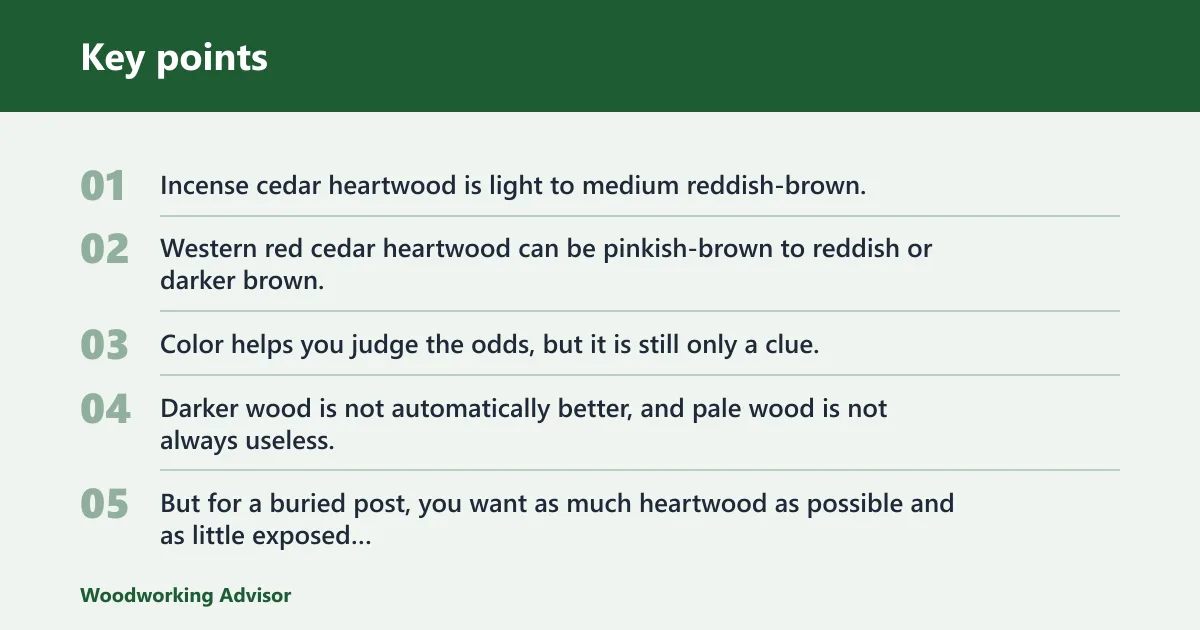
Incense cedar heartwood is light to medium reddish-brown. Western red cedar heartwood can be pinkish-brown to reddish or darker brown. Color helps you judge the odds, but it is still only a clue. It is not a guarantee.
What visible color can and cannot tell you
Darker wood is not automatically better, and pale wood is not always useless. But for a buried post, you want as much heartwood as possible and as little exposed sapwood as practical.
A common first-timer mistake is buying a post for appearance grade alone and assuming a cleaner-looking piece will also be the longest-lasting one. For ground contact, the better question is whether the post is straight, heartwood-heavy, and free of weak outer wood at the buried end.
Does lumber grade matter more than species?
Yes, often it does. For fence posts, the piece you buy can matter more than the species name because straightness, knot quality, and heartwood proportion affect how the post handles burial and load.
Common grade language includes clear and heart grades, appearance grades with tight knots, and knotty or construction-common stock. Lighthouse Fence notes that clear and heart grades have few or no knots, while knotty and construction-common boards are where loose knots pop out. That matters because loose knots and checking can weaken a post where you want continuity through the soil line.
Straightness, knots, and checking
A straight post is easier to plumb, brace, and set without forcing. That lowers the chance of stress at the base, especially when the soil is uneven or the fence line changes elevation.
Checking matters too. End-grain cracks can open the path for moisture, and the more the buried end cycles through wet and dry conditions, the more that crack can contribute to decay.
Which grade words to look for at the supplier?
For fence posts, ask for the straightest heartwood-dominant stock available, then inspect the actual piece. Do not assume a familiar species name means you are getting the right post stock.
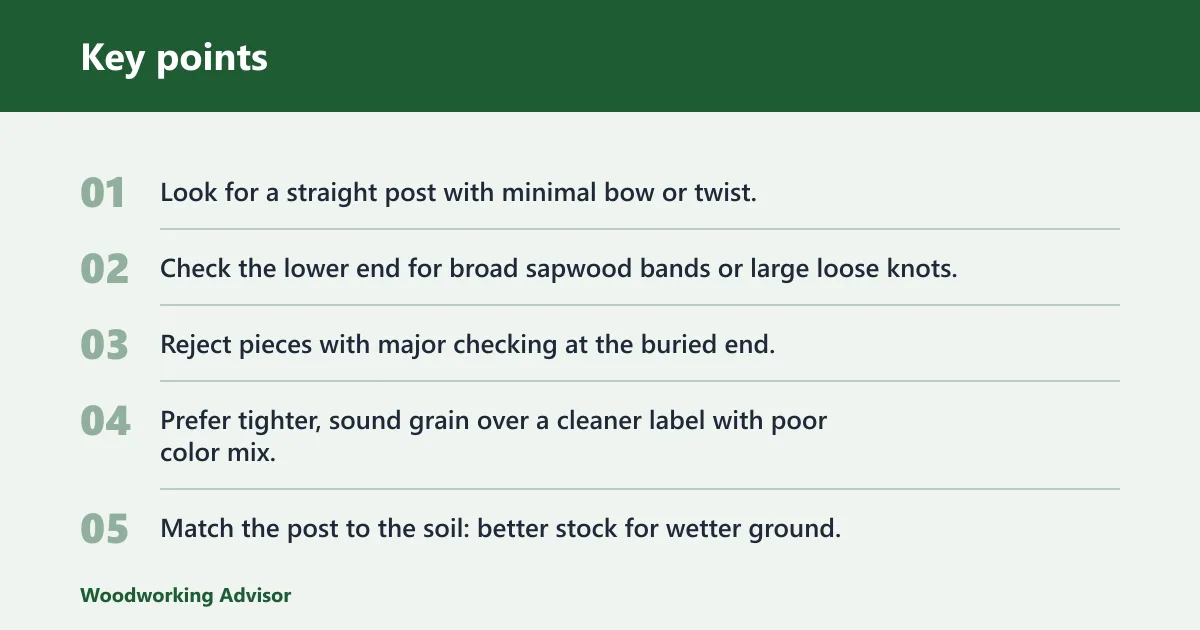
- Look for a straight post with minimal bow or twist.
- Check the lower end for broad sapwood bands or large loose knots.
- Reject pieces with major checking at the buried end.
- Prefer tighter, sound grain over a cleaner label with poor color mix.
- Match the post to the soil: better stock for wetter ground, less demanding stock only where drainage is good.
Cedar post decision matrix
| Factor | Incense Cedar | Western Red Cedar | Score note |
|---|---|---|---|
| Heartwood content | 3/5 | 4/5 | Western Red Cedar gets the nod for more dependable exterior heartwood use. |
| Ground-contact risk | 2/5 | 4/5 | Wet soil and poor drainage raise risk for both, but western red cedar holds up better when heartwood is present. |
| Straightness and stability | 4/5 | 4/5 | Tie if you are comparing sound, straight stock from the same supplier. |
| Local availability and cost | 4/5 | 3/5 | Incense cedar is often the budget-friendlier buy, but local supply can reverse that. |
| Maintenance tolerance | 3/5 | 4/5 | Neither species fixes poor drainage, but western red cedar gives you a larger margin of error. |
How to read the matrix
Use the matrix as a buying guide, not a law. If your site is dry and well drained, the cost advantage of incense cedar may matter more. If the posts will sit in damp soil, the safer play is to favor the species and stock with the better decay record.
Suppose you are building a 6-foot privacy fence along a side yard with heavy clay. In that case, a heartwood-rich western red cedar post is the better bet than a cheaper incense cedar post with more pale wood, because the soil condition is driving the risk more than the price tag.
Choose Incense Cedar if… / Choose Western Red Cedar if…
Choose Incense Cedar if your site drains well, the fence line stays relatively dry, and you can inspect the actual post for straightness and heartwood content before you buy. It is also the better fit when local pricing makes western red cedar much more expensive.
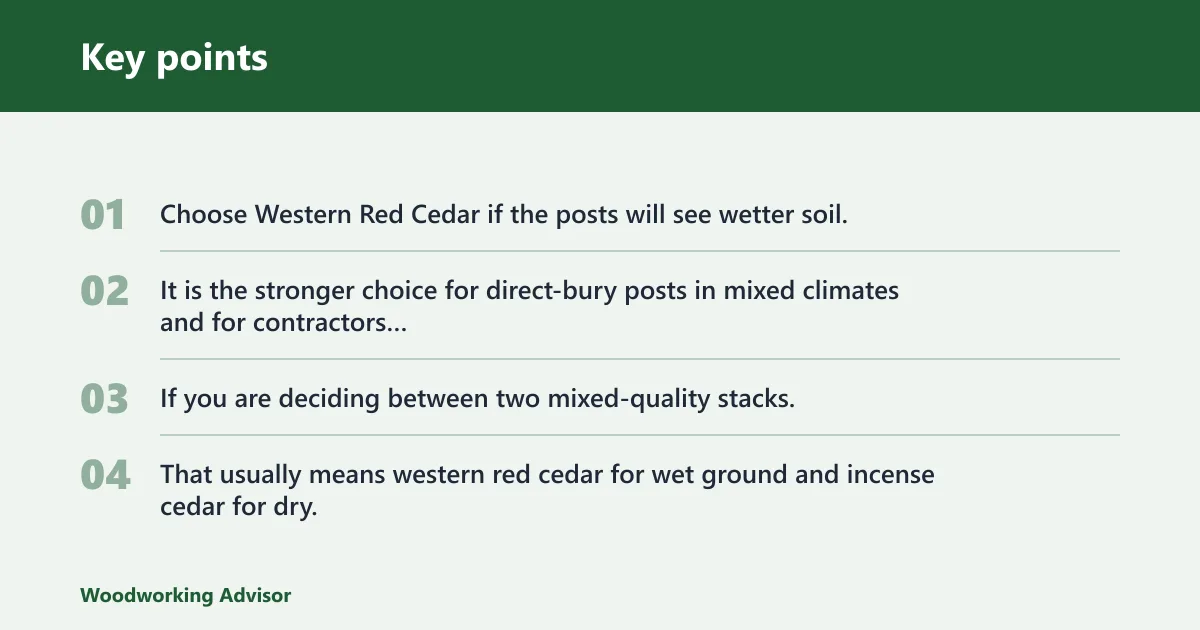
Choose Western Red Cedar if the posts will see wetter soil, if you want the lower ground-contact risk, or if you need the safer default when supplier quality varies. It is the stronger choice for direct-bury posts in mixed climates and for contractors who cannot control every soil condition on site.
If you are deciding between two mixed-quality stacks, pick the post with more heartwood and fewer defects first, then use species as the tiebreaker. That usually means western red cedar for wet ground and incense cedar for dry, price-sensitive jobs where the stock is still sound.

Frequently asked questions
Is incense cedar or western red cedar better for fence posts?
Western red cedar is usually better for fence posts set in the ground because its heartwood has the stronger durability reputation for exterior use. That said, the actual post matters more than the species name. A heartwood-heavy incense cedar post can beat a poor western red cedar post with more sapwood.
Does incense cedar cost less than western red cedar for posts?
Often yes, but not always. Incense cedar is frequently the more budget-friendly option, while western red cedar is commonly priced higher. Local supply can flip that relationship, so compare the actual posts on the rack rather than assuming the species name tells you the final cost.
Which cedar is more rot resistant for fence posts?
Western red cedar is usually the more rot-resistant choice for fence posts because its heartwood is the safer bet in ground-contact service. Incense cedar still has natural decay resistance in its heartwood, but it depends more heavily on getting a heartwood-rich piece with little sapwood and good site drainage.
Can western red cedar be used for fence posts?
Yes. Western red cedar is widely used for fencing and outdoor structures, and it is a common choice for posts when the piece is heartwood-dominant. For best results, avoid posts with large sapwood bands, keep the base free draining, and apply surface protection above grade as part of a broader durability plan.
Which cedar is better in wet climates for fencing?
Western red cedar is usually the better pick in wet climates because it gives you more margin against decay at the ground line. Wet soil, poor drainage, and constant moisture are the main threats, so a post with stronger heartwood performance is the safer place to start. Drainage still decides a lot.
Sponsored / affiliate links. As an Amazon Associate I earn from qualifying purchases. I may earn additional commission from eligible campaigns.
 Rustic Revival | Handmade Reclaimed Barnwood Craft Bundle | Unfinished Authentic Reclaimed Western Red Cedar Wood Planks for DIY, Home and School Projects (24" x 5.5" x .375") 6 Pack
 Rustic Revival | Handmade Reclaimed Barnwood Craft Bundle | Unfinished Authentic Reclaimed Western Red Cedar Wood Planks for DIY, Home and School Projects (24" x 7.25" x .375") 4 Pack