How Much Does a Redwood Fence Cost Compared to Cedar?
A redwood fence costs about 15% to 40% more installed than a cedar fence, and cedar is often the budget choice unless redwood’s decay resistance and appearance are priorities. If you ignore the full installed cost, you can come up short on posts, gates, hardware, stain, and disposal. This guide breaks down line-item costs, installed price ranges, and when redwood earns its premium over cedar.
Cedar vs redwood at a glance
Cedar is usually the lower-cost choice upfront. Installed cedar fences are shown at $27-45 per linear foot, while installed redwood fences are shown at $34-60 per linear foot. The gap often starts with board grade and supply, then changes once you add posts, concrete, hardware, finish, delivery, and permits.
Both woods resist rot naturally, but that does not mean every board grade performs the same or that standard fence boards should be treated as ground-contact parts. Fence pricing changes fast when you move from knotty boards to clearer stock, or from a common cedar type to a more limited redwood supply chain.
What this comparison includes
This comparison focuses on a 6-foot privacy fence because that is the build most buyers price first. It uses the full fence budget, not board price alone. That means boards, posts, hardware, concrete, labor, stain or sealant, delivery, disposal, and permits all matter.
A 150-foot run is the main example, with a 200-linear-foot note where larger projects can shift labor and delivery pricing. Gate count, slope, and layout change the budget too. A straight line on level ground costs less to build than a fenced yard with corners, grade changes, or multiple gates.
Redwood cedar cost table
The table below shows a text-only true cost comparison for a standard 150-foot privacy fence. Low, mid, and high totals are built from line items rather than a single lump sum, because that is where most pricing gaps appear. Board pricing moves the total most, but labor and delivery can swing the quote sharply by region.
| Line item | Cedar low | Cedar mid | Cedar high | Redwood low | Redwood mid | Redwood high |
|---|---|---|---|---|---|---|
| Boards | $2,250 | $3,000 | $3,750 | $3,000 | $4,050 | $5,250 |
| Posts | $525 | $675 | $900 | $525 | $675 | $900 |
| Hardware | $225 | $300 | $450 | $225 | $300 | $450 |
| Concrete | $225 | $300 | $450 | $225 | $300 | $450 |
| Labor | $2,250 | $3,375 | $4,875 | $2,400 | $3,600 | $5,250 |
| Stain or sealant | $300 | $450 | $675 | $300 | $450 | $675 |
| Delivery | $150 | $250 | $400 | $200 | $325 | $500 |
| Permits and disposal | $175 | $275 | $425 | $175 | $275 | $425 |
| Total | $5,900 | $8,625 | $10,925 | $7,050 | $9,975 | $13,900 |
In this model, redwood adds about $1,150 at the low end, $1,350 in the middle, and $2,975 at the high end. The largest regional swing is often boards in California and the Pacific Northwest, while inland and eastern markets often feel the bigger hit in shipping, yard inventory, and labor availability.
Which costs more installed?

Redwood costs more installed in most cases. The installed cedar range of $27-45 per linear foot sits below the installed redwood range of $34-60 per linear foot, and the material gap is often the first reason. Labor can be close, but supply, grade, and delivery often keep redwood ahead on price.
Material cost per linear foot
For budget planning, cedar material often lands around $15-$25 per linear foot in lower-range pricing, while redwood material is also often priced around $20-$30 or $25-$40 per linear foot in low-range estimates. FenceCalc says redwood materials cost 30-50% more than cedar, which fits the usual spread buyers see at the yard.
Western red cedar is the common premium fencing cedar. It is widely used for privacy and decorative fencing, and its per-linear-foot cost range is often competitive with other cedar choices. Northern white cedar can cost more in some markets and is often chosen for decorative fencing, with a lifespan estimate commonly cited around 15 to 30 years depending on exposure and finish.
Labor cost per linear foot
Labor is often similar for both woods, but not always identical. Local installers may price cedar and redwood differently based on layout, access, and finish work, while other pricing models break labor out separately. The crew still has to dig, set, align, fasten, and finish the fence either way.
Labor rises with terrain, gate count, tight access, and layout complexity. A two-person crew on level ground may price a simple run differently than a larger crew handling a slope, roots, or a long cornered layout. Hourly pricing also changes if demolition and haul-away are part of the job.
When posts and concrete narrow the gap
Posts, concrete footings, hardware, and permits are usually similar line items for cedar and redwood. That means the total gap is driven more by board grade, shipping, and finish choices than by the structural parts of the fence. If a bid looks far apart, check whether one quote includes disposal, stain, or gates and the other does not.
Say your fence is 150 feet long with two walk gates and a sloped side yard. The wood choice matters, but the gates, extra corner posts, and slower installation may add more than the species gap alone. That is why line items matter more than a single price per foot.
What changes the price of each fence?

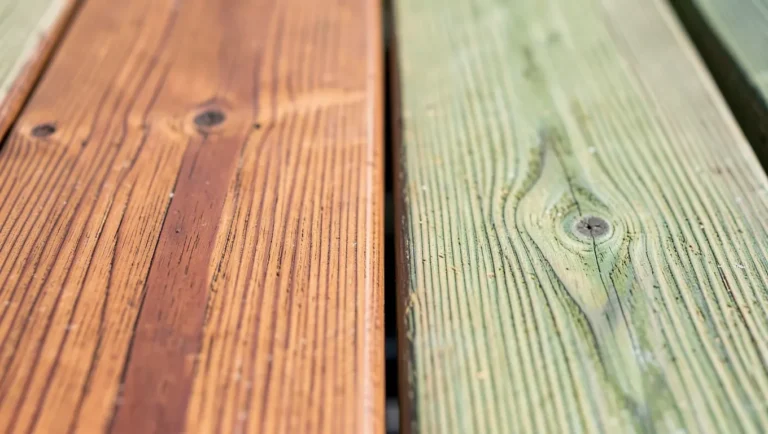
Fence grade has a large effect on price. Clear boards cost more than knotty boards, and higher-heartwood stock costs more than boards with more sapwood. For both cedar and redwood, lower-grade material can look acceptable from a distance, but it often brings more color variation and less consistent appearance.
Fence grade and board quality
Buyers usually pay more for clear, straight, and more uniform boards. Knotty stock is cheaper, but it is not the same as premium fencing material. In redwood, heartwood content matters because it is the denser, more decay-resistant portion; in cedar, ask for clear heartwood boards when you want the more durable, higher-grade option.
A common first-timer mistake is to compare board prices without checking how much sapwood is included. A low price can hide a lot of pale outer wood, which may be fine for some layouts but less desirable for a fence that needs cleaner appearance and more consistent wear.
Board width, height, and layout
A 6-foot privacy fence needs more material than a picket fence, and lattice panels raise the price again because the layout uses more labor and more components. Taller fences also increase wind load, which can push post size, footing size, and labor higher. The wider the board or panel assembly, the more the material budget grows.
For a 200-linear-foot redwood fence, the project cost depends on region, grade, and build style, and a longer run is also more likely to trigger larger delivery and crew charges than a 150-foot run.
Gate count and terrain
Every gate adds hardware, time, and alignment work. Uneven terrain can add layout time, extra post depth, and more careful fitting around grade changes. If your lot has roots, rocky soil, or narrow side access, labor may matter more than the wood species itself.
Regional pricing and supply
Redwood prices change by region more dramatically than cedar prices. Supply is more California-centered, so buyers in California usually have a better chance of finding competitive redwood pricing than buyers in inland states or the Southeast. Cedar is more broadly available, which often keeps freight and yard pricing steadier.
Pacific Northwest and California
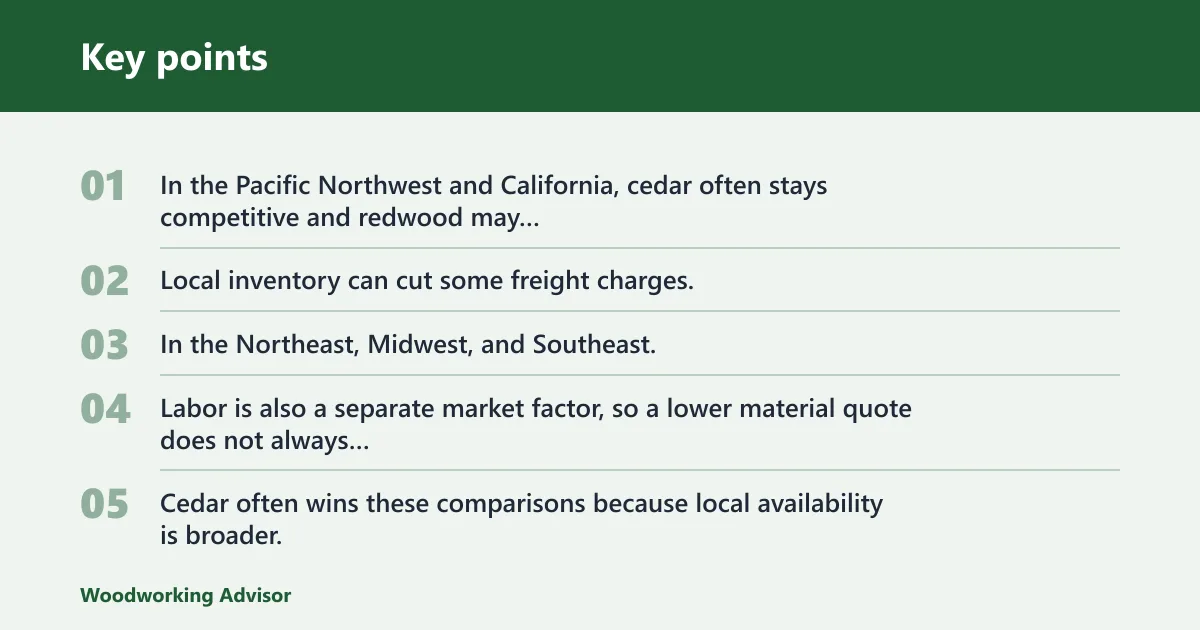
In the Pacific Northwest and California, cedar often stays competitive and redwood may be easier to source than it is elsewhere, but redwood still tends to sit above cedar on installed cost. Local inventory can cut some freight charges, yet premium heartwood grades can still move prices up quickly.
Northeast, Midwest, and Southeast
In the Northeast, Midwest, and Southeast, shipping premium becomes a larger part of the quote, especially for redwood. Labor is also a separate market factor, so a lower material quote does not always produce a lower installed price. Cedar often wins these comparisons because local availability is broader.
Picture a homeowner in the Midwest choosing between cedar and redwood for a straight 150-foot privacy fence. If the redwood board quote is higher and freight is added separately, the finished price gap can widen more than the buyer expected, even before stain and permit costs are added.
Yard inventory matters. If the local supplier has the right cedar grade on hand, the price can stay tighter. If redwood must be ordered in from a distant yard, the shipping premium can show up as a separate charge or be buried in the board price. Either way, the customer pays it.
How much maintenance should you budget?
Both cedar and redwood can be stained or sealed, and both need periodic maintenance if you want them to keep their appearance longer. The first-year cost is usually the same type of expense for each wood: finish material plus labor if you are not doing it yourself. The timing of the next coat depends on exposure, grade, and finish choice.
Stain or sealant costs
For a 150-foot privacy fence, stain or sealant often adds a few hundred dollars upfront, with more if you hire out application. Clear finishes can preserve a natural look but usually need closer attention than pigmented stains. A stained fence may hide weathering better, but it still needs reapplication.
Recoat timing as a variable, not a fixed rule
Maintenance frequency should not be treated as fixed for either species. Sun, rain, fence orientation, and board quality all change how soon a fence needs another coat. Redwood’s natural decay resistance does not remove the need for finish care, and cedar’s maintenance burden is not identical in every climate.
Do not budget a fence as “maintenance free” just because it is a premium softwood. The safer approach is to reserve a finish budget and assume inspection after the first season, then plan recoats based on exposure and how quickly the surface starts to dry, gray, or open up.
Choose cedar if… / Choose redwood if…
Choose cedar if keeping the total project price down matters most, if you want broader regional availability, or if you are building a standard privacy fence and do not need the premium look of higher-grade redwood. Cedar is usually the smarter spend when the rest of the fence package is already expensive.
Choose redwood if the site is in a market with good local supply, if you want a premium natural appearance, or if you are willing to pay more for a material that usually has stronger decay resistance and a higher-end finish when you are comparing similar grades, heartwood content, and exposure conditions. Redwood makes the most sense when the board grade and yard pricing are both favorable.
If the budget is tight, a mixed-material build can help. Some buyers choose cedar for the main run and spend more on gate faces or street-side panels, where appearance matters most. That keeps the total lower without forcing the whole fence into a premium material tier.
Frequently asked questions
How much more does a redwood fence cost than cedar?
A redwood fence usually costs about 15% to 40% more installed than cedar, depending on grade, region, and the amount of delivery or labor premium in the quote. The gap can shrink on simple jobs and widen when redwood boards are scarce or the project needs more gates and finish work.
What is the installed cost per linear foot for cedar vs redwood fencing?
Installed cedar fences are shown at $27-45 per linear foot. Installed redwood fences are shown at $34-60 per linear foot. Those ranges are a better planning tool than board price alone because they reflect the labor, posts, concrete, and other line items that affect the final bill.
Which is cheaper to install, cedar or redwood?
Cedar is usually cheaper to install. The reason is not only board cost; cedar also tends to have broader availability in many regions, which helps keep freight and yard pricing steadier. Redwood can be competitive in some California-area markets, but it usually remains the higher-cost option overall.
Does redwood last long enough to justify the higher price?
Sometimes, but not always. Redwood’s natural decay resistance can justify the premium when you want a higher-end appearance, have good local supply, and plan to keep the fence for many years. If the fence will be heavily shaded, stained, or replaced sooner for design reasons, cedar may be the better value.
How much does a 150-foot cedar or redwood fence cost?
For a 150-foot privacy fence, the comparison table shows cedar at $5,900 to $10,925 and redwood at $7,050 to $13,900. Those totals include boards, posts, hardware, concrete, labor, stain or sealant, delivery, and permits. The exact quote depends on grade, gates, terrain, and local supply.
What grade of cedar or redwood should I buy for a fence?
For most buyers, ask for clear heartwood boards or the supplier’s highest heartwood fencing grade because it gives you more consistent appearance and usually better durability than mixed or low-grade stock. Clear boards cost more than knotty boards, but the appearance difference is real. Avoid assuming that all lower-priced boards are equal on quality.
Do redwood fence prices change by region?
Yes. Redwood pricing is more sensitive to region than cedar pricing because supply is more California-centered. Buyers in California and parts of the Pacific Northwest may see tighter pricing, while inland and eastern buyers often pay more for freight, limited yard inventory, and added delivery handling.
How much should labor add to cedar vs redwood fence cost?
Labor often adds a large share of the total for both woods, and the species gap is usually smaller than the labor gap caused by terrain, gates, and access. Local crew pricing can vary widely.
Is cedar or redwood better for fence posts and privacy fencing?
For the fence itself, cedar is usually the better budget choice and redwood is the better premium choice. For posts, look first at the post material and footing design rather than assuming the board species should do the structural work. For privacy fencing, both woods work well when the grade and installation are right.
Sponsored / affiliate links. As an Amazon Associate I earn from qualifying purchases. I may earn additional commission from eligible campaigns.