How Much Does Marine Grade Plywood Cost Per Sheet?
In India, marine plywood usually costs about ₹70–₹220 per square foot, which works out to roughly ₹2,240–₹7,040 for a 4×8 sheet because a standard sheet covers 32 square feet. Exact pricing shifts with city, stock grade, transport distance, glue line, face veneer, core quality, and whether the panel is truly BWP or IS 710 rated. Buy the wrong grade and you can pay for durability you do not need, or replace panels early after moisture damage. This guide converts square-foot pricing into sheet cost and shows when the premium is worth paying.
Marine plywood cost by sheet

The fastest way to price marine plywood is to treat a 4×8 sheet as 32 square feet. That makes the math simple: multiply the quoted per-square-foot rate by 32, then add wastage, transport, and taxes if the dealer has not already included them.
For India, a commonly quoted pricing band is about ₹70–₹220 per square foot. On that basis, a 4×8 sheet can land anywhere from about ₹2,240 to ₹7,040 before extras. The middle of the market is often where most buyers end up, especially for 12mm to 18mm panels.
Convert square-foot pricing into sheet cost
Use the same formula for every quote: sheet price = per-square-foot price × 32. If a dealer quotes ₹125 per square foot, the sheet price is ₹4,000. If the quote is ₹180 per square foot, the sheet price is ₹5,760.
That conversion matters because some dealers quote only by area, while others quote by sheet. The total can look different until you reduce it to the same unit.
Price bands by thickness
Thickness changes the cost because thicker panels use more veneer plies and more resin. The published India ranges below are a useful comparison point, not a fixed national price.
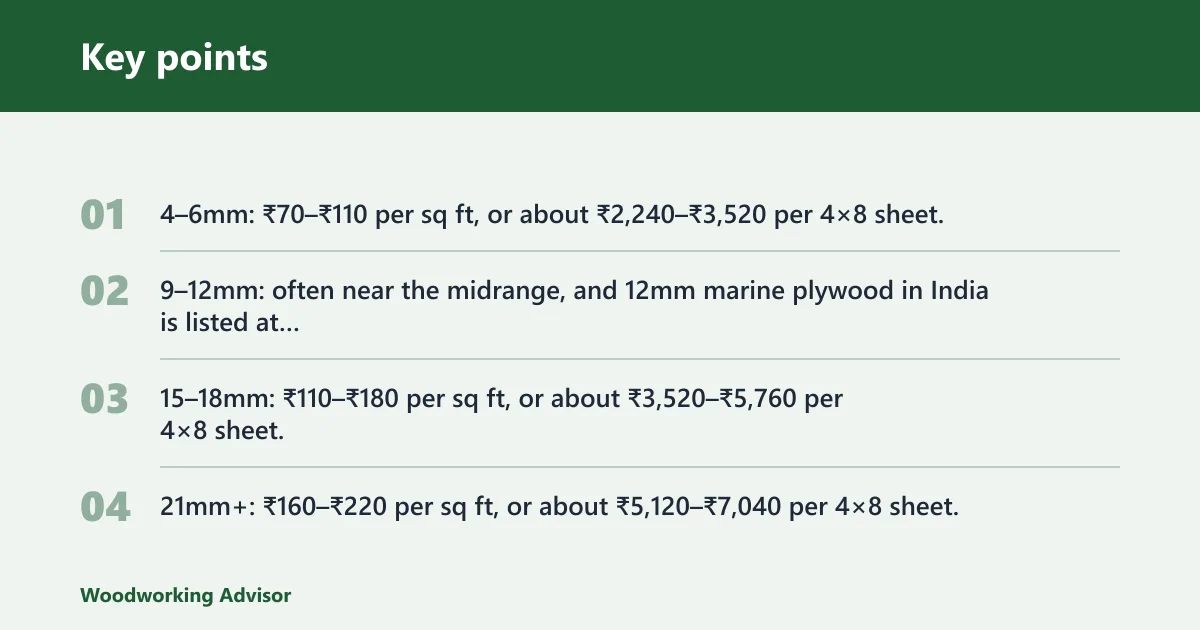
- 4–6mm: ₹70–₹110 per sq ft, or about ₹2,240–₹3,520 per 4×8 sheet.
- 9–12mm: often near the midrange, and 12mm marine plywood in India is listed at ₹2,200–₹4,200 per sheet.
- 15–18mm: ₹110–₹180 per sq ft, or about ₹3,520–₹5,760 per 4×8 sheet.
- 21mm+: ₹160–₹220 per sq ft, or about ₹5,120–₹7,040 per 4×8 sheet.
That translates to about ₹3,520–₹5,760 per 4×8 sheet, with premium metro pricing able to run higher.
The sheet price is only the starting point. Ask for transport, cutting waste, taxes, and any edge sealing charge in writing. The quote should also state whether delivery is included or billed separately.
A practical buying quote should leave room for 5–10% wastage. That extra allowance is common when you need cuts, trimmed edges, or a spare panel for color matching and defect rejection.
What makes marine plywood cost more?
Marine plywood costs more because it is built for higher moisture exposure and tighter failure tolerance than ordinary plywood. The premium comes from waterproof phenolic glue, stronger core construction, and better face veneers. In India, true marine plywood can cost 40–80% more than MR grade.
Waterproof glue and BWP construction
True marine plywood uses waterproof phenolic adhesive and BWP construction. That glue line is a major reason the price rises, because the panel is designed to hold together under wet conditions where ordinary interior plywood would fail faster.
For buyers comparing quotes, asking for BWP or IS 710 specs is the cleanest way to compare apples to apples. A panel sold as “marine” without those details may not be the same product.
Face veneer quality and core structure
Face veneer quality changes both the look and the price. Teak face and gurjan face options usually cost more than plain faces because they improve finish quality and can reduce patchy sanding or visible repairs.
Core construction matters just as much. A hardwood core usually costs more than a mixed-core panel, but it tends to carry less risk of warping and delamination. Mixed-core stock can be cheaper, yet it may not deliver the same long-term stability in damp locations.
Why thickness pushes the price up
Thicker sheets use more material, more plies, and more resin, so the price climbs as thickness increases. That is why 21mm+ marine plywood sits above 4–6mm stock. It is not only a matter of stiffness; it is also a material-cost issue.
Suppose you need cabinet sides for a sink base and the dealer offers a low 12mm quote. If the panel is thin, mixed-core, and missing clear IS 710 marking, the lower price may simply reflect lower build quality rather than a bargain.
How much does a 4×8 sheet cost?
A 4×8 sheet costs whatever the quoted square-foot rate times 32 square feet adds up to, plus any extra charges. In India, that usually places a full sheet in the ₹2,240–₹7,040 range, depending on thickness, face veneer, and dealer margin.
Use 32 square feet as the pricing base
The 4×8 format is the standard comparison unit because it equals 32 square feet. If a dealer quotes by sheet, divide the sheet price by 32 to compare against another seller’s per-square-foot rate. If the dealer quotes by area, multiply by 32 to compare against a sheet price.
What changes the quote from dealer to dealer
Dealer pricing shifts with city, stock grade, transport distance, and how much wastage is built into the quote. Coastal cities may price marine plywood 15–30% higher. Regional supply gaps can do the same.
The quote can also change if one dealer includes taxes and another excludes them. Always ask for the base price, transport, wastage, and taxes as separate line items.
When a low quote is a warning sign
A very low quote can mean the panel is actually BWR, MR, or a mixed-core board sold under a marine label. It can also mean the dealer is quoting only the base price and leaving out transport, cutting loss, or tax.
Low pricing is worth a second look when the seller cannot state the glue type, grade marking, or origin details. If those details are vague, the discount may not be real.
Marine plywood pricing table
| Per-square-foot range | 4×8 sheet total | Likely hidden costs | Worth it if |
|---|---|---|---|
| ₹70–₹110 | ₹2,240–₹3,520 | Waste 5–10%, delivery, taxes, edge sealing | Light moisture exposure, covered cabinetry, budget-sensitive joinery that still needs better water resistance than MR |
| ₹110–₹180 | ₹3,520–₹5,760 | Waste 5–10%, delivery, taxes, cutting loss | Kitchens, utility cabinets, bathroom furniture, or parts near sinks and steam |
| ₹160–₹220 | ₹5,120–₹7,040 | Waste 5–10%, delivery, taxes, edge sealing, possible premium freight | High splash exposure, exterior-facing joinery, boat work, dock parts, or long-life assemblies in wet locations |
This table is a calculator, not a fixed retail list. Use it to compare dealer quotes by converting every offer into the same 4×8 sheet format before deciding.
How do you verify genuine marine plywood?
Genuine marine plywood should show clear grade and construction details, not just a marketing label. Check for IS 710 on the panel or paperwork, inspect the face and edge quality, and ask for glue type and core description before you pay.
Check for IS 710 on the panel or paperwork
The most useful Indian check is the IS 710 mark. The 2026 guide also recommends verifying the IS:710 stamp and a boil test edge sample. Those two checks help separate true marine stock from panels that only carry a marine label.
If the seller cannot show the stamp, label, or documentation, treat the quote as incomplete. A genuine marine panel should not require guesswork.
Inspect the face veneer and core layers
Look at the face veneer for consistent grain, clean sanding, and few patched spots. Then inspect the edge. A hardwood core should look even and tight, while a mixed-core sheet may show inconsistent layers and a greater risk of warping or delamination.
Edge quality matters because it often reveals what the marketing label hides. If the edge shows voids, loose ply lines, or abrupt layer changes, the panel may not match the quoted grade.
Ask for grade, glue type, and origin details
Ask three direct questions: Is it BWP? Is it IS 710 rated? What is the core and face veneer species? Those answers matter more than a broad “marine” label.
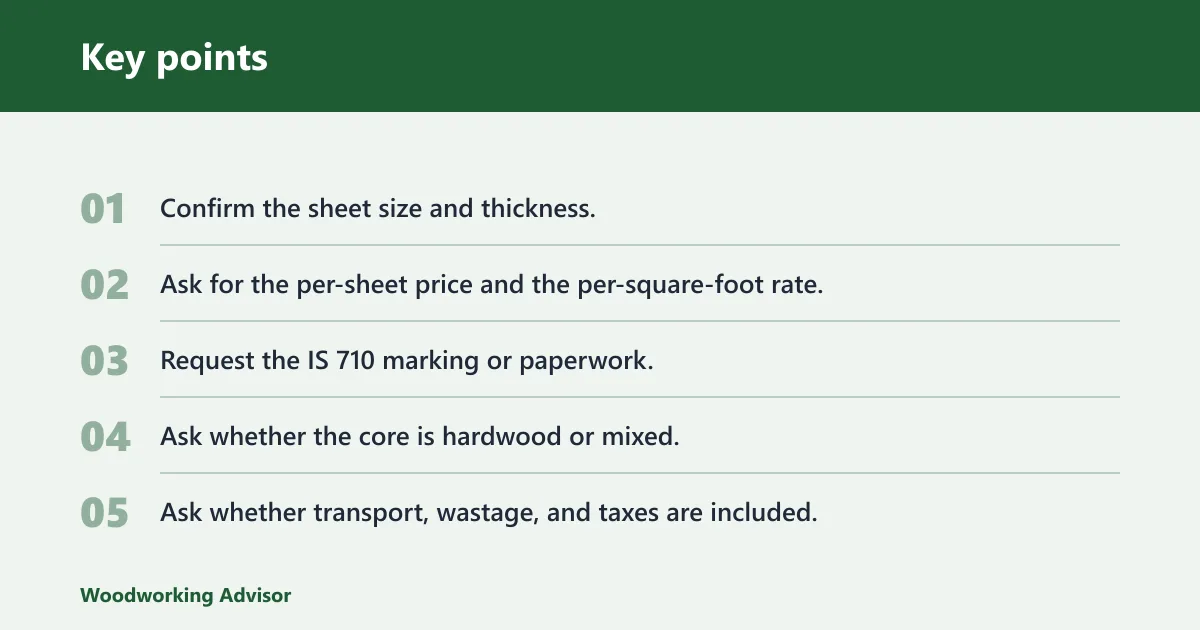
- Confirm the sheet size and thickness.
- Ask for the per-sheet price and the per-square-foot rate.
- Request the IS 710 marking or paperwork.
- Ask whether the core is hardwood or mixed.
- Ask whether transport, wastage, and taxes are included.
When is marine plywood worth paying for?
Marine plywood is worth the premium when moisture exposure is routine and failure would be expensive. That includes bathroom furniture, kitchen sink cabinets, utility joinery, boat parts, dock details, and other places where splash, humidity, or wet cleaning is expected.
Bathrooms, kitchens, and splash-prone joinery
For bathroom vanities and kitchen carcasses near sinks, marine plywood can be a sensible buy if the panel will face repeated moisture. It is still smart to seal cut edges and reduce standing water exposure, because no panel benefits from neglected joints.
Boat, dock, and exterior exposure cases
For boats and dock work, the premium is easier to justify because failures are more costly and moisture exposure is direct. In those cases, the better glue line and stronger core can matter more than the upfront price difference.
When BWR or regular plywood is enough
For low-moisture interiors, marine plywood is often overkill. A good BWR board or even regular plywood may be enough for wardrobes, dry partition walls, and other assemblies that do not face constant dampness.
Picture a wardrobe in a dry bedroom. Paying for top-end marine stock there usually adds cost without adding much value, because the panel is unlikely to see the moisture that drives marine-grade benefits.
How much marine grade checklist
A clean quote should make the price easy to compare and easy to verify. Before you pay, ask the dealer to break out the base price, transport, wastage, taxes, and any extra finishing charge such as edge sealing or delivery to site.
- Base price per square foot and per sheet
- Thickness in millimeters
- IS 710 or BWP confirmation
- Core type: hardwood or mixed
- Face veneer type: teak face, gurjan face, or other
- Wastage allowance of 5–10%
- Transport and unloading charges
- Taxes included or added later
- Cutting loss and edge sealing terms
- Return policy for rejected or damaged sheets
A common first-timer mistake is accepting a low headline quote and discovering later that transport, wastage, and taxes were excluded. The total then lands much higher than the first number suggested.
Frequently asked questions
How much does a sheet of marine grade plywood cost?
In India, a sheet usually falls somewhere between ₹2,240 and ₹7,040 for a 4×8 panel, based on the common ₹70–₹220 per square foot range. The exact figure depends on thickness, face veneer, core quality, and whether the sheet is truly BWP or IS 710 rated.
How much does a 4×8 sheet of marine plywood cost?
A 4×8 sheet is 32 square feet, so the price is the square-foot rate multiplied by 32.
Why is marine grade plywood so expensive?
Marine plywood costs more because it uses waterproof phenolic glue, tighter construction, and better face and core materials than basic plywood. In India, true marine stock can cost 40–80% more than MR grade, especially when the panel is thicker or carries a premium veneer.
How do I know if I’m being overcharged for marine plywood?
Compare the quote against the same thickness and the same specification. Ask for the per-square-foot rate, the sheet total, the IS 710 mark, and a breakdown of transport, wastage, and taxes. A vague “marine” label without those details is a warning sign.
What is marine plywood price per sq ft?
Marine plywood prices in India typically range from ₹70–₹220 per square foot. Thin panels sit near the bottom of that range, while 21mm+ stock sits near the top. A fair comparison always uses the same thickness and the same grade details.
Is marine plywood worth the extra cost?
Yes, when the panel will face regular moisture, repeated cleaning, or costly failure if it swells or delaminates. It is often not worth the premium for dry-room furniture, where BWR or regular plywood can meet the need at lower cost.
Sponsored / affiliate links. As an Amazon Associate I earn from qualifying purchases. I may earn additional commission from eligible campaigns.