Pin Oak vs Red Oak: How to Tell Them Apart
Pin oak usually grows on wet, flat sites with lower limbs that droop, while red oak more often grows on better-drained ground and has broader, less pendulous branches; leaf lobes and acorns confirm the ID. A wrong call can lead to poor planting placement and the wrong pruning or replacement choice. This guide ranks the most reliable clues, starting with site and leaves, then acorns, bark, and winter branching.
| Factor | Pin Oak | Red Oak | Winner |
|---|---|---|---|
| Site drainage | Wet, poorly drained ground; tolerates some flooding | Moist to dry, well-drained ground | Pin Oak in low, wet sites; Red Oak in upland sites |
| Leaf lobes and sinuses | 5 to 7 lobes; deep sinuses | 7 to 11 lobes; shallower sinuses | Red Oak |
| Acorn size and cap | Smaller, nearly round acorns; shallow saucer-shaped cap | Much larger acorns; flat, shallow cap | Red Oak |
| Branching habit | Many side branches; drooping lower limbs | Fewer, heavier limbs; lower limbs self-prune more | Pin Oak |
| Bark texture | Light gray-brown; smoother on a large scale | Wide ridges and flat tops; rougher with deeper furrows | Red Oak |
| Winter leaf retention | Young trees often keep dry brown leaves through winter | Usually drops leaves more fully | Pin Oak |
| Soil pH tolerance | Dislikes alkaline soil; can look chlorotic on alkaline sites | Tolerates acidic to near-neutral soil better | Red Oak |
| Hardiness range | Zones 3 to 9 | Zones 4 to 8 | Pin Oak for broader cold-to-heat range |
Pin oak vs red oak: the fastest way to tell
Start with the ground, then the crown, then the leaves. Pin oak points to wet, low, poorly drained soil and a tree with many side branches and drooping lower limbs; red oak points to better-drained ground and a broader crown with fewer low limbs. Leaves and acorns usually settle the call.
Side-by-side comparison snapshot
For a quick field check, look at the site first. A tree on a flat, soggy low spot is more likely to be pin oak; a tree on a raised, drier, well-drained site is more likely to be red oak. If leaves are present, red oak usually shows more lobes and shallower sinuses.
Does the site point to pin oak or red oak?
Yes, drainage is the strongest site clue. Pin oak fits wet, poorly drained ground and even some flooding, while red oak fits moist to dry, well-drained sites. Soil pH matters too, but drainage usually separates them more reliably in the field. (NCSU)
Drainage first: low ground vs well-drained ground
Low ground, swales, and edges of stormwater flow often favor pin oak. Upland yards, slopes, and soils that drain quickly favor red oak. If the tree is thriving on a site that stays wet after rain, pin oak moves up the list fast.
How soil pH changes the clue
Pin oak dislikes alkaline soil. On such sites, it can show chlorosis, weak growth, and a pale or tired look that makes identification less obvious. Red oak handles acidic to near-neutral soil better, so a chlorotic pin oak on alkaline ground may look less typical than a healthy one.
USDA zone range and where each tree fits
Pin oak is listed for zones 3 to 9, while red oak is listed for zones 4 to 8. That range helps with planting fit, but it is not a stand-alone ID cue. A tree can grow outside its ideal site and still look stressed, which can blur the visual signs.
Pin oak vs red oak leaves
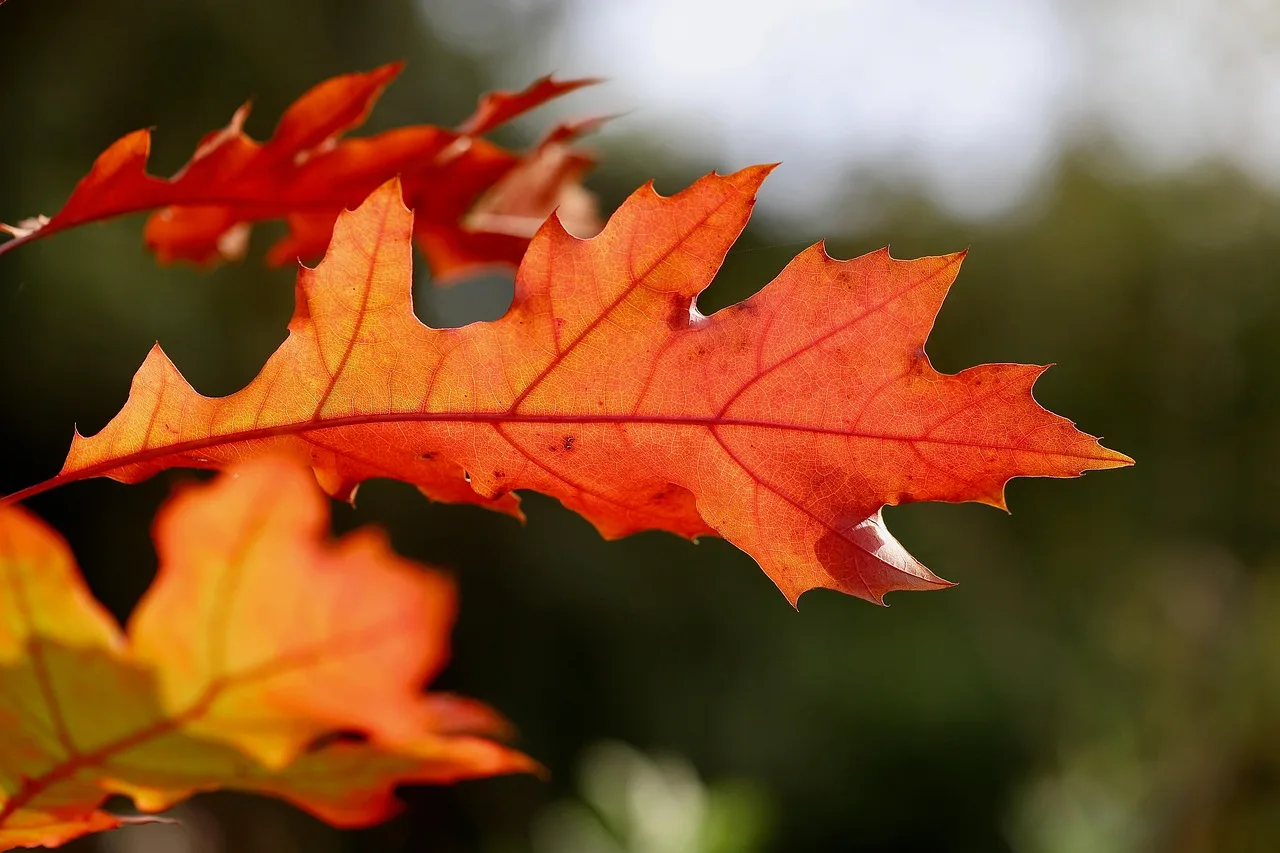
Leaves are one of the best visible clues when they are intact. Pin oak usually has around 5 to 7 lobes with deep sinuses, while red oak usually has around 7 to 11 lobes with shallower sinuses. Both have pointed, bristle-tipped margins, so lobe depth matters more than the bristle tip alone.
Lobe count and sinus depth
Count the lobes, then judge how deeply the cuts reach toward the midrib. Pin oak tends to look narrower and more cut-up, while red oak looks broader and less deeply divided. In mixed plantings, that difference is often the fastest leaf-based separator.
If a homeowner finds two young oaks along a driveway, one may have narrow leaves with deep cuts and five to seven lobes, while the other has broader leaves with seven to eleven lobes and shallower cuts. The first is more likely pin oak, the second red oak.
Pointed bristle tips in the red oak group
Do not let the bristle tip distract from the lobe pattern. Both trees sit in the red oak group, so both carry pointed, bristle-tipped lobes. That shared feature confirms the group, not the species.
What leaf damage and juvenile growth can hide
Juvenile trees and stressed trees can mislead you. Drought, insect feeding, storm tearing, or pruning can remove part of a leaf and make the lobe count look wrong. In those cases, shift to the site, acorns if present, and the branch structure.
Acorns, twigs, and buds
Acorns are useful, but only when they are present. Pin oak acorns are smaller and nearly round, with a shallow saucer-shaped cap. Red oak acorns are much larger and carry a flat, shallow cap. Twig and bud details can help in winter, but they are less decisive than site and leaves.
Acorn size and cap shape
Pin oak acorns are smaller than red oak acorns. The cap on pin oak is shallow and saucer-shaped, while red oak has a flat, shallow cap. If you are holding mature fruit from the same tree and the acorn looks notably larger, red oak is the better fit.
What twig and bud cues can add
In winter, twigs can support the ID when leaves are gone. Look for stout, pointed buds and the overall spacing of side branches. These clues help more when paired with the crown shape and bark, since twig traits alone are easy to read wrong from a distance.
Why acorns often fail as the only clue
Acorns are seasonal, may be out of reach, and may be missing in a given year or on a pruned tree. Deer, squirrels, and wind also remove them. Use acorns as confirmation, not as your only evidence.
Bark, branching, and winter clues
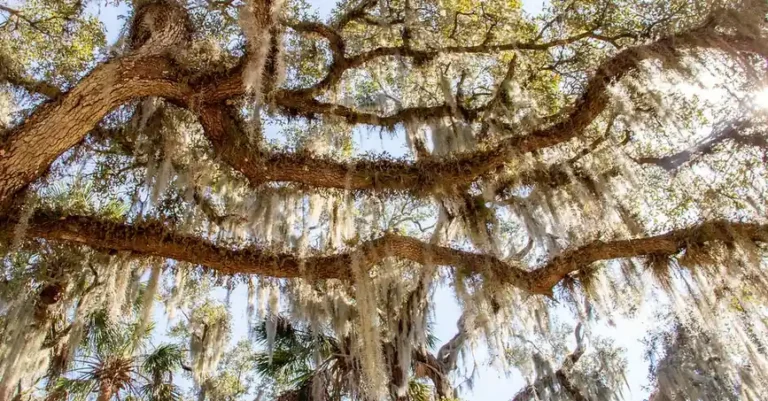
When leaves are missing, the branch habit and bark become more useful. Pin oak usually has many side branches and drooping lower limbs, while red oak has fewer, heavier limbs and tends to self-prune lower branches more. Bark also separates them better on mature trees than on young ones.
Drooping lower limbs and denser branching on pin oak
Pin oak often keeps a lower, skirt-like ring of branches. That dense branching pattern can make the crown look fuller near the ground. If the tree’s lower limbs hang rather than lifting cleanly, pin oak moves ahead in the comparison.
Fewer lower limbs and a broader crown on red oak
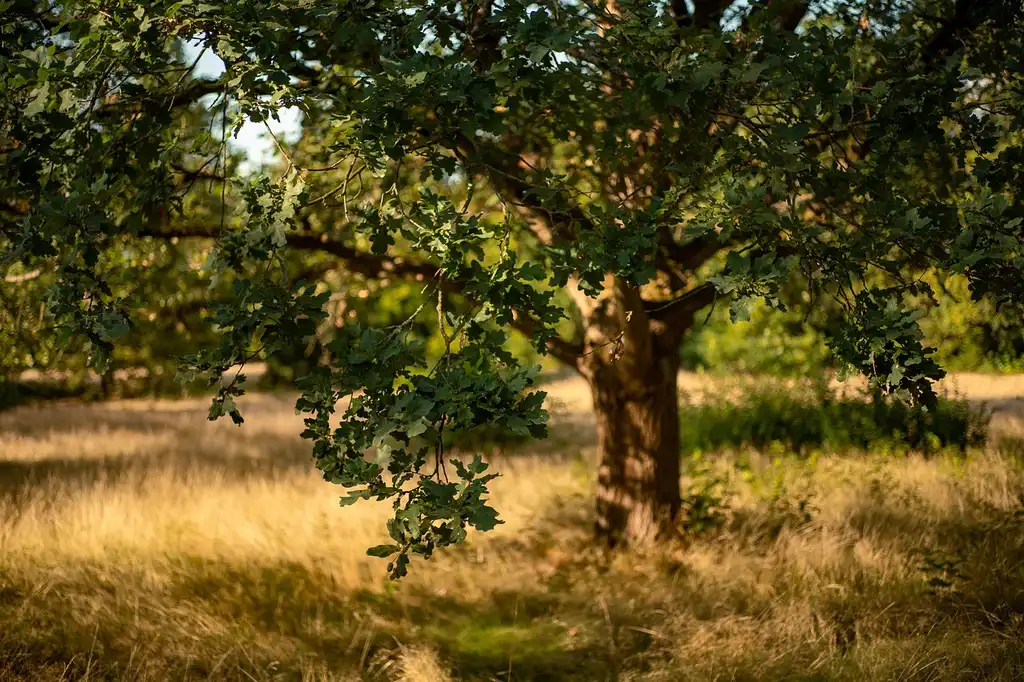
Red oak usually carries fewer low branches and a broader crown. The lower trunk often clears sooner as the tree matures. That habit gives the tree a more open look than pin oak at the same height.
Bark texture and winter leaf retention
Pin oak bark is light gray-brown and smoother on a large scale, while red oak bark shows wide ridges and flat tops with deeper furrows. Young pin oaks also often keep dry brown leaves through winter, which can be a very strong seasonal cue when the tree is leafless.
Oak ID confidence matrix
Use the most reliable traits first. Drainage and leaf structure usually beat bark and winter clues, while acorns are useful only when you can see them. This matrix ranks the traits from strongest to weakest so you can stop when the answer is already clear.
| Trait | What pin oak shows | What red oak shows | When the trait fails |
|---|---|---|---|
| Drainage | Wet, poorly drained low ground; some flooding | Moist to dry, well-drained upland ground | Mixed plantings and altered soils |
| Leaf lobe depth | 5 to 7 lobes with deep sinuses | 7 to 11 lobes with shallower sinuses | Juvenile trees and damaged leaves |
| Acorn size and cap | Smaller, nearly round acorns; shallow saucer-shaped cap | Larger acorns; flat, shallow cap | Seasonal absence and wildlife removal |
| Branching habit | Many side branches; drooping lower limbs | Fewer, heavier limbs; lower limbs prune off sooner | Pruning and crowded sites |
| Bark | Light gray-brown; smoother on a large scale | Wide ridges and flat tops; deeper furrows | Young trees |
| Winter leaf retention | Young trees often keep dry brown leaves | Usually drops leaves more fully | Wind, grazing, and age |
| Soil pH response | Can show chlorosis on alkaline soil | Handles acidic to near-neutral soil better | Compacted or disturbed soil can blur symptoms |
| Hardiness zone fit | Zones 3 to 9 | Zones 4 to 8 | Not an ID trait by itself |
Trait ranking from most reliable to least reliable
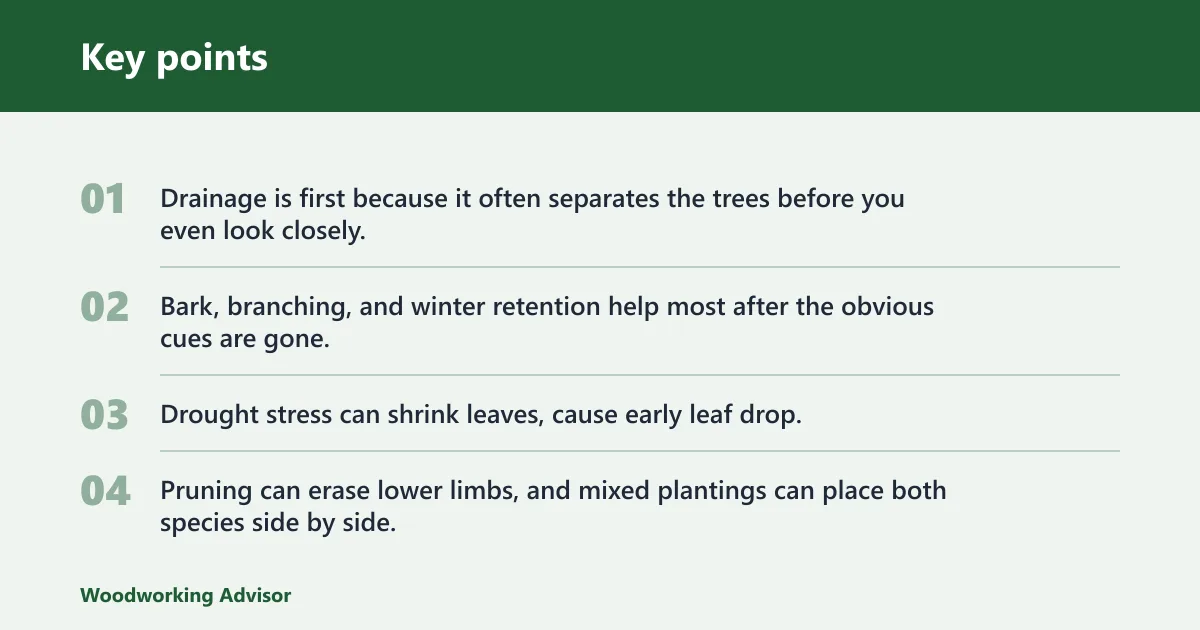
Drainage is first because it often separates the trees before you even look closely. Leaf lobes and sinus depth come next. Bark, branching, and winter retention help most after the obvious cues are gone.
When each trait fails: winter, drought stress, pruning, juvenile trees, and mixed plantings
Winter removes leaves and acorns. Drought stress can shrink leaves, cause early leaf drop, and make pin oak look weak on a bad site. Pruning can erase lower limbs, and mixed plantings can place both species side by side, which makes site clues less clean.
Choose Pin Oak if… / Choose Red Oak if…
Choose pin oak if the site is low, wet, poorly drained, or periodically flooded, and if you see drooping lower limbs with many side branches. Choose red oak if the site is well-drained, slightly drier, and the tree has a broader crown, fewer lower limbs, and larger acorns when they are present.
Best fit for wet, acidic, low-lying sites
Pin oak is the better match when drainage is poor and the soil is acidic to strongly acidic. If the tree is also carrying dry brown leaves into winter as a young specimen, that supports the call. For planting, that combination points to pin oak rather than red oak.
Best fit for moist to dry, well-drained sites
Red oak fits better where water moves through the soil and the site is not staying soggy. If the leaves have more lobes and shallower sinuses, and the crown is broad with fewer low limbs, red oak is the stronger answer. That is especially true on upland yards and slopes.
When planting choice and ID point to the same answer
When the site, leaves, and structure all agree, trust that combined reading. A low, wet site with a denser crown and deeply cut leaves points to pin oak. A well-drained site with larger acorns and a broader crown points to red oak.
Frequently asked questions
Is pin oak red or white oak?
Pin oak is a red oak, not a white oak. It belongs to the red oak group and shares the pointed, bristle-tipped leaf margins found there. For ID, do not use the group name alone; use drainage, leaf lobes, and the tree’s drooping lower branches to separate it from red oak. (Wood-database)
Red oak vs white oak identification
Red oaks have pointed, bristle-tipped lobes, while white oaks have rounded lobes or no lobes with bristles. That single leaf trait is one of the cleanest separators. Acorns also differ: red oaks mature over two seasons, while white oaks mature in one season.
What does a pin oak look like?
Pin oak usually has a wet-site look: a dense crown, many side branches, and lower limbs that droop toward the ground. Its leaves tend to have 5 to 7 lobes with deep sinuses, and young trees may keep dry brown leaves through winter. On alkaline soils, it may look chlorotic or weak.
How to tell oak from pine
Oaks are broadleaf trees with lobed leaves and acorns. Pines have needles in clusters or bundles and make cones rather than acorns. If the tree has a single flat leaf blade with lobes, you are not looking at a pine.
Pin oak vs water oak
Pin oak and water oak can both look narrow-leaved, but water oak usually has a different leaf shape with more variable, spatulate lobes rather than the regular deep sinuses of pin oak. Site also helps: pin oak strongly favors wet, poorly drained ground, but water oak often appears in warmer regions and a wider range of sites.
Black oak vs pin oak
Black oak and pin oak are both red oaks, so both have pointed, bristle-tipped lobes. Pin oak usually has more regular, deeply cut leaves and a drooping lower crown, while black oak often looks coarser and less uniform. Site and crown shape usually settle the comparison faster than bark alone.
Sponsored / affiliate links. As an Amazon Associate I earn from qualifying purchases. I may earn additional commission from eligible campaigns.