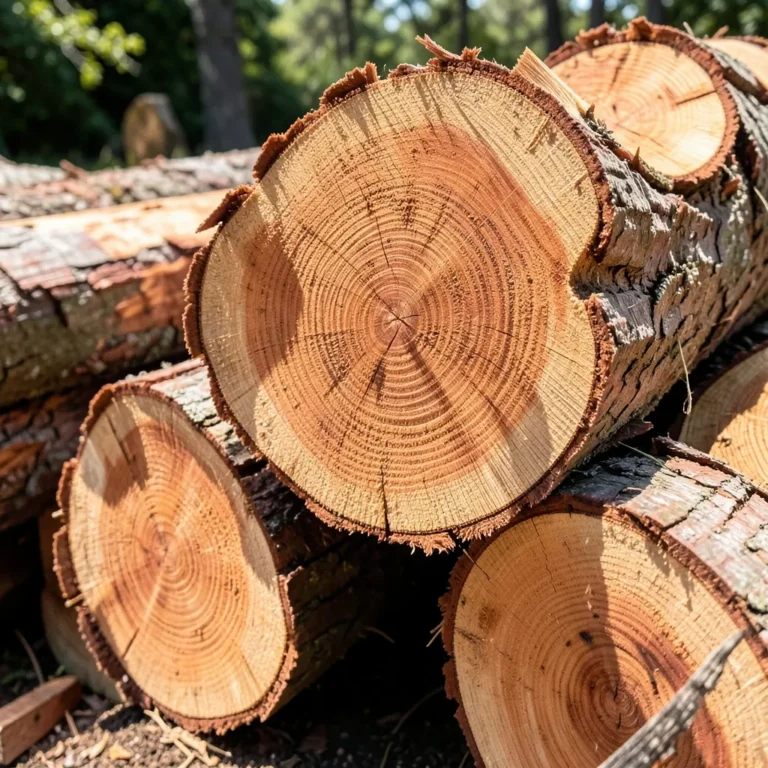
Port Orford Cedar vs Redwood: Which Is Better for Boat Building?
Port Orford cedar is the better choice for highly loaded, small marine parts where stiffness-to-weight matters. Redwood fits larger, lightly loaded trim and protected interior pieces. Pick the wrong wood and you invite creep, loose fasteners, extra weight, or early decay in service. This guide compares both woods by boat part, load, fastener holding, rot resistance, and where each one belongs.
| Factor | Port Orford Cedar | Redwood | Winner |
|---|---|---|---|
| Weight | Average dried weight: 29 lbs/ft³ | Generally lighter on a dried-weight basis than Port Orford cedar | Redwood |
| Stiffness and loaded-part use | Better fit for deck beams, carlins, and spars | Better fit for lightly loaded trim and non-structural parts | Port Orford Cedar |
| Rot resistance | Durable to very durable | Naturally rot resistant, but usually treated as the less durable structural option here | Port Orford Cedar |
| Bendability and shaping | Good for marine shaping, but better when straight-grained and sized carefully | Generally easier to work for simple trim shapes | Redwood |
| Fastener-critical use | Better for parts that need more holding and less crushing | Less suitable where screws or bolts see repeated load | Port Orford Cedar |
| Availability and cost | Limited-supply domestic softwood with very high prices | Usually the more available, more economical choice | Redwood |
Weight and specific gravity
Port Orford cedar, Chamaecyparis lawsoniana, is the denser structural choice in this comparison, with an average dried weight of 29 lbs/ft³. Redwood is commonly lighter on a dried-weight basis, which matters most where every pound affects trim balance, center of gravity, or the ease of handling long stock.
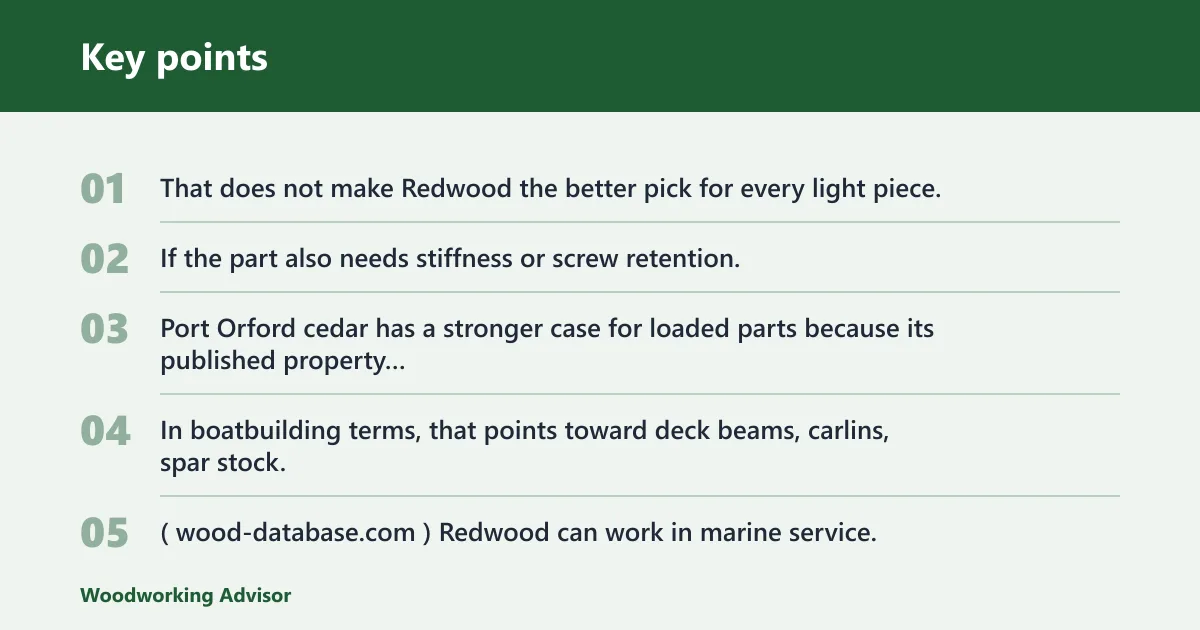
That does not make Redwood the better pick for every light piece. If the part also needs stiffness or screw retention, lower mass can come with more flex and more local crushing under fasteners.
Strength, stiffness, and crushing resistance
Port Orford cedar has a stronger case for loaded parts because its published property set includes a Janka hardness of 590 lbf, and the species is commonly described as having a good strength-to-weight ratio. In boatbuilding terms, that points toward deck beams, carlins, spar stock, and other members that see bending or concentrated load. (Wood-database)
Redwood can work in marine service, but it is the weaker structural option here. For ribs, beams, or narrow members that must hold shape under repeated load, redwood is the one that needs more caution.
Rot resistance, movement, and finish behavior
Port Orford cedar is reported as durable to very durable against decay and resistant to most insect attacks. That makes it well suited to damp marine locations, especially where water gets in and out of the wood rather than staying permanently trapped.
Both woods can weather well if sealed and kept dry when possible, but finish is not a substitute for species choice. A good coating helps service life. It does not turn a lightly loaded trim wood into a structural member.
Fastener holding, bending, and availability
For screws, bolts, and laminated members, Port Orford cedar is the safer pick because the better structural fit reduces the chance of localized crushing and splitting. Redwood’s softer character can be fine for trim, coamings, and other parts that do not see much hardware load.
On availability and cost, Redwood usually has the edge. Port Orford cedar is a limited-supply domestic softwood with very high prices, so it is often reserved for the parts where its properties matter most.
📊 Port Orford Cedar has an average dried weight of 29 lbs/ft3. Source: Wood-database.
Is Port Orford cedar stronger than redwood?
Yes, Port Orford cedar is the stronger choice for boatbuilding parts that carry load. Its combination of 29 lbs/ft³ dried weight, 590 lbf Janka hardness, and good strength-to-weight reputation puts it ahead of Redwood for members that must resist bending, crushing, and fastener stress.
That matters most in deck beams, carlins, spars, and similar pieces. Redwood can still work in marine service, but it is better treated as the lighter-duty option when structure is not the main job.
What the property set suggests for loaded parts
Boat timber selection is not only about decay resistance. You also need stiffness, crushing resistance, fastener holding, and straight grain when the part must stay true through repeated wet-dry cycles.
Where a beam must carry load without adding much mass, Port Orford cedar has the clearer advantage. Redwood is the easier sell only when the load is modest.
Why stiffness matters in beams, carlins, and spars
Stiffness keeps a beam or spar from sagging between supports. A softer wood may look acceptable at first, then move more once it sees repeated loading, hardware compression, or seasonal moisture changes.
That is why Port Orford cedar is a better fit for narrow structural stock. Redwood is more suitable when movement tolerance is higher and the member is mostly there to finish a surface or define shape.
Which wood is lighter for boat planking?
Redwood is lighter for boat planking on a dried-weight basis. Port Orford cedar’s average dried weight is 29 lbs/ft³, so it is still a light marine wood, but it is not the lighter of the two.
For planking, the right answer depends on load and exposure. If the plank is part of a lightly loaded topside or an interior lining, Redwood’s lower mass can be useful. If the plank also helps the hull keep its shape, Port Orford cedar is the safer structural call.
Where lighter stock matters most
Lighter stock matters most in long runs of trim, panels, and planking where added weight changes handling or trim. It also matters in parts that are easy to replace and not highly stressed.
Say your build needs thin interior strips below a cockpit seat. Redwood may save weight and cost there. If the same strip has to support hardware or hold a curved shape, Port Orford cedar is the better choice.
Which lasts longer in saltwater exposure?
Port Orford cedar has the stronger decay-resistance case for wet marine exposure. It is reported durable to very durable, and that gives it an edge for parts that stay damp, dry slowly, or see repeated wet-dry cycling around saltwater.
Redwood is also naturally rot resistant, but this comparison still favors Port Orford cedar where exposure is harsher or the part is harder to replace. Finishing helps both woods, yet neither coating nor sealant removes the need to choose the right species.
Above-water trim versus continuously damp components
Above-water trim, coamings, and cabin details usually face splash and condensation rather than full immersion. Redwood can be acceptable there if the part is not highly loaded and is kept coated.
For deck beams, carlins, and other members hidden in damp spaces, Port Orford cedar is the better match because decay resistance and stiffness both matter. That is where the saltwater environment punishes weaker stock first.
Dimensional stability in wet-dry cycles
Wood movement matters as much as decay. If a part swells and shrinks repeatedly, seams open, fasteners loosen, and finish fails sooner.
Good drying improves stability in either species, but the selection still starts with the part. Use the more stable, more structural wood where joints and fasteners must stay tight.
Port Orford cedar decision matrix
This matrix turns the wood choice into a part-by-part call. It is the best way to avoid using Redwood where a member needs stiffness, while also avoiding overspending on Port Orford cedar where the load is light.
| Boat part | Need | Port Orford Cedar | Redwood | Better fit |
|---|---|---|---|---|
| Deck beams | Stiffness, fastener holding, low creep | Strong fit | Less suitable | Port Orford Cedar |
| Carlins | Bending resistance and joint stability | Strong fit | Less suitable | Port Orford Cedar |
| Spars | Low weight with stiffness and straight grain | Strong fit | Possible only for lighter-duty pieces | Port Orford Cedar |
| Coamings | Weather exposure, moderate load, finish quality | Good fit | Good fit if load is low | Tie, use case dependent |
| Trim | Appearance, workability, lower load | Good fit | Strong fit | Redwood |
| Strip-planking | Light weight, bendability, cost control | Good fit for more demanding planks | Good fit for lower-load areas | Redwood |
Best-fit parts: deck beams, carlins, spars, and structural trim
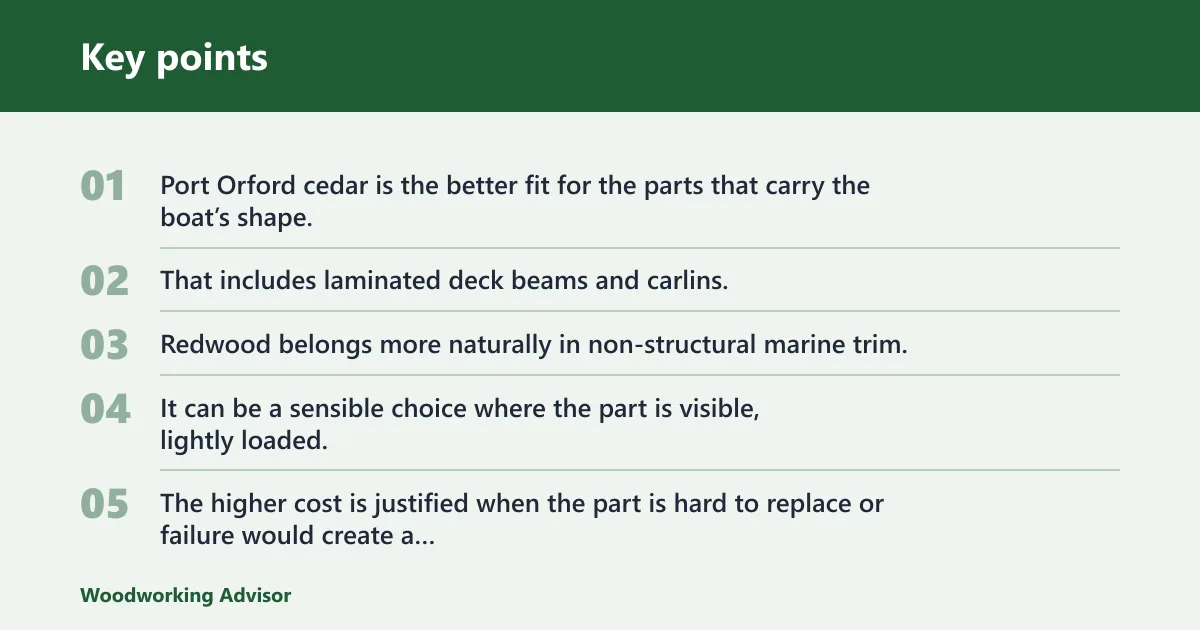
Port Orford cedar is the better fit for the parts that carry the boat’s shape. That includes laminated deck beams and carlins, which need stiffness and reliable hardware support more than they need the lowest possible price.
Redwood belongs more naturally in non-structural marine trim. It can be a sensible choice where the part is visible, lightly loaded, and easy to replace later.
When the higher cost is justified
The higher cost is justified when the part is hard to replace or failure would create a bigger problem than the material premium. A deck beam hidden under finished work is one example. A spar that affects sail shape is another.
That logic also fits similar construction references: laminated cedar deck beams and carlins, marine-grade plywood, and vinylester-based resins can point to a build that uses stronger wood where the loads are concentrated.
Known downsides: price, supply, and sawdust irritation
Port Orford cedar’s biggest downside is not performance. It is cost and supply. The species is limited in availability, and marine-grade stock can be expensive.
It can also cause skin irritation and asthma-like symptoms in some people, so dust control matters. That is especially important during sawing, sanding, and cleanup.
Picture a 28-foot cutter with laminated deck beams and carlins. Port Orford cedar makes sense there because the parts are narrow, structural, and worth the extra cost. Now picture a bright trim strip under a cockpit coaming. Redwood can be the more economical choice if the load stays low and the wood is well sealed.
Choose Port Orford Cedar if… / Choose Redwood if…
Choose Port Orford cedar for loaded or fastener-critical parts, especially when you need stiffness, decay resistance, and a better strength-to-weight balance. It is the better call for deck beams, carlins, spars, and structural trim, and it fits laminated members like those used in a Cape George Cutter-style build.
Choose Redwood for lighter-duty, more cost-sensitive marine parts where the load is modest and replacement would be simple. It fits trim, protected interior pieces, and other non-structural parts where lighter dried stock and easier availability matter more than structural reserve.
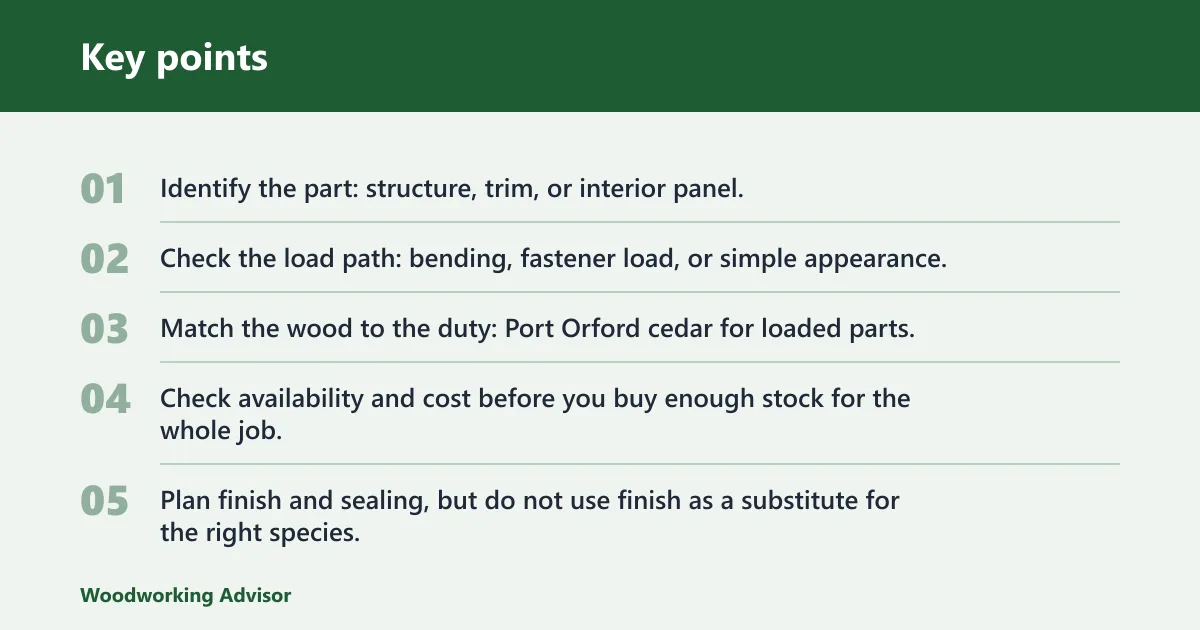
- Identify the part: structure, trim, or interior panel.
- Check the load path: bending, fastener load, or simple appearance.
- Match the wood to the duty: Port Orford cedar for loaded parts, Redwood for lighter-duty parts.
- Check availability and cost before you buy enough stock for the whole job.
- Plan finish and sealing, but do not use finish as a substitute for the right species.

Frequently asked questions
Is Port Orford Cedar stronger than redwood for boat building?
Yes, for boatbuilding parts that carry load, Port Orford cedar is the stronger choice. Its documented 29 lbs/ft³ dried weight, 590 lbf Janka hardness, and good strength-to-weight reputation make it better for beams, carlins, spars, and other members that must resist bending and crushing.
Which wood is lighter for boat planking, Port Orford Cedar or redwood?
Redwood is the lighter option for planking on a dried-weight basis. Port Orford cedar is still a light marine wood, but it is denser than Redwood, so the choice comes down to whether the plank is mainly cosmetic or also needs structural support.
Which lasts longer in saltwater exposure: Port Orford Cedar or redwood?
Port Orford cedar has the edge where saltwater exposure means repeated wetting, slow drying, or hidden dampness. It is reported durable to very durable against decay. Redwood is also rot resistant, but Port Orford cedar is the better fit for harsher marine locations.
Is Port Orford Cedar easier to bend and shape than redwood?
Redwood is usually easier to work for simple shaping, while Port Orford cedar is the better choice when you need the wood to bend without giving up stiffness. For curved structural parts, Port Orford cedar gives more useful resistance once the piece is in place.
Does Port Orford Cedar resist rot better than redwood on a boat?
In this comparison, yes. Port Orford cedar is reported durable to very durable and resistant to most insect attacks, so it has the stronger decay-resistance profile for boat parts that stay damp. Redwood still has natural rot resistance, but it is the less durable structural option here.
What boat parts should use Port Orford Cedar instead of redwood?
Use Port Orford cedar for deck beams, carlins, spars, and any narrow part that must hold fasteners or stay stiff under load. Those are the places where its higher strength-to-weight and better crushing resistance matter more than Redwood’s lower cost.
What are the downsides of using Port Orford Cedar on boats?
The main downsides are price, limited supply, and dust exposure. Port Orford cedar is a limited-supply domestic softwood with very high prices, and its sawdust can irritate skin or trigger asthma-like symptoms in some people. That makes dust control and selective use important.
Sponsored / affiliate links. As an Amazon Associate I earn from qualifying purchases. I may earn additional commission from eligible campaigns.