Will Primer Protect Wood From Rain?
Primer can help wood shed rain for a short time, but it is not a waterproof finish. Its protection depends on the primer type, full cure time, and whether you apply a topcoat before the weather turns. If you paint too soon, rain can soften the film, stain the wood, or force a full redo. This guide explains which primers tolerate moisture, how long to wait before rain, and what to do if wet weather is due.
How primer handles moisture exposure
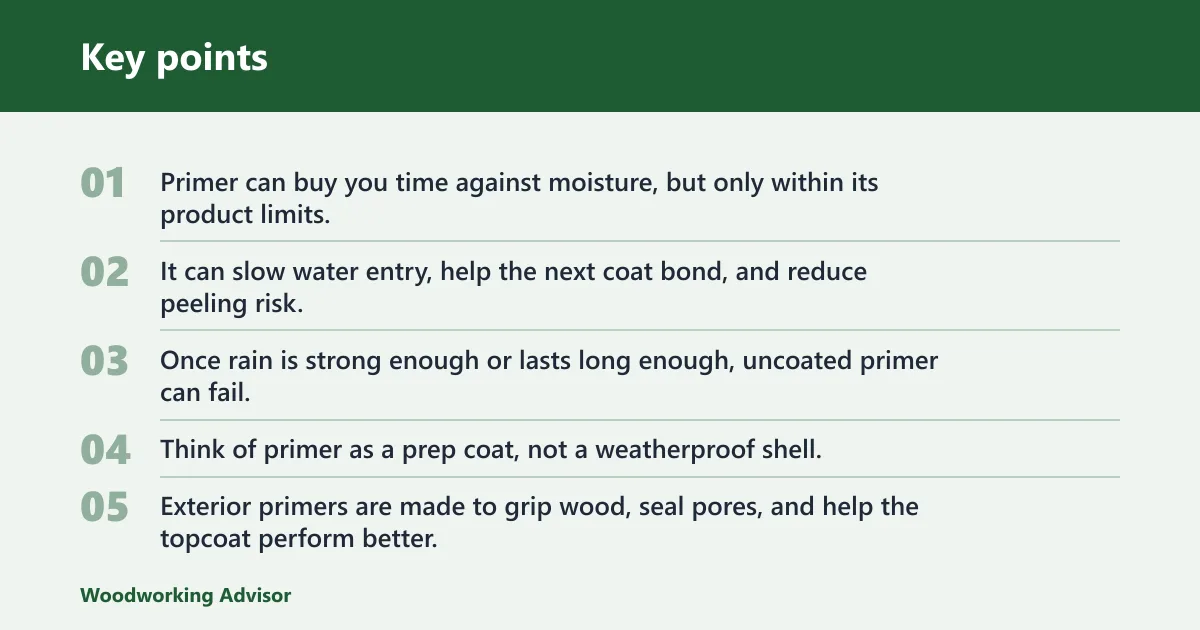

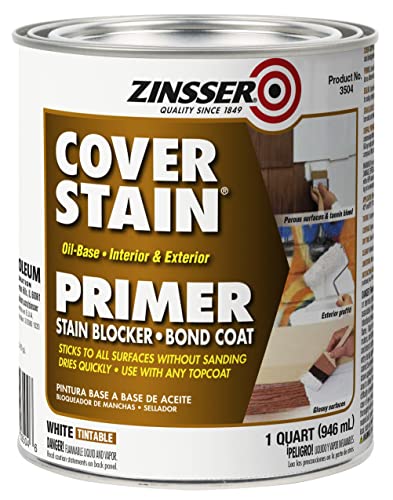
Primer can buy you time against moisture, but only within its product limits. It can slow water entry, help the next coat bond, and reduce peeling risk, yet it is not a finished rain barrier. Once rain is strong enough or lasts long enough, uncoated primer can fail.
Think of primer as a prep coat, not a weatherproof shell. Exterior primers are made to grip wood, seal pores, and help the topcoat perform better. That helps during short damp spells, but it does not replace paint, stain, or another exterior finish meant for direct rain.
Why primer is not a finished rain barrier
Primer films are designed around adhesion and sealing, not long-term water shedding. A touch-dry surface can still be vulnerable underneath, especially on bare wood where end grain drinks moisture fast. If rain lands before the film has cured enough, it can mark the surface or weaken the bond.
That risk is higher on rough, thirsty lumber and lower on a previously coated surface that still has a sound film beneath it. Even then, primer alone should be treated as temporary protection. The longer the rain exposure, the less safe it becomes.
What changes once a topcoat goes
A topcoat changes the equation because it adds the weather layer. Primer under paint or solid exterior stain is there to support adhesion, block stains, and reduce moisture entry. The finished coating system, not the primer by itself, is what should face repeated rain.
If you stop at primer, you are leaving the surface in a partial state. That may be fine for a short delay if the label allows it and the weather stays mild. It is not fine as a long-term outdoor finish.
How primer protects outdoor wood
Exterior primer helps wood in three main ways. It improves adhesion, so the topcoat is less likely to peel. It seals pores, which slows moisture entry. And many exterior formulas add mildew resistance or stain blocking, both of which matter on weathered wood.
Those benefits work together, but none of them erase the weather limit. A primer that resists mildew still needs proper prep and enough dry time. A stain-blocking primer still needs a topcoat if the surface will stay outside.
Adhesion and peel resistance
Primer gives the finish system a more even surface to bond to. That matters most on bare wood, where uneven grain and open pores can pull paint away later. On previously coated wood, primer can help bridge worn spots and create a more uniform base.
Sealing pores and slowing moisture entry
Wood moves with humidity and temperature. As it swells and shrinks, open pores can admit moisture. Primer reduces that uptake for a time, but it does not seal every path forever. End grain, joints, and checked surfaces still need careful attention.
Mildew resistance and stain blocking
Mildewcide is an additive that helps resist mildew growth on exterior surfaces. It is useful in shaded, damp, or humid spots, where mold and mildew can start sooner. It does not fix trapped moisture, and it does not replace cleaning, sanding, or dry wood.
Stain-blocking primers matter when tannins, rust bleed, or old marks can telegraph through the finish. That is why many exterior primers combine sealing and stain control. The benefit is real, but the coating still needs proper cure time before heavy weather.
Primer rain decision table
Use this table to separate brief damp resistance from actual rain exposure. The rain-risk window is the period when the primer may be touch-dry, yet still too fresh for real weather. If a topcoat is due, that timing matters too.
| Primer type | Minimum application temperature | Touch-dry time | Rain-risk window | Can it be used on damp wood? |
|---|---|---|---|---|
| Water-based acrylic exterior primer | 40°F to 90°F for INSL-X Prime All | Often fast; Zinsser Bulls Eye 1-2-3 dries to the touch in 30 minutes | High until the film has cured and the topcoat is on | No, unless the label explicitly allows damp wood |
| Oil-based exterior primer | Label-specific | Varies by product | High until cured; do not treat touch-dry as weather-safe | Usually no unless the label says otherwise |
| Rust-Oleum 312283 Deck Start Wood Primer | Label-specific | Dries to touch in 1 hour | Can be exposed to rain too soon if left uncoated; topcoat in 1 to 2 hours | Yes, it can be applied to damp wood |
| Zinsser Bulls Eye 1-2-3 Water-Base Primer & Sealer | 35°F | 30 minutes | Still needs protection until recoated and cured | Follow the label; do not assume damp-wood approval |
How to read the table: touch-dry means the surface is no longer tacky. It does not mean the coating can take rain. Rain risk stays in play until the primer has cured enough for the product and, when needed, until the topcoat is on.
Which primer type fits which weather window? If rain is close and the product label allows damp application, a specialty primer such as Rust-Oleum 312283 may buy you more flexibility. If you need cold-weather application, Zinsser Bulls Eye 1-2-3 can be applied at 35°F. If you need a broad temperature window, INSL-X Prime All is listed for 40°F to 90°F.
Which primer type should you use?
The best primer depends on the wood condition, the weather, and the final finish. For faster dry time, water-based acrylic primer is often the practical pick. For stronger stain blocking and water sealing, oil-based primer still has a place. If the surface is damp, choose only a product that explicitly allows that use.
Water-based acrylic primer for faster dry times
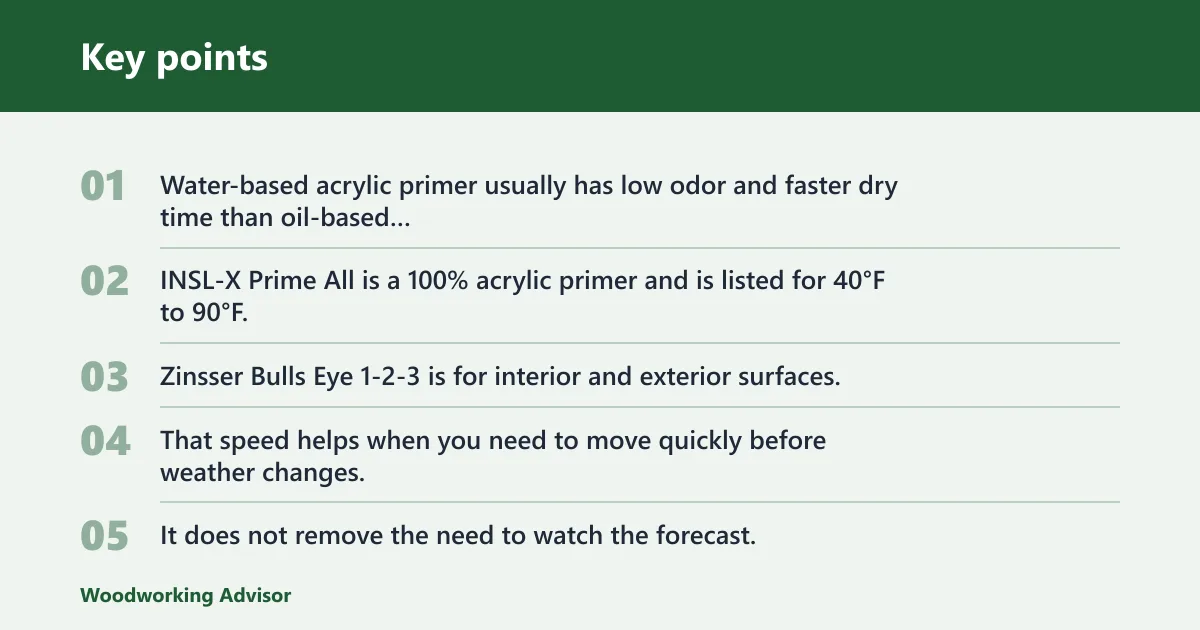
Water-based acrylic primer usually has low odor and faster dry time than oil-based formulas. INSL-X Prime All is a 100% acrylic primer and is listed for 40°F to 90°F. Zinsser Bulls Eye 1-2-3 is for interior and exterior surfaces, dries to the touch in 30 minutes, and is ready to recoat in 1 hour.
That speed helps when you need to move quickly before weather changes. It does not remove the need to watch the forecast. Fast-drying primer can still be too fresh for rain if you miss the recoat window or leave it untopcoated.
Oil-based primer for stain blocking and sealing
Oil-based primer is often chosen for stain blocking, water sealing, and sanding ease. It can be a strong choice on tannin-prone woods or where previous stains need control. It also tends to hold up well as a sealing base before a durable exterior topcoat.
The tradeoff is slower weather readiness on many products. Read the label for application temperature, dry time, and recoat time. Do not assume an oil-based primer is safe for damp wood unless the can says so.
When a damp-surface primer makes sense
A damp-surface primer can be used when the wood is not wet through, such as after dew, light surface moisture, or a short weather delay. Rust-Oleum 312283 Deck Start Wood Primer is designed for decks, fences, docks, and furniture, and it can be applied to damp wood.
It also dries to touch in 1 hour, can be topcoated after 1 to 2 hours, and covers up to 450 sq. ft. That makes it useful for outdoor repairs where waiting for a perfectly dry day is not practical. It is still not a substitute for a proper topcoat.
Say your deck rail has a few damp boards after an overnight shower, but the forecast turns dry by midday. A damp-wood primer can help you start sooner, while a standard primer would force more waiting. The key is to use only the product that explicitly allows that condition.
Can you prime damp wood outdoors?
Yes, but only when the product label allows it and the surface is damp, not soaked. Damp can refer to surface moisture, light dew, or a board that still feels cool and slightly wet after exposure. It should not mean standing water, dark water spots, or wood that is soft and saturated.
Some primers are made for that margin. Rust-Oleum 312283 is one example, and its label use is clear. Most exterior primers are not that forgiving, so do not assume damp wood is acceptable just because the job is outdoors.
What “damp” can mean in product instructions
In practical use, damp usually means the surface has moisture on it but is not dripping. It may also mean wood that has had time to lose visible wetness yet still carries some surface moisture. That is very different from a wet board after rain.
If the surface feels cool and slick, or if water beads remain in grain lines, wait longer. Primer applied too soon can fish-eye, blister, or dry unevenly. That can lead to peeling later.
When damp wood is still too wet to coat
Do not prime if the wood is visibly wet, if water stands in knots or cracks, or if rain is expected before the film can set. Fresh exterior wood also needs care; if it is sopping from pressure washing or recent rain, wait until the surface is ready for the product.
Previously coated wood is different from bare wood. A sound old coating can reduce absorption, while bare boards drink faster and stay vulnerable longer. If the surface is bare and thirsty, a damp-start primer may help, but only within the label rules.
Risks if you prime before the surface is ready
Priming too early can trap moisture, weaken the bond, and leave the finish soft under the film. Rain may then mark the surface, dull the primer, or create visible lap marks. On wood that moves a lot, that weak first layer can lead to peeling later.
A common first-timer mistake is priming a fence after a quick wipe-down, then seeing rain arrive before the next coat. The primer looks dry on top, so it seems safe. The hidden moisture underneath has other plans.
How long before rain after priming?
Touch-dry is not full cure. The safe waiting period depends on the label, the temperature, the humidity, and whether you still need a topcoat. For some fast-dry primers, the next coat can go on in 1 hour; weather safety can still lag behind that timing.
If rain is coming soon, treat the project as a race against cure time. A primer that dries quickly may still need more time before it can face direct rain. If the topcoat is not on yet, the risk is higher.
Touch-dry versus recoat time
Touch-dry means you can touch the surface without leaving a mark. Recoat time means another coat can go on without disturbing the film. Neither number is the same as full cure. That is why a product can be ready for topcoat yet still be vulnerable to rain.
Zinsser Bulls Eye 1-2-3 dries to the touch in 30 minutes and is ready to recoat in 1 hour. Rust-Oleum 312283 dries to touch in 1 hour and can be topcoated after 1 to 2 hours. Those are useful timing marks, but they do not make the primer rainproof by themselves.
Weather exposure risk before full cure
Until cure is far enough along, rain can soften the film or push moisture into the coating. That is especially risky on bare wood, where the primer is the first line of defense. On previously painted surfaces, the risk may be lower, but it is not gone.
If the forecast calls for rain before the primer has had time to cure, stop and cover the area if you can do so without touching the wet surface. If the label permits, a quick recoat or topcoat before the weather turns is better than leaving primer exposed.
What to do if rain is coming soon
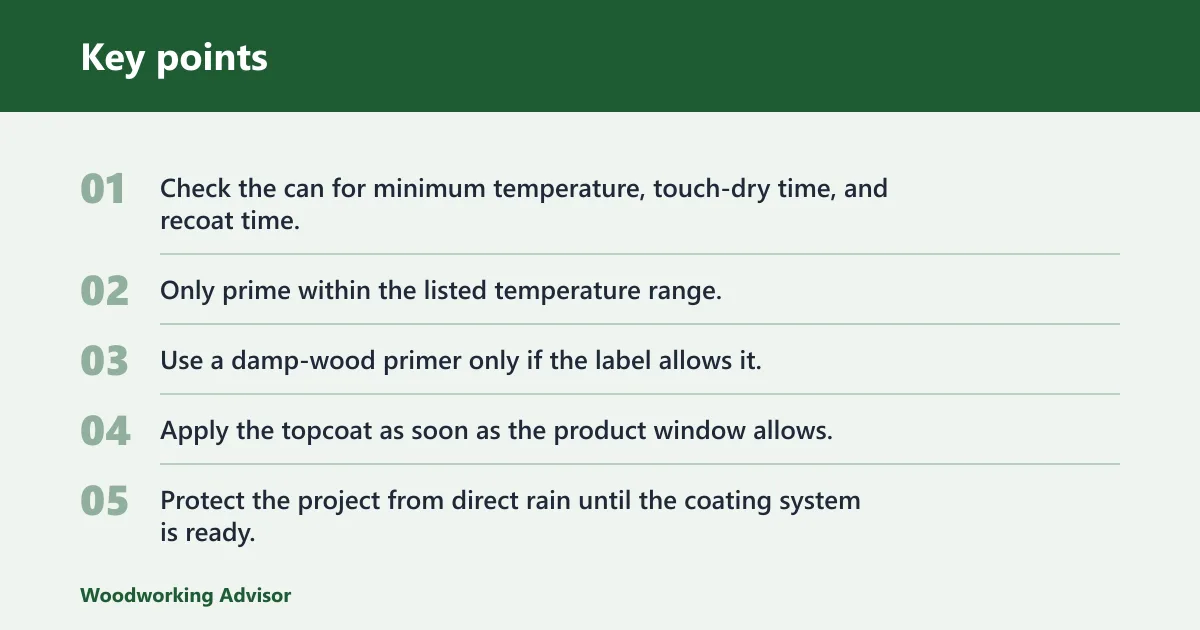
- Check the can for minimum temperature, touch-dry time, and recoat time.
- Only prime within the listed temperature range.
- Use a damp-wood primer only if the label allows it.
- Apply the topcoat as soon as the product window allows.
- Protect the project from direct rain until the coating system is ready.
Suppose you are priming a set of porch steps in the afternoon and rain is due that night. A fast-dry product may get you to recoat on time, but only if you stay within the label’s temperature range and complete the topcoat before the storm. If that is not realistic, wait.
How do you protect wood from rain?
Protect wood from rain by using a clean, dry, properly prepared surface, then applying the right exterior primer and topcoat within the product’s timing window. Primer alone gives short-term moisture resistance; the full coating system gives real outdoor protection. If the forecast is bad, timing matters as much as product choice.
Surface prep is part of the result. Remove dust, loose fibers, chalk, and mildew before priming. Bare wood, previously painted wood, and damp wood each need a different decision. Mixing those conditions up is a fast way to get peeling or blotching.
Protection checklist for outdoor wood
- Identify the surface: bare wood, previously coated wood, or damp wood.
- Choose an exterior primer that fits the wood condition and forecast.
- Stay inside the listed temperature range.
- Respect touch-dry and recoat times, but do not treat them as full cure.
- Apply the topcoat before the primer sits exposed too long.
- Use a mildewcide-containing primer where mildew pressure is high.
Good prep helps every step after it. If the wood is dirty or damp beyond the label allowance, even a strong primer will struggle. If the topcoat is delayed, the primer stays in a risk window longer than it should.
Frequently asked questions
Will primer protect wood from rain?
Primer can protect wood from rain for a short time, but only up to its product limits. It slows moisture entry and helps the next coat bond, yet it is not a finished weather barrier. Direct rain before full cure can still damage the film or mark the wood.
Does exterior primer protect wood from rain?
Exterior primer helps wood resist rain better than bare wood, but it is still only part of the system. It seals pores, improves adhesion, and may add mildew resistance. For outdoor exposure, you still need a topcoat if you want real weather protection.
Does primer protect wood?
Yes, primer protects wood in a limited way by improving adhesion, reducing moisture entry, and helping block stains. That protection is strongest when the primer is matched to the wood condition and followed by a suitable exterior finish. Primer by itself is temporary.
How long does exterior primer need before rain?
There is no single universal wait time. Some products dry to touch in 30 minutes or 1 hour and are ready to recoat in 1 hour, but rain safety depends on cure time and the product label. If rain is near, do not assume the surface is ready.
Sponsored / affiliate links. As an Amazon Associate I earn from qualifying purchases. I may earn additional commission from eligible campaigns.