Does Gorilla Glue Go Bad? Signs It’s Expired
Yes, Gorilla Glue can go bad; if the bottle is past its date, has hardened, or stays grainy and won’t foam after warming and shaking, discard it. Using failed glue weakens joints, wastes clamps and lumber, and can leave a bond that breaks apart later. This guide shows how to tell cold-thickened glue from truly spoiled glue, plus simple checks before you use it.
Does Gorilla Glue go bad?
Yes. “Bad” means the adhesive no longer wets the surface, cures normally, or develops the bond strength the label implies. For Gorilla products, the failure signs depend on the formula: Original Gorilla Glue can thicken, separate, or crust; Super Glue can skin over or harden in the nozzle; Wood Glue can become lumpy or stringy.
Expired bottle or cold bottle: the difference
A cold bottle can look wrong and still be usable. Once it warms to room temperature, the flow may return, especially with Original Gorilla Glue and Gorilla Wood Glue. True failure usually stays visible after warming, shaking, and a clean nozzle test on scrap.
For Original Gorilla Glue, check the texture and how it reacts to moisture. If a bottle stays gritty, rubbery, or partly cured after warming, discard it. If it only thickened in a cold shop, it may recover.
When a scrap test is the right next step
If the adhesive is still liquid but looks off, test it on scrap before trusting it on a project part. That matters most after cold storage, a sticky cap, or a nozzle that has dried at the tip. A scrap test tells you more than color alone.
- Warm the bottle to room temperature.
- Clean the tip and clear any plug.
- Dispense a small bead on scrap.
- Watch whether the glue flows normally and cures as expected.
- Discard it if it stays grainy, separates, or hardens in the bottle or nozzle.
How can you tell if Gorilla Glue has gone bad?
Look for changes that survive warming and cleaning. Thickening alone does not prove failure. Persistent clumps, stringing, crusts, separation, a hardened nozzle tip, or a product that never behaves like its formula should are better signs that the bottle is done.
Texture changes: thickening, clumps, stringing, crusts
Texture tells you a lot. Original Gorilla Glue should still dispense as a usable liquid, not as rubbery bits or a partly cured mass. Super Glue should not leave hardened strings at the opening. Wood Glue should not become lumpy, gelled, or full of dried flakes.
Cap contamination is a common cause. A little cured residue on the threads or nozzle can seed more curing inside the bottle. If you see a hardened tip, clear it before you assume the whole container is bad.
Color and flow changes to watch
Color shift by itself is not always fatal, but major changes are a warning. Watch for separation, unusual clouding, or a product that flows in broken globs rather than a smooth stream. For Original Gorilla Glue, a bottle that no longer foams after normal use is another red flag.
Suppose you open an Original Gorilla Glue bottle and the liquid looks darker than usual, with small gelled bits in the neck. If warming and shaking do not restore a smooth flow, do not rely on it for a load-bearing joint.
What to do before you throw it out
Do not toss a bottle the moment it feels thicker in a cold shop. First warm it to room temperature, clean the cap, and dispense a small amount on scrap. If the product still behaves oddly, or the nozzle remains partially cured, discard it.
Original, Wood, and Super Glue
These products fail in different ways. Original Gorilla Glue is a moisture-activated polyurethane adhesive that expands as it cures, while Gorilla Wood Glue and Gorilla Super Glue cure by different chemistry and storage rules. Treating them the same leads to bad calls about shelf life.
Original Gorilla Glue: polyurethane, moisture-activated, foaming cure
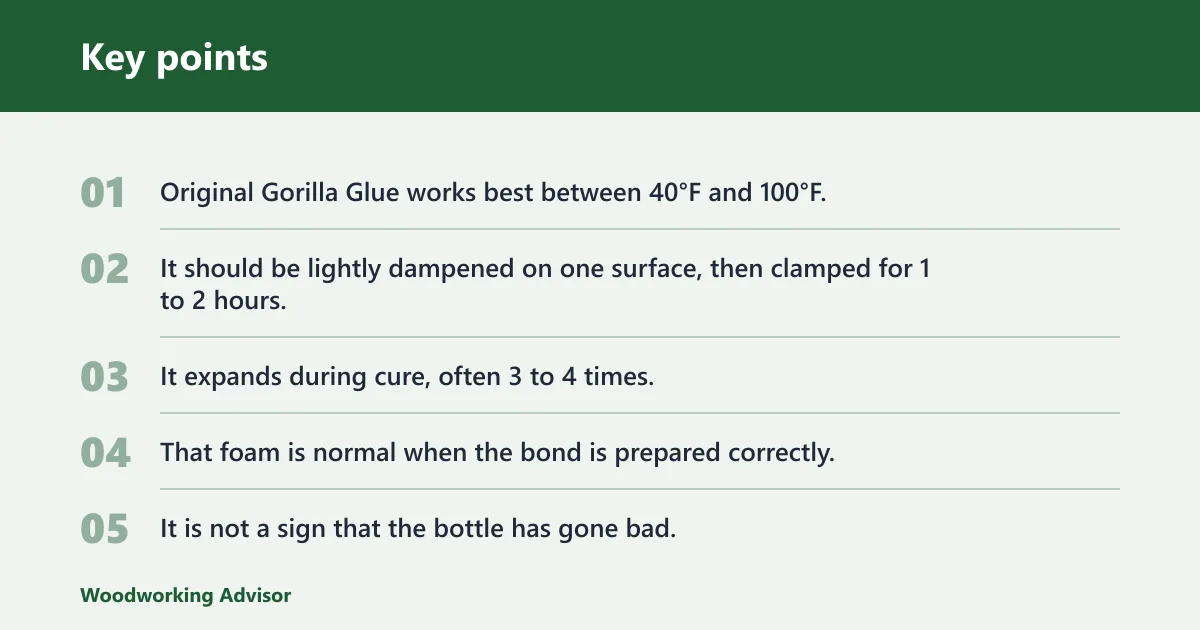
Original Gorilla Glue works best between 40°F and 100°F. It should be lightly dampened on one surface, then clamped for 1 to 2 hours, with full cure in about 24 hours. It expands during cure, often 3 to 4 times, so too much glue or too much water can cause excessive foam.
That foam is normal when the bond is prepared correctly. It is not a sign that the bottle has gone bad. The warning sign is when the glue no longer reacts normally after warming, shaking, and a scrap test.
Gorilla Wood Glue: open time, clamp time, and cure
Gorilla Wood Glue is a wood-to-wood adhesive with a 20 to 30 minute clamp time and a 24 hour full cure. It also has Type II water resistance and stains naturally like wood, so surface prep matters if you want a clean finish line.
If Wood Glue thickens in storage, warm it and test the flow. If it still spreads smoothly and bonds scrap wood normally, it may be fine. If it stays stringy, lumpy, or partially set, replace it.
Gorilla Super Glue: fast set, room-temperature use, storage sensitivity
Gorilla Super Glue dries in 10-45 seconds and is applied at room temperature. It is not gap filling, so a thick, crusted bottle is a bigger problem than with a slower wood glue. Store it in a cool, dry location away from heat and humidity; those conditions can cause premature aging.
Its service temperature ranges from -65°F to 220°F, but storage is the main shelf-life concern. A cap that has been left open in a humid shop can shorten usable life fast. A hardened nozzle or a bottle that skins over inside is usually not worth saving.
Gorilla Glue decision table
This table separates a cold or contaminated bottle from one that should be discarded. When in doubt, warm the product first, clean the tip, and test on scrap before you trust a real joint.
| Product type | Normal appearance | Warning signs | Quick recovery step | Discard threshold |
|---|---|---|---|---|
| Original Gorilla Glue | Liquid that dispenses smoothly; foams during cure; works best with light moisture | Grainy texture, separation, crusting at the tip, no normal foam after warming, rubbery bits in the bottle | Warm to room temperature, shake gently, clear the nozzle, then test on scrap with a slightly damp surface | Still grainy, partially cured, or unable to flow normally after warming and cleaning |
| Gorilla Wood Glue | Smooth wood-to-wood glue with normal flow and a 20 to 30 minute clamp window | Lumps, stringing, skinning in the bottle, hardened nozzle, persistent separation | Warm it, clean the cap, and check spreadability on scrap wood | Clumpy, gelled, or hardened in the bottle or nozzle after warming |
| Gorilla Super Glue | Thin liquid, fast set, room-temperature application | Skins over, strings at the tip, cloudy residue, hardened plug, slow or uneven set | Store cool and dry, clear the tip, and test a tiny drop on scrap | Hardened in the bottle, or still fails to bond after a small scrap test |
How long does Gorilla Glue last once opened?
Opened bottles last as long as their storage conditions allow. Cool, dry storage with the cap sealed helps all three products. Air exposure, humidity intrusion, and contaminated caps shorten usable life, especially for Original Gorilla Glue and Gorilla Super Glue.
Storage conditions that shorten usable life
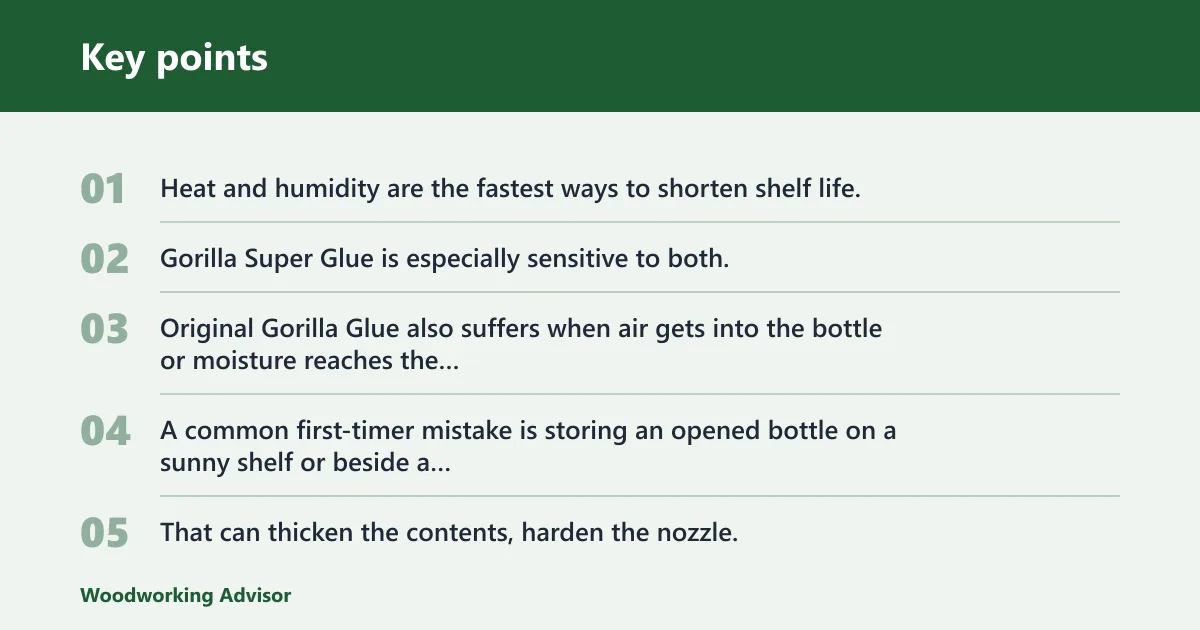
Heat and humidity are the fastest ways to shorten shelf life. Gorilla Super Glue is especially sensitive to both. Original Gorilla Glue also suffers when air gets into the bottle or moisture reaches the neck and cures material inside the cap.
A common first-timer mistake is storing an opened bottle on a sunny shelf or beside a heater. That can thicken the contents, harden the nozzle, or create partial cure inside the container long before the glue is truly used up.
How cap sealing and air exposure change the bottle
A poor seal lets oxygen, humidity, and dust work into the opening. That can lead to crusts, skinning, or cured particles that fall back into the bottle. Clean threads matter. A dirty cap can make a still-usable bottle act expired.
For Original Gorilla Glue, air exposure plus humidity can create a bottle that looks fine at first but fails in use. For Super Glue, even brief exposure around a humid bench can trigger premature aging. For Wood Glue, repeated opening and closing can thicken the product and contaminate the nozzle.
How to recover cold-thickened glue
Move the bottle to room temperature and give it time to normalize before judging it. Then clean the tip, shake or knead as the label allows, and dispense a small amount on scrap. If the glue returns to normal flow, it may still be usable.
Do not thin these products with random solvents. That can ruin the bond chemistry. If the bottle remains cloudy, gritty, or partially cured after warming, replace it.
What affects cure time and bond strength?
Cure time is not the same as shelf life. Temperature, humidity, surface porosity, and clamp time change how a fresh bond behaves, but they do not explain a bottle that has gone bad. You need both checks: product condition and application conditions.
Temperature, humidity, and surface porosity
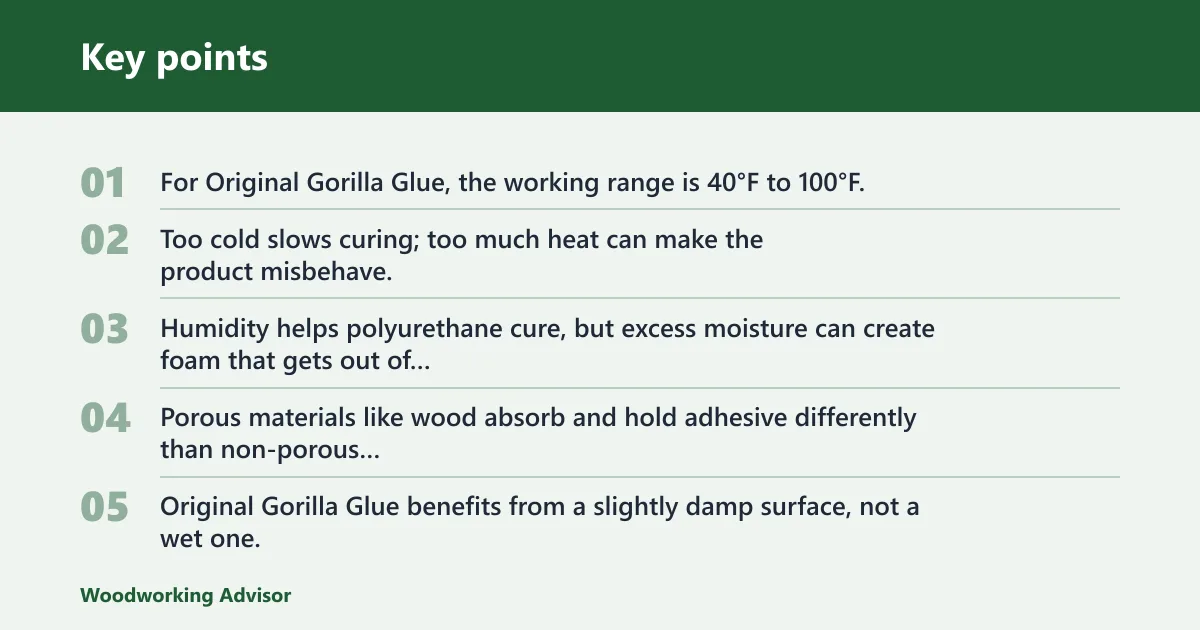
Temperature changes cure speed. For Original Gorilla Glue, the working range is 40°F to 100°F. Too cold slows curing; too much heat can make the product misbehave. Humidity helps polyurethane cure, but excess moisture can create foam that gets out of control.
Porous materials like wood absorb and hold adhesive differently than non-porous materials like metal or plastic. Original Gorilla Glue benefits from a slightly damp surface, not a wet one. Too much water can cause excessive foaming and weaken the joint line.
Why light moisture helps Original Gorilla Glue
Original Gorilla Glue needs moisture to cure, so a light dampening on one surface helps it react. That is different from soaking the joint. On porous material, a thin damp film is usually enough. On non-porous material, excess moisture can sit on the surface and create foam instead of a tight bond.
Picture a chair repair on bare hardwood. A light wipe with a damp cloth on one mating surface can help the adhesive cure. If you pour on water, the joint may foam out and leave less solid adhesive where the wood actually meets.
Clamp time, handling strength, and full cure
Clamp time is only the first stage. Handling strength comes before full cure, and neither means the joint is ready for hard use. Original Gorilla Glue should be clamped for 1 to 2 hours, but do not stress the bond before 24 hours. Gorilla Wood Glue needs 20 to 30 minutes of clamping and also reaches full cure in 24 hours.
Some competitors cite 1 to 2 hours as a clamp window, and that is useful as a starting point. It is not the same as full strength. If you remove clamps too early or load the joint before full cure, the bond can creep or fail later.
Frequently asked questions
Does Gorilla Glue expire?
Yes, Gorilla Glue can expire in the practical sense that it stops performing as intended. Shelf life depends on the formula, storage, and how often air and humidity reach the bottle. A product that is hardened, crusted, or still grainy after warming should be treated as expired.
Does gorilla wood glue go bad?
Yes. Gorilla Wood Glue can go bad if it skins over, turns lumpy, or develops a hardened nozzle. Warm it to room temperature first, then check whether it still spreads smoothly on scrap wood. If the glue remains stringy or partially cured, replace it.
Does gorilla Super Glue go bad?
Yes. Gorilla Super Glue is sensitive to heat and humidity, so storage matters a lot. It should be kept in a cool, dry location. If the bottle skins over, hardens in the tip, or stops setting normally after a small scrap test, discard it.
How do you tell if Gorilla Glue has gone bad?
Look for signs that remain after warming and cleaning: hardened tips, persistent graininess, clumps, separation, stringing, or a bottle that no longer behaves like its formula should. If a scrap test still fails after room-temperature recovery, the glue is not worth using on a real joint.
Is Gorilla Glue permanent?
Once fully cured, these adhesives are intended for durable bonds, but “permanent” does not mean indestructible or suitable for every joint. Surface prep, clamp time, and full cure still matter. A weak or contaminated bond can fail even if the label says the glue cures hard.
Sponsored / affiliate links. As an Amazon Associate I earn from qualifying purchases. I may earn additional commission from eligible campaigns.