Shellac vs Lacquer: Which Finish Should You Choose?
Choose Shellac for fast drying, spot repairs that blend, and strong compatibility as a sealer or barrier coat. Choose Lacquer for a harder film and a finish schedule built for production work, especially on furniture and trim. Pick the wrong finish and you can get finish failures, stain bleed-through, or repairs that never blend cleanly. This guide compares shellac and lacquer by compatibility, repairability, drying, durability, and topcoat options so you can match the finish to the project.
| Factor | Shellac | Lacquer | Winner |
|---|---|---|---|
| Drying and recoat speed | Quick to dry; a common shellac workflow uses a 2-pound cut for a full finish, and lighter cuts for sealing. | Quick-drying solvent-based finish; suited to fast production coats. | Tie |
| Repairability | Easy to spot-repair because fresh shellac can melt into previous shellac layers. | Can be repaired, but blending patches is usually less forgiving than shellac. | Shellac |
| Moisture and wear resistance | Sensitive to water and high humidity; better for light-to-moderate duty. | Forms a protective film and is generally the better pick for higher-use surfaces. | Lacquer |
| Compatibility as an undercoat | Dewaxed shellac can accept polyurethane, lacquer, water-based finishes, and paint. | Acts as a topcoat, but is less useful as a universal barrier layer. | Shellac |
Shellac vs lacquer: the core trade-off
Shellac wins when compatibility, sealing, and repair matter most. Lacquer wins when you want a harder film and a fast, repeatable finish schedule. That trade-off matters more than sheen. The right choice depends on future touch-ups, moisture exposure, and how fast you need to move from coat to coat.
What shellac
Shellac is made from resin secreted by lac insects and dissolved in denatured alcohol. It is easy to apply, quick to dry, and available in clear or amber tones. It also comes in waxed and dewaxed forms, and that difference changes what can go over it.
What lacquer
Lacquer is a quick-drying, solvent-based wood finish that leaves a protective film and often a high-gloss appearance. It is commonly grouped with varnish and polyurethane in shop comparisons because the choice often comes down to film strength, drying speed, and the job’s repair needs.
The choice between repairability and film durability
Shellac is the better repair-first finish. Lacquer is the better film-first finish for wear. If the surface may need future patching, shellac’s reactivation with alcohol is a clear advantage. If the surface will see more handling or needs a tougher build, lacquer usually makes more sense.
Is shellac or lacquer better for furniture?
For furniture, lacquer is usually better when the goal is a harder, more durable film on a high-use surface. Shellac is often the better furniture choice when you need fast turnaround, stain control, or easy future touch-up. The right answer changes with the piece. A dining table, a cabinet door, and an antique side table do not need the same finish behavior.
Furniture that needs fast turnaround
Lacquer fits production furniture because it dries fast and supports quick coat sequencing. Shellac also dries fast, but lacquer is usually the better fit when the priority is building a more durable film across many parts in less time.
Furniture that may need future spot repair
Shellac is the stronger choice for spot repair. Small burn-throughs, a rubbed edge, or a water ring on a low-wear piece are easier to blend when the finish can be reactivated and feathered into the old layer.
When appearance matters more than moisture resistance
Shellac is a strong match for decorative furniture, antiques, and pieces where you want a clear or warm amber look without a heavy film. Picture a 12-inch keepsake box on a bedroom shelf: shellac gives you fast dry time and easy touch-up, while the lower moisture demand keeps the choice sensible.
Which finish dries faster?
Both dry fast, but shellac is usually the faster, simpler finish to recoat in a small-shop workflow. Lacquer also dries quickly, which is why it is common in production finishing, yet shellac often feels easier to manage because you can brush or wipe it on and recoat with less overspray planning. The practical difference is workflow control, not just clock time.
Shellac drying speed and recoat timing
Shellac is described as quick to dry, and a common approach is to wait at least 30 minutes after the first coat before moving on. A thinner shellac mix can act as a light sealer before staining, which helps keep the process moving without loading on too much material too early.
Lacquer drying speed and overspray window
Lacquer also dries quickly, but it is usually used as a sprayed system. That means you must manage atomization, overspray, and recoat conditions more tightly than with shellac in many trim or furniture jobs.
How drying time affects sanding and workflow
Fast drying can reduce sanding waits, but it can also punish poor prep. Shellac typically needs light intercoat sanding to knock down raised grain, and about 400-grit sandpaper or #0000 steel wool are common options for that step. A common first-timer mistake is rushing the second coat before the first has leveled enough, then sanding through the film at an edge.
Can you use shellac as a sealer under lacquer?
Yes, dewaxed shellac is a common sealer under lacquer. Dewaxed shellac works well as a universal adhesion primer because it accepts lacquer, polyurethane, water-based finishes, and paint. The key rule is simple: use dewaxed shellac when you want the undercoat to stay compatible with future finishes.
Dewaxed shellac as an adhesion primer
Dewaxed shellac contains very little wax, which is why it is often useful as a barrier coat. It can help seal knots, reduce stain bleed-through, and create a consistent surface before lacquer or other topcoats.
Waxed shellac no-go combinations
Waxed shellac contains 3–5% natural wax. It is fine as a standalone finish, but it should not go under polyurethane or varnish, and it is a poor choice when you want broad topcoat compatibility. If the next coat must bond reliably, wax becomes the problem.
Where lacquer over shellac can fail
The failure mode is usually adhesion, not color. If shellac still contains wax, or if the shellac film was contaminated or poorly cured, lacquer can fish-eye, bead, or lose grip. Always check the label for dewaxed shellac when the plan is to topcoat with another film finish.
Shellac lacquer decision table
| Scenario | Recommended finish | Reason | Red flags |
|---|---|---|---|
| Antique repair | Shellac | Blends well, repairs cleanly, and can be feathered into existing shellac. | Do not assume the old finish is shellac without a scrap test. |
| Decorative box | Shellac | Fast dry time and a clean clear-to-amber look suit low-wear display pieces. | Skip it if the box will live in a damp room or see heavy handling. |
| Kitchen cabinet touch-up | Lacquer | Better fit for a tougher film on a high-use surface that gets frequent wiping. | Check compatibility with the existing coating before spot spraying or brushing. |
| Tabletops | Lacquer | More practical when the top must handle wear, spills, and repeated cleaning. | Shellac can soften with water and humidity, so avoid it for demanding tabletops. |
| Trim | Lacquer | Fast production finishing and a harder film suit baseboards, casings, and doors. | Watch for overspray and match the existing finish system. |
| Stained pine | Shellac | A thin shellac coat can seal and control blotching before stain or topcoat work. | Use dewaxed shellac if another finish will go on top. |
| High-humidity room | Lacquer | Shellac is sensitive to water and high humidity, so lacquer is the safer film choice. | Avoid shellac on bathroom trim, laundry areas, or similar damp spaces. |
| Prefinished topcoat compatibility | Shellac | Dewaxed shellac is the better bridge coat when you need strong adhesion over uncertain surfaces. | Waxed shellac is a no-go under polyurethane or varnish. |
Suppose you are touching up a maple cabinet door with a small burn mark near the handle. Shellac is the better fix if you need a small repair to disappear into the old film. If the same door sits in a busy kitchen and gets wiped daily, lacquer becomes the safer long-term film choice.
A common first-timer mistake is choosing shellac for a bathroom vanity because it dries quickly. The finish may look fine at first, then high humidity and repeated splash exposure make the surface less reliable than a lacquer film would be.
Shellac and lacquer in practical repair work
Shellac is easier to blend into older shellac and is often the safer choice when you do not know exactly what is already on the wood. Lacquer can be repaired, but the margin for clean spot blending is usually smaller. That matters on trim, antique edges, and cabinet faces where a patch must disappear.
Drying-window speed, sanding burden, and recoat friction
Shellac usually asks for less equipment and less recoat friction. You can apply it with a cloth, a brush, or both, and a scrap test is smart before full application to check consistency and wiping behavior. Lacquer can move faster on a schedule, but it often shifts the burden to spray control and surface prep.
Choose Shellac if… / Choose Lacquer if…
Choose Shellac if the project needs barrier-coat compatibility, fast spot repair, or a thin finish on furniture, antiques, decorative boxes, or stained pine. Choose Lacquer if the surface will see more wear, the room has more moisture, or you want a harder film on tabletops, trim, and production furniture.
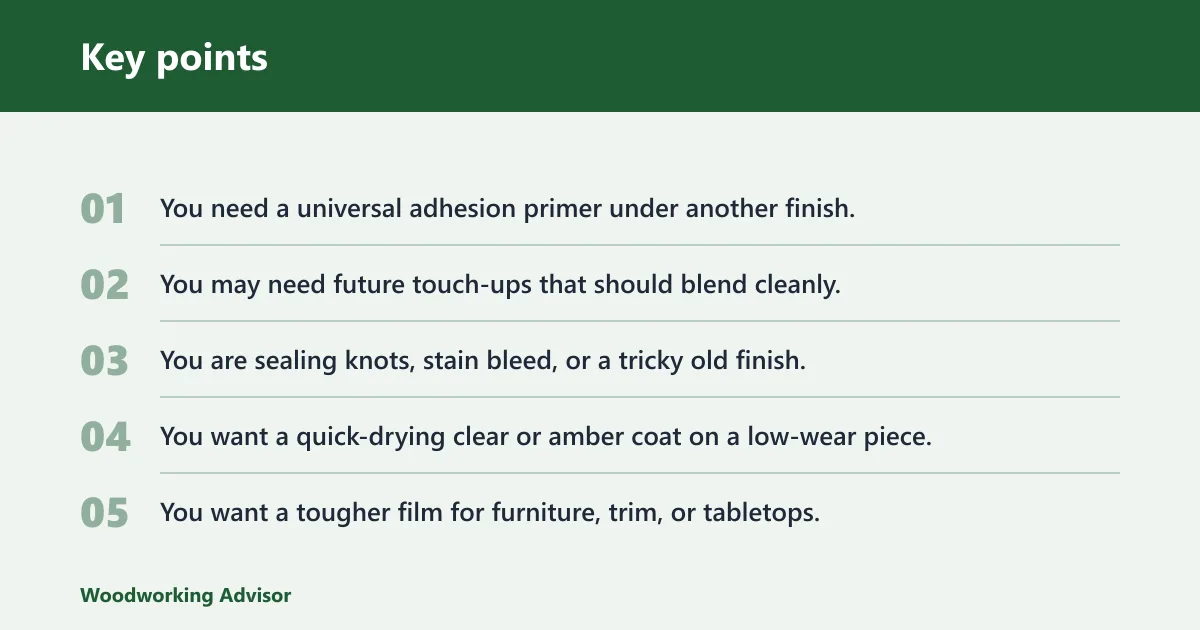
Choose Shellac
- You need a universal adhesion primer under another finish.
- You may need future touch-ups that should blend cleanly.
- You are sealing knots, stain bleed, or a tricky old finish.
- You want a quick-drying clear or amber coat on a low-wear piece.
Choose Lacquer
- You want a tougher film for furniture, trim, or tabletops.
- You are finishing in a workflow that rewards fast production coats.
- The room has more humidity, splash risk, or frequent cleaning.
- You need a glossy protective coat and are prepared to match the existing system.
Red flags that should override the default choice
If the existing finish is unknown, test on scrap before proceeding. If you plan to topcoat shellac with polyurethane or varnish, use dewaxed shellac only. If the project is exposed to moisture, heat, or heavy wear, shellac should lose to lacquer unless repairability is the main priority.


Shellac forms
| Shellac form | Wax content | Best use cases | Topcoat compatibility | No-go combinations |
|---|---|---|---|---|
| Waxed shellac | 3–5% natural wax | Standalone finish on decorative work, simple clear coats, and quick low-wear projects. | Limited; use as the final coat, not as a universal base layer. | Do not use under polyurethane or varnish. |
| Dewaxed shellac | Below 0.5% wax | Barrier coat, sealer, stain blocker, and adhesion primer before multiple topcoats. | Accepts polyurethane, lacquer, water-based finishes, and paint. | Avoid assuming any shellac is dewaxed unless the label says so. |
For shellac work, the mix matters. A 2-pound cut is a common full-finish ratio, while thinner cuts are used as light sealer coats before staining. Denatured alcohol is the solvent for shellac, and it is flammable during application, so ventilation and careful handling matter.
Before committing to a piece, do a scrap test. That check is useful for shellac consistency, wiping behavior, and whether the mix leaves a sticky surface or a clean dry film. It is a small step that can prevent a bad bond or a blotchy result.
Frequently asked questions
What is the difference between shellac and lacquer?
Shellac is a natural resin finish dissolved in denatured alcohol, while lacquer is a quick-drying solvent-based finish used on wood surfaces. Shellac is better for repairability and sealing; lacquer is better when you want a harder film and a more production-friendly finishing schedule.
Which finish dries faster, shellac or lacquer?
Both dry quickly, but shellac is often easier to manage in small-shop work because it can be wiped or brushed on and recoated with little delay. Lacquer is also fast, especially in spray work, but the process usually depends more on equipment, dust control, and overspray management.
Is shellac more durable than lacquer?
No. Lacquer usually gives you the better protective film for wear and handling, while shellac is more sensitive to water and high humidity. Shellac’s strength is repairability and compatibility, not maximum durability in wet or high-wear settings.
What is the difference between waxed and dewaxed shellac?
Waxed shellac contains 3–5% natural wax and is best used as a standalone finish. Dewaxed shellac has wax content below 0.5% and is the version you want when another finish must bond over it, including polyurethane, lacquer, water-based finishes, or paint.
Should I choose shellac for decorative wood only?
No. Decorative pieces are a good fit, but shellac also earns its place as a sealer, stain blocker, and compatibility layer under other finishes. Choose it when repairability and topcoat flexibility matter more than moisture resistance or heavy wear protection.
Does lacquer resist water better than shellac?
Yes. Shellac is sensitive to water and high humidity, so lacquer is usually the safer choice for rooms and surfaces exposed to moisture. That difference matters on tabletops, cabinets near sinks, and trim in damp spaces where finish failure would be costly.
Sponsored / affiliate links. As an Amazon Associate I earn from qualifying purchases. I may earn additional commission from eligible campaigns.