Traeger Wood Pellet Grill Review: Pros and Cons
Traeger pellet grills are worth the premium if you want dependable app control, broad dealer support, and strong resale value. Budget buyers should usually skip them because comparable pellet cookers cost less and cook about the same. Paying extra for the badge without needing those extras can leave you with higher ownership costs and no better barbecue. This review breaks down the pros, cons, warranty, repair costs, and which buyers should choose Traeger or look elsewhere.
For buyers who want wood-fired flavor with steadier temperature control, Traeger makes sense. For buyers who mainly want the lowest cost per cook, the brand’s top tiers are harder to justify.
Traeger wood pellet grill verdict

Pros and cons
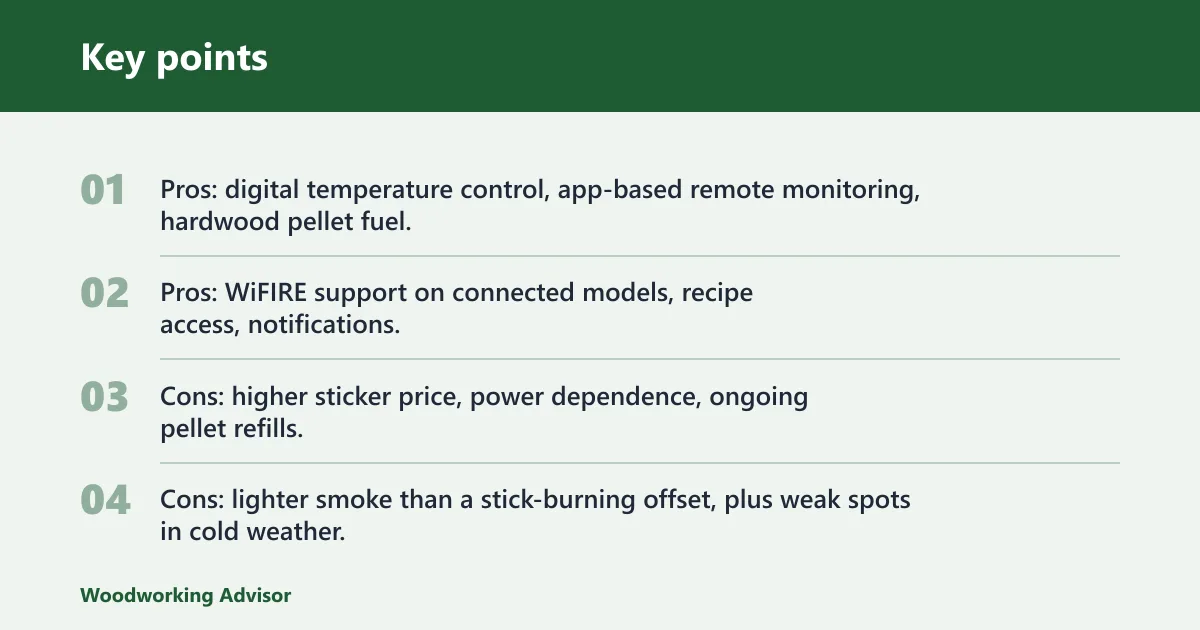
- Pros: digital temperature control, app-based remote monitoring, hardwood pellet fuel, wide cooking space on higher tiers, and easier low-and-slow cooking than a traditional charcoal setup.
- Pros: WiFIRE support on connected models, recipe access, notifications, and controller settings in the app.
- Cons: higher sticker price, power dependence, ongoing pellet refills, and a cleanup routine that takes more attention than a gas grill.
- Cons: lighter smoke than a stick-burning offset, plus weak spots in cold weather, searing, and portability.
Traeger ownership cost and fit
The real cost of a Traeger is not the sticker alone. You also pay for hardwood pellets, electricity, cleanup time, and occasional maintenance when ash, grease, or probes cause trouble.
| Model | Purchase price tier | Pellet consumption assumption | Electricity dependence | Cleanup burden | Cold-weather risk | Best-use scenario |
|---|---|---|---|---|---|---|
| Woodridge | Mid-range entry | Moderate for typical weeknight cooks; pellets refilled during longer cooks | Must be plugged in for ignition, auger, fan, and controller | Lower than older ash-pan designs because of the EZ-Clean Grease and Ash Keg, but still requires ash and grease checks | Moderate; temperature swings can grow in wind and sustained cold | First-time buyer who wants app control, broad cooking space, and a lower step into Traeger ownership |
| Woodridge Pro | Upper mid-range | Similar fuel behavior to the base Woodridge, with the same pellet dependence | Same power dependence as other pellet grills | Similar routine, with added attention to pellet supply because of larger cooking plans | Moderate; better as a premium family cooker than as a winter cure-all | Buyer who wants Super Smoke Mode, a pellet sensor, and a longer warranty |
| Timberline 1300 | High premium tier | Higher total use is likely on large cooks because of the 1,300 square inches of space | Requires electricity for all controller functions | More surfaces to clean, more grease to manage, and more time spent keeping probes and internals clear | Moderate to high if used in harsh winter conditions without shelter or insulation help | Large-batch cooking, frequent entertaining, and buyers who accept premium pricing for capacity and connected control |
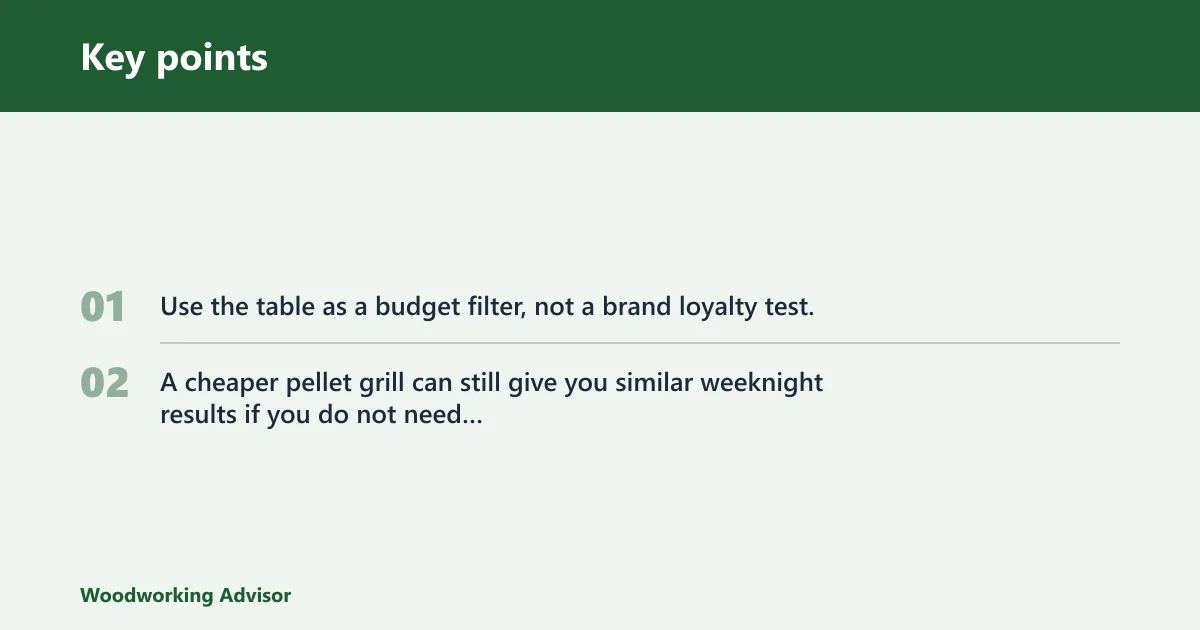
Use the table as a budget filter, not a brand loyalty test. A cheaper pellet grill can still give you similar weeknight results if you do not need the app, the dealer network, or the larger cooking area of the higher tiers.
Traeger pellet grills work
Traeger grills typically use hardwood pellets, digital temperature control, and an electric auger system to feed fuel into the fire pot. That setup gives you easier low-and-slow cooking than a charcoal pit, but it also means the grill needs power and repeated pellet refills during long sessions.
What the cooking cycle changes
The controller meters pellets, a fan keeps air moving, and the fire pot burns on a cycle that keeps cabinet temperature steadier than a live-fire pit. That is why these grills are often described as set-and-forget cookers.
Set-and-forget is real, but it has limits. A pellet grill does not behave like an offset smoker with heavy blue smoke and a firebox you tune by feel. It is easier to run, yet more dependent on electronics, clean airflow, and dry fuel.
Traeger’s connected models add WiFIRE app control. Carnivore Style describes Traeger grills as using wood pellets and digital control to aid consistency, and that is the right basic idea for buyers comparing them with simpler smokers.
What do you get from the app?
The Traeger app adds remote monitoring, temperature changes from your phone, recipe access, notifications, and firmware or settings controls. That does not replace good prep, but it does make it easier to check a brisket, adjust a cook, or catch a temperature alert without standing by the grill.
Where app control helps most
App control is most useful on long cooks, such as pork shoulder, brisket, or ribs that run for hours. It is less useful for quick weeknight grilling, where you can open the lid and check the food directly.
A common first-timer mistake is assuming the app removes all attention from the cook. It does not. It cuts down trips outside, but the grill still needs pellets, power, and a clear burn path.
Which Traeger model fits you?
Choose the Woodridge if you want the current base model with app control, 860 square inches of cooking space, a 180-500°F range, six cooking methods, and the EZ-Clean Grease and Ash Keg. Choose the Woodridge Pro if you want Super Smoke Mode, a pellet sensor, a 10-year warranty, and more cooking space than the base Woodridge. Choose the Timberline 1300 if you need 1,300 square inches, a 24-pound hopper, and premium connected control.
Woodridge
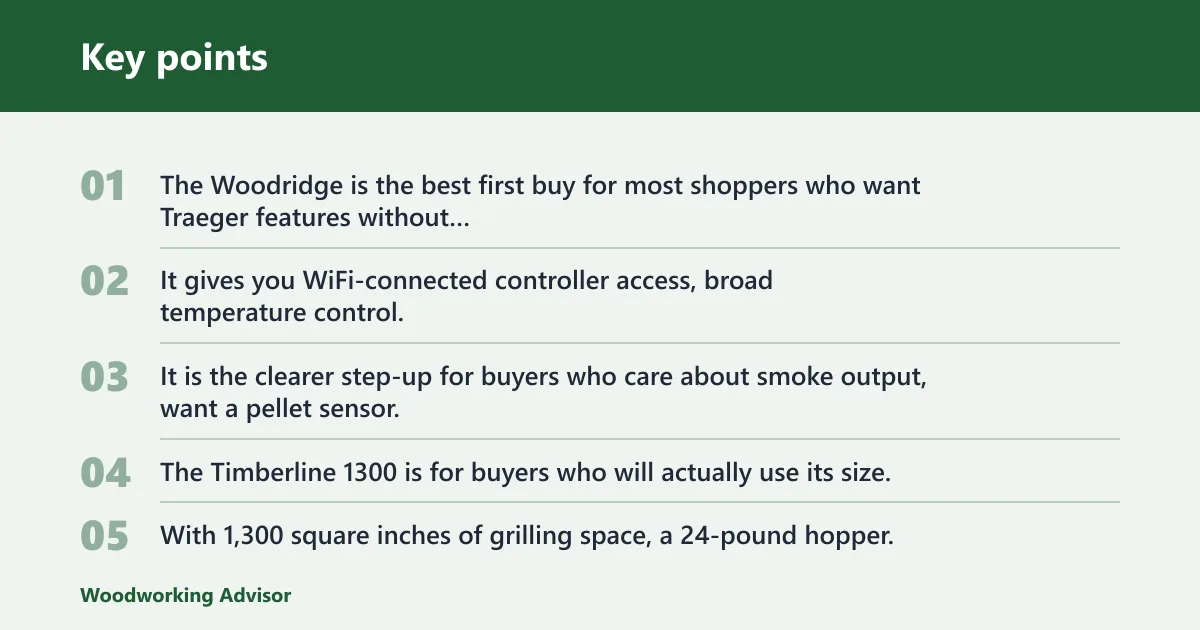
The Woodridge is the best first buy for most shoppers who want Traeger features without jumping straight into premium pricing. It gives you WiFi-connected controller access, broad temperature control, and enough space for family cooks, but it does not have Super Smoke Mode.
Woodridge Pro
The Woodridge Pro sits in the middle. It is the clearer step-up for buyers who care about smoke output, want a pellet sensor, and value the 10-year warranty more than a lower entry price.
Timberline 1300
The Timberline 1300 is for buyers who will actually use its size. With 1,300 square inches of grilling space, a 24-pound hopper, Wi-Fi control for temperatures and timers, and Super Smoke, it is a premium option aimed at larger cooks rather than casual patio use.
Suppose you cook two racks of ribs once a month and a few chickens on weekends. The Woodridge should cover that. If you regularly cook for a crowd, the Timberline 1300 makes more sense, but only if you are prepared for the price premium and the larger cleanup load.
What features separate the Woodridge, Ironwood, and Timberline lines?
The Woodridge is the entry point, the Woodridge Pro moves into a stronger mid-range position, and Timberline sits at the premium end with the most capacity and the highest price. The practical split is not only size; it is also warranty, smoke mode, pellet management, and how much cooking volume you truly need.
Woodridge versus Woodridge Pro
The Woodridge Pro adds Super Smoke Mode, a pellet sensor, and a 10-year warranty. The base model lacks Super Smoke Mode.
Ironwood in context
Traeger’s line structure can shift over time, so shoppers comparing old stock should confirm the exact model label and feature set before paying a premium. If a retailer lists an older Ironwood or a carryover unit, compare the controller, hopper, app support, and warranty carefully against the current Woodridge and Timberline models.
Timberline versus the lower tiers
Timberline is the line that asks for the highest budget and, in return, gives the most room and a premium feature set. It is not the best answer for every buyer, and it is not the most efficient choice if you only cook for a few people at a time.
How hard is cleanup and maintenance?
Cleanup is manageable, but it is not trivial. You still need to deal with ash management, grease management, pellet storage, unused pellets, and the occasional problem from a jammed auger or a probe that reads poorly.
Ash and grease management
Traeger’s cleanup systems help, especially on the Woodridge with its EZ-Clean Grease and Ash Keg. Even so, ash overflow can still happen if you let the grill run too long without checking it, and grease buildup can smoke or create a mess if the tray and drain are ignored.
Pellet storage and jam risk
Pellets need to stay dry. A damp bag can swell, bridge in the hopper, or feed badly into the auger. Emptying unused pellets matters when the grill will sit for a while, especially in humid weather or during a long off-season break.
Probe and controller issues
Probe inaccuracies can lead to undercooked or overcooked food if you trust them blindly. A separate instant-read thermometer is still useful. Say your grill holds 250°F on the controller but the food probe reads strangely high; the fix may be as simple as checking probe placement and cleaning the sensor before you start the next cook.
How much smoke flavor do Traeger pellet grills really produce?
Traeger grills produce wood smoke flavor, but it is usually lighter than what you get from a stick-burning offset smoker. That tradeoff is part of the appeal: less fire management, less soot, and more temperature control, with a milder smoke profile than traditional offsets.
What affects smoke level
Smoke output depends on pellet quality, cook temperature, airflow, and how long the food stays in the pit. Super Smoke Mode on the Woodridge Pro and Timberline can increase smoke character, but it does not turn a pellet grill into an offset.
Picture a pork shoulder running at 225°F on a cold day. The grill can still deliver good smoke flavor, but the cabinet has to work harder to stay steady, and the smoke profile will remain cleaner and lighter than a stick burner.
Do Traeger grills hold temperature well in cold weather?
Traeger grills can hold temperature in cold weather, but performance depends on body construction, wind exposure, and how hard the controller has to work. A sheltered patio helps. Bitter wind and low ambient temperatures can make recovery slower, especially on larger, less insulated grills.
What changes in winter
Cold air pulls heat from the cabinet and can lengthen warm-up and recovery times after lid openings. Pellet consumption may also rise because the grill must feed more fuel to stay on target, though the exact amount depends on the model and conditions.
Do not assume every pellet grill behaves the same in winter. A covered patio in a mild climate is very different from an exposed deck in freezing wind. Premium pricing does not erase physics.
Do Traeger grills need electricity to run?
Yes. Traeger grills need electricity to run because the controller, auger, fan, ignition system, and any app-connected functions depend on power. If power is interrupted, the grill cannot keep feeding pellets the way it should.
Why power matters
Electricity is part of the convenience package. It also creates a limit. If you want a cooker that can run off-grid, a pellet grill is the wrong category.
How much does ownership really cost?
Beyond the sticker price, the ongoing bill comes from pellets, electricity, and maintenance time. Wood pellets are sold in 20-pound bags and come in different wood species, so your fuel choice also changes flavor. A premium model can cost more to buy and more to maintain even if the food quality is good.
What to budget
- Pellets: plan on repeated refills for long cooks, especially on larger models.
- Power: keep the grill on a live outlet every time you cook.
- Cleanup: set aside time for ash and grease management after several cooks.
- Maintenance: inspect probes, hopper contents, and the auger path before trouble starts.
Who it’s for
Traeger suits buyers who want wood-fired flavor, digital control, app monitoring, and a familiar dealer-backed brand. It is a weaker fit for shoppers who want the cheapest pellet cooker available, who need off-grid use, or who care more about searing and portability than about low-and-slow convenience.
Best fit
Buyers moving from charcoal or gas to pellet cooking often appreciate the lower learning curve. The Woodridge is the cleanest entry point, while the Woodridge Pro is the better step-up if you want stronger smoke settings and a longer warranty.
Skip the Timberline premium tier if you do not cook for large groups, if you will rarely use the extra space, or if you are mainly paying for the badge. Also skip the brand if your priority is the lowest long-term cost and you are comfortable giving up app control and dealer support.
Frequently asked questions
Is a Traeger wood pellet grill worth the money?
Traeger is worth the money if you value app control, broad dealer support, and a familiar ownership experience more than the lowest purchase price. If you mainly want similar pellet-grill performance for less money, the premium tiers are harder to defend.
What are the pros and cons of Traeger pellet grills?
The main pros are temperature control, wood-fired flavor, app support, and easier low-and-slow cooking. The main cons are price, power dependence, pellet refills, cleanup, and lighter smoke than a stick-burning offset.
Which Traeger model is best for a first-time buyer?
The Woodridge is the safest first buy for most new shoppers.
Which Traeger has the best value for the price?
The Woodridge often has the best value for most buyers because it covers the essential Traeger experience without the premium jump of Timberline. The Woodridge Pro becomes the better value only if Super Smoke Mode, the pellet sensor, and the 10-year warranty matter enough to justify the higher tier.
Sponsored / affiliate links. As an Amazon Associate I earn from qualifying purchases. I may earn additional commission from eligible campaigns.