What Angle to Cut Wood for an Octagon? 22.5 Degrees + Chart
Set your miter saw to 22.5 degrees. That is the angle for every cut when you build a flat, eight-sided octagon from eight equal boards.
That one number hides three traps that make octagons come out with gaps. The 22.5 sits on the saw scale, not on your protractor, which reads 67.5 from the board edge. It only applies when the boards lie flat, like a frame or table apron, and it changes as soon as the sides lean outward, like a planter or a gazebo roof. And the side-length formula most people copy only works if you measure corner to corner. This page covers each trap with the numbers.
The Short Answer: 22.5 Degrees on the Saw Scale
Best Angle Finder for Octagon Cuts
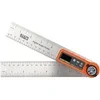 |
Klein Tools 935DAF Digital Angle Finder, $39.98 Octagon joints only close if the saw really sits at 22.5 degrees. This finder reads to within 0.2 degrees and can calculate miter saw settings, so you can check the saw before the first cut.
|
A regular octagon has eight corners of 135 degrees each. Each corner is made of two boards, so each board end takes half of the 45 degrees by which the outline turns at that corner: 45 ÷ 2 = 22.5 degrees. Set the saw table to 22.5 degrees (blade vertical, bevel at zero), cut one end, swing the saw to the other side for the opposite end, and repeat for all eight boards.
The confusion is the measuring tool. Hold a protractor or angle finder against a finished mitered end and it reads 67.5 degrees between the cut face and the board edge (90 − 22.5). That is the same cut, just measured from the other side. If you set a saw to 67.5 you will cut the wrong joint entirely. Always set the saw scale, and use the angle finder to confirm that the scale is honest.
Octagon Angle Chart for Woodworkers
Every number you will run into when you build an octagon, and which one actually goes on the saw:
| Measurement | Value | What it means in the shop |
|---|---|---|
| Sides | 8 | Eight equal boards for a regular octagon |
| Interior angle at each corner | 135° | Angle you would measure inside the finished corner |
| Exterior (turning) angle | 45° | 360 ÷ 8, the amount the outline turns at each corner |
| Miter saw setting | 22.5° | Half of 45°. This is the number that goes on the saw scale |
| Angle from cut face to board edge | 67.5° | What a protractor reads on a finished end; not a saw setting |
| Sum of interior angles | 1,080° | (8 − 2) × 180 |
| Angled cuts needed | 16 | Two ends on each of the 8 boards |
Flat Frame or Upright Wall: Where the 22.5 Goes
People searching for this are usually building one of two very different things, and the saw setup is not the same.
- Flat frame (table apron, picture frame, mirror, tabletop banding): the boards lie flat and the joint is seen from above. Set the miter to 22.5 degrees and keep the bevel at 0.
- Upright walls with vertical sides (a planter, a bin, a gazebo post layout): the board lies on its wide face on the saw, but the joint runs through its thickness. Keep the miter at 0 and tilt the bevel to 22.5 degrees.
Mixing the two up is the most common reason an octagon planter will not close. If the board stands upright in the final build, the cut that matters is the bevel.

Splayed Octagons: Compound Angles for Planters and Lampshades
If the sides lean outward, so the top is wider than the bottom, neither 22.5 on the miter nor 22.5 on the bevel is right. You need a compound cut, with both set at once. For a regular octagon, with the board lying face down on the saw and the lean measured from vertical, the settings come from two formulas:
Bevel angle = arcsin( cos(lean) × sin 22.5° )
| Side lean from vertical | Outward lean per 12 in of height | Miter setting | Bevel setting |
|---|---|---|---|
| 0° | 0.0 in | 0.0° | 22.5° |
| 5° | 1.0 in | 2.1° | 22.4° |
| 10° | 2.1 in | 4.1° | 22.1° |
| 15° | 3.2 in | 6.1° | 21.7° |
| 20° | 4.4 in | 8.1° | 21.1° |
| 30° | 6.9 in | 11.7° | 19.4° |
| 45° | 12.0 in | 16.3° | 15.7° |
At 0 degrees of lean you get the upright-wall case from above (bevel 22.5, miter 0). A 10 degree lean needs only about 4.1 degrees of miter and 22.1 degrees of bevel, which is close enough to 22.5 that a small planter may hide the difference. At 30 degrees the settings are 11.7 and 19.4, and a plain 22.5 would leave a visible gap. I calculated these table values from the geometry rather than copying a published chart, so make a test joint from scrap before cutting good lumber. Which way to tilt the blade depends on which face of the board is up, and a scrap cut will show you in seconds.
Octagon Side Length: Across Flats vs Across Corners
Before you cut, you need the length of each side. The popular rule of thumb is side = diameter × 0.3827, but that only holds if the “diameter” is measured from corner to opposite corner. Most people measure a table or frame the other way, flat side to flat side, and then the multiplier is 0.4142. Using the wrong one on a 36 inch tabletop makes every side more than an inch too short.
| Overall size | Side length if measured across flats (× 0.4142) | Side length if measured across corners (× 0.3827) |
|---|---|---|
| 12 in | 4.97 in | 4.59 in |
| 24 in | 9.94 in | 9.18 in |
| 30 in | 12.43 in | 11.48 in |
| 36 in | 14.91 in | 13.78 in |
| 42 in | 17.40 in | 16.07 in |
| 48 in | 19.88 in | 18.37 in |
Quick check: a 24 inch octagon measured across flats has 9.94 inch sides, and that same octagon measured across corners is 25.98 inches wide. Decide which dimension your plan means (a tabletop or a floor plan is nearly always across flats) and measure that way every time.
How Long to Cut Each Board
The side length above is the inside edge of a frame, or the outside edge of a solid shape. A mitered board is longer on one face than the other, because each end adds width × tan 22.5° to the long point. For a board of width W:
Example: a frame built from 3.5 in wide boards (a true 1×4) with a 10 in inside side needs 10 + 0.8284 × 3.5 = 12.9 in measured at the long point.
Set your stop block to the long-point length and cut all eight boards without moving it, so every side comes out the same. This is also the best defense against gaps: a 0.5 degree error on each cut becomes a 1 degree error at every joint, and over eight joints that adds up to 8 degrees, far more than the last joint can hide. For the step-by-step saw setup, including the stop-block method, see our guide on how to cut an octagon on a miter saw.

Making an Octagon From a Square Panel (No 22.5 Cuts)
For a solid tabletop, a plywood floor or a glued-up panel, you do not need a miter saw at all. Start with a square as wide as the octagon across flats, then cut off the four corners at 45 degrees. Each corner cut removes a right triangle with legs of 0.2929 × the width (width ÷ (2 + √2)). On a 36 inch square, measure 10.54 inches from each corner along both edges, connect the marks, and cut on the lines with a circular saw, jigsaw or track saw. The eight flats come out at 14.91 inches, the same as the 36 inch row in the table above, which is a good cross-check on your math.
Tips for Tight Octagon Joints
- Test the saw first. Cut two scrap pieces at 22.5 and check that the joined pair reads 135 degrees on your angle finder before cutting good stock.
- Cut a spare. Mill one extra board so you can sneak up on a final joint or replace a bad cut without changing the grain match.
- Dry-fit with tape. Lay the eight boards face down, edge to edge, run painter’s tape across the joints, flip, add glue and fold the ring closed. The tape acts as a hinge and keeps the joints aligned while the glue sets.
- Work the last joint. Gaps tend to collect at the final joint. If it is slightly open, shave a hair off the long points of the two neighboring boards instead of recutting the whole ring.
- Clamp short pieces. Do not hold small offcuts by hand near the blade; use a clamp or a stop block on the fence.
Frequently Asked Questions
What angle do I cut wood to make an octagon?
For a flat, regular octagon, set the miter saw to 22.5 degrees with the bevel at 0 and cut both ends of all eight boards. If the boards stand upright, like planter walls with vertical sides, keep the miter at 0 and tilt the bevel to 22.5 degrees.
What are the angles of an octagon?
A regular octagon has eight interior angles of 135 degrees each, which total 1,080 degrees. The outline turns 45 degrees at each corner, and each board end is cut at 22.5 degrees on the saw scale, or 67.5 degrees measured from the cut face to the board edge.
How do I calculate octagon side length from the width?
Multiply the width across flats by 0.4142, or the width across corners by 0.3827. A 36 inch tabletop measured across flats has 14.91 inch sides.
What miter saw angle do I use for an octagon with leaning sides?
Use a compound cut. For eight sides, the miter is arctan(sin(lean) x tan 22.5) and the bevel is arcsin(cos(lean) x sin 22.5). A 15 degree lean works out to about 6.1 degrees of miter and 21.7 degrees of bevel.
Can I make an octagon without a miter saw?
Yes. Cut a square panel to the width across flats and remove each corner with a 45 degree cut that starts 0.2929 times the width from the corner. A circular saw, jigsaw or track saw works for this.
Conclusion
The number to remember is 22.5 degrees on the saw scale, but which setting it goes on depends on how the boards sit in the finished build. Use the miter for flat frames, the bevel for upright walls, and the compound formula when the sides lean. Measure across flats unless the plan says corners, cut every board to the same long-point length, and check the saw with an angle finder first. For other settings, the miter saw angle chart and our guide to cutting 22.5 degree angles cover the rest of the common cuts.
Sponsored / affiliate links. As an Amazon Associate I earn from qualifying purchases. I may earn additional commission from eligible campaigns.
 Klein Tools 935DAF Digital Angle Finder, Precision Measurements, Miter Saw Protractor Angle Calculation and Portable Design
 Corner Angle Finder - Miter Saw Protractor Bevel Gauge Tool with Scales, Goniometer Ruler for Woodworking, Carpenter, Construction, DIY Measurement, Aluminium Alloy Premium Digital Angle Finder