Why Does Ash Wood Warp After Milling?
Ash wood warps after milling because hidden growth stress and a sudden moisture imbalance release as you remove material; wide flat-sawn boards and pieces with pith, juvenile wood, or reaction wood move the most. Ignoring that movement can ruin glue-ups, throw joinery out of square, and waste stock. This guide explains why ash moves, how to spot boards most likely to warp, and how to mill and store them with less distortion.
Why ash moves after milling

Ash moves after milling because the board no longer has the same internal balance it had while attached to the log. As moisture leaves or enters the wood, the cells swell and shrink, and fresh faces and edges begin changing faster than the core. If the board also carries hidden growth stress, the release can show up as bow, crook, cup, twist, or kink.
That release is often stronger in ash than many woodworkers expect. Ash is a hardwood species used for furniture, flooring, and tool handles, so it gets selected for parts that need strength and clean machining. But grain orientation still controls movement. Once milling exposes new surfaces, the board starts responding to ambient humidity immediately.
What milling exposes inside the board
Milling changes the moisture path. A rough board can dry unevenly through its shell and core, but surfacing it removes that buffer and exposes fresh wood on both faces. If one face dries faster, the board bends toward the drier side. If the two faces dry at different rates, cupping and twist become more likely.
How moisture imbalance starts the move
Moisture content is not just a number on a meter. It describes how much water is in the wood relative to the dry wood mass, and ash will respond to ambient humidity until it reaches a stable condition. The target should be stable before use, especially for joinery, doors, tabletops, and other parts that must stay square.
Some ash carries internal tension from leaning growth, compression wood, or other reaction wood patterns. That stress may stay hidden while the board remains intact. After ripping or surfacing, the balance changes and the board opens up. A straight board can become bowed or twisted minutes after the cut because the restraint is gone.
Ash warp risk triage table
This table gives a fast way to sort freshly milled ash before you commit it to a project. The goal is to separate boards that can be used now from boards that need more time, narrower ripping, or a hard pass for critical work.
| Board type | Sawing pattern | Width | Thickness | Visible end-grain clues | Likely warp type | Warp risk 1-5 | Recommended handling | Decision |
|---|---|---|---|---|---|---|---|---|
| Quarter-sawn clear board | Quarter-sawn | 4 in. to 6 in. | 4/4 to 5/4 | Vertical grain, tight rings, little pith influence | Minor bow or crook | 1 | Sticker and let it settle briefly; check again before final milling | Use immediately |
| Flat-sawn wide board | Flat-sawn | 8 in. to 12 in. | 4/4 | Flat or cathedral grain, rings face broadside | Cup, then twist | 4 | Rip into narrower parts before final surfacing if possible | Rip into narrower parts |
| Board with pith nearby | Flat-sawn or mixed | 6 in. to 10 in. | 4/4 to 8/4 | Pith line, juvenile wood, ring pattern off-center | Twist or split movement | 5 | Use only for noncritical parts after extra drying and re-squaring | Reject for critical joinery |
| Leaning-tree stock | Any pattern | 4 in. to 8 in. | 4/4 to 6/4 | Eccentric rings, reaction wood, uneven growth spacing | Bow and crook | 4 | Expect movement after ripping; rough cut oversize and restack | Sticker and wait |
| Thick resawn stock | Mixed | 6 in. to 12 in. | 8/4 | Heavy core, slower moisture release, possible case-hardening symptoms | Cup and bow | 3 | Accustom slowly, then re-surface after movement slows | Sticker and wait |
Which warp type are you seeing?
Bow, cup, twist, and crook are different shapes, and each points to a different moisture or stress pattern. Bow runs along the length like a gentle arch. Crook bends edge to edge. Cup shows across the width. Twist puts one corner high and the opposite corner low, which often means uneven drying plus internal stress.
Bow and crook
Bow usually shows up when the board dries unevenly from face to face or when stress releases along the length. Crook is a side bend and often appears in narrow stock, especially when growth rings are not centered. Both can make long parts hard to fit to a straight reference.
Cup and twist
Cup is the classic warning sign of tangential movement, which is the maximum movement direction in wood. Flat-sawn ash often cups first because the growth rings are laid out to move unevenly across the width. Twist usually means the board had uneven grain, reaction wood, or a drying mismatch across all four corners.
What each shape says about the board
If the board cups, think face-to-face moisture imbalance first. If it twists, check grain deviation, pith influence, and how it was stacked. If it bows or crooks right after ripping, hidden stress is likely part of the story. The shape itself is a clue, not just a defect.
Why grain orientation changes stability
Grain orientation matters because wood moves differently across its growth rings. Tangential movement is greater than radial movement, while longitudinal movement is minimal. That difference is why one board layout stays flatter than another, even when both come from the same tree and the same drying cycle.
Quarter-sawn ash and lower cup risk
Quarter-sawn lumber is usually the more stable board orientation. Its rings stand closer to vertical, so radial movement has more influence than tangential movement. That does not make ash motionless. It just reduces the chance of wide-face cupping and makes visible furniture parts easier to keep flat.
Flat-sawn ash and higher warp risk
Flat-sawn lumber is common because it yields wide boards, but it also carries higher warp risk. The growth rings lie flatter, which makes tangential shrinkage show up across the face. If you need a broad tabletop or panel, flat-sawn ash demands more sorting, more care in storage, and better time to settle.
Should you kiln dry or air dry ash?
For ash, kiln drying gives more control, while air drying gives more time. Kiln drying gives precise control over temperature, humidity, and airflow, so it can reduce moisture differences and lower warping risk. Air drying is slower and less expensive than kiln drying, but it needs careful stacking and patient handling to avoid uneven drying.
What kiln drying controls
Kiln drying can reduce internal stress by controlling how fast the shell and core dry. That matters in ash because a board that dries too fast on one face can lock in distortion. Proper kiln drying lowers the chance that a board will move again as soon as it enters a heated shop.
What air drying requires
Air drying needs open spacing, consistent stickers, and protection from one-sided drying. Hot, dry conditions can cause rapid surface drying, while high humidity in rainy seasons slows the process and can leave moisture trapped inside. In changing climates, especially where seasonal moisture swings are strong, uneven drying risk rises.
When each method fits furniture stock
Use kiln-dried ash when you need faster, more predictable stock for furniture parts. Air-dried ash can work well for less urgent projects if it has had time to stabilize and has been stacked correctly. Either way, do not move straight from milling to final joinery unless the board has already settled and rechecked flat.
Proper stacking keeps both faces drying at a similar rate. That is the simplest way to slow new warp. Use flat support, even stickers, and enough airflow that the board can dry without one side being trapped against a solid surface. Improper storage can create wood warping risk very quickly.
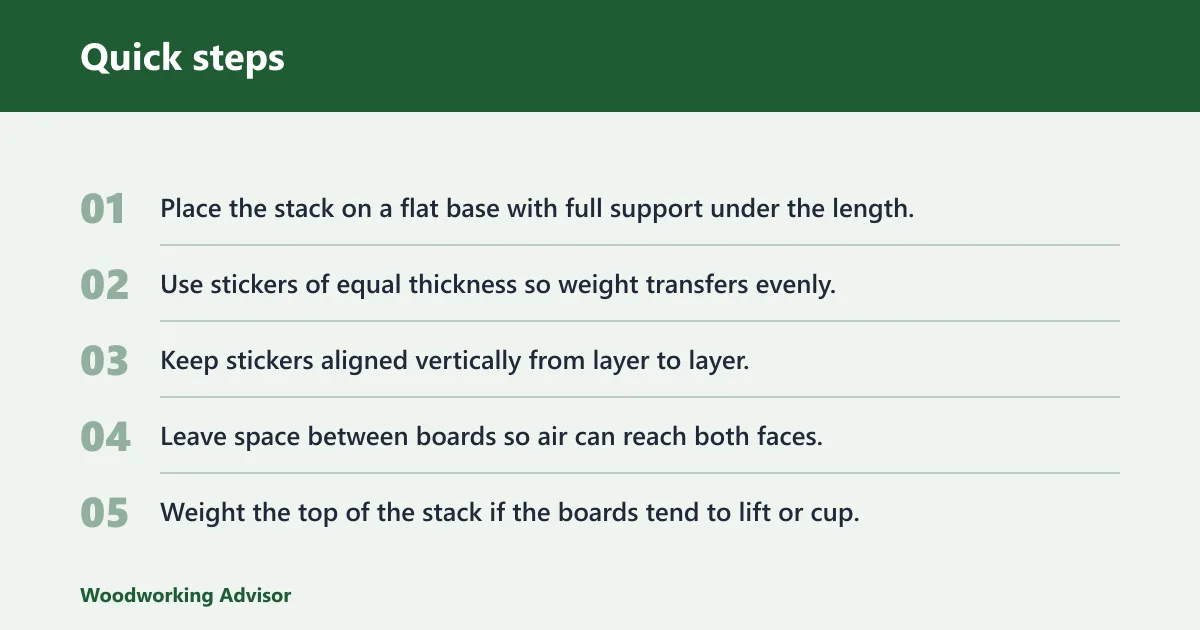
- Place the stack on a flat base with full support under the length.
- Use stickers of equal thickness so weight transfers evenly.
- Keep stickers aligned vertically from layer to layer.
- Leave space between boards so air can reach both faces.
- Weight the top of the stack if the boards tend to lift or cup.
- Check the stack after the first drying interval and restack if any board begins to lean, bow, or twist.
Sticker spacing and alignment
Sticker spacing should be even across the stack so each board gets similar support. Misaligned stickers create pressure points that can imprint the wood or encourage a set in the wrong shape. Keep the stickers directly above one another through the pile.
Airflow, weight, and flat support
Airflow should reach both faces, but avoid direct one-sided exposure that dries only the top edge. Weight on top of the stack helps keep the boards flat while moisture evens out. A level base matters just as much as airflow, because a rack that starts crooked can teach the lumber the wrong shape.
How often to restack or check movement
Check newly milled ash more often during the first stage after surfacing or ripping, when most movement appears. A common first-timer mistake is to mill wide ash, set it on edge in a corner, and assume it will stay put. It will not. If a board changes shape, restack it before it sets into that distortion.
When warped ash is still usable
Warped ash is not always waste. It can still be useful for panels, frames, or edge-glued parts if you can cut around the movement and leave enough thickness for cleanup. The question is not whether it moved. The question is whether the movement leaves enough sound stock for the job.
Panels, frames, and edge-glued parts
Use mildly warped ash for parts that can be trimmed after glue-up or for frame stock that will be cut to final length later. Edge-glued components can tolerate some variation if the mating edges are straightened first. Panels are less forgiving if the board wants to keep cupping after assembly.
When to rip into narrower pieces
Ripping a wide board into narrower strips can release hidden stress and also reduce the width available for cupping. That is useful when the board is otherwise sound. If the piece moves after ripping, plane and joint it again, then let it sit before final dimensioning.
When to reject a board for critical joinery
Reject ash for critical joinery when it shows active twist, repeated movement after re-flattening, pith-related instability, or reaction wood patterns that keep opening up. A board that will become a drawer side, rail, or precise cabinet part needs predictable behavior more than maximum yield.
Does ash warp more than maple or oak?
Species matters, but board layout and drying history matter more. Ash can move enough to surprise you, especially in wide flat-sawn stock, yet maple and oak also warp when the moisture gradient is uneven. The practical difference is often in how the board was sawn, dried, and stored before it reached your bench.
What matters more than species alone
A board with pith, juvenile wood, or reaction wood will be less stable than a cleaner board from the same species. A wide flat-sawn ash board can move more than a narrow quarter-sawn maple board simply because the geometry is less forgiving. That is why sorting the board matters more than naming the species.
How ash compares in practical shop use
Ash is often chosen for furniture, flooring, and tool handles because it machines well and has good strength. But for stability, quarter-sawn ash usually gives a better result than wide flat-sawn ash. If the project has visible surfaces, choose the more stable layout first and keep the wider, riskier stock for parts that can be trimmed or hidden.
Which stock choices reduce risk?
Choose quarter-sawn or rift-leaning boards when the part must stay flatter. Choose narrower widths when possible. Use kiln-dried stock for faster projects, and air-dried stock only after it has had enough time to settle. If you want fewer surprises, buy or mill with the final part shape in mind, not just the rough yield.
Frequently asked questions
Why does ash wood warp after milling?
Ash wood warps after milling because cutting opens fresh surfaces, which lets moisture leave or enter unevenly. Hidden growth stress can also release once the board is no longer restrained by the log. Wide flat-sawn pieces, pith, and reaction wood raise the risk of bow, cup, twist, or crook.
What causes wood to warp after cutting or milling?
Wood warps after cutting or milling when moisture changes faster on one side than the other, or when internal stress is released. Tangential movement is the maximum movement direction in wood, so boards with grain laid broadside often cup first. Poor stacking and uneven airflow make the problem worse.
How wet can ash lumber be before it moves?
Ash lumber can move at almost any moisture level if the two faces dry unevenly or if hidden stress is still present. The safer question is whether the board has stabilized to the environment where it will be used. If the moisture content is still changing, expect movement before final joinery.
Does quarter sawing ash reduce warping?
Yes. Quarter-sawn ash usually reduces cupping risk because radial movement is moderate compared with other grain directions, while tangential movement is the larger driver of face warp. It does not stop movement entirely, but it usually gives you a flatter, more predictable board for visible work.
How should ash boards be stacked after milling?
Stack ash boards flat, sticker them evenly, align the stickers vertically, and keep air moving around both faces. Add top weight if the boards want to lift or cup. Check the stack after the first drying interval, because boards with hidden stress may change shape again and need to be restacked.
Sponsored / affiliate links. As an Amazon Associate I earn from qualifying purchases. I may earn additional commission from eligible campaigns.