Why Does Varnish Stay Sticky?
Varnish stays sticky when it has not cured enough, went on too thick, or picked up contamination. In cool, damp air, give it longer and expect slow cure below about 65°F. If you leave it alone too soon, dust clings, the film can wrinkle or print, and you may need to sand it off. This guide shows how to separate cure trouble from thickness or contamination, then choose the right fix for cold-weather finishing.
What makes varnish stay tacky


Sticky varnish usually means the film is still losing solvent, still oxidizing, or both. That is different from a surface that only feels cool or slightly draggy for a few hours. Oil-based varnish often needs about 24 hours between coats and may take 5-7 days to cure fully, while water-based varnish is often ready for recoating in around 6 hours but still needs more time to harden.
Temperature matters first. One source flags below 50°F as a sticky-risk zone, and another gives oil-based varnish a room range of 40°F to 90°F. Those two numbers do not mean every product works well across that span; they point to the same fact, colder rooms slow evaporation and cure, especially in winter with low airflow.
Humidity matters too, but it is not the only cause. Around 40% to 50% relative humidity is often cited as ideal, while humidity above about 50% can slow drying and very high humidity can make curing unreliable in another source. Temperature, film thickness, and airflow often decide whether the coating ever firms up.
What sticky feel tells you about the film
A film that is tacky only on the surface often points to slow cure. A film that feels gummy deeper down, prints easily, or stays soft under a fingernail for days usually points to too much build, trapped solvent, or a bad finish stack. If the problem is only mild tack on top, waiting can be reasonable. If the whole coat stays soft, waiting may only waste time.
Sticky varnish troubleshooting table
This table separates the common failure modes that get lumped together as “sticky varnish.” Start with the symptom you see, not with a guess about the product.
| Symptom | Likely cause | Quick test | Wait or strip? | Corrective action |
|---|---|---|---|---|
| Surface is tacky after overnight drying in a cold room | Low temperature, slow cure | Check room temperature; below 50°F is a warning sign | Wait if the film is thin and clean | Warm the room gently, improve airflow, and give it more time |
| Film stays soft in the middle or prints under light pressure | Coat too thick or recoated too soon | Look for a skin on top with soft underneath | Strip if softness persists after a practical cure window | Remove excess, then recoat in thinner layers with proper flash time |
| Sticky only on one area or around edges | Contamination or damp substrate | Inspect for wax, silicone, stain residue, or wet wood | Strip contaminated spots if cleaning does not help | Clean the substrate, let it dry, and test a small area before recoating |
| Older can feels thick, skinned, or strange before application | Product age or poor storage | Open the can and check for skinning, clumps, or heavy thickening | Do not rely on it if performance looks doubtful | Use fresh varnish and discard badly degraded product |
| New coat stays sticky over an older finish | Incompatible undercoat or mixed finish system | Rub a hidden spot with the planned topcoat and watch for softening | Strip if the finish layer reacts or will not support a test patch | Use a compatible system and test a small area first |
Is the room too cold?
Yes, cold air can keep varnish tacky, especially when the room is below about 50°F. Some sources also flag below 10°C as a curing problem zone. Cold slows solvent release and leaves the film soft longer, so a coat that would dry in a warm shop can stay sticky through the next day in winter.
Why winter airflow matters
Moving air helps evaporation, but it should move across the surface, not blast directly at one spot. A fan set to gentle circulation is useful because it refreshes the air above the film. Hair dryers are a poor fix because they can stir dust and warm the film unevenly.
Suppose you finish a cabinet door in a basement shop at 48°F with the furnace off overnight. The coat may still be soft the next morning even if the same product would normally be recoatable in about 24 hours. The fix is not more heat from a handheld dryer; it is a warmer room, thinner coats, and steady airflow.
Can humidity keep varnish tacky?
Yes, high humidity can slow drying and make cure less predictable, especially for oil-based products. Around 40% to 50% RH is a useful target, while above 50% slows drying in one source and above 85% can make cure very difficult. Humidity is a warning sign, though, not the only cause.
How moisture slows evaporation and cure
Varnish needs solvent to leave the film and, for oil-based products, oxygen to complete cure. Damp air slows that process. If the room is also cool, the problems stack up. A warm, dry atmosphere is the safer finishing condition, especially for winter work.
Water-based varnish is less dependent on oxidative cure than oil-based varnish, but it still fails in the same bad conditions. It can dry between coats in around 6 hours, yet it can remain soft if the room is cold, the coat is heavy, or the substrate is wet.
Did you apply the coat too heavily?
Too much varnish is a common reason a film stays sticky. Thick coats can skin over on top while the interior stays soft. Recoating too soon can trap solvent as well. Thin coats are safer because they let solvent escape and keep the film from sagging under its own build.
Thin-coat corrections
- Stop adding more coats until the film firms up.
- Check whether the surface has skinned over while staying soft underneath.
- Improve airflow and wait for a realistic cure window.
- If the film is clearly overbuilt, remove excess before trying again.
- On the next coat, apply less material and keep the wet film even.
A common first-timer mistake is loading a brush heavily on a 2-foot by 3-foot tabletop, then trying to fix lap marks with a second pass after a few minutes. That can leave a soft, gummy film that looks dry at the edges but stays sticky in the middle.
Sticky varnish from moisture or contamination
Varnish over damp wood, a wet substrate, or a surface with contamination can stay tacky even if temperature and humidity look acceptable. Wood moisture content below about 15% as a practical target. Water leaks under the film can also keep the coating from drying properly.
Damp wood and wet substrate problems
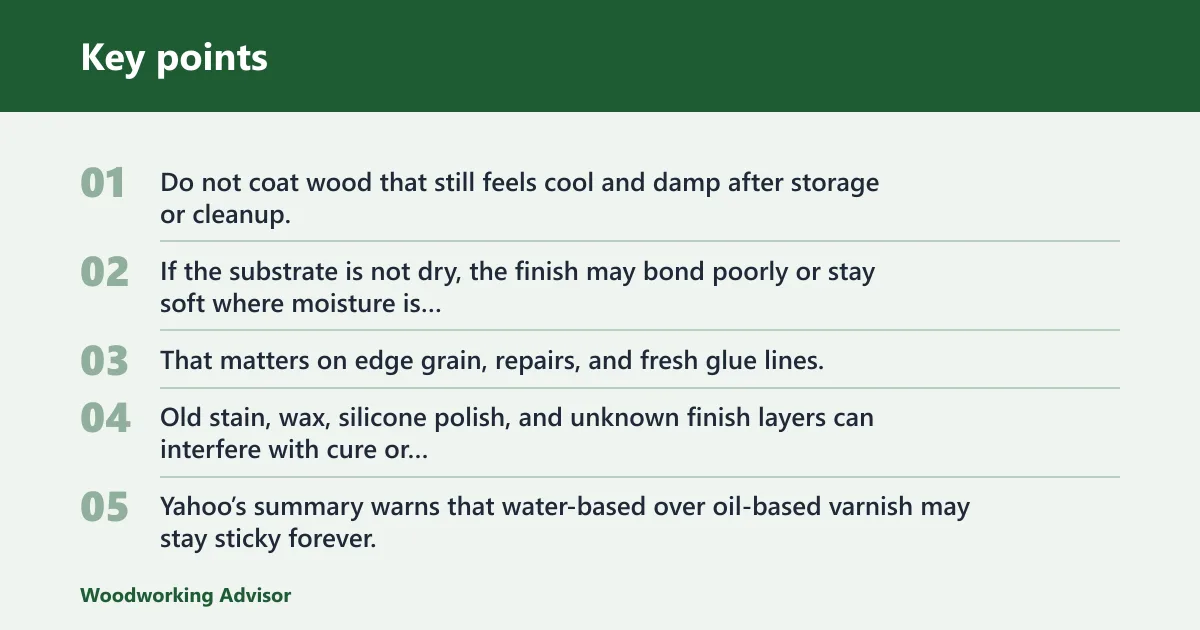
Do not coat wood that still feels cool and damp after storage or cleanup. If the substrate is not dry, the finish may bond poorly or stay soft where moisture is trapped. That matters on edge grain, repairs, and fresh glue lines.
Old stain, wax, silicone, and mixed finish issues
Old stain, wax, silicone polish, and unknown finish layers can interfere with cure or create persistent tackiness. Mixed systems are especially risky. Yahoo’s summary warns that water-based over oil-based varnish may stay sticky forever, which is why a small test area matters before recoating over an unknown film.
If the old surface softens when you apply the new coat, stop. That is a compatibility problem, not a patience problem. Waiting longer usually does not fix a finish stack that is chemically wrong.
Varnish cleanup and recovery steps
Light tackiness can sometimes be corrected by softening or wiping away excess uncured finish with mineral spirits or white spirit on a rag or cloth. Work in ventilation, wear gloves, and keep the cleanup limited to excess film. Do not flood the surface with solvent.
Using mineral spirits or white spirit safely
- Open windows or run ventilation before you start.
- Put on gloves.
- Use a clean rag dampened, not soaked, with mineral spirits or white spirit.
- Wipe only the sticky excess that has not cured.
- Let the surface dry, then reassess before recoating.
Oil-finish rags can combust if left bunched up. Dry them flat outdoors, or store them in a proper sealed metal container until disposal. Do not leave solvent-wet rags in a pile.
If the film is still gummy after a practical cure window, or if it is thick, contaminated, or incompatible, stripping and starting over is usually the better choice. Waiting makes sense for slow cure. It does not make sense for a finish system that is chemically wrong.
Frequently asked questions
Why does varnish stay sticky?
Varnish stays sticky when solvent is still trapped, the coat was too thick, the room is too cold, or the surface was contaminated. Low temperature and poor airflow slow drying. If the film is thin and clean, waiting may solve it; if it stays gummy, the finish may need removal.
Does varnish go bad?
Yes, varnish can degrade in storage. Look for skinning, thickening, clumps, or a sour or unusual smell. Bad storage can leave a product that applies poorly or never firms up right. If the can looks suspect before you start, use fresh varnish instead of forcing a questionable batch.
Can you varnish over varnish?
Yes, if the existing coat is sound, clean, and compatible with the new product. Unknown old finish, wax, silicone, or a mixed system can cause tackiness. Light sanding and a small test patch are the safest checks before you commit to the full surface.
How long does varnish last?
Shelf life depends on product and storage, so there is no single number that fits every can. In use, oil-based varnish often needs about 24 hours between coats and about 5-7 days to cure fully, while water-based varnish often dries between coats in around 6 hours but still needs more time to harden.
Can low temperature make varnish stay tacky?
Yes. Below about 50°F is a common sticky-risk zone, and some sources flag below 10°C as a curing problem. Cold slows evaporation and cure, so a coat that might behave normally in a warm room can stay soft for much longer in winter conditions.
Can high humidity keep varnish sticky?
Yes, high humidity can slow drying, especially when the room is also cool. Around 40% to 50% RH is often considered a better finishing range, while above 85% can make cure very unreliable for some products. Humidity is one part of the problem, not the only one.
Sponsored / affiliate links. As an Amazon Associate I earn from qualifying purchases. I may earn additional commission from eligible campaigns.