Best Fillers for Deep Gouges (2026): Based on Specs and Reviews
For deep gouges over about 1/8 inch, use a two-part epoxy or polyester filler; use water-based or latex filler only for shallow cosmetic dents under a finish. Wrong filler shrinks, cracks, sands unevenly, and can telegraph through stain or paint. This guide compares repair material by damage depth, finish system, and whether the gouge needs rebuilding or only cosmetic blending.
Quick comparison
| Product | Badge | Best for | Price | ||
|---|---|---|---|---|---|
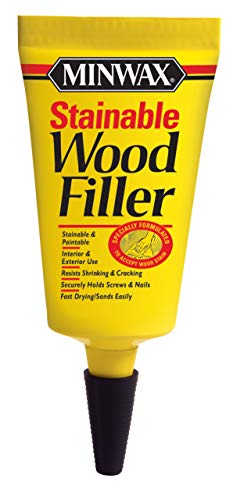 |
Minwax 42851000 Stainable Wood Filler, 1 oz, Natural | WoodMinwax | Our pick | 1 oz · Minwax · Natural stainable filler | $5.38
Price as of 21 Oct 2026
|
View |
 |
System Three SculpWood Putty Epoxy Wood Filler, 8 oz, BrownSYSTEMTHREE | Upgrade pick | 8 oz · System Three · Brown epoxy putty | $19.95
Price as of 21 Oct 2026
|
View |
 |
Titebond Original Wood Glue 5064, Industry Standard forTitebond | Also great | $5.49
Price as of 21 Oct 2026
|
View |
The main split is simple: cosmetic fillers hide surface damage, while epoxy rebuilds missing wood. Once the gouge passes about 1/4 inch deep, a single-pass filler often becomes a riskier choice than a layered repair or rebuild product.
Finish system matters just as much. Paint-grade repairs give you more room for error, while stain-grade work usually needs a product that takes color predictably and a test patch before you commit.
How we chose
This comparison centers on four practical filters: gouge depth, whether the surrounding wood is sound, finish compatibility, and what the repair must do after curing. That means the right pick can be different for a paint-grade trim nick and a missing chunk on a finished furniture leg.
The product categories also have to do different jobs. A filler that sands flush is not the same thing as a putty that stays flexible, and neither is the same as a hand-mixable epoxy that can be drilled or shaped after cure.
We also weighed failure modes that matter in the shop or on a bench: shrinkage, crumbling, poor stain uptake, visible repair lines under raking light, and weak results when a filler is asked to rebuild structure.
Deep gouge decision table
| Gouge depth | Wood condition | Finish goal | Right repair material | Failure mode to watch |
|---|---|---|---|---|
| Under 1/8 inch | Sound wood, no loose fibers | Paint or light touch-up | Shallow cosmetic filler | Shrinkage can leave a shallow dip if you do not overfill slightly |
| About 1/8 to 1/4 inch | Sound wood, edges intact | Paint-grade or hidden repair | Latex-based filler in one or more passes | One thick pass can sink or crack as it dries |
| Deeper than 1/4 inch | Sound wood, but the cavity is deep | Paint-grade, with flush sanding after cure | Layered latex fill or two-part epoxy | Single-pass filler often shrinks, telegraphs, or leaves a soft center |
| Deeper than 1/4 inch | Missing fibers, broken edge, or lost corner | Repair that can be shaped or drilled | Two-part epoxy wood repair putty | Standard filler is too weak for rebuild work |
| Shallow scratches and nail holes only | Finished wood, stain and topcoat already on | Blend after finishing | Non-hardening wood putty | It stays soft and is not meant for structural rebuilding |
| Small gouges on stain-grade furniture | Stable wood, visible grain matters | Stain match | Stainable wood filler with test patch or preconditioning | Poor stain uptake can leave a blotchy patch or a bright repair line |
A common mistake is picking a filler that matches the wood grain but can’t bridge the depth of a wide gouge. A brown filler that looks close in the tube can still flash under side light after sanding, or take stain differently from the surrounding wood.
Say your dining chair leg has a 3/16-inch dent with intact edges and a paint finish planned. A layered latex filler is a practical path because the damage is deep enough to matter, but not so open that you need a rebuild.
Latex-based wood filler: best for layered gouges
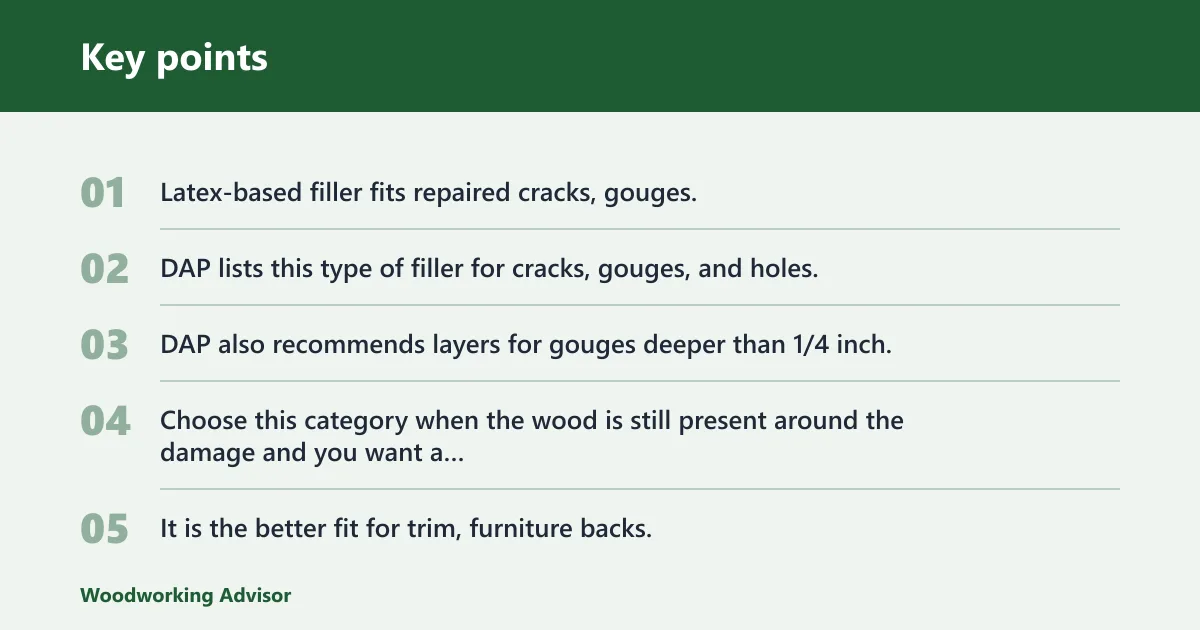
Latex-based filler fits repaired cracks, gouges, and holes where you need a sandable surface and the cavity is not missing major wood. DAP lists this type of filler for cracks, gouges, and holes, and says deeper fills can take 36 hours to dry. DAP also recommends layers for gouges deeper than 1/4 inch.
When it fits
Choose this category when the wood is still present around the damage and you want a smooth, paintable repair. It is the better fit for trim, furniture backs, and other spots where the repair must lie flush more than it must carry load.
For shallow work, drying can be much faster. Bob Vila reports a range of 15 minutes to 8 hours for wood filler in general, but deeper applications take longer, and the practical takeaway is to give thick fills time to harden before sanding.
Dry time and layering
Layering matters once the gouge is deeper than 1/4 inch. A thick single pass can skin over while the center stays soft, which leads to sink-back, crumbling at the edge, or a repair that looks flat until the next day and then drops below the surface.
Overfill slightly, then let each pass cure before adding the next. Bob Vila also recommends overfilling because filler shrinks as it dries, which is especially important on wider gouges where a flush finish is the real goal.
Weak points
The drawback is strength, not convenience. Latex-based filler is a cosmetic repair material, so if the gouge has broken away a corner or removed enough wood that the part needs rebuilding, this category can leave a fragile patch that sands out unevenly or fails under stress.
For stain-grade work, this category can also be inconsistent if the surrounding wood is absorbent. That is where test spots and finish planning matter more than the brand on the tube.
Two-part epoxy wood repair putty: best for rebuilds
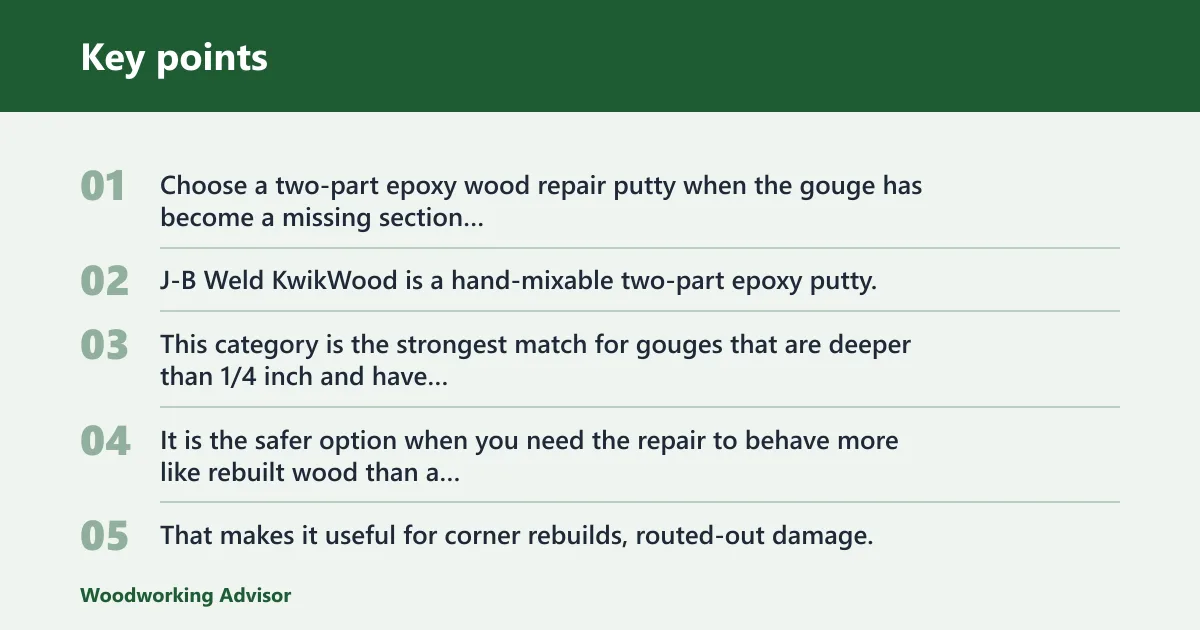
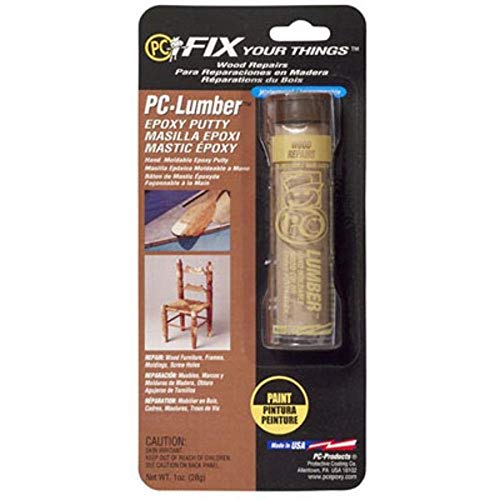
Choose a two-part epoxy wood repair putty when the gouge has become a missing section rather than a simple depression. J-B Weld KwikWood is a hand-mixable two-part epoxy putty, and published product details and buyer feedback say it can be shaped, drilled, and sanded after cure.
Why it suits deep damage
This category is the strongest match for gouges that are deeper than 1/4 inch and have lost shape, edge support, or enough material that a cosmetic fill would collapse into the void. It is the safer option when you need the repair to behave more like rebuilt wood than a skin over a cavity.
That makes it useful for corner rebuilds, routed-out damage, and other spots where you need a firm edge before you sand flush. It is not a stain-matching shortcut; it is a rebuild material first.
Shaping, drilling, and sanding
After cure, epoxy putty can be shaped and sanded, and some products in this category can be drilled. That matters if the repair must accept a screw, a pin, or a small hardware hole after the patch hardens.
Do not confuse this with non-hardening putty. Epoxy becomes a hard repair mass after cure, while non-hardening putty remains a soft cosmetic material for the final touch-up stage.
Cure timing and limits
The honest drawback is that epoxy demands more planning. It typically needs a proper mix, a working window before it hardens, and full cure before you machine it or sand aggressively. If you rush the process, you can pull the repair out of the cavity or leave a gummy edge.
Also, epoxy is not a finish by itself. You still need to sand flush and then move into paint or topcoat work, because an exposed repair edge can still read under raking light if the surrounding surface is not prepared well.
Stainable wood filler: best for color match
Stainable filler is the better choice when the repair has to disappear under stain rather than paint. Minwax says this filler is specially formulated to accept Minwax stain colors, and that makes it useful for small gouges, nail holes, and knot repairs where color matching matters more than rebuild strength.
Stain-grade repairs
Use stainable filler when the wood is already part of a visible furniture or trim surface and you want the patch to blend into the finished grain pattern as closely as possible. This is a cosmetic category, not a structural one.
The same source recommends a preconditioner before filling stained wood, which is a practical warning that the surrounding fibers may take stain differently from the repair. A test patch is the safe move before you commit to the whole piece.
Test patches and preconditioning
Stain acceptance is never universal. Even stainable filler can read lighter or darker than the surrounding wood after stain and topcoat, so it is smart to test on a hidden spot or on a scrap made from the same species.
That extra step matters more on furniture than on paint-grade trim, because stain-grade repairs are judged from a shorter viewing distance and under harsher light.
Common finish issues
The main failure mode is poor stain uptake. If the repair drinks stain differently, the patch can turn muddy, blotchy, or too bright, and that mismatch often becomes more visible after the topcoat goes on.
Another problem is flash under raking light. A repair that looks fine straight on can still show as a flat spot when light crosses the surface, so sanding flush and checking the reflection line both matter.
Which one should you buy?
If the repair is shallow and purely cosmetic, start with a filler that sands flush and matches the finish system. If the gouge is deeper than 1/4 inch, move up to layered latex filler or epoxy instead of forcing a one-pass cosmetic product into a deep cavity.
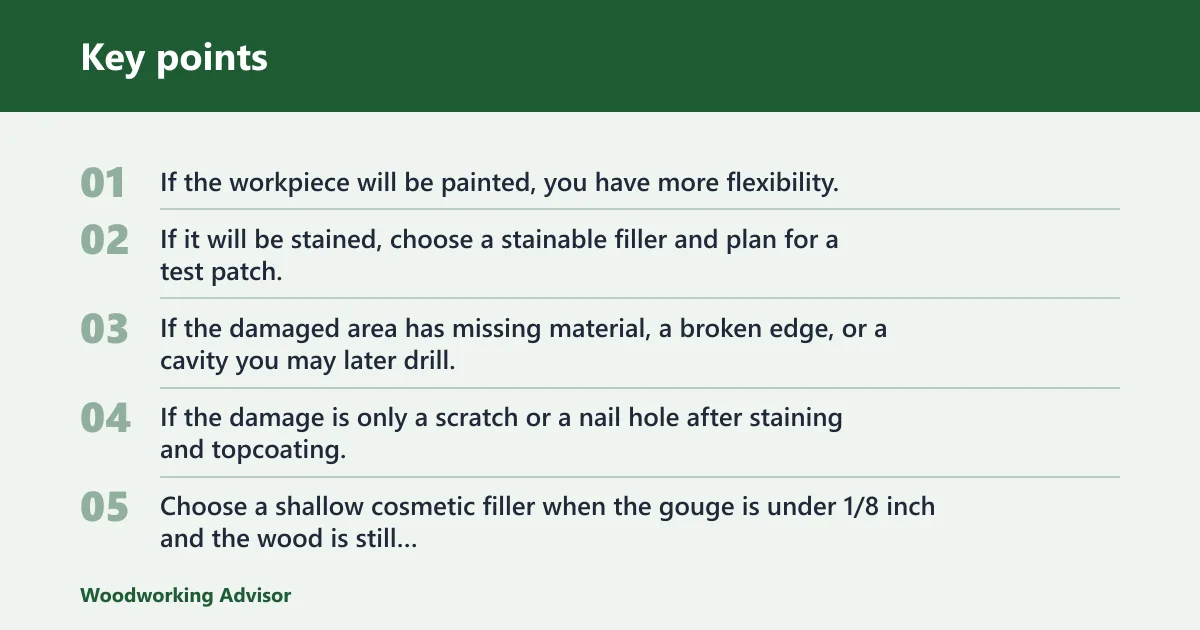
If the workpiece will be painted, you have more flexibility. If it will be stained, choose a stainable filler and plan for a test patch, because stain-grade furniture repairs are less forgiving of color mismatch than paint-grade trim.
If the damaged area has missing material, a broken edge, or a cavity you may later drill, epoxy is the safer choice. If the damage is only a scratch or a nail hole after staining and topcoating, non-hardening putty is the final touch-up product, not the main repair.
Best for shallow cosmetic repairs
Choose a shallow cosmetic filler when the gouge is under 1/8 inch and the wood is still sound. This is the fastest path for paint-grade touch-ups, but it still needs sanding flush after cure or it may leave a visible ridge.
Best for gouges deeper than 1/4 inch
Choose layered latex filler if the wood is sound and the cavity is deep but not missing a major chunk. Choose two-part epoxy if the gouge needs rebuilding, shaping, or later drilling. Deep fills often need more than one pass, and forcing a single thick application is a common reason for sink-back and crumbling.
Best for stain-grade furniture
Choose stainable filler when the repair must blend under stain, especially on furniture and visible trim. Expect to test, precondition if needed, and sand flush before the topcoat, because the right color in the tub does not guarantee the right result on the board.
Best when you may need to drill or shape the repair
Choose a two-part epoxy wood repair putty. It hardens into a repair mass that can be shaped, drilled, and sanded after cure, which makes it the better option when the gouge is more than cosmetic and the final geometry still matters.
Picture a cabinet corner that lost a 1/2-inch wedge near a hinge screw hole. That is not a job for non-hardening putty, and it is rarely a one-pass filler job either. A rebuild putty is the safer path because the repair has to hold shape before finish work begins.
Suppose a bookshelf rail has shallow scrape marks, and the owner wants a stain finish with minimal color difference. A stainable filler can work, but only if you accept that a preconditioner or test patch may be needed to keep the repair from flashing lighter than the surrounding wood.
Choose Minwax if… / Choose System Three if… / Choose Titebond if…
Choose Minwax Stainable Wood Filler if the damage is small, the finish is stain-grade, and color match matters more than rebuild strength. Its drawback is the same one stainable fillers always have: the stain match still needs testing, and it is not the right answer for missing wood.
Choose System Three SculpWood Putty Epoxy Wood Filler if the gouge is deep, the edge is broken, or you need a repair that can be shaped, drilled, and sanded after cure. The trade-off is more prep and cure time than a simple filler, but it is the better fit for rebuild work.
Choose Titebond Original Wood Glue if the issue is a joinery problem, not an open gouge. Wood glue is for bonding wood to wood at a joint; it is not a gap-filling substitute for missing material, and it will not solve a visible cavity on its own.
Frequently asked questions
What is the best wood filler for large gaps?
Two-part epoxy is usually the best choice for large gaps when the wood is missing, broken, or needs a rebuild. If the gap is deep but the surrounding wood is intact, layered latex filler can work. Large gaps are where shrinkage, crumbling, and weak edges show up fastest.
What wood filler works for gouges deeper than 1/4 inch
Repairs deeper than 1/4 inch often need layered application, and many products explicitly call for that approach. Latex-based filler can work in layers if the cavity is still cosmetic, while two-part epoxy is better when the gouge needs structure, shaping, or later drilling. A single-pass cosmetic filler is the riskiest option here.
Can you drill into wood filler after it dries?
Yes, but only for the right product. Two-part epoxy wood repair putty can be shaped, drilled, and sanded after full cure. Non-hardening putty is not for drilling, and standard cosmetic fillers may crumble or tear if you ask them to hold a fastener hole.
Is wood filler stainable for furniture repairs?
Some wood filler is stainable, but that does not guarantee a perfect match on furniture. Stainable filler is the better option when color matters, yet it may still need a preconditioner or test patch. Expect to sand flush and verify the color before you commit to the final finish.
Should deep gouges be filled in layers?
Yes, when the product instructions call for it, especially for gouges deeper than 1/4 inch. Layering reduces the risk of shrinkage, soft centers, and cracking as the repair dries. It is also the better way to keep a deep fill from sinking below the surface after sanding.
Sponsored / affiliate links. As an Amazon Associate I earn from qualifying purchases. I may earn additional commission from eligible campaigns.