3/4 Sanded Plywood at Lowe’s: Grades, Thickness & Best Uses
3/4 sanded plywood at Lowe’s is the go-to sheet good for DIY shelving, cabinet boxes, and workbench tops — but the panel you carry to the register almost never measures a true 3/4 inch, and not every panel labeled “plywood” on that rack is actually the sanded grade you want. This guide covers the real thickness, which grades to look for, and the CDX mix-up that trips up a lot of first-time buyers.
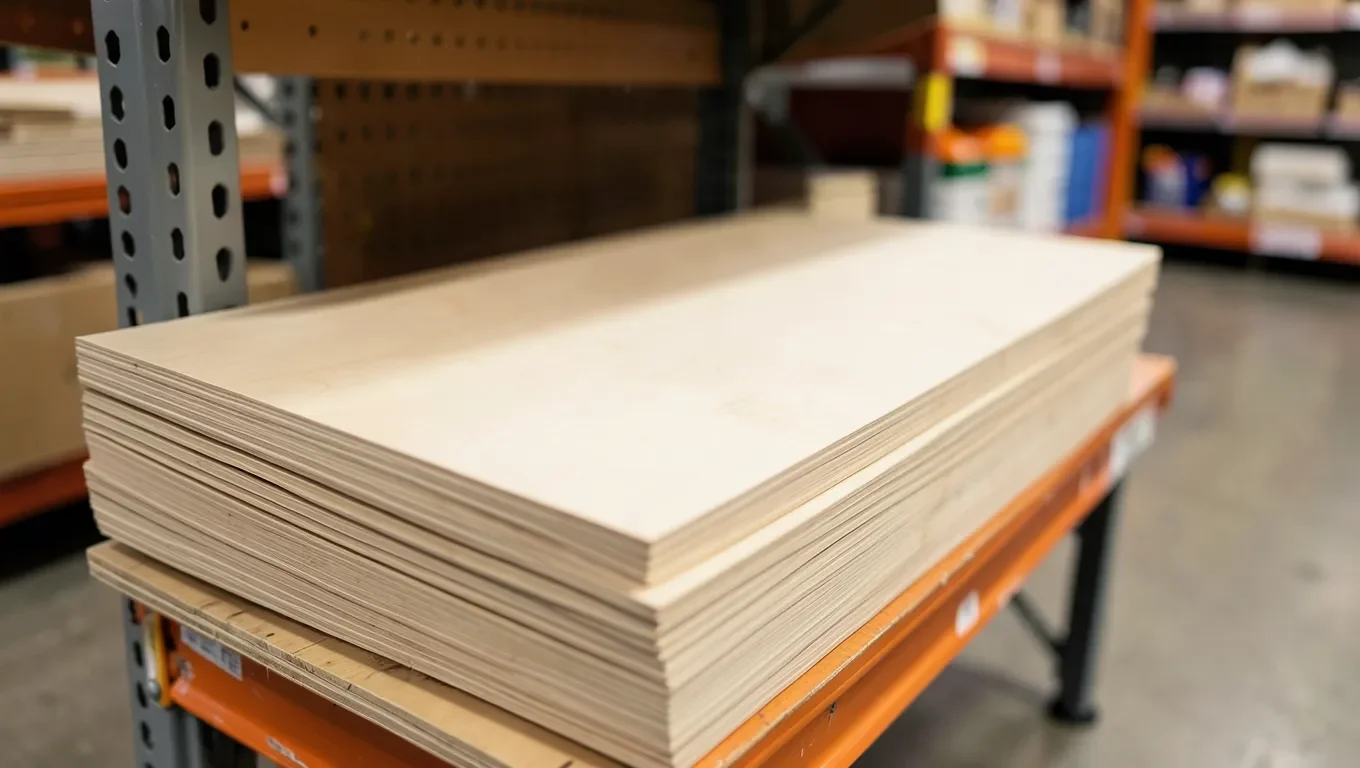
Plywood is the material almost every home shop reaches for once a project needs a flat panel bigger than a single board, and Lowe’s is one of the easiest places to buy it because the stock turns over fast and most stores keep two or three sanded grades in the 3/4-inch bin at any given time. The catch is that “sanded” and “grade” aren’t the same thing, and the “3/4” printed on the shelf tag is a rounded-off nominal number, not a caliper reading. Get those two details confused and a shelving unit that was supposed to sit flush ends up a hair proud at every joint.
What “3/4 Sanded” Actually Means — And Why It’s Not Really 3/4 Inch
Best Blade for Clean Sanded-Plywood Cuts
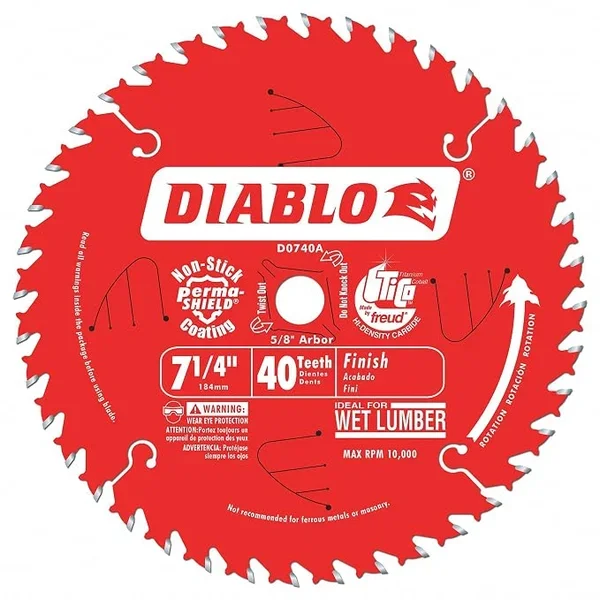 |
Freud Diablo D0740A 7-1/4" 40T Finish Blade – $20.39 A fine-tooth finish blade keeps the sanded face veneer from chipping out on the cut line, which a standard framing blade can’t do.
|
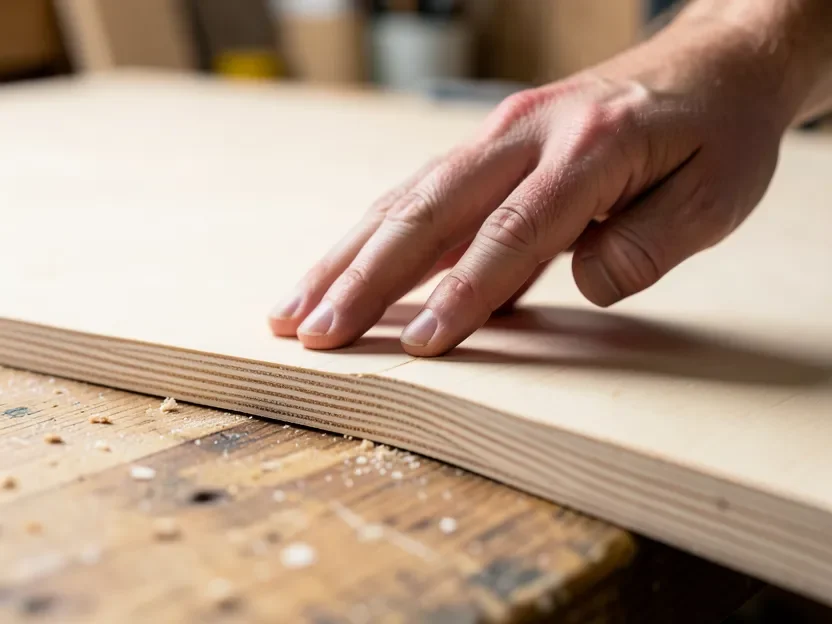
Plywood is built from thin layers, or “plies,” of wood veneer glued together with the grain of each layer running perpendicular to the one below it. That cross-grain construction is what keeps a sheet flat and resistant to warping compared to a solid board of the same width. “Sanded” refers to a separate step after the panel is pressed: at least one face, and usually both, gets run through a wide-belt sander to remove mill marks and even out the surface so it’s ready for paint, stain, or a clear finish without you doing that work by hand first.
The Real Thickness Behind the “3/4”
Here’s the detail most buying guides skip: the “3/4” on a sanded plywood panel is a nominal size, not a measured one. Manufacturers sand material off both faces to get that smooth surface, and industry voluntary product standards (the same ones Lowe’s suppliers build to) allow the finished panel to land noticeably under the nominal call-out. In practice, a “3/4-inch” sanded sheet usually measures close to 23/32 inch — about 0.719 inch, or roughly 18.3mm — not a true 0.750 inch. Imported panels sometimes measure a hair thinner still, closer to 18mm even by metric spec rather than by conversion.
This matters for anything with a tight tolerance: a dado or groove cut to “fit 3/4-inch plywood” using a stack dado set sized for a true 0.750 inch will leave the panel loose in the joint. Shelf-pin systems, drawer slide spacing, and flush inset panels in a face frame can all end up slightly off if you design around the nominal number instead of measuring the actual sheet with calipers before you cut. It’s a small difference, but it’s the kind of thing that turns a “why doesn’t this fit” moment into a redo.
Grades That Matter — and the CDX Mix-Up
Plywood grading uses letters (A, B, C, D) to describe how clean each face is, with A being the smoothest and most defect-free and D allowing open knots and patches. Lowe’s stocks a handful of combinations, and knowing which letters you’re actually looking for saves a wasted trip:
- AC or BC Plywood: One face (A or B) is sanded smooth and largely free of knots, the other (C) is a lower utility grade. This is the standard pick for shelving, cabinet sides, or any project where only one face shows.
- Sande Plywood: An imported, tropical-hardwood-veneer panel (commonly labeled “Sande” or sold under an okoume/lauan-family species) that’s sanded smooth on both faces. It’s a common, more affordable stand-in for cabinet-grade birch when both sides of the panel will be visible.
- Cabinet-Grade (Birch or Maple) Plywood: The nicest option Lowe’s typically carries, with a tight, consistent veneer sanded smooth on both faces. Costs more, but it’s worth it for furniture-grade work.
Here’s the correction worth remembering: CDX plywood is not sanded. The “C” and “D” are the two roughest face grades in that letter system, and CDX is sold specifically as an unsanded structural sheathing and subfloor panel — the kind of plywood that goes under a roof or a floor where nobody will ever see it. It will have visible knots, filled patches, and rough mill marks on both faces. If a panel at Lowe’s is tagged CDX, don’t expect the smooth, finish-ready surface you’re picturing for a shelf or a cabinet side; that’s the opposite of what the “sanded” panels in this guide are for. Check the grade stamp or shelf tag for AC, BC, Sande, or cabinet-grade lettering, not just the word “plywood,” before you load a sheet onto the cart.
3/4 Sanded Plywood vs. the Other Sheet Goods at Lowe’s
Sanded plywood isn’t always the right sheet good for the job. Here’s how it stacks up against the other materials in the same aisle:
| Material | Actual Thickness (3/4" Nominal) | Best For | Skip It If… |
|---|---|---|---|
| 3/4 Sanded Plywood (AC/BC/Sande) | ~23/32" (0.719") | Shelving, cabinet sides, furniture bases, visible surfaces | You need a true 0.750" for a tight dado or insert |
| CDX / Sheathing Plywood | ~23/32" (0.719") | Subfloors, roof decking, wall sheathing — hidden structural use | Any surface will be visible or painted |
| MDF | ~0.703–0.735" | Painted cabinet doors, speaker boxes, panels with no exposed edge | The project needs to hold screws at a thin edge or get wet |
| OSB | ~0.719–0.734" | Subflooring, sheathing, budget structural panels | You need a paintable or stainable surface |
| Solid Wood Board (e.g., 1×4 pine) | Actual 0.75" (true dimension) | Trim, edge-glued panels, fine furniture where grain shows on an edge | You need a wide, stable panel that won’t cup |
The pattern worth noticing: almost none of these panels measure their nominal thickness exactly. Sheet goods across the board run slightly under their stated size, which is why measuring the actual panel before cutting joinery is a habit worth building regardless of which material ends up on the cart.
Best Projects for 3/4 Sanded Plywood
Shelving
This is the most common use by a wide margin. The 3/4-inch thickness gives enough rigidity to span a typical shelf run without sagging when it’s supported every 24 to 32 inches, and the sanded face takes paint or stain without extra prep.
Cabinetry and Furniture
For DIY cabinet boxes, drawer bottoms, or tabletops, sanded plywood is far more dimensionally stable than solid lumber — it won’t cup or expand across its width the way a wide solid board can, which matters for keeping cabinet doors and face frames aligned over time. Higher grades like Sande or birch cabinet plywood can look close to real hardwood once finished.
Workshop and Garage Builds
Workbenches, tool storage, and jigs all benefit from a flat, durable surface, and 3/4 sanded plywood handles daily shop abuse better than thinner panels while staying light enough to move around without help.
Buying It at Lowe’s: What to Check Before You Load the Cart
Before grabbing the first sheet on the rack, run through this quick checklist:
- Will the surface be visible? If yes, look for AC, BC, Sande, or cabinet grade — not CDX.
- Will it bear significant weight? 3/4-inch stock is generally fine, but the span between supports still matters more than the thickness alone.
- Check flatness. Sight down the edge of the sheet in the store; a little bow can be worked around, a twisted panel usually can’t.
- Check the core, not just the face. Softwood (fir or pine) cores are common and perfectly fine for most builds; hardwood-core panels cost more and are worth it mainly for furniture.
- Standard sheet size is 4×8 feet. Confirm it’ll fit in or on your vehicle, or have Lowe’s make a rough cut in-store before you leave.
Cutting and Joining Without Tearing Up the Face Veneer
The sanded face is thin, so a rough cut can tear the veneer right at the surface instead of leaving a clean edge. A few things make the difference:
- Blade tooth count: A high-tooth-count finish blade (40T or more, like the one above) leaves a smooth, chip-free line where a standard 24T framing blade will tear the veneer.
- Cut with the good face up on a table saw (blade cuts up through the panel) or good face down with a circular saw (blade cuts down into the panel) — tear-out happens on the side the teeth exit, not the side they enter.
- Score the cut line with painter’s tape or a utility knife pass before cutting if you’re using a lower tooth-count blade.
- Support both sides of the cut so the offcut doesn’t snap away and tear the panel before the cut finishes.
Because plywood edges expose the raw ply layers instead of the smooth sanded face, an edge that will stay visible — a shelf front, a cabinet door edge — usually looks better with a thin strip of iron-on edge banding in a matching species applied after cutting, rather than left as bare plywood edge grain.

For joining pieces, glue and screws (with pre-drilled pilot holes near edges to prevent splitting) remain the simplest strong method for most DIY builds. A pocket-hole jig is a fast, hidden-fastener option for cabinet boxes, and dadoes or rabbets cut with a table saw or router give the strongest, most self-aligning joint for shelving and casework.
Finishing: Paint, Stain, or Seal
- Painting: A quality primer followed by two topcoats gives the most forgiving, even finish. Semi-gloss or satin finishes hold up best to regular cleaning.
- Staining: Use a pre-stain conditioner first — plywood’s face veneer and its inner plies can be different species and absorb stain unevenly without one.
- Sealing: Even left natural, a clear polyurethane or lacquer will protect the surface from moisture and wear.
If your project actually needs a structural, hidden-use panel rather than a finish-grade face — a subfloor, for example — that’s a different buy entirely; see our breakdown of Lowe’s 3/4 plywood subfloor options for the OSB and CDX side of the aisle.
Frequently Asked Questions (FAQ)
Is 3/4 sanded plywood from Lowe’s actually 3/4 inch thick?
No, and that’s true of sanded plywood at any retailer, not just Lowe’s. “3/4-inch” is the nominal size printed on the shelf tag and panel stamp. The actual thickness of a sanded panel is typically closer to 23/32 inch (about 0.719 inch, roughly 18.3mm) because the sanding pass that creates the smooth face removes material from both sides. If a project’s tolerances assume a true 0.750-inch panel — a dado cut, a shelf-pin hole spacing, or a flush inset into a face frame — measure your actual sheet with calipers before you cut anything, rather than trusting the nominal number.
Is CDX plywood the same as sanded plywood?
No. CDX pairs the two roughest, least-finished veneer grades in the standard A-B-C-D letter system, and it ships unsanded as a structural sheathing and subfloor panel rather than a finish-ready one. Expect open knots, filler patches, and rough mill texture on both sides, not a smooth face. For shelving, cabinets, or furniture where the surface will actually be seen, ask for AC, BC, Sande, or birch cabinet-grade instead — those are the panels that get the smooth, sanded treatment.
Is 3/4 sanded plywood smooth enough to stain directly?
Generally yes for AC, BC, or cabinet-grade panels. Apply a pre-stain wood conditioner first, since plywood’s face veneer and inner plies can be different wood species that absorb stain unevenly, which shows up as blotching without a conditioner. CDX and other unsanded grades are not smooth enough to stain and shouldn’t be used where the surface will show.
Can I use 3/4 sanded plywood outdoors?
Not without real modification. Standard interior sanded plywood uses glue and veneers that aren’t rated for repeated wetting, and it will delaminate over time even if you seal the surface. For an outdoor build, use exterior-rated plywood (often marked with a “W” for waterproof glue bond, sometimes called BC exterior or marine-style okoume/sande plywood) or pressure-treated lumber instead.
Buscas información en español? Consulta plywood en español para los términos regionales, grados y conversiones métricas.
Sponsored / affiliate links. As an Amazon Associate I earn from qualifying purchases. I may earn additional commission from eligible campaigns.