Why Is Ash Wood Hard to Find at Lumber Yards?
Ash wood is hard to find at lumber yards because emerald ash borer damage cut the standing supply, and many yards now keep less of it on hand because it turns slowly and demand swings. If you do not plan ahead, you can waste time chasing boards, pay more for special orders, or redesign around another species. This guide explains the ash supply chain, why yards carry less of it, and what to do when you need it.
How lumber yards prioritize stocking other woods


Ash is harder to find because the standing tree supply changed, local yard stocking stayed conservative, and buyers often grab what reaches the rack before it sits long. White ash and green ash do not arrive evenly across regions, so availability can vary from one yard to another.
That uneven supply matters. Ash tree losses reduced the volume available to sawmills in many areas, and mills do not always keep every species moving the same way. Yards usually keep faster-moving hardwoods in stock, while ash may sit in smaller lots, special-order bins, or mixed bundles that disappear fast when demand rises.
Commodity shortages make the problem worse. During the pandemic period, construction companies were dealing with a lumber crunch. Pressure-treated wood and plywood were especially hard to find, production had been reduced to about 50 percent efficiency, and higher demand plus slower output created bottlenecks. One supplier sold five months of pressure-treated inventory in one month, and the email said the huge sales increase stripped the supply chain.
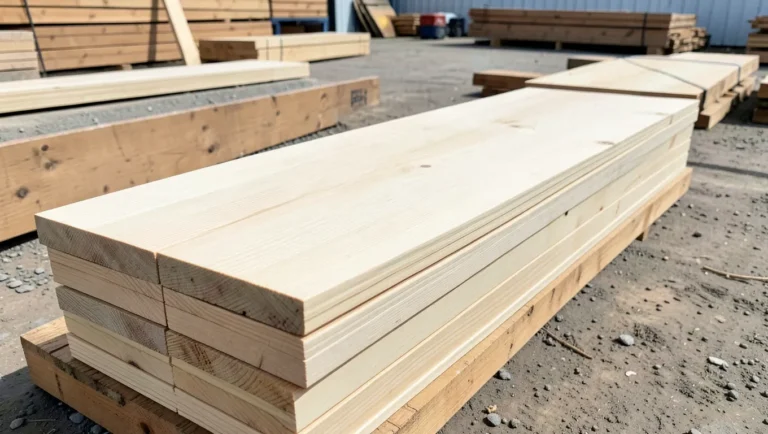
Ash availability also varies by product form. Rough-sawn ash, kiln-dried stock, wide boards, and longer lengths can vanish before small 1x stock does. If a yard has only a few packs on the floor, those packs may reflect current local demand rather than a reliable restock promise.
How yard stocking habits affect ash supply
Lumber yards often stock the materials that move fastest and reorder the rest. Ash can lose shelf space to oak, maple, birch, or construction-grade items that sell faster and fit more customer jobs. That means ash may be available by special order while common hardwoods stay visible on the rack.
For buyers, the issue is not only species scarcity. It is also the yard’s inventory choice, supplier backorders, and the way each store manages limited board-foot space. A store that serves cabinet shops may keep more select hardwood. A store focused on trim and framing may keep very little ash.
Which ash forms disappear first?
Specialty cuts usually disappear before plain stock. Wide boards, longer lengths, and clean FAS or select material often sell faster because they fit furniture parts, tabletops, and matching runs. After that, kiln-dried ash can be harder to find than air-dried material, and S4S stock often sells faster than rough-sawn lumber because it is ready to use.
If you need a specific thickness, assume the search gets harder as the request gets narrower. A yard may be able to source 1x stock more easily than 2x stock, or the reverse, depending on what its mill partners cut and what its supplier has left in backorder.
Is ash wood hardwood or softwood?
Ash is a hardwood. It comes from deciduous tree species, including white ash and green ash. It is valued for a straight grain, useful strength, and a balance of stiffness and flexibility.
White ash vs green ash
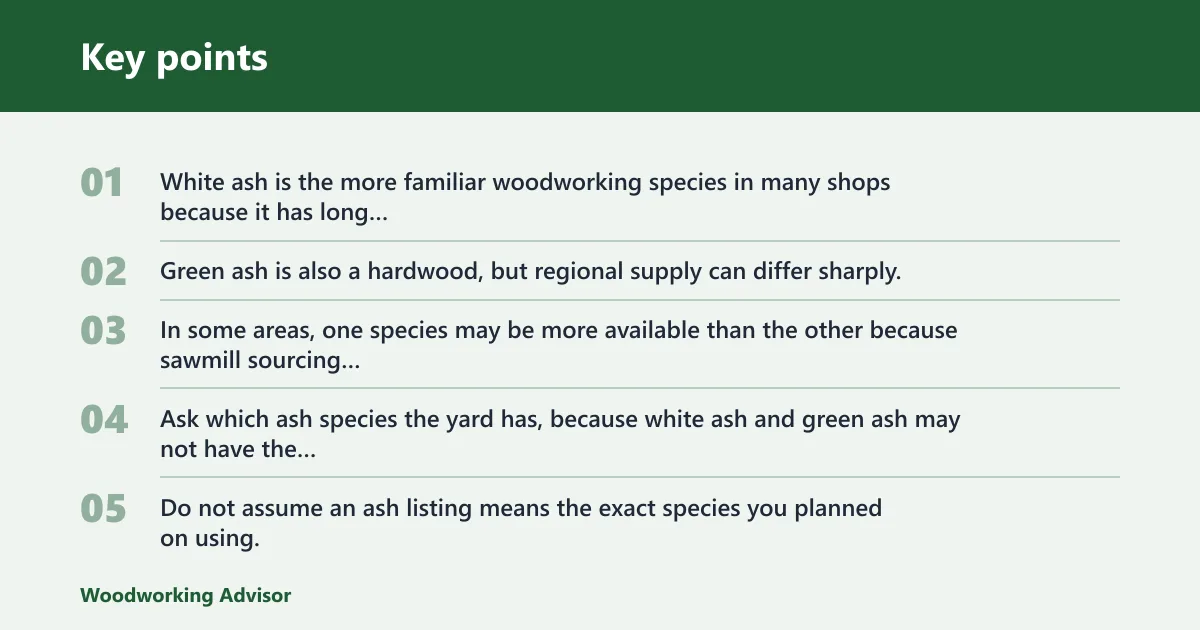
White ash is the more familiar woodworking species in many shops because it has long been used for furniture, bent parts, bats, and trim. Green ash is also a hardwood, but regional supply can differ sharply. In some areas, one species may be more available than the other because sawmill sourcing depends on local tree loss, salvage flow, and what arrives at the mill.
For buyers, that means the label matters. Ask which ash species the yard has, because white ash and green ash may not have the same appearance, availability, or price. Do not assume an ash listing means the exact species you planned on using.
Hardness, weight, and grain pattern
Ash is known for a clear grain pattern, moderate weight, and good impact resistance. It machines well for many woodworking tasks and finishes in a way many buyers like for visible surfaces. That combination helps explain why ash is still wanted even when it is harder to source than oak or maple.
Compared with other hardwoods, ash is often chosen when the project needs a visible grain and a material that is strong without feeling overly heavy. That is useful for stair parts, chairs, and trim parts that need stable stock and a clean look.
Workability for furniture and trim
Ash cuts, planes, and sands well when moisture content is under control and the boards are clear of defects. It is generally a practical choice for furniture parts and interior trim, but availability can be the limiting factor rather than the wood’s working behavior. If a project depends on matching grain across multiple pieces, buying enough from the same batch matters.
Say your project needs four 8-foot, 1×6 ash boards for a bench seat. A yard may have one board on the rack and three more on backorder. In that case, matching the grain and color may matter more than finding the first available piece.
What makes ash stock harder to buy than other hardwoods?
Ash can be harder to buy because the board-foot supply is tighter, mills allocate it unevenly, and yards often receive it in smaller lots than more common hardwoods. Even when ash exists in the supply chain, the exact form you need may not be sitting in local stock.
Board-foot supply and sawmill allocation
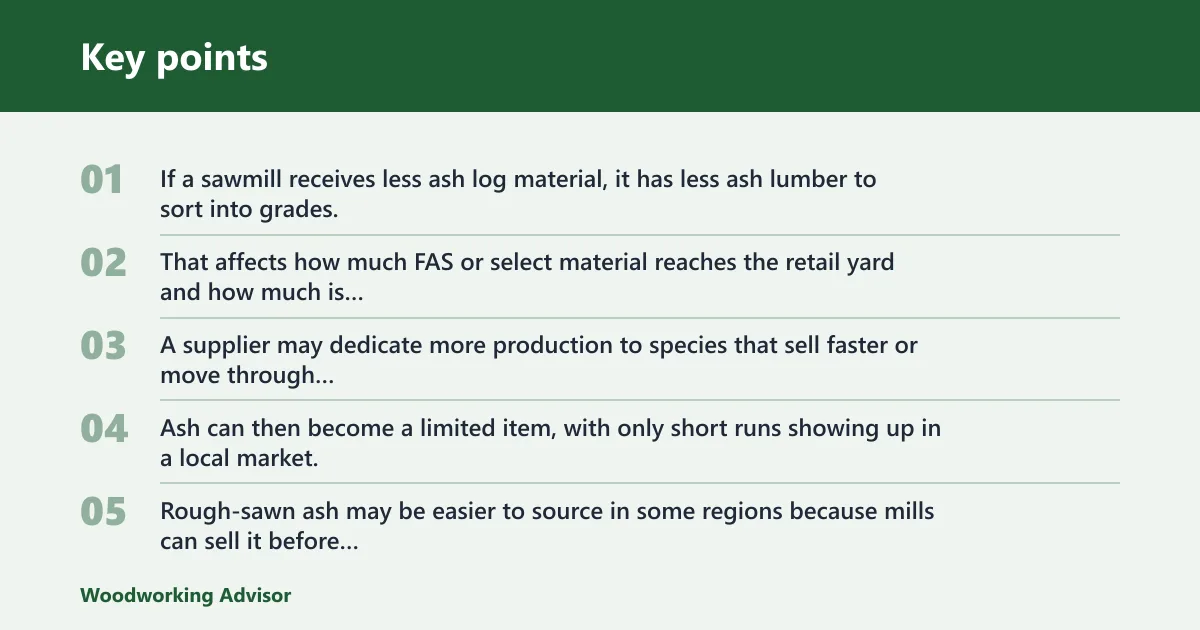
Board-foot supply is the core issue. If a sawmill receives less ash log material, it has less ash lumber to sort into grades, thicknesses, and lengths. That affects how much FAS or select material reaches the retail yard and how much is reserved for higher-demand outlets.
Mills also decide how to allocate each run. A supplier may dedicate more production to species that sell faster or move through contractor accounts more predictably. Ash can then become a limited item, with only short runs showing up in a local market.
Rough-sawn vs S4S availability
Rough-sawn ash may be easier to source in some regions because mills can sell it before planing and surfacing. S4S ash usually needs more processing, so it can be thinner on the ground when production slows or transport gets delayed. If you can use rough stock and surface it yourself, your odds improve.
That said, many DIY woodworkers and small contractors need ready-to-use material. Once a yard has to plane, grade, and package the boards, the same pile can shrink fast. That is why S4S ash often disappears before rough stock in a tight market.
Kiln-dried, air-dried, and seasoning status
Moisture content matters as much as species. Kiln-dried ash is preferred for many indoor projects because it is ready sooner and more stable at purchase. Air-dried or partially seasoned ash may still be useful, but the yard should state the drying method clearly so you can plan for movement, storage, and milling.
If a board is not dry enough, it can cup, twist, or shrink after cutting. That risk is one reason buyers ask specifically for kiln-dried ash instead of accepting any ash that happens to be available.
Ash availability checksheet
Use this before you call a yard. It keeps the conversation focused and saves time.
| Check item | What to ask | Why it matters |
|---|---|---|
| Species | Is it white ash or green ash? | The species affects availability, appearance, and sourcing. |
| Thickness | Do you have 1x stock or 2x stock? | Some thicknesses sell out faster than others. |
| Widths | What widths are on hand? | Wide boards are often harder to find than narrow ones. |
| Lengths | What lengths can you supply? | Long boards may require a separate pull from inventory. |
| Drying method | Is it kiln-dried or air-dried? | Moisture content affects stability and project timing. |
| Grade | Do you have FAS, select, or another grade? | Grade changes clear yield and board appearance. |
| Lead time | How long for special order? | Lead time may be days or several weeks. |
| Minimum order | Is there a minimum board-foot order? | Some suppliers will not break a case for one small job. |
| Substitution options | Can you suggest oak, hickory, maple, or birch? | Substitutes may keep the project moving. |
| Regional mill source | Can you source from a regional mill? | Local mill access can shorten replacement time. |
Where can you get ash lumber if your yard is sold out?
If your local yard is sold out, the fastest path is to call nearby yards before driving, then ask whether they can source from a regional mill or check a supplier’s backorder window. Ash availability can vary by region and yard, so the first store that says no may not reflect the wider market.
Replacement supply can take time. In one shortage example, replacement supply from Western Canada was 5-6 weeks away. That kind of delay shows why a local call matters before you plan a cut list around ash that is not actually in hand.
A practical buyer workflow
- Call three to five nearby lumber yards and ask for ash by species, thickness, and drying status.
- Ask whether they have local stock, special order options, or mill allocation coming in soon.
- Confirm board widths, lengths, and grade before you leave home.
- Ask if the yard can source from a regional mill instead of waiting on a distant supplier.
- Compare lead time and minimum order against your project deadline.
- If the lead time is too long, switch to a substitute before you commit to a design that depends on ash.
How to handle backorders and restock timing
Ask whether the yard is waiting on supplier backorders or a mill shipment. Those are different delays. A yard may have no ash on the floor but still expect a small shipment soon, while another may be waiting weeks for the next run to arrive. That difference changes whether you wait or move on.
Suppose a shop needs 20 board feet of ash for drawer fronts, but the yard only has 8 board feet in stock and the rest is on backorder. In that case, redesigning the drawer fronts around maple or birch may be the smarter move than pausing the build.
What ash substitutes work for your project?
If ash is unavailable, the best substitute depends on the job. Oak is often a general stand-in for strength and familiar hardwood behavior. Hickory works well when shock resistance matters. Maple and birch are useful when you want a lighter-colored look and a different grain character.
Oak as a close stand-in
Oak is a common alternative when you need a durable hardwood with reliable supply. It is not identical to ash, but it is often easier to source in many yards and can suit furniture, trim, and casework where a strong, visible-grain hardwood is acceptable.
Hickory for strength and shock resistance
Hickory is a good choice when the part takes impact or repeated stress. It is usually harder and tougher than ash, though it can be more demanding to machine. Use it when function matters more than matching ash’s exact appearance.
Maple or birch for lighter-colored work
Maple and birch are practical when the project calls for a lighter visual tone or a more uniform surface. They can be easier to find than ash in many regions, and they fit painted work, clean-lined furniture, and cabinet parts where grain pattern is not the main feature.
Frequently asked questions
Why is ash wood hard to find at lumber yards?
Ash is hard to find because supply shrank after ash-tree loss, yard stocking is conservative, and buyers often clear available inventory quickly. White ash and green ash do not arrive evenly across regions, so local stock can vanish even while another market still has boards on hand.
Is ash a hardwood or softwood?
Ash is a hardwood. It comes from deciduous trees, and it is used for furniture, trim, and other woodworking jobs that benefit from a strong but workable material. The question usually matters because buyers want to compare ash against oak, maple, hickory, and birch.
How hard is ash wood compared with other hardwoods?
Ash is generally considered a strong, durable hardwood with useful impact resistance and a moderate weight. It is often chosen for parts that need toughness without feeling excessively heavy. For many woodworking jobs, its grain and workability matter as much as its hardness.
Where can I get ash lumber if my local yard is sold out?
Call nearby yards, ask about special orders, and check whether a regional mill can source ash faster than a distant supplier. Availability varies by region and yard. If the lead time is too long, compare substitutes before the project stalls.
What should I ask a lumber yard before ordering ash?
Ask for species, thickness, widths, lengths, kiln-dried or air-dried status, grade, lead time, minimum order, substitution options, and whether the yard can source from a regional mill. Those questions tell you whether the order fits your project and schedule.
What ash wood alternatives should I use if I can’t find any?
Use oak if you want a close all-purpose substitute, hickory for extra strength and shock resistance, and maple or birch for lighter-colored work. The right choice depends on the part, the finish, and how closely you need to match ash’s grain and appearance.
Sponsored / affiliate links. As an Amazon Associate I earn from qualifying purchases. I may earn additional commission from eligible campaigns.