Does Shellac Go Bad? Shelf Life of Shellac and Flakes
Yes. Mixed shellac is often usable for about one year, though shelf life can vary with formula and storage. Dry flakes last longer, but they still need to dissolve cleanly and harden properly on wood. If old shellac smells weak, stays gummy, or will not dry on glass, discard it.
What bad shellac looks and acts like on wood
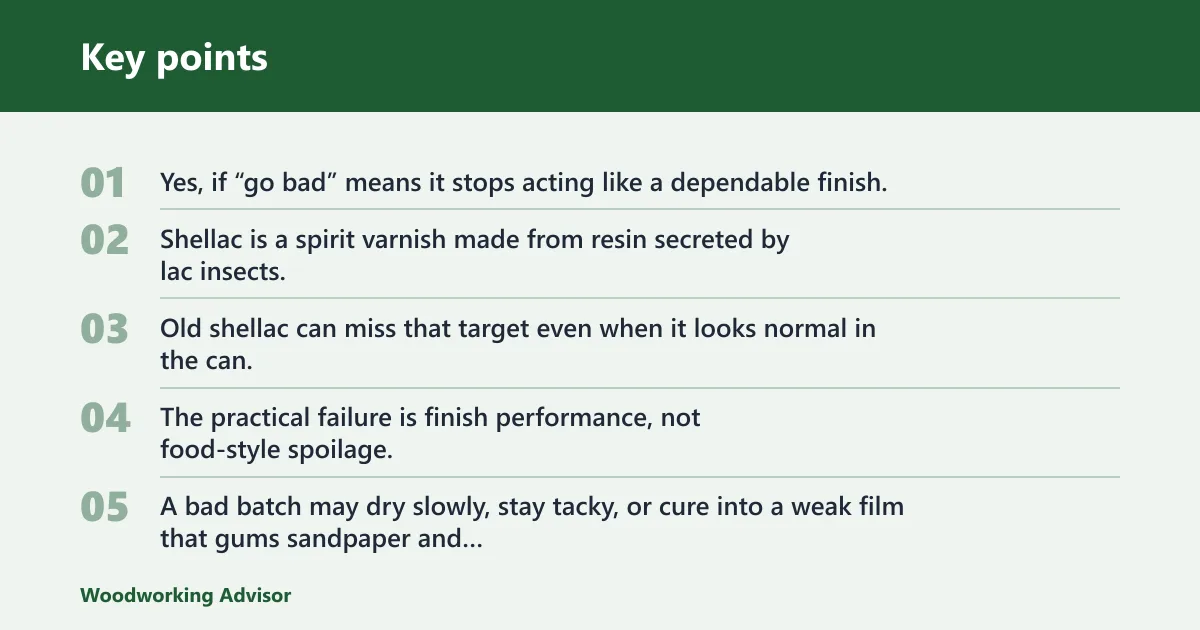


Yes, if “go bad” means it stops acting like a dependable finish. Shellac is a spirit varnish made from resin secreted by lac insects, and it is meant to dry, harden, and leave a solid film on wood. Old shellac can miss that target even when it looks normal in the can.
The practical failure is finish performance, not food-style spoilage. A bad batch may dry slowly, stay tacky, or cure into a weak film that gums sandpaper and traps dust. Once dry and hardened, shellac is safe in the workshop; the issue is whether it gets there.
What “going bad” means on wood
On wood, shellac is bad when it no longer forms a firm film in a normal drying window or leaves a surface that can be marred with light pressure. Old shellac can remain gummy after the solvent evaporates, which is a clear sign that the coating chemistry has slipped out of spec.
That matters more than the date printed on the label. A can can still be within the marked period and perform poorly if it has been stored warm, opened repeatedly, or contaminated.
How long does shellac last?
Liquid shellac has a limited shelf life, commonly about one year, but the real window depends on storage, additives, and age. Shellac flakes last longer in dry storage because they are sold as a dry or flaked form and are not already premixed with solvent. Fresh mixing often gives the most reliable result.
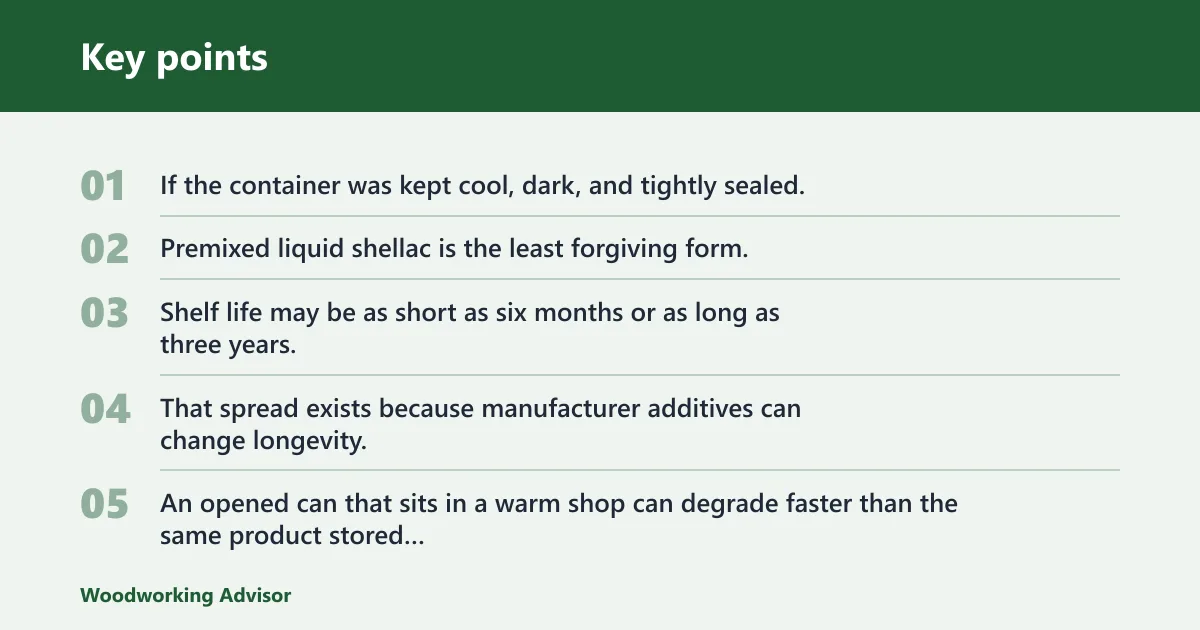
Use the date as a clue, not a verdict. If the container was kept cool, dark, and tightly sealed, shellac may stay usable longer than a warm, half-empty can on an open shelf. If it was stored badly, it may fail early.
Liquid shellac shelf life and why it varies
Premixed liquid shellac is the least forgiving form. Shelf life may be as short as six months or as long as three years, and about one year is a common target for many products. That spread exists because manufacturer additives can change longevity, and storage conditions matter a lot.
Heat and light cut useful life short. An opened can that sits in a warm shop can degrade faster than the same product stored sealed in a cool, dark cabinet.
How long shellac flakes last in dry storage
Shellac flakes have a long shelf life, but not a permanent one. Dry flakes usually keep better than liquid shellac because they are not already mixed with alcohol, and fresh mixing can restore reliability if the raw material is still sound.
Even so, old flakes can still fail to dissolve fully or can make a mix that behaves poorly if moisture has entered the bag or jar. Once they are dissolved, the mixed batch should be judged the same way as any other liquid shellac.
What manufacturer date codes can and cannot tell you
A best-by or date code is a starting point, not a final answer. It can tell you when the product was packed or when the maker expects the best performance, but it cannot account for heat, light, air exposure, or contamination after the sale.
That means a fresh-looking date does not guarantee good cure, and an older code does not automatically mean discard. Judge the shellac by smell, mix behavior, and dry-down.
What changes shellac shelf life?
Shellac lasts longest when it is kept cool, dark, and sealed, with clean solvent and minimal air exposure. Shelf life changes when temperature rises, light reaches the container, or the alcohol carries water or other impurities. Resin blend, additives, and wax content also change how the finish behaves.
Heat, light, and sealed storage
Heat speeds aging. Light and air also shorten working life because they make storage less stable over time. Keep both liquid shellac and flakes sealed tightly, away from windows, heaters, and bright shelves.
Cool storage is better than a hot attic or sunlit bench. For unopened liquid shellac, that can mean the difference between a usable batch and one that never hardens correctly.
Additives, resin blend, and wax content
Different shellac products are not identical. Manufacturer additives can lengthen or shorten shelf life, and the wax content matters for how a finish behaves later. Button-lac contains wax, so treat it as a waxed shellac rather than a universal sealer for every finishing schedule.
Dewaxed shellac is often preferred when you plan to add another finish on top. It is sold in multiple tints, and it is commonly chosen as a sealer because it gives more predictable compatibility in mixed finish systems.
Alcohol quality and water contamination
Shellac is dissolved in ethyl alcohol or denatured alcohol. If the solvent contains water or other impurities, the mix can cloud, dissolve poorly, or leave finish problems on the wood. That is one reason a batch can fail even when the resin itself is still serviceable.
Contaminated alcohol can also change dry-down and final feel. If a batch looks wrong after mixing, check the solvent before blaming the shellac alone.
Shellac usability checklist
This checklist separates three cases: unopened liquid shellac, opened liquid shellac, and shellac flakes. Use it to decide whether the material is ready to use, should be strained and tested, or should be discarded. The checks focus on smell, clarity, sediment, stir behavior, dry time, and tackiness.
| Decision path | Smell | Clarity | Sediment | Stir behavior | Dry time | Tackiness | Final recommendation |
|---|---|---|---|---|---|---|---|
| Unopened liquid shellac | Normal alcohol/resin smell | Mostly clear or evenly tinted | Little to none | Mixes smoothly after gentle shaking | Dries in about 45 minutes on wood | Hardens dry, not sticky | Use if all checks pass |
| Opened liquid shellac | No weak, sour, or off odor | No heavy clouding | Light settled residue only | Resuspends without lumps or stringy gel | Dries normally for the cut used | Not gummy after solvent flashes off | Strain-and-test if borderline; otherwise use |
| Shellac flakes | Dry, clean, normal resin smell | Not applicable until mixed | No damp clumps or crusting | Dissolves fully in alcohol | Mixed batch dries normally | No soft or sticky cure | Mix fresh; discard if it will not dissolve cleanly |
Smell, clarity, and sediment checks
Start with the container itself. A weak, off, or stale smell can signal aging solvent or a compromised batch. Cloudiness and sediment matter too, especially if they are heavy enough to stay suspended after gentle mixing.
A small amount of settled material is not always a deal-breaker, but chunky deposits or persistent haze are warning signs. For flakes, look for moisture damage, clumping, or crusting before you mix.
Stir behavior and mix appearance
Healthy liquid shellac should resuspend without resistance. If it turns stringy, lumpy, or refuses to blend smoothly, the batch may be past its useful life or contaminated. Fresh flakes should dissolve in alcohol rather than leaving gritty residue or ungelled fragments.
A half-used quart that has sat on a shelf for about a year may leave soft strings on the stir stick. That is not a storage quirk you should ignore. Strain and test only if the rest of the signs still look reasonable.
Dry time and tackiness test
Shellac coatings on wood generally dry in about 45 minutes, so a simple test panel is valuable. Apply a small amount to scrap, let the solvent flash off, and check whether the film turns firm instead of staying rubbery or soft.
If the patch remains tacky after a normal dry window, or if it gums up when rubbed lightly, the batch is failing. Old shellac can remain gummy after the solvent evaporates, so a surface that never hardens should not go back into service.
Use, strain-and-test, or discard decision
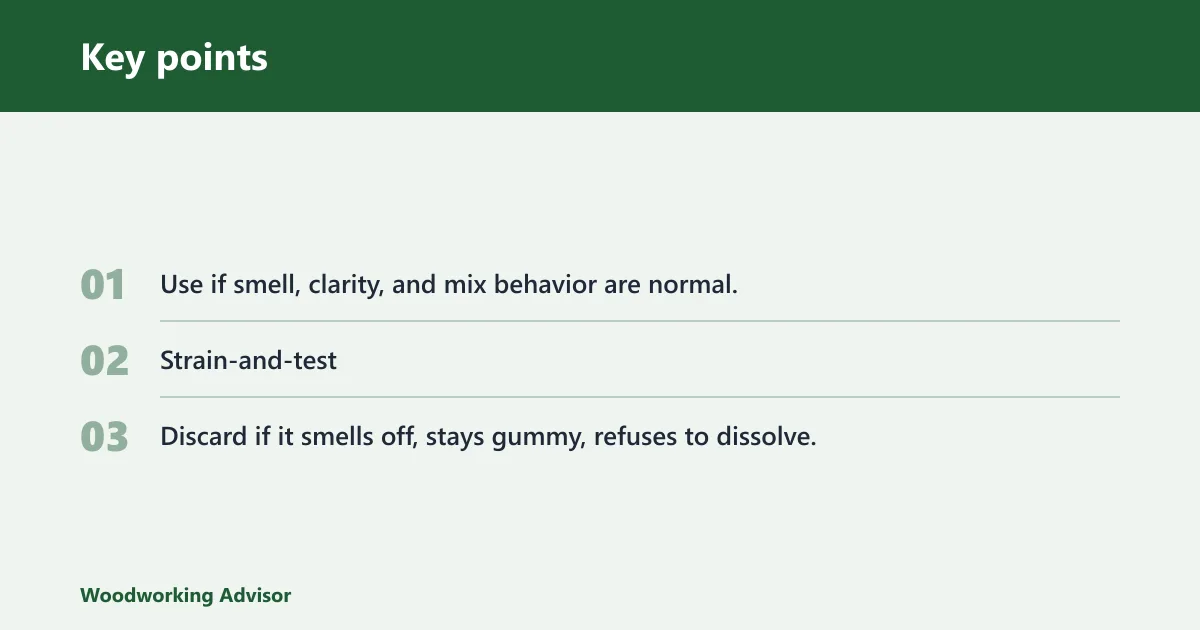
- Use if smell, clarity, and mix behavior are normal, and a scrap panel dries and hardens within the expected window.
- Strain-and-test if the liquid has light sediment, minor haze, or has been opened but still seems close to normal.
- Discard if it smells off, stays gummy, refuses to dissolve, or leaves a soft film after a test coat.
How to tell old shellac is failing
Old shellac usually fails in visible, testable ways. Look for cloudiness, sediment, poor flow, slow dry-down, and a film that stays soft. Those are finish defects, not cosmetic quirks. If the batch cannot make a hard, even coat on scrap, it is not ready for wood.
Cloudiness, sediment, and stringy mix behavior
Cloudiness can signal water contamination, aging solvent, or resin changes. Sediment is not always fatal, but heavy sediment or stringy gel behavior usually means the batch is unreliable. Shellac flakes that do not dissolve cleanly raise the same concern.
A common first-timer mistake is to shake a questionable can, brush it on a project, and hope the film evens out. If the mix already looks wrong in the container, do a scrap test first.
Gummy film, slow dry-down, and soft cure
Gummy film is one of the clearest failure modes. Even after the alcohol should have flashed off, the coating can stay soft and collect dust. That is a finish problem, not a normal drying delay.
If the test spot is still tacky after a reasonable dry period, do not “fix” it with more coats. The batch itself is the issue.
Poor flow, weak coverage, and finish defects
Old shellac may flow badly, leave lap marks, or cover unevenly. It can also leave a weak film that scratches easily or feels brittle in one area and soft in another. Those defects matter because they affect sanding, topcoating, and final appearance.
Picture a small furniture panel sealed with an old batch that looked fine in the jar but dries soft in the corners. The panel may still need stripping or resanding if the film never hardens evenly.
Should you use shellac flakes or liquid?
Flakes usually store longer, and fresh mixing often gives the most dependable result. Liquid shellac is convenient, but it has a shorter working life once premixed. If you need maximum reliability, flakes plus fresh alcohol are the safer storage choice for the long run.
Why flakes usually store longer
Flakes last longer because they are dry and not already diluted. That makes them easier to keep in reserve, especially for occasional projects or repair work. The key is dry, sealed storage so moisture does not spoil the batch before you dissolve it.
When fresh mixing improves reliability
Fresh mixing lets you control the cut and start with solvent you trust. That matters when the job needs a predictable sealer or when an older liquid batch is questionable. If the flakes are still dry and clean, mixing a new batch is often the best way to restore confidence.
When opened liquid shellac is still worth saving
Opened liquid shellac is worth saving only if it still passes the usability checks. A can that smells normal, mixes smoothly, and dries properly on scrap can still do useful work. Once it starts staying tacky, clouding badly, or leaving a weak film, discard it.
How should shellac be stored?
Store shellac cool, dark, and sealed. That simple rule applies to both liquid product and flakes. Heat, light, moisture, and air exposure all shorten usable life, and a half-used can or jar is usually the first place problems show up.
Cool, dark, sealed storage
A closed cabinet is better than a sunny shelf. Keep containers tightly sealed and away from heaters, windows, and damp corners. That is the best way to slow aging and preserve finish performance.
What to do with half-used cans and jars
Minimize the air space above the liquid. Transfer only if the new container is clean and truly sealable. For liquid shellac, less headspace generally means less exposure to air and slower loss of performance.
Storage notes for flakes in humid shops
Flakes should stay dry, not just sealed. In a humid shop or basement, use a container that blocks moisture and avoid repeated opening. If flakes clump, crust, or look damp, treat them as suspect before you mix.
Frequently asked questions
Does shellac go bad?
Yes, in the sense that it can stop curing into a hard, usable film. Old shellac may stay gummy, dry slowly, or leave a weak coating on wood. The main question is not safety; it is whether the finish will dry, harden, and accept later work properly.
How long does liquid shellac last once opened?
Once opened, liquid shellac often becomes a one-year material, though some products last as little as six months or as long as three years depending on storage and formula. If it has been warm-stored, repeatedly opened, or exposed to air, shorten your expectations and test it on scrap.
How long do shellac flakes last in storage?
Shellac flakes have a long shelf life when kept dry, cool, and sealed. They usually outlast premixed liquid shellac because they are not already diluted with alcohol. Even so, moisture contamination can ruin their performance, so dry appearance and clean dissolution still matter.
How can I tell if shellac is too old to use?
Check smell, clarity, sediment, and how it behaves when stirred or dissolved. Then brush a small sample on scrap and see whether it dries and hardens normally. If it stays tacky, goes gummy, or refuses to mix cleanly, it is too old for reliable work.
Can shellac that is past its date still dry properly?
Yes, sometimes. The printed date is only a guide, and a well-stored batch can still perform after that point. But once shellac starts drying slowly, staying soft, or leaving a gummy film, do not trust the label over the test panel.
What happens if shellac is mixed with water or contaminated alcohol?
Water or impure alcohol can cause cloudiness, poor dissolution, and finish problems. The mix may not flow well, and the film may dry unpredictably or fail to harden correctly. If the solvent is suspect, test a small amount before committing to a project surface.
Sponsored / affiliate links. As an Amazon Associate I earn from qualifying purchases. I may earn additional commission from eligible campaigns.