Best Bamboo Cutting Boards for Kitchens (2026): we compared
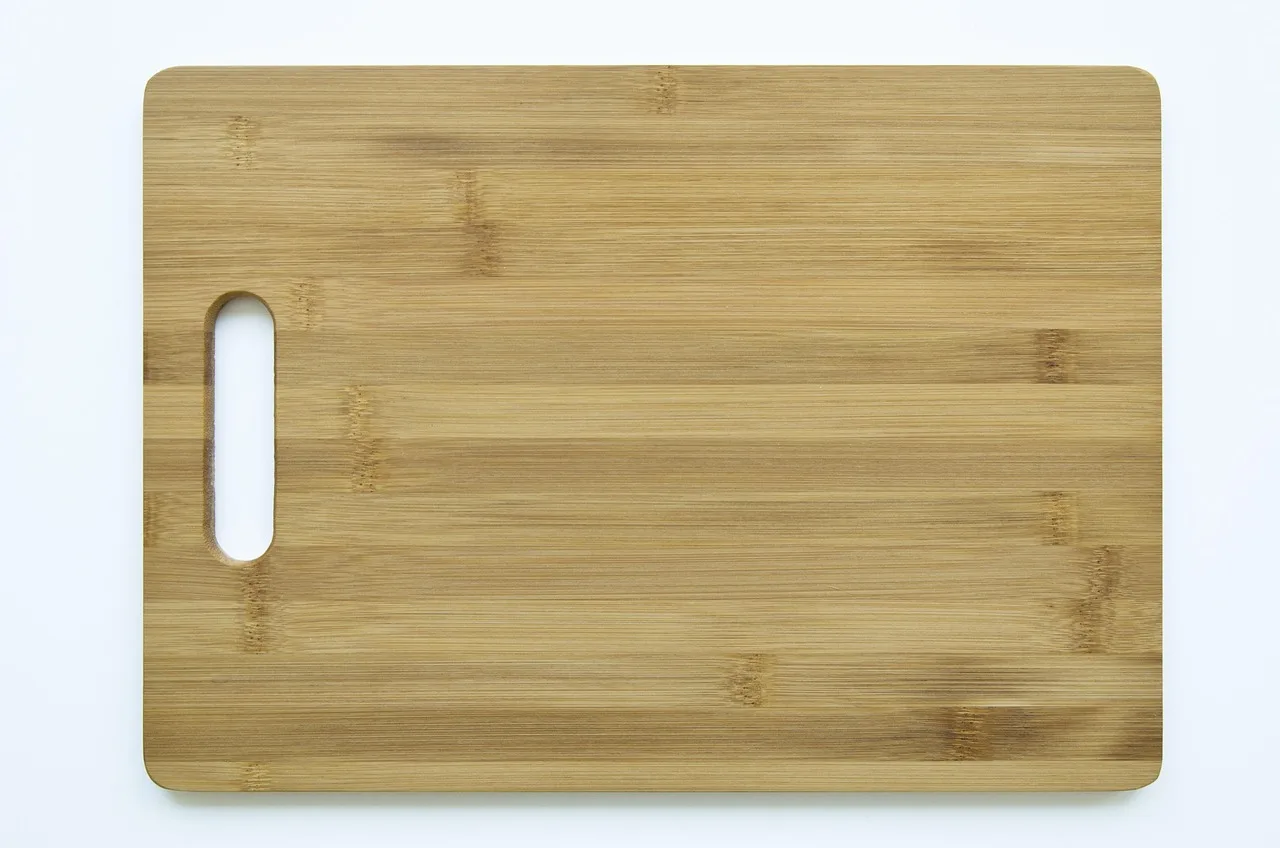
A good bamboo cutting board is often a medium-weight board around 3/4 to 1 inch thick, finished with a food-safe oil, with a generous size and non-slip feet if you want durability, easier maintenance, and less knife drag. Thin, untreated boards warp and split faster. This guide compares board types, weight, finishes, and safe food-prep use.
Quick comparison
| Product | Badge | Best for | Price | ||
|---|---|---|---|---|---|
 |
OXO Good Grips Plastic Carving & Cutting Board – White,OXO | Also great | 14.34 x 21.11 in · Plastic Carving Board | $37.95
Price as of 14 Oct 2026
|
View |
 |
Chef Craft Select Bamboo Cutting Board, 12.5 x 9.5 inch,Chef Craft | Budget pick | 12.5 x 9.5 in · Natural Bamboo | $11.99
Price as of 14 Oct 2026
|
View |
 |
Bamboo Cutting Board for Kitchen – 17" Large Wooden CuttingBambüsi | Our pick | 17 in x 11 in · Carbonized Bamboo | $16.99
Price as of 14 Oct 2026
|
View |
The best bamboo board for most kitchens is the one that stays flat, gives you enough working area, and does not turn washing into a chore. Size and weight matter as much as bamboo itself, and treatment matters more than marketing claims about extra hardness or moisture resistance.
📊 Kitchenwink’s editor’s choice is the Greener Bamboo Cutting Board Set – 3 Piece. Source: 8 Best Bamboo Cutting Boards: Top Tested Picks 2026.
How we chose
These picks and buying rules favor boards that hold position on the counter, keep cleanup practical, and match common prep habits. The main filters were size, weight, surface treatment, juice-groove usefulness, and whether the board fits real sink and counter spaces without constant lifting.
We also weighed maintenance honestly. Bamboo needs care, especially around drying and oiling, so a board that looks good on paper but asks for frequent rescue from warping or odor retention does not rate well.
Bambüsi 17-inch carbonized bamboo board: best for everyday use
This is the closest fit for a most-households pick because it gives you more working room than compact boards and includes a deep juice groove for messier prep. The carbonized bamboo treatment can help with moisture resistance, but it does not replace full drying after each wash.
Its drawback is the usual one for larger bamboo boards: it can be heavier and a bit less convenient to move to the sink. The side handles help, but a large board still asks for more storage space and more disciplined upkeep than a small prep board.
Quick picks
| Pick | Best for | Key spec | Price range |
|---|---|---|---|
| Bambüsi 17-inch carbonized bamboo board | Everyday prep and mixed tasks | Large size with deep juice groove | $16.99 |
| Chef Craft Select Bamboo Cutting Board | Small kitchens and light prep | 12.5 x 9.5 inch compact bamboo board | $11.99 |
| OXO Good Grips Plastic Carving & Cutting Board | Raw meat and lower cross-contamination risk | Non-porous, non-slip, integrated drip catcher | $37.95 |
The largest bamboo board here is the best all-around fit for most cooks. The compact bamboo option saves space, while the plastic board is the safer workflow choice when raw meat prep is frequent.
Chef Craft Select Bamboo Cutting Board: best for small kitchens
This board suits compact counters, quick prep, and cooks who want bamboo without dedicating a large footprint to storage. A 12.5 x 9.5 inch board is easier to lift, easier to rinse, and easier to stash in a narrow cabinet or shallow sink area.
The tradeoff is obvious: less working area means more interruptions, more ingredient spillage, and less room for a cutting rhythm. It also gives you less spill protection if you are slicing tomatoes, citrus, or any food that sheds liquid.
OXO Good Grips Plastic Carving & Cutting Board: best for meat workflow
This is the safer pick when sanitation workflow matters more than bamboo preference. Its non-porous surface and integrated drip-catcher make it easier to separate raw-meat prep from other tasks, and the non-slip feet help keep it planted during carving.
The drawback is that it is not bamboo, so it does not answer the bamboo-only shopping question. It also lacks the warmer cutting feel some cooks want from a bamboo board, so it is best treated as a separate utility board rather than a general bamboo replacement.
What is the best bamboo cutting board for everyday use?

The best bamboo cutting board for everyday use is a medium-heavy board with enough surface area to handle vegetables, bread, and proteins without constant crowding. For most home cooks, that means a board around the 15 by 20 inches minimum ATK recommends, with a weight near the 15 pounds sweet spot and a finish that has been treated with food-grade mineral oil.
Why this default works
A larger board reduces edge spills and gives you room to separate chopped food from uncut food. A heavier board stays put better on the counter, while a finish that has been properly oiled is less likely to dry out and crack.
ATK’s favorite wood board measures 18 by 24 inches, which shows how useful a larger surface can be if your counter and storage allow it. For bamboo, the same logic applies, but you still need to keep the board easy enough to lift for hand washing.
Are bamboo cutting boards good for knives?
Bamboo boards are usable with knives, but they are harder than many common wood cutting boards, so they tend to feel firmer under the blade and can wear edges faster than softer woods. That does not make them unusable. It means you should expect a denser cutting feel and plan on more routine knife maintenance.
What that means at the board
The surface feel most cooks notice is stiffness, not softness. Slices can sound and feel more “clicky” than on a softer edge-grain wood board. If you use thin, high-hardness knives and care about edge retention, bamboo is acceptable, but not the gentlest material available.
Deep-carbonized bamboo changes the look of the board and may help limit moisture uptake, but it does not make the cutting surface softer. Claims about extra durability should be read as treatment claims, not proof that knives will experience less wear.
What size bamboo cutting board should I get?
Choose the size based on counter fit first, sink fit second, and only then on how much working area you want. Small kitchens often work better with compact boards, while most home cooks should look for at least 15 by 20 inches if storage and washing space allow it.
Practical size ranges
- Small kitchens: about 12 x 8 to 13 x 10 inches.
- General everyday use: about 15 x 20 inches or larger.
- Large prep space: about 18 x 24 inches if your counter and cabinet space can handle it.
ATK says boards thicker than 2 inches can raise knives too high for taller cooks, so thickness should not be confused with quality. A board around 3/4 to 1 inch thick is a practical target for many bamboo boards because it balances stability with manageable weight.
Are bamboo cutting boards dishwasher safe?
Most bamboo cutting boards should not be treated as routine dishwasher items, even when a listing hints at easy cleanup. Heat, soaking, and prolonged moisture exposure can lead to warping, splitting, and loosening of glued joints. Hand washing and immediate drying are the safer default.
What to look for instead of dishwasher claims
If a bamboo board is marketed as dishwasher safe, check whether that claim is supported by the board’s build, adhesive quality, and finish. A board with a full-coverage glue line, no visible gaps, and a stable finish may survive more abuse, but repeated dishwasher cycles are still a risk, not a care method.
For bamboo, the better question is not whether it can survive a dishwasher cycle once. It is whether the board will stay flat, sanitary, and intact after repeated wet-dry cycles.
What is the best bamboo cutting board for meat?
The best bamboo cutting board for meat is one with a juice groove, enough weight to stay put, and a size that gives you room to manage drips without pushing food off the edge. For raw meat, though, a separate non-porous board is often the safer workflow because cleanup is simpler and cross-contamination is easier to control.
When a juice groove helps
A juice groove matters most when you are carving roasts, slicing tomatoes, or trimming meat that releases liquid. It keeps the spill contained and reduces cleanup on the counter.
It does not solve sanitation problems by itself. If you prep raw poultry often, a bamboo board with a groove still needs strict washing, immediate drying, and separation from ready-to-eat foods. A second board, ideally non-porous, is the better choice for frequent raw-meat work.
What is the best bamboo cutting board for health?
The best bamboo cutting board for health is the one that supports clean workflow, dries quickly, and does not trap food in cracks, odor spots, or damaged glue lines. Bamboo is not inherently safer than other board materials. Hygiene depends on cleaning, drying, and separating raw foods from ready-to-eat foods.
Wood versus bamboo safety concerns
Wood and bamboo both need proper sanitation, but the practical difference is maintenance behavior. A board that warps, checks, or opens seams creates more places for residue to linger. A flat, intact board that is hand-washed and dried promptly is the healthier choice than any board left wet or stored while damp.
That is why treatment, thickness, and finish matter. Deep-carbonized bamboo may resist moisture better than untreated bamboo, but it does not replace basic sanitation steps.
Do bamboo cutting boards need to be oiled?
Yes. Bamboo boards need oiling to slow moisture loss and reduce the chance of drying, splitting, and roughening at the surface. Food-grade mineral oil is a common initial protection step, and it is often the simplest maintenance choice for ongoing care.
A practical care schedule
- Wash by hand with mild soap and warm water.
- Dry immediately with a towel on both sides.
- Let the board air-dry upright so both faces ventilate.
- Apply food-grade mineral oil when the surface looks dry or pale.
- Recheck seams, warping, and odor retention regularly.
For a new board, start with the manufacturer’s oiling guidance if it exists. After that, a monthly check is a reasonable baseline for normal home use, with more frequent oiling if the board gets washed often or lives in a dry kitchen.
Which bamboo cutting board is the most durable?
The most durable bamboo cutting board is usually the one with solid lamination, a thickness around 0.75 to 1 inch, a stable weight, and a finish that resists repeated moisture exposure. Deep-carbonized bamboo may improve moisture resistance, but it is not a magic fix for warping or splitting.
What durability really means
Durability is not only surface hardness. It also means the board keeps its shape, does not open up at the seams, and stays usable after repeated wash-and-dry cycles. A very hard board that cracks early is less durable than a moderately hard board that stays flat.
ATK notes that heavier boards can be difficult to lift for cleaning, and the sweet spot for weight was 15 pounds. That is a useful target if you want a board that stays stable without becoming a burden at the sink.
Bamboo board scorecard: 7 criteria that matter
Use this matrix to compare bamboo boards by how they behave in a real kitchen, not by brand language. Scores run from 1 to 5, where 5 is strongest for that criterion.

| Criterion | What a strong board looks like | Weak board warning signs | Suggested spec range |
|---|---|---|---|
| Stability on the counter | Heavy enough to resist sliding, with feet or a grippy base | Lifts at the corners, skates during chopping | Near 15 pounds for larger boards; non-slip feet help |
| Knife feel | Firm but not glassy, with controlled drag | Feels very hard or chattery under the blade | 0.75 to 1 inch thick is a practical target |
| Moisture resistance | Well-sealed, minimal swelling, dries flat | Edges swell, seams open, board cups | Factory-oiled or maintained with food-grade mineral oil |
| Maintenance burden | Simple hand wash, easy drying, infrequent re-oiling | Needs frequent rescue from dryness or odor | Hand wash only; dry immediately after use |
| Raw-meat suitability | Used in a separated workflow with a juice groove or paired secondary board | Shared for all prep without careful cleaning | Best as a dedicated board, not the only board |
| Counter and sink fit | Fits your prep zone and can be washed without awkward angles | Too wide for sink, too small for prep | Small: about 12 x 8 to 13 x 10; general: 15 x 20 or larger |
| Value | Useful size, stable build, sensible finish, no junk features | Cheap but flimsy, or expensive without better function | Match price to size, finish, and handling needs |
Use the scorecard this way: a small board can still rate well on value and sink fit, while a large board can win on stability and raw-food handling. The right pick is the one that matches your actual prep habits, not the one with the longest feature list.
Which one should you buy?
Choose the Bambüsi if you want the best everyday bamboo board from this group, because it offers the best mix of size, juice control, and general-purpose utility. Choose the Chef Craft board if counter space is tight or you need a smaller backup board. Choose the OXO board if raw meat is a regular task and sanitation workflow matters more than bamboo.
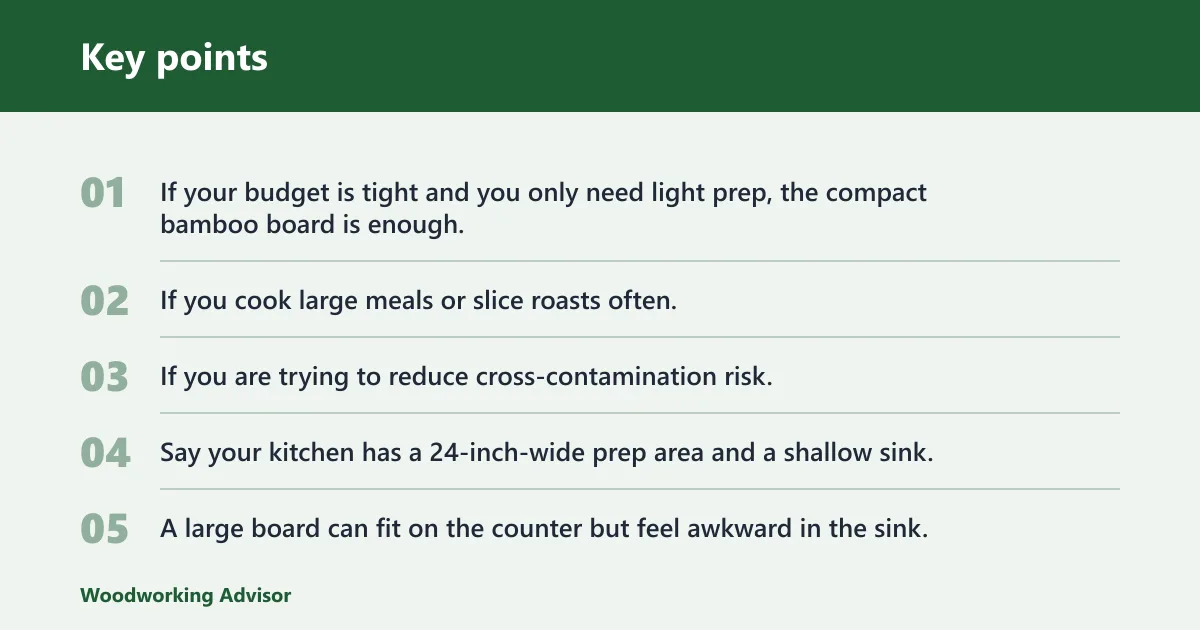
If your budget is tight and you only need light prep, the compact bamboo board is enough. If you cook large meals or slice roasts often, a bigger board with a groove is the better fit. If you are trying to reduce cross-contamination risk, separate raw meat from vegetables and bread, and do not rely on a single bamboo board for everything.
Say your kitchen has a 24-inch-wide prep area and a shallow sink. A large board can fit on the counter but feel awkward in the sink, so a medium board with a good finish may be the smarter compromise. Suppose you prep chicken thighs twice a week; a dedicated non-porous board is easier to keep in rotation than a bamboo board that also handles salad, fruit, and bread.
Sponsored / affiliate links. As an Amazon Associate I earn from qualifying purchases. I may earn additional commission from eligible campaigns.