Larch Wood Cutting Board Review
A larch wood cutting board is worth buying if you want a board with strong visual character, fair moisture tolerance, and a knife feel that is gentler than hard maple, while accepting more surface wear than maple. Choose maple for maximum hardness, walnut for a softer knife feel and darker marks, or bamboo for lower entry cost. Pick the wrong wood, and you can get faster scoring, more visible wear, or a surface that feels hard on knives. This review compares larch wood cutting boards with maple, walnut, and bamboo so you can judge price, durability, maintenance, and value.
Larch cutting board trade-offs


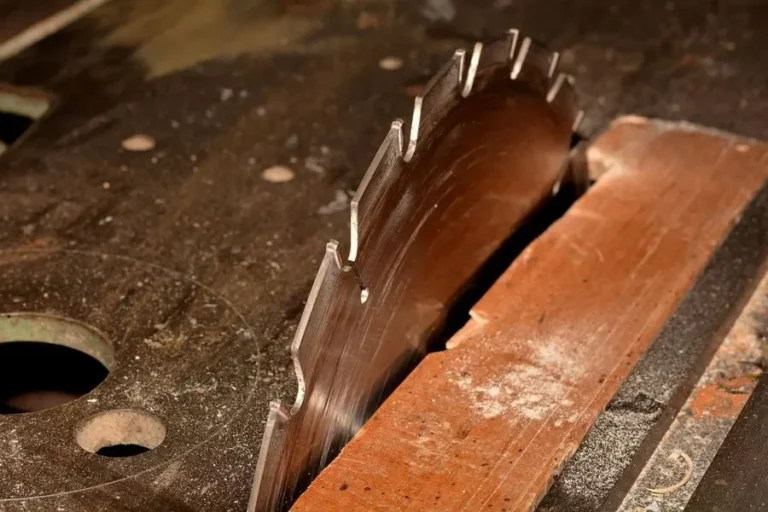
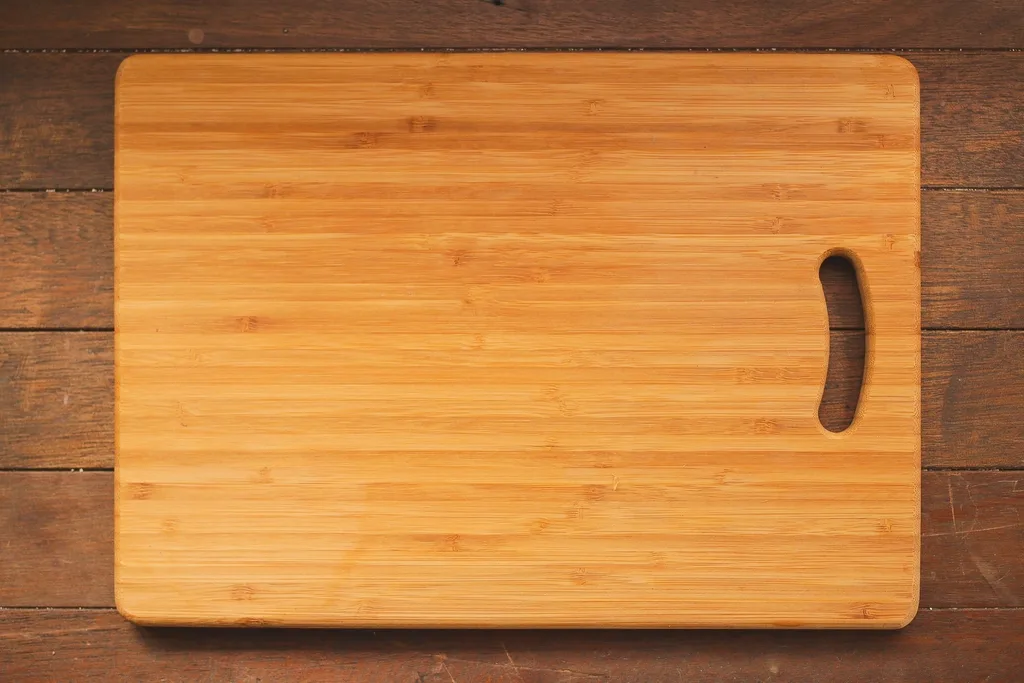
Larch sits in a practical middle ground. It is a softwood, but several larch species are harder than many other softwoods and have natural resin plus a slightly oily feel that helps with moisture resistance. That does not make larch maintenance-free, and it does not make it as scratch-resistant as hard maple.
The choice is simple: you get warmth, visual character, and decent knife feel, but you give up some surface hardness and long-term scratch resistance. If you cook often and cut on the board every day, that trade matters more than grain pattern.
What larch wood is doing in a cutting board
Larch wood is often used in end-grain cutting boards because the fiber structure suits that construction well. Larch Wood Canada describes its boards as made from Canadian-sourced larch and notes a 10-year warranty. The brand has been doing business since 2003, which matters because premium boards depend on build quality and support as much as species choice.
The product page also describes larch as a stunning softwood and says it is also known as Tamarack or Juniper. That naming can be confusing. In the kitchen, the more useful question is not the label, but which larch species you are getting and how hard it is.
Is larch wood good for cutting boards?
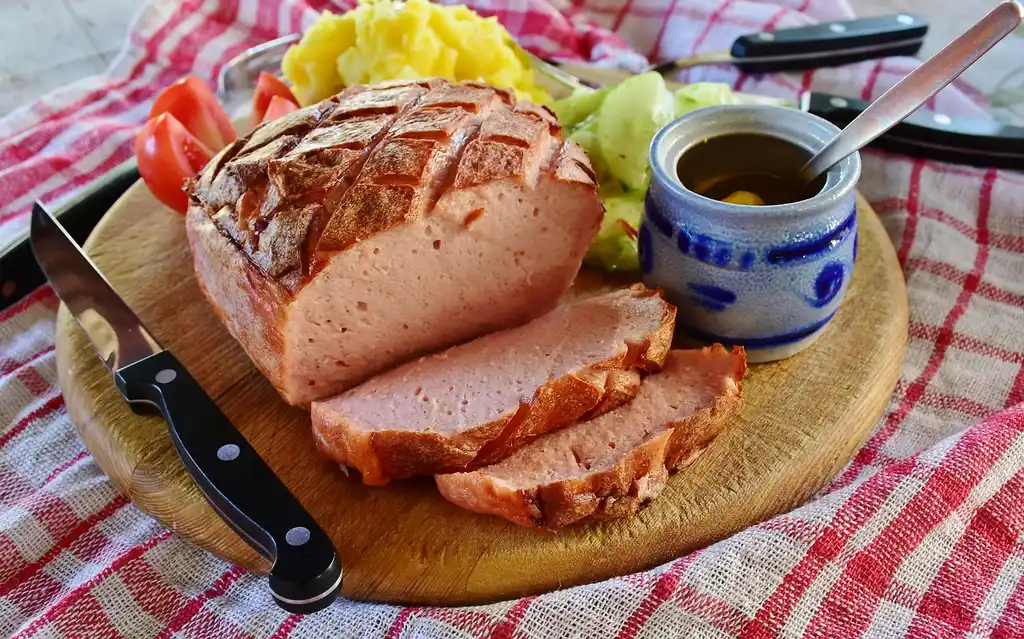
Yes, larch can be a good cutting-board wood if you want a board that is friendlier to knives than harder woods and you are fine with visible wear over time. It fits buyers who value appearance, moderate moisture resistance, and a softer cutting feel more than maximum surface hardness.
That said, “good” depends on the board construction and species. Larch from different regions does not perform the same, and end-grain construction changes both feel and price. A larch board can be a smart buy; it is not a universal best buy.
How larch hardness affects knife wear
Hardness affects how quickly the surface shows scoring and compression. Bevel & Bond lists Eastern Canadian larch, or tamarack, at 590 lbf Janka hardness. That is much softer than hard maple, which is commonly listed at 1,450 lbf. In practical terms, a softer board tends to show knife marks sooner and may need sanding or resurfacing earlier.
Western larch is listed at 830 lbf, and European larch at 740 lbf. Those numbers are still below hard maple, but they suggest better resistance than many other softwoods. If you slice daily with a sharp chef’s knife, the difference between 590 and 830 lbf is not academic. It affects how fast a board starts to look used.
What moisture resistance means in daily use
Larch has natural resin and a somewhat oily feel, and several species are used in outdoor applications such as boatbuilding, fencing, and flooring. That points to useful moisture and rot resistance. It does not remove the need to wash carefully, dry upright, and avoid soaking. Moisture resistance is a trait; drying habits are the maintenance part.
Boards can still warp, stain, or crack if they are left wet, soaked, or stored poorly. A larch board may handle kitchen moisture better than a lot of softwoods, but it is still a wooden board. Water on the surface is manageable. Water left in the fibers is a problem.
Where knife marks and stains show up first
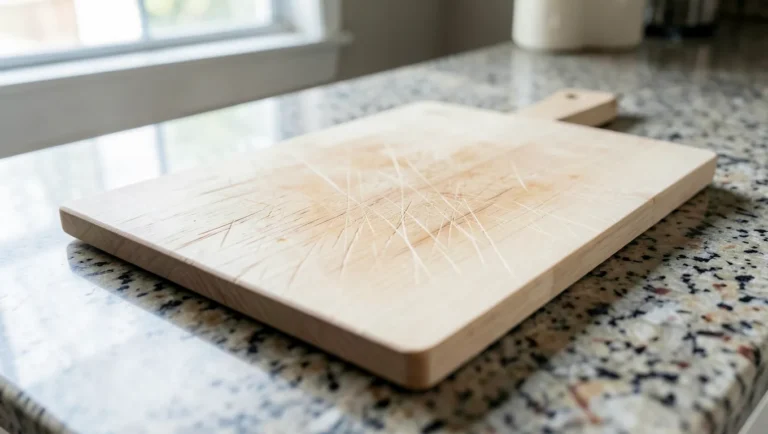
On larch, the first wear usually appears where the knife lands most often: the center strip, the main prep lane, and any repeated rocking path from a chef’s knife. Staining tends to collect around cut grooves, juice channels, and places where wet food sits before wiping.
The 18-inch board is described as being used for onions, carrots, and chicken prep about five nights a week. If it is left damp after each session, you should expect the first visible issues to be dull scoring and darker spots near the main work zone, not on the outer edges.
Larch board buyer table
This table is the quickest way to judge whether larch matches your buying priorities. It focuses on the issues that matter after the first month: hardness, moisture behavior, knife feel, visual character, and the kind of wear you can expect with regular kitchen use.
| Wood | Hardness | Moisture resistance | Knife-friendliness | Visual distinctiveness | Expected wear | Best for | Not for |
|---|---|---|---|---|---|---|---|
| Larch | Softwood; varies by species, from 590 lbf to 830 lbf in the species named here | Better than many softwoods; resin and oily feel help, but care still matters | Very good in end-grain form | Warm, natural, visually distinct | Moderate marking, possible staining and surface wear over time | Buyers who want style, decent moisture tolerance, and a softer cutting feel | Shoppers who want the hardest, most scratch-resistant surface possible |
| Maple | Harder; hard maple is 1,450 lbf | Depends on finish and care; not known for larch-like resin feel | Good, but firmer on knives than larch | More understated | Better scratch resistance, slower visible wear | Heavy daily prep and buyers focused on long service life | Anyone wanting a softer, warmer aesthetic |
| Walnut | Generally softer than maple | Depends on construction and care | Gentler feel than maple | Dark and easy to hide marks | Shows use more slowly than many light woods, but is not the hardest choice | Buyers who want softer knife feel and a darker look | People who need maximum hardness |
| Bamboo | Often hard for its weight, but performance varies by product | Can be stable when well made, but quality varies widely | Can feel harder on knives than wood boards | Plain and uniform | Can be prone to edge wear or glue-line issues in lower-quality boards | Budget-minded buyers | Anyone prioritizing knife feel over price |
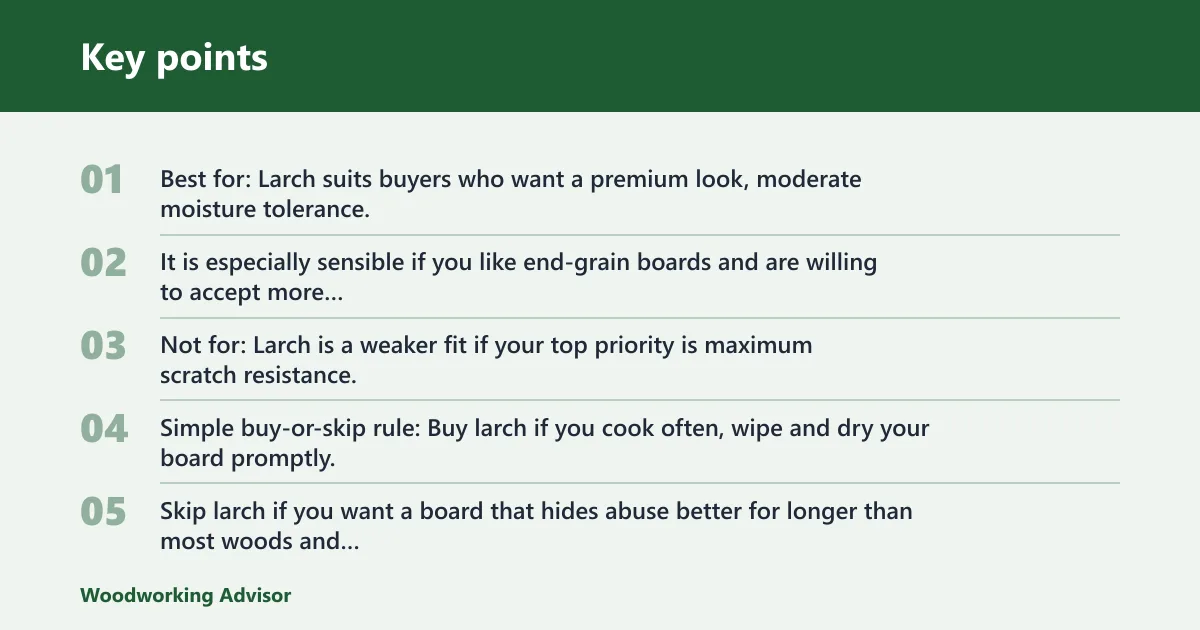
Best for: Larch suits buyers who want a premium look, moderate moisture tolerance, and a board that does not feel overly hard under the knife. It is especially sensible if you like end-grain boards and are willing to accept more visible wear than maple.
Not for: Larch is a weaker fit if your top priority is maximum scratch resistance, the longest possible refinish interval, or the hardest kitchen surface you can buy. That is where maple tends to win.
Simple buy-or-skip rule: Buy larch if you cook often, wipe and dry your board promptly, and care about appearance as much as wear. Skip larch if you want a board that hides abuse better for longer than most woods and you do not want to think about maintenance.
How does larch compare with maple, walnut, and bamboo?
Larch compares well on feel and appearance, but it does not outrun maple on hardness. Against walnut, larch is usually the brighter, more moisture-tolerant-looking choice. Against bamboo, larch is the warmer, more traditional wood option, while bamboo often wins on entry price.
Larch vs maple
Maple is the benchmark for hardness. At 1,450 lbf, hard maple is clearly tougher on paper than the larch figures listed for Eastern Canadian, Western, and European larch. In a kitchen, that usually means maple resists deep scoring and repeated knife tracks better over the long run.
Larch is the better fit if you care more about a softer cutting feel and a more distinctive look. Maple is the better fit if your board gets heavy daily use and you want the surface to stay flatter and cleaner-looking for longer.
Larch vs walnut
Walnut usually sits in a more knife-friendly lane than maple and often hides wear better because of its darker color. Larch can be better if you want a lighter, more striking board and some extra moisture tolerance from the wood’s resinous character.
Choose walnut when you want a softer visual tone and are okay with a board that is not as hard as maple. Choose larch when you want visible grain, warm color, and a board that feels slightly more tactile without moving into maple stiffness.
Larch vs bamboo
Bamboo is often sold on price and a clean, modern look. It can be a practical value choice, but quality varies a lot from board to board, and some bamboo boards feel harder on knives than wood boards. Larch usually offers a more traditional cutting feel and stronger visual distinction.
If you want the lowest entry cost, bamboo is often the first comparison point. If you want a board that feels more like a fine wood product and less like a utility slab, larch is the more appealing option.
End-grain vs edge-grain larch boards
End-grain is the premium construction for larch cutting boards because the wood fibers face upward. That arrangement is kinder to knives and often gives the board a more forgiving cutting feel. It also costs more because it takes more material, more labor, and more careful assembly.
Why end-grain costs more
End-grain boards are harder to produce than edge-grain boards. The maker has to orient and glue more blocks, and the finished board usually takes more time to plane, sand, and square. That helps explain why larch round cutting boards are listed at $250.00, a medium carving board at $330.00, a large Ki serving board at $360.00, and an end grain butcher block at $389.00.
Those prices put larch into premium territory. You are not paying only for wood. You are paying for species selection, labor, and the board format.
What you gain in knife feel
End-grain can feel smoother under repeated chopping because the knife passes between fiber ends rather than across long fibers. That matters most on boards used for frequent prep. It does not make the board indestructible, but it can slow the appearance of obvious slicing lines compared with a less forgiving surface.
A common first-timer mistake is buying an attractive board for serving and then using it like a daily prep surface. A 14 x 20 inch larch end-grain board can handle that role better than a thin edge-grain tray, but it will still show cut patterns if you use it hard and clean it poorly.
What to expect from upkeep and repairs
End-grain boards can be repaired more easily than many thin boards because the working face can sometimes be resurfaced, but they still need regular oiling, dry storage, and quick cleanup after wet foods. Deep grooves, staining, and cracked glue joints are the failure cases to watch.
Edge-grain larch boards cost less and can still be useful for lighter prep or serving. If you cut hard foods daily, though, end-grain is the version that justifies the premium more clearly.
Choose larch if… / Choose maple if…
Choose larch if you want a board with stronger visual character, a softer feel than maple, and better odds of keeping a warm, natural look on the counter. Choose maple if your top priority is maximum hardness, long scratch resistance, and a board built for repeated, hard daily prep.
Walnut fits in between on feel and appearance. Bamboo fits lower on price, but it is less compelling if knife feel and long-term refinement matter more than initial cost.
Choose larch if…
- You want an end-grain board that feels kinder to knives than a very hard surface.
- You are comfortable with visible wear and occasional resurfacing.
- You value a warmer, more distinctive board on the counter.
- You will dry the board promptly and avoid soaking.
Choose maple if…
- You want the hardest surface in this comparison.
- Your board sees heavy chopping every day.
- You want slower visible scoring and a longer path to refinish work.
- You care more about durability than about a softer cutting feel.
What should you look for in a larch board?
Look past the species name and check the details that affect value over time. The right larch board should tell you which larch it uses, how it is built, what support comes with it, and whether the price matches the construction.
Species and origin details
Do not assume all larch boards behave the same. Eastern Canadian larch, or tamarack, is listed at 590 lbf and is used by Larch Wood Canada. Western larch, or Larix occidentalis, is listed at 830 lbf and is used for flooring, veneer, plywood, and construction lumber. European larch, or Larix decidua, is listed at 740 lbf and is used in boatbuilding, fencing, and flooring.
Those numbers help explain why one larch board may wear differently from another. If a product listing does not name the species or source, you are missing part of the value picture.
Warranty, build quality, and repairability
A 10-year warranty is a useful sign, but it does not replace good construction. Check for tight joints, even sanding, stable feet, and a flat surface that sits securely on the counter. Family-run or handmade positioning can be useful, as The Wood Carpenter notes that larch boards are often handmade and premium, but the finish quality still needs to justify the price.
Repairability matters too. A premium board should be thick enough to resurface, and the maker should give care instructions that make sense: wash promptly, dry fully, and oil on schedule. If the board is meant to be decorative but not practical, the price should reflect that.
Price-to-lifespan checks
Use price against likely lifespan, not against appearance alone. A $250.00 round board can be fair if the build is strong and the board stays stable. A $389.00 end grain butcher block needs stronger long-term value to justify itself, especially if you plan to use it hard every week.
Ask whether the board is meant for prep, serving, or both. A serving board that rarely sees a knife can justify a premium look more easily than a daily chopping board. That distinction is where many buyers either overspend or buy too lightly built a board.
Frequently asked questions
How hard is larch wood?
Larch hardness varies by species. Those figures put larch below hard maple, which is commonly listed at 1,450 lbf, so larch should be expected to show wear sooner.
How durable is larch wood for daily knife use?
Larch can handle daily knife use, especially in end-grain form, but it is not the most wear-resistant choice. Expect scoring, staining in high-use areas, and some surface dulling over time. Good drying habits and routine oiling matter just as much as the wood species itself.
Does larch wood resist water and warping?
Larch has natural resin and a somewhat oily feel, and several species are used in outdoor or moisture-exposed applications. That suggests useful water resistance, but it does not prevent warping if the board stays wet or is dried unevenly. Quick cleanup and full drying still matter.
Is larch softer than maple for cutting boards?
Yes. Hard maple at 1,450 lbf is clearly harder than the larch figures listed for tamarack, Western larch, and European larch. That means maple generally resists knife marks and surface wear better, while larch usually feels a bit friendlier under the blade.
They can be, especially if you want better knife feel and plan to use the board for regular prep. End-grain construction costs more because it is harder to make, and the board should be thick enough to justify repair and maintenance over time. For light serving, the premium is harder to justify.
How do larch boards compare with walnut or bamboo?
Larch usually offers a more distinctive wood look than bamboo and a warmer, lighter appearance than walnut. Walnut tends to hide wear well and feels softer under the knife, while bamboo often wins on entry price. Larch sits between them on value, with better moisture character than many buyers expect.
What should you look for in a larch wood cutting board review?
Look for the exact species, the Janka numbers, whether the board is end-grain or edge-grain, the warranty, and the price. A useful review should explain wear, staining, drying, and repairability instead of stopping at appearance. If those details are missing, the review is only half useful.
Is elm wood good for cutting boards?
Elm can be used for cutting boards, but it is a separate buying question from larch. If you are comparing woods, focus on hardness, build type, and maintenance support. For a board purchase, the practical issue is whether the species and construction match how often you cut and how much wear you accept.
How hard is larch wood: larch hardness depends
Larch hardness depends on species. That range is useful because it shows larch is not a single-performance wood, and none of those figures reaches hard maple.
How durable is larch wood
Larch is moderately durable for a cutting board, especially when the board is made well and cared for properly. It resists moisture better than many softwoods, but it can still stain, groove, crack, or warp if neglected. For high-use kitchens, durability should be judged against maple, not against appearance alone.
Sponsored / affiliate links. As an Amazon Associate I earn from qualifying purchases. I may earn additional commission from eligible campaigns.