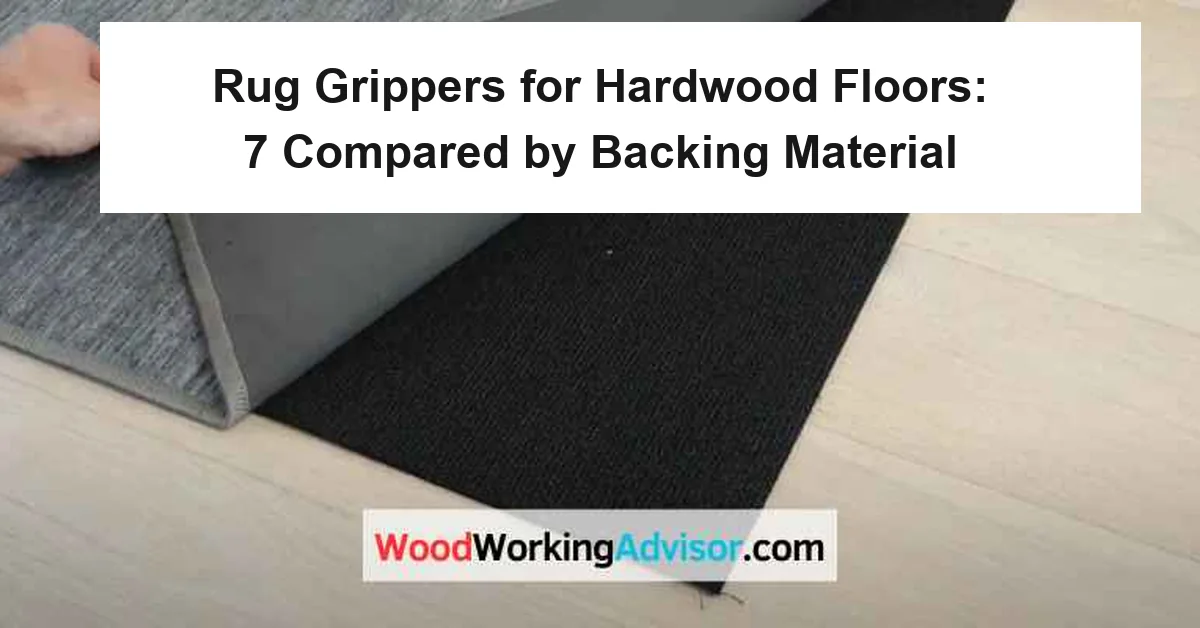
Rug Grippers for Hardwood Floors: 7 Compared by Backing (2026)
The best rug gripper for hardwood floors is the RUGPADUSA Dual Surface felt-and-natural-rubber pad ($89.95 for 8’x10′), because it is the only pick here whose maker states in writing that it will not stain, strip or mar a finished floor. Corner grippers are cheaper, but they fix curling corners only. They do not stop a rug sliding, and that difference decides which one you actually need.
Most roundups on this topic treat “rug gripper” and “rug pad” as the same product. They are not. One is four sticky tabs at the corners; the other is a sheet that covers the whole rug footprint. They fail in different ways, they cost about ten times different, and only one of them has a documented history of wrecking floor finishes.
We compared seven of them on the axis that actually matters on a wood floor: what the backing is made of, and what the manufacturer will and will not say about your finish.
Rug Grippers for Hardwood Floors Compared: Backing, Finish Safety and Real Cost
Every price below is the live Amazon buy-box price pulled on 2 August 2026. The “cost per 5×8 rug” column is derived, not quoted — the formula is under the table so you can check the arithmetic. Where a manufacturer does not publish a material or a floor restriction, the cell says “not published” rather than a guess.
| Product | Backing material (per maker) | Maker’s own floor exclusions | What it actually fixes | Price | Cost per 5×8 rug (derived) | Verdict |
|---|---|---|---|---|---|---|
| RUGPADUSA Dual Surface 1/4″ | 22 oz/sq yd recycled felt + 14 oz/sq yd natural rubber | None. States “safe for all floors and finishes” if flooring maker’s cure times are met | Sliding + cushion | $89.95 (8’x10′) | $44.98 | Best all-round; the only pick with a written finish-safety claim |
| Gorilla Grip Rug Grippers, 8 pc | Not published | Gripper page says only “check floor manufacturer’s directions”. Brand’s own rug pad excludes lacquered and refinished floors | Corner curl only | $8.98 (8 pc) | $4.49 | Cheap curl fix; adhesive sits on your finish |
| iPrimio NeverCurl V-Shape, 4 pk | Rigid V-shape insert; adhesive bonds to the rug, not the floor | Not published | Corner curl only | $9.99 (4 pk) | $9.99 | Safest corner fix — nothing adheres to the floor |
| Mohawk Home Felt + Latex 1/4″ | Recycled felt + “latex rubber” (natural vs synthetic not published) | Not published | Sliding + cushion | $60.00 (8’x10′) | $30.00 | Cheapest full pad; the unspecified latex is the open question |
| RUGPADUSA Basics 100% Felt | 24 oz/sq yd felt, no backing layer at all | None; safe for all floors | Cushion only — maker states “NOT NON-SLIP” | $69.95 (8’x10′) | $34.98 | Zero rubber contact, but it will not grip anything |
| RUGPADUSA Vinyl Lock | Felt + EVA; maker states “contains no rubber or latex” | Built for vinyl/LVP specifically | Sliding on vinyl plank | $161.95 (8’x10′) | $80.98 | Only if your “hardwood” is actually LVP |
| Rabenda Rug Tape Gripper, 12 pc | Not published | Not published | Corner curl only | $8.99 (12 pc) | $3.00 | Cheapest per rug; least disclosed of any pick |
How the cost-per-rug column was calculated
Pads are sold by area and corner grippers are sold by the piece, so the sticker prices are not comparable. Both were normalised to the same job: securing one 5×8 ft area rug, which is 40 square feet with four corners.
- Full pads: (list price ÷ pad area in sq ft) × 40 sq ft. The RUGPADUSA Dual Surface at $89.95 for an 8’x10′ pad is 80 sq ft, so $89.95 ÷ 80 = $1.124/sq ft, × 40 = $44.98.
- Corner grippers: (pack price ÷ pieces per pack) × 4 corners. The Gorilla Grip 8-pack at $8.98 is $1.12 per piece, × 4 = $4.49, and the pack covers two rugs.
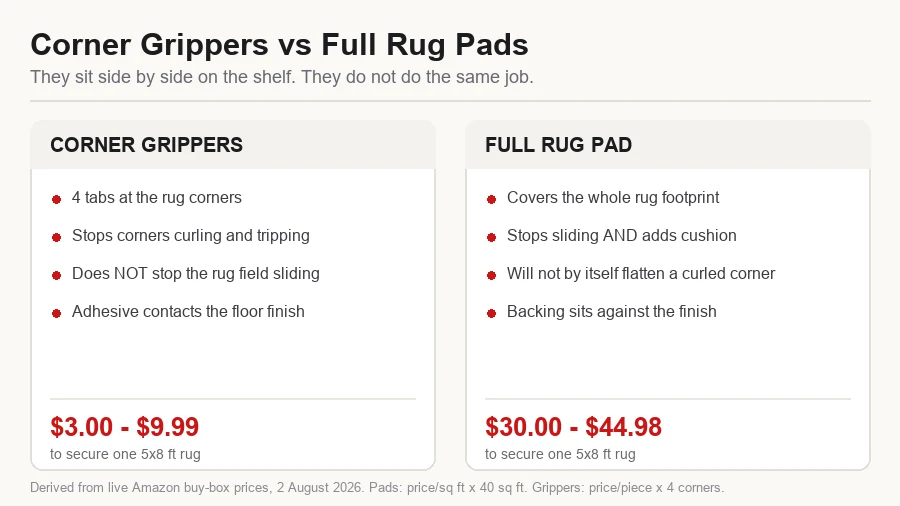
That normalisation produces the single most useful number on this page: securing one 5×8 rug costs $3.00 to $9.99 with corner grippers, or $30.00 to $44.98 with a full pad. A ten-fold gap looks like an obvious win for the cheap option until you notice they are not solving the same problem.
Why Rug Backing Chemistry Matters on a Wood Floor
This is the part the product listings skip. A wood floor is not bare wood — it is wood under a cured film of polyurethane, or a penetrating oil, or wax. That film is a plastic, and plastics interact with other plastics.
PVC, vinyl foam and cheap synthetic “latex” backings contain plasticizers — additives that keep the material soft and flexible. Plasticizers are not chemically bonded into the material, so they migrate. Pressed against a floor finish for months under a rug that nobody moves, they leach out of the backing and into the finish, softening it and leaving a yellow, orange or hazy patch in the exact shape of the pad. The flooring trade calls this plasticizer migration, and the reason it matters to a buyer is simple: it is a stain inside the finish, not on top of it. No cleaner reaches it. The repair is sanding that section back and refinishing.
We have set this out the same way in our guide to cleaning an area rug on a hardwood floor, and the industry guidance is consistent: felt, jute and natural rubber are the backings that do not carry this risk, because they contain nothing that needs to migrate.
The manufacturers confirm it themselves, in the fine print
You do not have to take a chemistry argument on trust. Two of the biggest names in this category say it on their own product pages.
- Gorilla Grip sells its full-area rug pad on a product URL that literally reads pvc-rug-pad, and the page states it is “not intended for use on carpet, vinyl, lacquered, acrylic, natural stone, porous, or refinished surfaces.” Lacquered and refinished floors are an enormous share of real American hardwood. That exclusion appears in no competing roundup we read.
- RUGPADUSA sells a separate product line for vinyl plank purely because of backing chemistry. Its Vinyl Lock pad’s first bullet is “CONTAINS NO RUBBER OR LATEX: this rug pad’s felt and EVA construction is specially formulated not to stain or discolor your vinyl or luxury vinyl plank floors.” A manufacturer does not build and stock an entire second SKU to solve a problem that does not exist.
Read those two together and the buying rule falls out on its own: the backing material is the specification, and any product that will not tell you what its backing is made of has told you something. Three of the seven picks below do not publish it.
Best Rug Grippers for Hardwood Floors
1. RUGPADUSA Dual Surface — #1 Best Overall
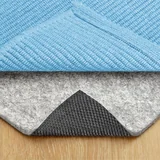
$89.95 — 8’x10′, $1.12/sq ft
Felt + natural rubber · 1/4″ thick · Made in USA
Check Price on AmazonThis is the pick because of what RUGPADUSA is willing to put in writing. The company states its felt-and-natural-rubber pads “won’t stain, strip, or mar hard surfaces as long as flooring manufacturer’s instructions are followed.” No other product in this comparison makes an affirmative finish-safety claim; the rest either stay silent or list exclusions.
The specification behind that is 22 oz per square yard of needle-punched recycled felt bonded to 14 oz per square yard of natural rubber. Natural rubber is tapped latex, not a compounded synthetic, so there is no plasticizer package in it to migrate. The felt face is needle-punched specifically so moisture can pass through rather than sit trapped against the finish — which is the second way rugs damage wood floors, independent of chemistry.
- Pros: The only written non-staining claim in this group; genuine grip on the whole rug footprint, not just corners; 1/4″ of felt adds real cushion and quietens footfall; low VOC and odourless out of the box.
- Cons: Ten times the cost of corner tabs; you must trim it to your rug (aim for one inch smaller per side); 1/4″ of loft can foul a door that already clears the floor tightly.
Main drawback: the finish-safety claim is conditional on “flooring manufacturer’s instructions”, and that condition has teeth on a newly finished floor. Waterborne and oil-modified polyurethanes keep curing for two to four weeks after they stop feeling tacky. Put any rubber-backed pad down inside that window and you can imprint the pattern of the rubber into a finish that has not fully hardened. If your floors were done this month, use pick 5 instead.
Buy this one if the rug moves when you walk on it and you intend to keep the floor for years. It is the option with the least to go wrong and the most disclosure behind it.
2. Gorilla Grip Rug Grippers — Best Rug Gripper for Corners That Curl
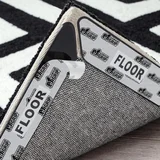
$8.98 — 8 pieces, $4.49 per rug
Dual-sided adhesive · 8″ x 6.5″ each · Reusable
Check Price on AmazonThis is the product most people mean when they search for a rug gripper, and it is the one Bing sends the most traffic for by brand name. It earns its place: at 8 inches by 6.5 inches these are notably longer than typical corner tabs, so they hold a bigger span of the corner down and are much harder to kick loose than a 3-inch square.
Used for what it is — a curl fix — it works. A corner that lifts is the single most common tripping hazard in a room with an area rug, and eight pieces at $8.98 handles two rugs.
- Pros: Extra-long footprint grips more of the corner than rivals; genuinely reusable after a rinse and dry; low profile enough to stay invisible under a rug; cheapest credible brand-name option per rug.
- Cons: Backing material is not published anywhere we could find; adhesive sits directly on the finish; does nothing about the rug sliding as a whole; grip weakens on rugs with a loose or fuzzy backing.
Main drawback: the disclosure gap. Gorilla Grip’s page for these grippers says only “check floor manufacturer’s directions before using to be sure product will not harm floor surface” — which puts the decision back on you without giving you the material you would need to make it. It is worth knowing that the same brand’s full-area rug pad is sold on a URL reading pvc-rug-pad and explicitly excludes lacquered and refinished surfaces. That exclusion is written about the pad, not these grippers, and we are not going to claim otherwise. But if you have a lacquered or recently refinished floor, that is the brand signalling caution somewhere in its range, and the grippers give you no data to rule yourself back in.
Practical approach: test one on an out-of-sight patch — inside a closet doorway, under furniture — leave it a month, then lift it and look. That is a real check you can run in your own house, and it costs nothing.
3. iPrimio NeverCurl V-Shape — Best Rug Gripper That Never Touches the Floor Finish
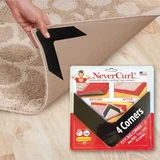
$9.99 — 4 pack, $9.99 per rug
7.5″ x 7.5″ · V-shape insert · Bonds to the rug
Check Price on AmazonThe NeverCurl solves the corner problem with geometry instead of stickiness. It is a rigid V-shaped insert that adheres to the underside of the rug corner and uses its own spring tension to hold that corner flat against the floor. The maker’s phrasing is the point: “the NeverCurl grippers attach to the rug, not the floor.”
For anyone worried about their finish, that single design decision removes the entire risk category. There is no adhesive against the polyurethane, so there is nothing to migrate into it and nothing to peel off when you remove it. On a rented apartment floor or a floor you have just paid to have refinished, that matters more than a few dollars.
- Pros: No adhesive contacts the floor at all; works on hardwood, tile and laminate equally; holds heavier rug corners than a flat tab because it uses mechanical tension; removable without touching the finish.
- Cons: Most expensive per rug of the three corner options at $9.99; the adhesive that bonds to the rug is permanent in practice, so it is a one-rug commitment; bulkier than a flat tab and can be felt underfoot on a thin rug.
Main drawback: it is still only a corner fix. A NeverCurl at each corner will keep a rug lying perfectly flat and will not stop that rug travelling six inches down the hallway over a month. If your complaint is sliding rather than curling, this is the wrong product no matter how floor-safe it is.
4. Mohawk Home Felt + Latex Rubber — Best Value Rug Pad for Hardwood Floors
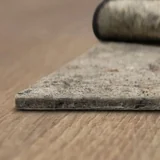
$60.00 — 8’x10′, $0.75/sq ft
Recycled felt + latex rubber · 1/4″ thick · Dual surface
Check Price on AmazonAt $0.75 per square foot this is the cheapest way to get a genuine full-coverage pad under a rug, undercutting the RUGPADUSA Dual Surface by a third. It is the same basic architecture — a recycled felt face for cushion, a rubber underside for grip — and it is reversible, so the felt can face down if you are laying the rug over carpet instead.
For a room where the rug slides and the budget is real, it is a sound buy. TechGearLab, which physically tested nine rug pads, ranked the Mohawk dual-surface pad as its best value pick, and their finding that felt-and-rubber constructions outperform simple waffle-pattern PVC pads on grip matches what the material logic predicts.
- Pros: Cheapest full pad per square foot here; reversible for rug-over-carpet use; 1/4″ recycled felt gives real cushion and sound absorption; widely stocked in common rug sizes.
- Cons: “Latex rubber” is not specified as natural or synthetic; no finish-safety statement published; thinner-feeling than the RUGPADUSA at the same nominal 1/4″.
Main drawback: the word “latex” is doing a lot of unexplained work. Natural latex is tapped rubber and is fine against a finish. Synthetic latex — styrene-butadiene, typically — is a compounded material and is the class the flooring trade warns about. Mohawk does not say which one this is, and we could not find it published. That is not an accusation, it is a gap, and it is the honest reason this is the value pick rather than the overall pick. If your floor is old, hard-wearing and already due for a refinish in a few years, the risk is academic. On a floor you have just had done, pay the extra $15 for the pad that states its rubber is natural.
5. RUGPADUSA Basics 100% Felt — Best for Newly Refinished Floors
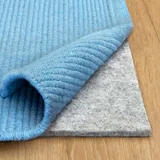
$69.95 — 8’x10′, $0.87/sq ft
24 oz/sq yd felt · No rubber layer · 1/4″ thick
Check Price on AmazonThis is here for one specific buyer: the person whose floors were refinished in the last month and who has been told, correctly, not to put anything rubber-backed on them yet. A polyurethane finish keeps hardening for weeks after it is walkable, and during that window a rubber backing can emboss its own texture into the film permanently.
Pure felt has no backing layer at all — just 24 oz per square yard of dense fibre. Nothing can migrate out of it because there is nothing in it to migrate. It is the only genuinely zero-risk option in this comparison.
- Pros: No rubber, latex, PVC or adhesive touches the finish; excellent cushion and sound damping for the price; protects the rug’s own fibres from grinding against the floor; breathable, so trapped moisture can escape.
- Cons: It is not a gripper; costs more than the Mohawk pad that does grip; needs trimming like any full pad.
Main drawback: RUGPADUSA states it plainly in the listing’s first line — “NOT NON-SLIP — this pad is meant for use with rugs anchored by furniture or heavy rugs that stay in place on their own.” That is unusually honest labelling for this category, and it is also a hard limit. If your rug is not pinned by a sofa or heavy enough to stay put, this pad will not fix your problem. Buy it for a rug under a bed or a dining table; do not buy it for a runner in a hallway.
6. RUGPADUSA Vinyl Lock — Best for Vinyl Plank and Laminate Floors
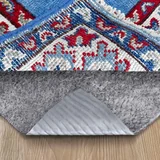
$161.95 — 8’x10′, $2.02/sq ft
Felt + EVA · No rubber or latex · Low profile
Check Price on AmazonA large share of people searching for a rug gripper for “hardwood floors” do not have hardwood. They have luxury vinyl plank or laminate that looks like oak, and the advice for those floors is genuinely different — not a hedge, an inversion.
Natural rubber, the material that makes pick 1 safe on polyurethane, is the material that stains vinyl. Rubber and vinyl are chemically incompatible in the other direction, which is why RUGPADUSA manufactures and stocks a separate line whose defining feature is the absence of rubber: “contains no rubber or latex: this rug pad’s felt and EVA construction is specially formulated not to stain or discolor your vinyl or luxury vinyl plank floors.” The grip comes from a ribbed EVA backing instead.
If you are not certain which floor you have, our comparison of hardwood, laminate and vinyl is the fastest way to settle it before you spend anything.
- Pros: The only pick with an explicit written non-staining claim for vinyl and LVP; low profile so it clears doors; felt face still protects the plank’s wear layer from grit.
- Cons: By far the most expensive per square foot of the full pads at $2.02; stock runs thin on popular sizes; pointless money if your floor really is wood.
Main drawback: the price. At $80.98 to cover a 5×8 rug it is nearly double the best hardwood pad here. You are paying for a formulation, not for performance — on grip alone a cheaper pad would do. Buy it only when the floor underneath is vinyl and you want the staining question closed.
7. Rabenda Rug Tape Gripper — Best Budget Rug Grip Tape for Hardwood Floors
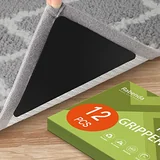
$8.99 — 12 pieces, $3.00 per rug
Triangle profile · 5.9″ x 2.95″ · Washable
Check Price on AmazonAt $3.00 to do a whole rug this is the cheapest thing on the page by a wide margin, and the triangular shape is a sensible piece of design — a triangle set into a rug corner puts adhesive along both edges that are actually lifting, which a square does not.
Twelve pieces covers three rugs. For a rental, a temporary layout, or a lightweight rug in a low-traffic room, it does the job for the price of a coffee.
- Pros: Cheapest per rug at $3.00; triangle geometry suits corners better than square tabs; thin enough to be invisible; rinses and reuses.
- Cons: No published backing material; no published floor exclusions; adhesive-based, so it relies on tack rather than mass; corner curl only.
Main drawback: it is the least-documented product in this comparison. The listing says “no damage” and “no residue”, and those are marketing claims with no material specification behind them. Adhesive tape products are also the one category with a genuine removal risk on wood: on an older or already-worn finish, a strong adhesive left in place for a long time can lift flakes of finish when you peel it off. That risk is small on sound polyurethane and real on a tired or waxed floor. Our guide to rug tape on hardwood floors covers removing it without taking the finish with it.
How We Picked These
We have not physically tested these seven products, and nothing above is written as though we had. This comparison is built from three checkable sources, and you can verify every one of them yourself.
- Manufacturer specifications and disclosures. Backing weights, material composition, thickness and floor restrictions were taken from each maker’s own product pages — RUGPADUSA, Gorilla Grip and Mohawk Home — not from retailer listings, which frequently disagree with the manufacturer. Where a maker publishes nothing, the table says “not published”. We did not fill a single gap with an assumption.
- Third-party physical testing, named. Where independent hands-on data exists we cite it rather than imitate it. TechGearLab ran nine rug pads through a four-metric comparison and published scores; their conclusion that felt-and-rubber constructions beat waffle-pattern PVC on grip is theirs, from their bench, and is credited as such.
- Live pricing and availability. Every price and every stock status in this article was pulled from the Amazon buy box on 2 August 2026, not carried over from a previous version of this page. The derived cost-per-rug figures were recalculated from those live prices.
The limits, stated plainly: we cannot tell you how any of these feel underfoot after a year, and we cannot tell you what Mohawk’s latex actually is, because Mohawk does not say. What this page can do that a hands-on review usually does not is put seven products’ backing materials, published floor exclusions and normalised costs in one table — because that is the comparison that decides whether your floor is fine in five years, and nobody else had assembled it.
What to Consider When Buying a Rug Gripper for Hardwood Floors
Backing Material: The Only Spec That Really Matters
Rank the backings in the order the flooring trade does. Safe: 100% felt, jute, and felt bonded to natural rubber. Risky: PVC, vinyl foam, and anything described only as “latex” without the word natural in front of it. Unknown: any product that does not tell you. On a floor you care about, treat unknown as risky — disclosure costs a manufacturer nothing, so silence is a choice.
Adhesive vs Non-Adhesive Grippers
Adhesive tabs and tapes bond to the floor and hold well immediately. Their two failure modes are chemical (something in the adhesive interacts with the finish) and mechanical (removal lifts a weak finish). Non-adhesive designs like the NeverCurl bond to the rug and use tension against the floor instead, which removes both risks. If your floor is new, expensive, rented or already worn, pay the extra few dollars for the non-adhesive route.
Corner Grippers vs Full Rug Pads
This is the decision most buyers get wrong, because the two are merchandised together. Corner grippers hold four corners flat and do essentially nothing about the rug travelling across the room. Full pads generate friction across the whole footprint and stop travel, but will not by themselves flatten a corner that has memory from being rolled. Diagnose the actual complaint first: if you are tripping on a lifted corner, buy grippers; if the rug creeps, buy a pad; if both, a pad plus two corner tabs is the honest answer.
Your Floor Finish: Polyurethane, Lacquer, Oil or Wax
Cured polyurethane is the toughest common finish and tolerates the most. Lacquer is softer and more solvent-sensitive — note that Gorilla Grip’s pad exclusion names lacquered floors specifically. Penetrating oil and wax finishes are the most vulnerable of all, because there is no hard film to protect the wood; adhesives can pull wax off and rubber can mark oil. If you have a waxed floor, use felt or nothing. Our guide to cleaning polyurethane floors is a useful check on which finish you are dealing with.
Newly Refinished Floors and Cure Time
A floor that feels dry is not a floor that has cured. Waterborne and oil-modified polyurethanes continue to harden for roughly two to four weeks after the last coat, and manufacturers commonly ask you to keep rugs off entirely during that period. Laying a rubber-backed pad on a half-cured film can imprint the rubber’s pattern permanently. Wait it out, or use 100% felt in the meantime.
Rug Size and How Much Coverage You Need
Buy a pad one size up and trim it, rather than one size down. The target is roughly one inch inside the rug’s edge on every side, so the pad disappears but supports the rug right to the perimeter. A pad that stops three inches short lets the edges flap and wear. For corner grippers, four pieces secures a rectangular rug; long runners want six, with two along the middle of the long edges.
Pad Thickness and Door Clearance
A 1/4″ pad plus a 1/2″ rug is three quarters of an inch of new height. Measure the gap under any door that swings over the rug before ordering. Where clearance is tight, a 1/8″ pad or a low-profile option keeps the door working; where there is room, the thicker pad is meaningfully more comfortable and quieter.
Radiant-Heated Floors Need Their Own Rule
This one is missing from every competing roundup we read, and it comes from the National Wood Flooring Association’s own installation guidelines: “items such as area rugs, mattresses, exercise mats, pet beds, bean bags, or other highly insulating products that cover the floor will trap heat and increase the temperature of the floor it is covering, which can result in irreversible damage to any type of floor.” A thick felt pad is an excellent insulator, which over a radiant system is exactly the wrong property. If your floor is heated, choose the thinnest pad that does the job and keep rugs small.
Price per Rug, Not Price per Pack
Pack sizes in this category are designed to be hard to compare — 8 pieces, 12 pieces, 16 pieces, 4 pieces. Divide by four corners to get the cost of doing one rug, and the ranking changes: the 12-piece Rabenda at $8.99 works out cheaper per rug than the 4-pack NeverCurl at $9.99 by more than three to one. Pads are worse, sold by area against a rug you have to measure. Convert everything to the cost of the job before you compare anything.
Renting? “Renter Friendly” Is Not a Standard
The phrase appears on listings with no definition behind it and no warranty attached. A landlord’s floor is the one where an invisible stain under a rug turns into a deposit dispute two years later. Renters get the most value from the non-adhesive route: a full felt-and-natural-rubber pad, or NeverCurl inserts that never contact the floor at all.
How to Fit a Rug Gripper on a Hardwood Floor
- Clean and dry the floor completely. Vacuum, then damp-mop with a cleaner your finish maker approves, then let it dry fully. Grit trapped under a pad grinds the finish every time someone walks over it, and adhesive will not bond to a dusty or damp surface.
- Confirm your finish is cured. If the floor was refinished within the last month, stop and wait, or use a 100% felt pad with no rubber backing until the cure window has passed.
- Test one gripper in a hidden spot first. Put a single tab under a closet doorway or beneath a piece of furniture, leave it three to four weeks, then lift it and inspect the finish for any change in colour or sheen. This is the only test that reflects your actual floor and your actual product.
- Trim a full pad one inch inside the rug on every side. Lay the pad out, put the rug on top, mark the overhang, and cut with scissors or a utility knife against a straightedge. Felt cuts cleanly; do not tear it.
- Position corner grippers under the rug corner, not at the very tip. Set each piece an inch or two in from the point so the adhesive sits under material rather than under a fold. Peel, press the rug side down first, then lower the corner onto the floor.
- Press firmly and leave it alone for 24 hours. Adhesives reach full strength over time. Walking the rug into place immediately is what causes early lifting.
- Lift and check every six months. Move the rug, look at the floor underneath, and vacuum both sides. Early discolouration is fixable if you catch it; the same stain left for three years is a refinishing job.
If the rug still creeps after all this, the problem is friction, not fixing — and our guide to stopping rugs slipping on hardwood covers the remaining options.
Frequently Asked Questions
Do rug grippers damage hardwood floors?
Some do. The damage is not scratching, it is chemical: PVC, vinyl foam and synthetic latex backings contain plasticizers that migrate out of the backing and into the floor finish, leaving a yellow or hazy patch that no cleaner removes because it is inside the finish rather than on it. Felt, jute and natural rubber backings do not carry that risk. Adhesive tapes add a second, separate risk, which is lifting a weak or waxed finish on removal.
Are Gorilla Grip rug grippers safe for hardwood floors?
Gorilla Grip does not publish the backing material for its corner grippers, and its page says only to “check floor manufacturer’s directions before using to be sure product will not harm floor surface”. Separately, the same brand’s full-area rug pad states it is “not intended for use on carpet, vinyl, lacquered, acrylic, natural stone, porous, or refinished surfaces”. That exclusion is written about the pad, not the corner grippers. On a sound, cured polyurethane floor the grippers are widely used without incident; on a lacquered, waxed or recently refinished floor, test one in a hidden spot for a month first.
What is the safest rug pad backing for hardwood floors?
100% felt is the safest, because it has no backing layer and therefore nothing that can migrate into the finish. Felt bonded to natural rubber is the best combination of safety and grip, and it is the only construction in this comparison whose maker states in writing that it will not stain, strip or mar a hard surface. Avoid PVC, vinyl foam and any product that describes its backing only as “latex” without specifying natural.
Does rug grip tape leave residue on hardwood floors?
Most rug tapes are marketed as residue-free and behave that way on a sound, fully cured polyurethane finish removed within a reasonable period. The failures happen at the margins: tape left down for years, tape on a waxed or oiled floor, or tape on a finish that is already worn thin. In those cases removal can lift flakes of finish along with the adhesive. Remove tape slowly at a shallow angle rather than pulling it straight up, and warm it gently with a hairdryer if it resists.
How many rug grippers do I need for a 5×8 rug?
Four — one at each corner — which is why an 8-piece pack covers two rugs and a 12-piece pack covers three. If the rug is a long runner or sits in a high-traffic doorway, add two more along the middle of the long edges. Note that corner grippers only stop corners curling; if the whole rug is sliding across the floor, four grippers will not fix it and you need a full pad instead.
What keeps a rug from sliding on carpet?
Rubber does not grip carpet, so a pad designed for hardwood will not work over carpet. What works is a dedicated rug-on-carpet pad with a textured or needle-punched surface that mechanically interlocks with the carpet pile, or a reversible felt-and-rubber pad laid felt-side-down. Carpet-to-carpet gripper tabs are the low-cost option for corners.
Can I use a rug gripper on newly refinished floors?
Not straight away. Polyurethane keeps curing for roughly two to four weeks after it stops feeling tacky, and a rubber-backed pad or adhesive tab applied inside that window can emboss a pattern into the softened film permanently. Most finish manufacturers ask you to keep rugs off entirely for that period. If you need something down sooner, a 100% felt pad with no rubber and no adhesive is the safe interim choice.
Final Thoughts
The RUGPADUSA Dual Surface is the pick because it does the whole job — stops the sliding, cushions the rug, and comes with the only written promise here that it will not stain, strip or mar your finish. At $44.98 to cover a 5×8 rug it costs ten times what a set of corner tabs costs, and that is the trade being made.
If you take one thing from this page, make it this: work out whether your rug is curling or sliding before you spend anything. Corner grippers at $3.00 to $9.99 per rug fix curling and do nothing for sliding. Full pads at $30.00 to $44.98 fix sliding and will not flatten a stubborn corner. They are sold beside each other as though they were interchangeable, and they are not — and buying the wrong one is the most common way people end up convinced that rug grippers do not work.
Whatever you choose, lift it twice a year and look underneath. Nothing on this list is as expensive as refinishing a room. For the wider picture on keeping floors in good order, our hardwood flooring guides cover cleaning, refinishing and repair.
Sponsored / affiliate links. As an Amazon Associate I earn from qualifying purchases. I may earn additional commission from eligible campaigns.