Best Stains for Hard Maple (2026): research shows
For hard maple, start with dye stain, then add a thin washcoat if you need tighter control; use gel stain only when you want darker, more even color with less grain visibility. Skip blotch control and you get dark clouds, weak figure, and an uneven surface under finish. This guide ranks stain types by blotch risk and shows a repeatable test-panel workflow before you touch the project.
Quick comparison
| Product | Badge | Best for | Price | ||
|---|---|---|---|---|---|
 |
OSMO Polyx Hard Wax Oil .75 L (25.3 Fl. Oz.)Osmo | Upgrade pick | Osmo Polyx Hard Wax Oil · 0.75 L · Clear Matt | $59.99
Price as of 13 Oct 2026
|
View |
 |
Minwax 66060000 Gel Stain, Walnut, 1 QuartMinwax | Also great | Minwax Gel Stain · 1 qt · Walnut | $19.05
Price as of 13 Oct 2026
|
View |
 |
Minwax Wood Finish, Special Walnut, 1/2 PintMinwax | Budget pick | Minwax Wood Finish · 1/2 pt · Special Walnut | $8.48
Price as of 13 Oct 2026
|
View |
 |
1/2 pt Minwax 13407 Clear Pre-Stain Wood Conditioner, 1/2Minwax | Pair with it | Minwax Pre-Stain Conditioner · 1/2 pt · Oil-based | $8.88
Price as of 13 Oct 2026
|
View |
 |
General Finishes Oil Base Gel Stain, 1 Quart, Antique WalnutGeneral Finishes | Our pick | General Finishes Gel Stain · 1 qt · Antique Walnut | $59.21
Price as of 13 Oct 2026
|
View |
Hard maple, or Acer saccharum, is tight and diffuse-porous, so it absorbs stain unevenly compared with open-pored woods. The table below ranks the main stain approaches by blotch control, color depth, and how much grain they leave visible on hard maple tabletops, cabinet doors, and furniture parts.
How we chose
The ranking below weighs five factors: blotch risk, color consistency, grain visibility, application difficulty, and the kind of project each stain type fits best. Hard maple is often confused with soft maple, but the sanding and stain behavior differ enough that the distinction matters.
Two failure points matter more on maple than on many woods: too-fine sanding and end-grain pull. Both can change how dark the wood looks after stain, even when the face grain seems uniform.
OSMO Polyx Hard Wax Oil.75 L (25.3 Fl. Oz.): best for a natural finish after dye or light stain
Use this on cabinets, furniture, and tabletops when you want a low-sheen clear topcoat that keeps the maple looking like maple. Based on the spec sheet and owner feedback, the matte look and grain-friendly finish make it a strong topcoat after a successful color test.
The drawback is that it is a clear finish, not a color fix. It will not solve blotching by itself, so the stain choice and test board still do the heavy lifting.
Minwax Gel Stain, Walnut, 1 Quart: best for controlled color on visible grain
This fits vertical parts, cabinet frames, doors, and turnings where you want a familiar stain color with less run risk. Gel stain sits closer to the surface than penetrating stain, so it usually gives better control on blotch-prone maple.
The drawback is grain opacity. If you overwork it, the surface can look heavy or muddy, especially on tightly grained hard maple.
Minwax Wood Finish, Special Walnut, 1/2 Pint: best for traditional penetrating stain color
This is for projects that need a classic oil-stain look and you are willing to do more prep and testing. It is easy to apply with a cloth or brush along the grain, and the 5-15 minute wipe window helps when you need a predictable workflow.
The drawback is blotch risk. On hard maple, penetrating pigment can soak unevenly unless you sand carefully and control dwell time.
Minwax Clear Pre-Stain Wood Conditioner, 1/2 Pint: best for reducing blotch before oil stain
This helps when you want a familiar oil-stain color on a maple project and need a buffer against uneven absorption. It is most useful right before stain, and it is specifically recommended for oil-based stain projects.
The drawback is limited correction power on very dense maple. It can reduce blotching, but it will not erase bad sanding, heavy end-grain absorption, or a poor stain application.
General Finishes Oil Base Gel Stain, Antique Walnut, 1 Quart: best for even dark color on difficult parts
This fits doors, trim pieces, and furniture parts where you want a darker result and better control than a penetrating stain usually gives. Its heavy-bodied formula helps keep the color more even on difficult woods.
The drawback is transparency. Like other gel stains, it can soften grain contrast if you want a clear, high-definition maple look.
How do you test stain on hard maple before the project?
Use a real sample board made from the same species, cut from the same stock if possible, and sanded through the same grit schedule. Compare bare maple, conditioner, dye, gel, and pigmented stain on face grain, edge grain, and end grain so you can see where the color shifts.
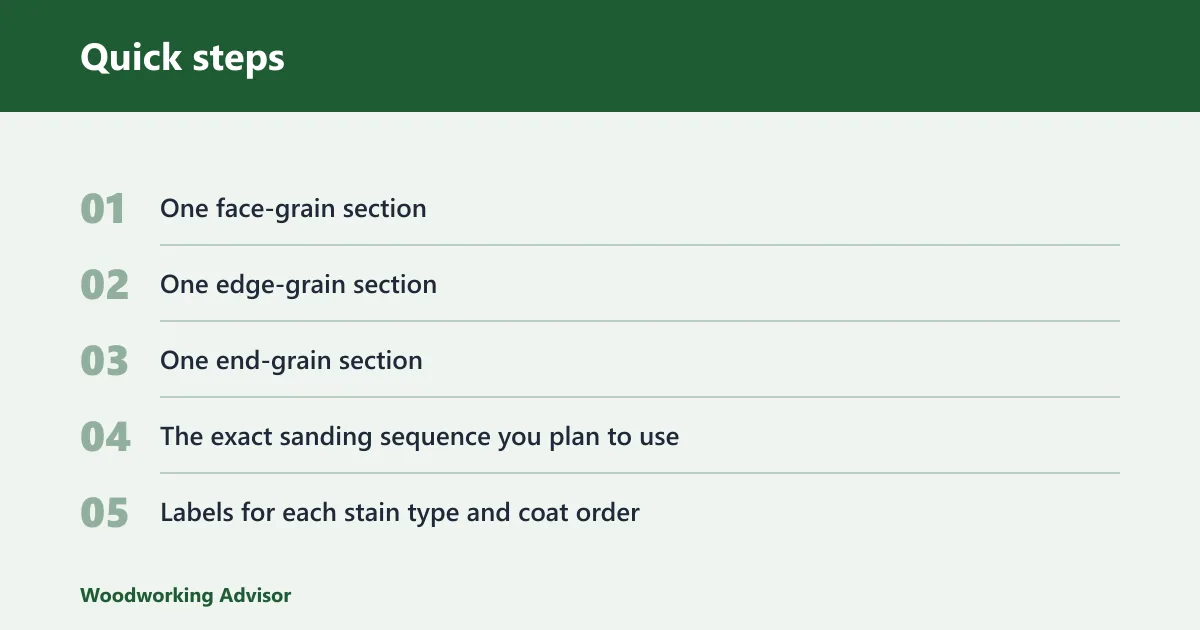
A test board is the only reliable way to verify color before the project. Hard maple can look calm on the face and very dark on the end grain, so a single scrap strip is not enough.
What to put on the sample board
- One face-grain section
- One edge-grain section
- One end-grain section
- The exact sanding sequence you plan to use
- Labels for each stain type and coat order
Step-by-step sample workflow
- Sand the sample exactly like the project, ending at the same grit.
- Mark sections for bare wood, conditioner, dye, gel, and pigmented stain.
- Apply one product at a time, keeping the dwell time identical.
- Wipe each section at the same interval and in the same direction.
- Record the order, open time, and wipe-off timing on the board.
- Let the sample dry fully, then add the clear coat you plan to use.
Say your cabinet door has a 12-inch rail and a 3-inch stile. If the stile edge grain goes two shades darker than the center panel on the sample, you can change sanding, add a washcoat, or switch stain type before the real door is touched.
How do you stain hard maple without blotching?
Sand consistently, choose a stain type that limits absorption, and test every combination on a sample board first. The cleanest result usually comes from dye stain or a thin washcoat over hard maple, because both reduce the contrast between thirsty and dense areas.
What you’ll need
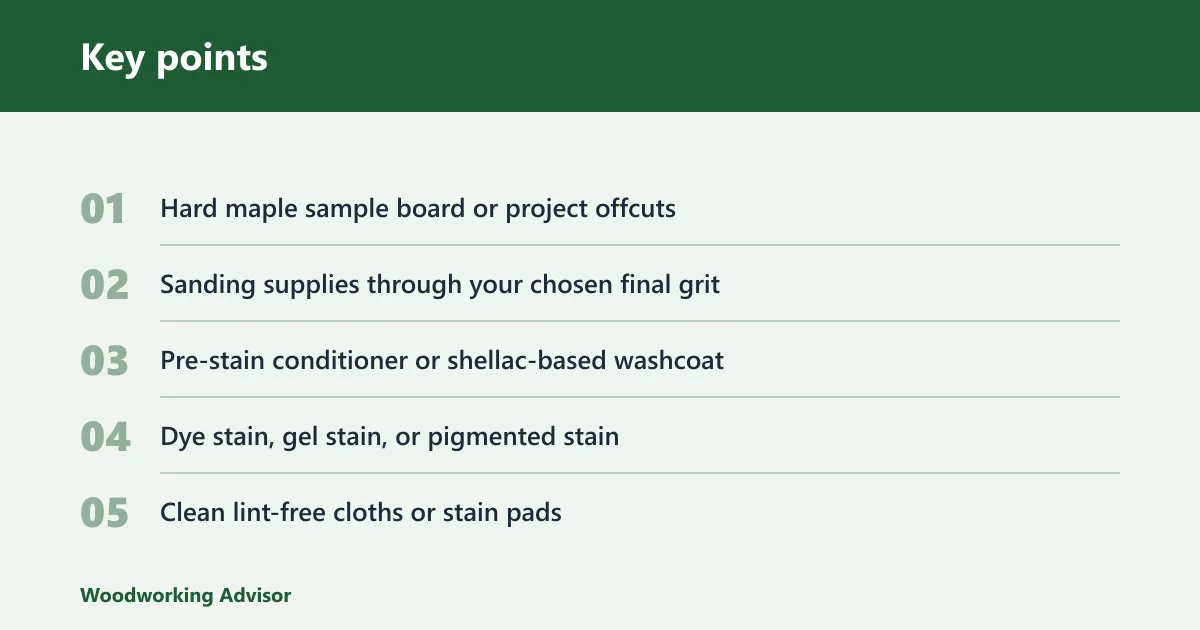
- Hard maple sample board or project offcuts
- Sanding supplies through your chosen final grit
- Pre-stain conditioner or shellac-based washcoat
- Dye stain, gel stain, or pigmented stain
- Clean lint-free cloths or stain pads
- Clear finish for the final topcoat
Preparation and application
- Sand through a consistent grit progression and stop before the surface gets polished smooth.
- Inspect for swirl marks and scratch lines under angled light.
- Apply conditioner or washcoat only if your test panel shows it helps.
- Stain face grain, edges, and end grain in the same session.
- Wipe excess evenly and avoid reworking areas that have started to set.
- Lock the color with the planned clear coat only after the test panel matches the goal.
Picture a 30-by-20-inch maple panel for a small table top. If the end grain at the breadboard ends turns almost black while the center stays light, that is a sanding-and-absorption problem, not a finish problem.
Common mistakes
Too-fine sanding is a frequent cause of streaking on hard maple. A polished surface can slow stain uptake in some spots and make nearby areas look darker by comparison, so the final grit matters more than many woodworkers expect.
Another problem is overusing conditioner. It can cut blotching, but too much can flatten color, especially when paired with a light stain. Excess rubbing on gel stain can also muddy the grain instead of refining it.
End-grain darkening is normal on maple and needs separate testing. If the sample board shows sharp contrast there, try a washcoat or move to dye stain before you commit to a cabinet door or tabletop.
If that did not work, try this next: sand a fresh sample one step coarser, apply a thinner washcoat, and retest the exact stain. If the color is still uneven, switch from pigmented stain to dye stain or from penetrating stain to gel stain.
Which one should you buy?
Choose dye stain if you want the most even color on a show surface. Choose gel stain if you want more control and less blotch risk. Choose conditioner-assisted pigmented stain if the project needs a familiar stain color, and choose a seal coat or washcoat when your test board shows strong end-grain pull.
Best choice by project type
- Cabinets: Gel stain or dye stain, depending on how much grain you want to keep visible.
- Furniture panels: Dye stain first, because it keeps figure clearer and usually looks more uniform.
- Small parts and turnings: Gel stain or a dye-and-clear schedule, since edge and end-grain control matters most.
For dark stain on hard maple without streaks, start with dye stain on a test board, then add a thin shellac washcoat only if the end grain still pulls too hard. That sequence gives you the best chance of keeping the figure visible while reducing clouding.
Frequently asked questions
How to stain maple without blotching
Match the sanding schedule across every part, then compare bare wood, conditioner, and stain on scrap from the same stock. Wipe excess at the same interval on every test section so you can see the real color spread before finishing.
Is maple hard to stain
Yes. Hard maple is dense and diffuse-porous, so it often absorbs stain unevenly compared with open-pored woods. The difficulty is controllable, but only if you treat sanding, stain type, and testing as part of the same process.
Can you stain maple
Yes, but the result depends on the method. Dye stain gives the most uniform color, gel stain gives more control, and pigmented stain usually needs careful wiping or a barrier coat to keep the result even.
How well does maple take stain
It can take stain well enough for furniture and cabinets, but the color usually needs more control than on oak or ash. The final result depends heavily on sanding grit, end-grain behavior, and whether you use a washcoat or conditioner.
Should I use a pre-stain conditioner on hard maple
Use it when your test panel shows blotching with a penetrating stain, especially on cabinet parts or furniture with broad panels. It helps most with oil-based stain and less when the maple is very dense or the surface has been sanded too fine.
Sponsored / affiliate links. As an Amazon Associate I earn from qualifying purchases. I may earn additional commission from eligible campaigns.